
Intro
Cleaning products are part of ordinary family life, yet a baby's rapid movement, hand-to-mouth behavior, and small body size can turn a brief lapse in storage or supervision into a serious exposure. It is understandable to feel pulled between maintaining a hygienic home and avoiding chemical hazards. The practical goal is not a perfectly sterile house, but a home where cleaning products are used deliberately and stored so a baby cannot access them.
Prevention works best when it is built into daily routines: choosing lower-risk formats where possible, putting products away immediately, controlling residue and fumes, and knowing how to respond calmly if an exposure is suspected.
Highlights
The most effective prevention measure is keeping household cleaners locked, out of sight, and out of reach every time they are not actively being used.
Original packaging matters because labels provide product identification and first-aid information for poison specialists and clinicians.
Laundry and dishwasher detergent packets deserve particular caution: their concentrated contents and appealing appearance can create a high-risk exposure for young children.
A possible ingestion, eye exposure, skin exposure, or inhalation event should prompt immediate expert guidance rather than home remedies.
Why babies are especially vulnerable
Babies explore through touch and taste long before they understand danger. A crawling infant can reach a low cabinet, grab a bottle left beside a toilet, or mouth an item dropped during laundry. Mobility can advance quickly, so a storage arrangement that seemed adequate last month may no longer be protective. Babies and young children also have limited ability to communicate what they touched or swallowed, which can delay recognition of an exposure.
The clinical consequences of a cleaning product depend on the ingredient, concentration, amount, route of exposure, and the child’s age and size. Some products mainly irritate skin, eyes, or airways. Others, including corrosive drain cleaners, oven cleaners, and some toilet products, can cause chemical burns. Concentrated detergents may foam, irritate mucosal tissue, and create aspiration risk if vomiting occurs. This is why safe storage of household chemicals is more reliable than trying to judge, in the moment, whether a product looks harmless.
Risk is not limited to ingestion. A baby may rub cleaner into their eyes, inhale aerosolized droplets or vapors, or contact a freshly treated surface and then put their hands in their mouth. Prevention should therefore consider the entire cleaning process, from product selection and use through drying, storage, and disposal.
Build storage that still works on a busy day
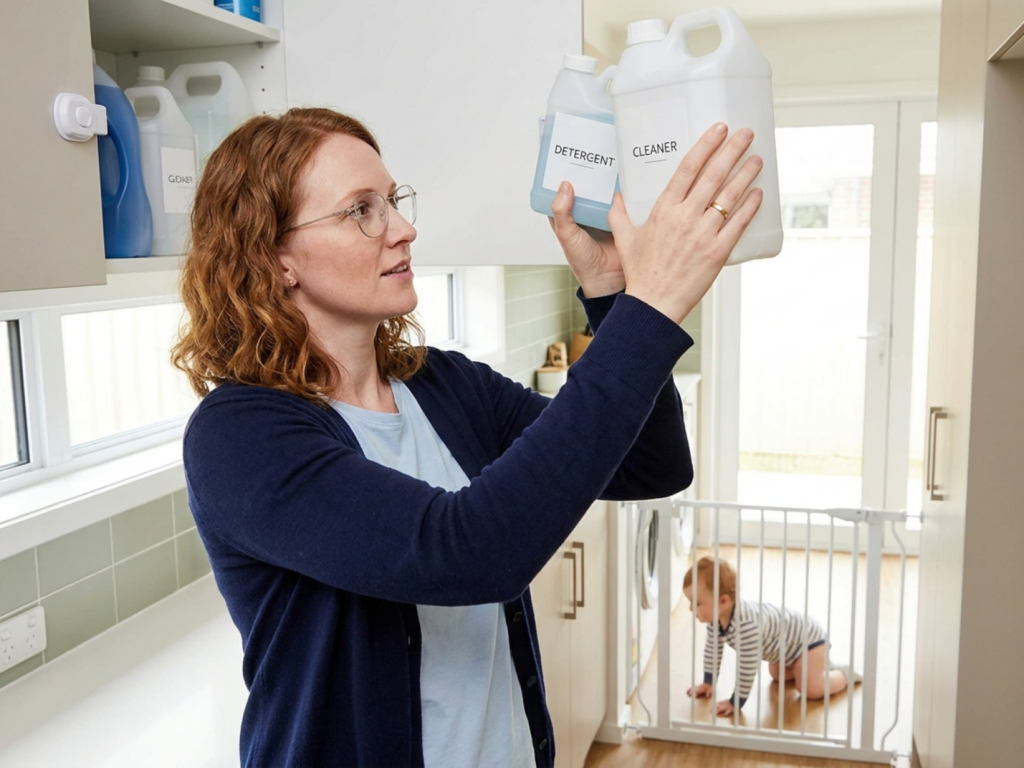
The strongest approach is physical separation: keep cleaning and laundry products in a locked cabinet or cupboard that is above a child’s reach and out of sight. A safety latch can add protection, but it should not be the only safeguard if products are routinely left on a floor, counter edge, or open shelf. Make putting the product away part of the task itself, before moving to the next room or responding to the baby.
Store products in original containers with labels intact. Transferring liquids into drink bottles, food jars, or unmarked spray bottles can cause dangerous confusion for children and adults. The original label may also identify ingredients and provide instructions that are relevant if a poison center or healthcare professional must advise you. Keep caps secured, and do not rely on a child-resistant closure as a childproof one.
- Choose one locked location for household cleaners, stain removers, laundry products, and dishwasher supplies.
- Keep a portable cleaning caddy inaccessible when not in your hand; do not leave it on the floor during interruptions.
- Ask guests and caregivers to keep handbags, travel-size cleaners, hand sanitizer, and nicotine-containing products out of reach too.
- Check storage areas after moving house, visiting relatives, or changing routines, when products are more likely to be temporarily misplaced.
A simple rule helps reduce decision fatigue: if you are not actively holding and using a cleaning product, it belongs in its locked storage place.
Treat laundry and dishwasher products as high-risk items
Laundry detergent, dishwasher detergent, bleach, fabric treatments, and stain removers are common household products but are not benign for a child to handle. Detergent packets are especially concerning because they are highly concentrated, may resemble candy to a young child, and can rupture when squeezed or bitten. Their contents can reach the mouth, eyes, and skin at once. Where there is a baby or young child in the home, avoiding detergent packets can remove a particularly preventable hazard.
Use products only when you can maintain direct control of them. Do not ask a child to carry, sort, or play near detergent containers, even when they are closed. Load the washing machine or dishwasher, secure the product immediately, and close appliance doors afterward. A child can access a forgotten packet from a countertop, open bag, laundry basket, or appliance compartment in seconds.
Empty packaging should also be discarded promptly in a covered bin that a child cannot open. Rinse or wipe accidental drips according to the product directions while keeping baby away from the work area. Do not leave measuring caps, dosing cups, or contaminated cloths within reach. These details can feel minor, but they remove opportunities for an exposure during ordinary household transitions.
Use cleaning routines that reduce residue and fumes
Cleaning around an infant requires attention to both direct access and the environment left behind. Read product directions and use only the indicated amount; using more does not necessarily clean better and may increase residue or airborne irritants. Keep baby out of the room while spraying, disinfecting, descaling, or using products with strong fumes. Open windows or use appropriate ventilation when the label recommends it, and allow treated areas to dry fully before the baby returns.
Surface residue after cleaning is particularly relevant on floors, low tables, play mats, high-chair trays, and other areas touched frequently by hands and mouths. Follow label instructions about rinsing food-contact surfaces, and do not improvise mixtures. Combining certain cleaners, such as bleach with ammonia or acidic products, can release hazardous gases. Use one product at a time, never mix cleaning agents, and store each container closed.
For routine dirt, consider whether a less hazardous method is sufficient, such as soap and water for a washable surface, while still following hygiene guidance for the specific task. Product choice should be based on the surface, soil, and needed level of disinfection, rather than on fragrance or perceived strength. Strongly fragranced cleaning sprays may be unpleasant or irritating for some infants and caregivers, especially in poorly ventilated rooms.
Cleaning and baby care often compete for attention. Planning short tasks during naps or when another responsible adult is supervising can reduce the chance that a bottle, bucket, or wet surface is left unattended.
Plan for bathrooms, kitchens, and temporary hazards
Some rooms create repeated exposure opportunities because cleaners are used there often. In bathrooms, toilet bowl cleaners, disinfectants, drain products, and limescale removers should be locked away immediately after use. Never leave a bucket of cleaning solution, a toilet brush holder containing chemical residue, or an open product near a bathing baby. A baby should never be placed in a tub or on a floor that has not been thoroughly prepared and cleared of cleaning supplies.
In kitchens, keep dishwasher products, degreasers, and surface cleaners away from feeding preparation areas until products have been stored and surfaces have been handled as directed on their labels. High-touch household surfaces need regular cleaning, but a baby does not need to be in the room while that work happens. Be especially careful with products left under the sink, because this is a predictable exploration site once crawling begins.
Temporary hazards often cause the greatest problems: a cleaner set down while answering the door, a shopping bag waiting to be unpacked, or an overnight guest’s products stored at floor level. Build a quick room scan into the end of each cleaning session. Look at the baby’s level, including under furniture and around bins, and remove bottles, packets, wipes, cloths, and caps before bringing baby back into the space.
Know how to respond to a suspected exposure
Even careful families can face an unexpected incident. If you think your baby may have swallowed, inhaled, spilled, or rubbed a cleaning product into their eyes or skin, remove the product from reach and seek immediate guidance from your local poison center or emergency service. Have the container available, including the name, ingredients, concentration, and estimated time of exposure. Do not wait for symptoms to become obvious before calling for advice.
Do not induce vomiting and do not give food, drink, or medication unless a poison specialist or healthcare professional specifically tells you to do so. These actions can be unsafe for some substances and can increase aspiration risk. If product is in the eyes or on the skin, follow urgent professional instructions; prompt gentle flushing with running water is often advised for chemical contact, but the appropriate duration and next steps depend on the product and exposure.
Call emergency services immediately for trouble breathing, persistent coughing or choking, severe sleepiness, collapse, seizures, significant burns, or any rapidly worsening condition. Bring the original container with you if urgent in-person care is needed. After the event, consider reviewing how access occurred without blame. Adjusting one cabinet, routine, or product type can meaningfully reduce the chance of recurrence.
Urgent safety warnings
- Keep drain cleaners, oven cleaners, bleach, toilet products, and concentrated detergents locked away at all times.
- Never transfer cleaning products into food or drink containers, even temporarily.
- Do not mix cleaning products; some combinations can release dangerous gases.
- Do not induce vomiting after a possible ingestion unless a poison specialist or clinician directs you to do so.
- Seek emergency help immediately for breathing difficulty, seizures, collapse, severe burns, or reduced responsiveness.
Tools & Assistance
- Install and regularly test child-safety latches on cleaning-product cupboards
- Program your local poison center number into every caregiver's phone
- Use a locked, high storage bin for cleaning caddies and laundry supplies
- Review product labels before first use and keep containers available for emergencies
FAQ
Are child-resistant caps enough to protect a baby?
No. Child-resistant packaging can slow access but is not childproof. Locked, out-of-sight, out-of-reach storage remains the primary protection.
Should I use disinfectant everywhere once I have a baby?
Routine cleaning should match the task and product directions. Excess product may leave residue or create fumes, so discuss specific hygiene concerns with your child's healthcare professional.
What should I do if my baby puts a detergent packet in their mouth?
Remove it if it is easily accessible, keep the package, and contact a poison center or emergency service immediately for product-specific advice. Do not induce vomiting.
Can I clean while my baby is in the same room?
Avoid having baby nearby when using sprays, concentrated products, or products with fumes. Keep them supervised in another safe area until supplies are put away and surfaces are dry.
Sources
- HealthyChildren.org (American Academy of Pediatrics) — Poison Prevention & Treatment Tips for Parents
- Health Service Executive — Poison risks to your child
- PubMed Central — Unintentional pediatric exposures to household cleaning products
Disclaimer
This article is for general educational purposes and is not a substitute for individualized medical or poison-control advice. For a suspected exposure, contact a poison center, emergency service, or qualified healthcare professional promptly.















Please log in to leave a comment.