
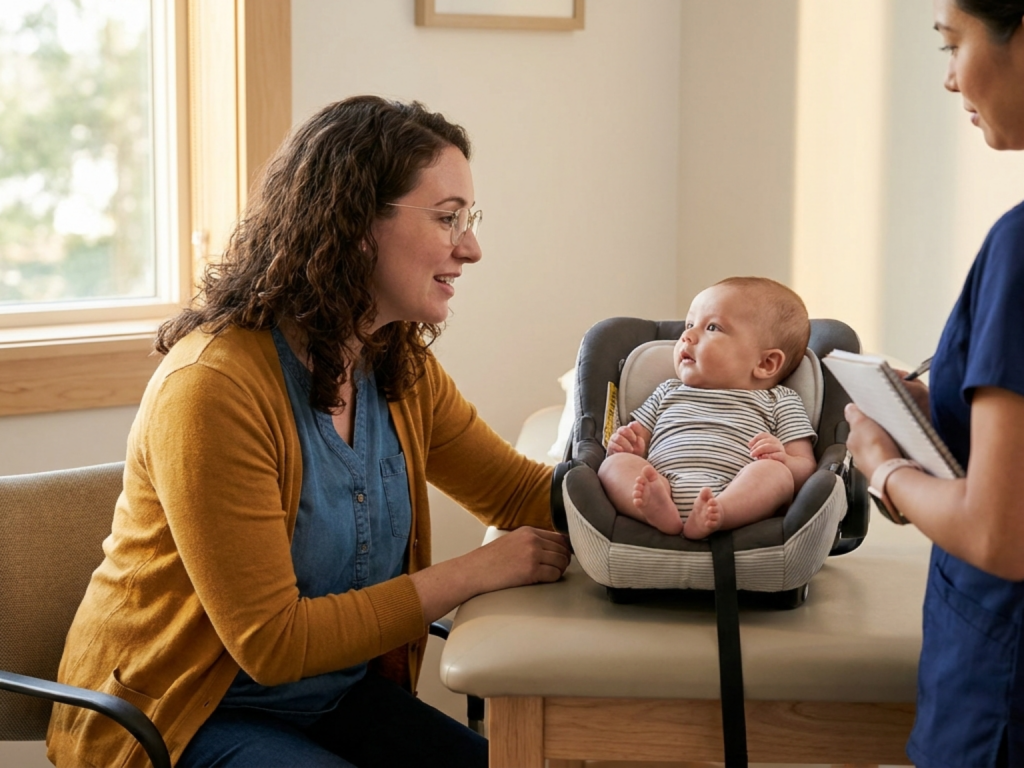
Intro
Talking with a baby is more than a way to fill quiet moments. Everyday vocal exchanges help an infant notice speech sounds, connect words with people and events, practice turn-taking, and gradually build an internal map of language. These benefits do not depend on elaborate lessons or constant entertainment. They develop through warm, responsive communication woven into feeding, bathing, dressing, play, and rest.
Infants vary widely in temperament, hearing, attention, and developmental timing. The suggestions below describe supportive communication practices rather than a test of parenting or a diagnostic checklist. A pediatrician, family physician, or speech-language pathologist can help interpret concerns in the context of a child’s overall development, hearing, medical history, and exposure to more than one language.
Highlights
Frequent, child-directed speech supports language processing and vocabulary growth.
A baby benefits from pauses, eye contact, facial expression, and responses to their sounds, not only from hearing an adult talk.
Routine activities such as feeding, diapering, walking, and bathing provide natural opportunities for rich language.
Babbling, gestures, gaze, and vocal play are meaningful communication attempts before first words appear.
Persistent concerns about hearing, interaction, or communication should be discussed with a healthcare professional.
Why talking supports early development
During the first three years, the nervous system is highly responsive to language input. Babies are learning to discriminate speech sounds, recognize familiar voices, detect patterns in syllables, and associate spoken labels with people, objects, actions, and emotional states. This learning begins before a child can produce recognizable words.
Research on child-directed speech has linked greater exposure to speech addressed directly to infants with more efficient processing of familiar words and larger expressive vocabularies later in development. The likely mechanism is cumulative learning: a baby repeatedly hears language in a meaningful social context, notices which sounds recur, and gradually connects those sounds with experiences.
Conversation also supports broader neurodevelopment. When an adult responds contingently to a baby’s gaze, movement, babble, or cry, the infant learns that communication can influence another person. This early reciprocity helps establish attention regulation, social orientation, and the foundations of pragmatic language, which includes using communication appropriately in social situations.
Use infant-directed speech naturally
Infant-directed speech is often called baby talk. It typically includes a somewhat higher pitch, exaggerated intonation, slower pacing, clear pronunciation, repetition, and short grammatical units. These features can make speech easier for an infant to attend to and segment. They do not require artificial words or permanent simplification of language.
Speak clearly and warmly, using ordinary vocabulary that fits the baby’s experience. For example, during dressing, an adult might say, “Here is your sleeve. We are putting your arm through.” During a walk, describe what the baby can see: “That is a bus. It is moving quickly.” Repetition is useful because infants need many exposures before a word becomes familiar and meaningful.
It is appropriate to expand language as the child grows. If a baby reaches toward a cup, you can acknowledge the gesture with, “You want the cup. Here is your cup.” Later, if the child says “ba” for ball, respond with “Yes, ball. A red ball is bouncing.” This technique, sometimes called expansion or recasting, models more mature language without demanding imitation.
Build conversation through responsive interaction
Effective communication with an infant is not a monologue. It is a sequence of noticing, responding, and allowing time for the baby to contribute. This is often described as serve-and-return interaction: the baby offers a vocalization, facial expression, gaze, or movement, and the adult responds in a way that is related to that signal.
Try face-to-face interaction with babies when they are alert and comfortable. Position yourself at a suitable distance, follow their gaze, imitate a sound, and then pause. The pause matters because infants need processing time and an opportunity to vocalize or move in response. Avoid interpreting a lack of immediate response as a failure; a baby may be tired, hungry, overstimulated, or simply observing.
Give the baby conversational turns during singing and nursery rhymes. Pause before a familiar ending, wait after a babble, or copy the rhythm of the baby’s vocal play. Smiling, raised eyebrows, and varied facial expression can reinforce social attention. When the baby looks away, arches, fusses, or becomes quiet, reduce stimulation and offer a break. Responsive communication includes respecting signs that the interaction should pause.
Talk during routines, play, and reading
Daily care provides repeated, predictable contexts in which words can acquire meaning. During feeding, name foods, utensils, body sensations, and actions. During bathing, describe temperature and sequence. During diapering, use consistent words for body parts and clothing. These brief exchanges are valuable because the adult’s words occur alongside observable events.
Play supports language when adults follow the baby’s interest rather than directing every moment. If the baby shakes a rattle, describe the sound and action: “Shake, shake. The rattle is loud.” If the baby watches a toy disappear under a cloth, use words such as “under,” “gone,” and “there it is.” Simple cause-and-effect play gives language a concrete reference.
Shared book reading can begin in the newborn period, even when the infant cannot understand a story. Use board books or cloth books safely, point to pictures, label objects, and vary your voice. It is not necessary to finish every page. Follow the child’s attention and return to favorite images. As the child becomes more verbal, ask open questions and add detail to their answers. Keep screens from displacing active human interaction; recorded speech cannot provide the same contingent response as a caregiver.
Support communication across the first year
Communication develops progressively, but milestones are broad ranges rather than deadlines. In the early months, babies may calm to a familiar voice, make pleasure sounds, watch faces, and respond to changes in tone. By approximately four to six months, many infants experiment with vocal play, laugh, take turns making sounds, and show interest in voices.
Later in the first year, many babies babble with repeated consonant-vowel patterns, respond to their name, use gestures such as reaching or pointing, and understand a few familiar words or routines. Adults can support this stage by naming what the baby looks at, acknowledging gestures, and treating babbling as a conversation. If the baby points toward a dog, say, “You see the dog. The dog is walking.”
Gestures and vocalizations should be valued alongside spoken words. A baby who communicates through gaze, reaching, facial expression, or body movement is practicing intentional communication. Do not pressure the infant to perform for visitors or repeat sounds on demand. Frequent low-pressure interaction is more developmentally appropriate than drilling.
Expand language in the second and third years
During the second year, many children begin using words for people, objects, actions, and requests, although vocabulary size and speech clarity vary considerably. Continue to label experiences and add one or two words to what the child says. If the child says “car,” you might answer, “A blue car is going fast.” Offer choices, such as “Do you want the spoon or the cup?” and allow enough time for a response.
As children approach the third year, they often combine words, follow more complex directions, and participate in short conversations. Talk about location, quantity, sequence, and emotion: “The blocks are under the chair,” “We have two apples,” or “You are frustrated because the tower fell.” This vocabulary helps children organize experiences as well as communicate needs.
Children exposed to multiple languages can learn more than one language successfully. Caregivers should generally use the languages in which they can communicate most naturally and richly. Mixing languages within a conversation can be a normal feature of multilingual development and is not, by itself, evidence of a disorder. A professional assessment should consider the child’s communication across all languages.
Recognize concerns and seek guidance
Language development should be considered together with hearing, social communication, motor skills, cognition, and the child’s medical and family history. A child may have an uneven profile, and a single missed milestone does not establish a diagnosis. Nevertheless, early discussion with a healthcare professional is appropriate when caregivers notice limited response to sound or voice, little interest in social interaction, loss of previously acquired communication skills, or persistent difficulty communicating needs.
Hearing impairment can affect speech and language learning, sometimes subtly. Mention concerns about responding to voices, turning toward sounds, recurrent ear disease, or inconsistent reactions to sound during a medical visit. A clinician may recommend formal hearing evaluation or referral to a speech-language pathologist. Developmental screening and early intervention services can provide additional assessment and support when indicated.
Do not wait for a child to “catch up” if concern is persistent or a skill has been lost. Seek urgent medical advice for sudden developmental regression, acute changes in responsiveness, or other concerning symptoms. Families may also need practical support: communication should remain warm and enjoyable, and caregivers should not be blamed when a child’s development differs from expectations.
When to contact a professional
- Discuss limited response to voices, sounds, or a caregiver’s name with a healthcare professional.
- Seek guidance if babbling, gestures, eye contact, or other communication skills are absent or markedly reduced.
- Report any loss of previously acquired language or social communication skills promptly.
- Ask about hearing assessment when ear disease or inconsistent responses to sound are concerns.
- Use corrected age when discussing milestones for a preterm infant, and ask the child’s clinician how to interpret progress.
Tools & Assistance
- A daily routine-based language journal noting new sounds, gestures, words, and responses
- Board books, cloth books, songs, and familiar objects for shared attention
- A pediatric or family medicine appointment for developmental surveillance and hearing concerns
- A licensed speech-language pathologist for communication assessment and caregiver coaching
- Local early intervention services or public health developmental programs
FAQ
Should I use baby talk or speak normally to my baby?
Use clear, expressive infant-directed speech while continuing to model real words and grammatical sentences. A higher pitch, repetition, and animated intonation can support attention without requiring exaggerated or incorrect words.
How much should I talk to my baby each day?
There is no medically defined daily word quota. Aim for frequent, responsive exchanges throughout ordinary routines, while following the baby’s cues for alertness, interest, and the need for rest.
Does reading help if my baby cannot understand the story?
Yes. Shared reading exposes babies to speech sounds, rhythm, vocabulary, and joint attention. Pointing, labeling pictures, and responding to the baby’s reactions are more important than completing the entire book.
Can learning two languages delay my baby’s speech?
Learning more than one language does not inherently cause a language disorder. Count communication across all languages when considering development, and seek professional assessment if concerns persist.
What should I do if I am worried about communication?
Raise the concern with the child’s pediatrician or another qualified healthcare professional. They can review development, consider hearing evaluation, and refer to early intervention or speech-language services when appropriate.
Sources
- PubMed Central — Talking to children matters: Early language experience strengthens processing and builds vocabulary
- National Institute on Deafness and Other Communication Disorders — Speech and Language Developmental Milestones
- PubMed Central — How young children learn language and speech
Disclaimer
This article provides general educational information and does not diagnose, treat, or replace advice from a qualified healthcare professional. Consult your child’s clinician about individual developmental or hearing concerns.















Please log in to leave a comment.