
Intro
Choosing a baby carrier can feel surprisingly complex, especially when every option promises comfort, closeness, and convenience. If you are recovering from birth, feeding frequently, caring for more than one child, or trying to protect your back and shoulders, the right carrier can make daily care feel more manageable.
This guide explains how to compare baby carriers with attention to infant airway safety, hip positioning, caregiver ergonomics, feeding practicality, and real-life use. It is not a substitute for individualized medical advice, particularly for premature babies, babies with respiratory or neuromuscular conditions, or caregivers with pain or mobility limitations.
Highlights
The safest carrier is one that keeps your baby upright, close, visible, and supported, with the airway unobstructed at all times.
A hip-healthy fit usually supports the thighs and allows an M-shaped hip position rather than letting the legs dangle straight down.
Comfort for the caregiver matters: a carrier that causes shoulder, neck, pelvic, or back pain is unlikely to be used safely for long.
Newborns, premature infants, and babies with medical conditions may need professional guidance before being carried in a sling or carrier.
Start with your baby’s age, size, and medical needs
The first question is not which carrier is most popular, but whether it is appropriate for your baby’s current developmental stage. A newborn has limited head and neck control, a relatively large occiput, and a higher risk of airway compromise if the chin flexes toward the chest. For this reason, a newborn carrier must provide reliable newborn head and neck support while keeping the face visible and the nose and mouth clear.
Check the manufacturer’s minimum and maximum weight limits, but do not rely on weight alone. Some babies meet a weight threshold but still lack the tone, length, or head control needed for a particular position. Premature infants, low-birth-weight babies, babies with hypotonia, laryngomalacia, reflux with respiratory symptoms, congenital heart disease, or recent hospitalization deserve extra caution. For these babies, ask a pediatrician, neonatal clinician, physiotherapist, or trained babywearing educator for individualized advice before routine use.
For healthy term newborns, many families choose a stretchy wrap, ring sling, or adjustable soft structured carrier with a newborn setting. The key is that the baby should be held high on the caregiver’s chest, close enough to kiss, and not curled deeply into a C-shape. As the baby grows and gains trunk control, more carrying positions may become possible, but each new position should still preserve airway visibility, spinal support, and hip comfort.
Know the main carrier types
Different carrier types suit different families, and no single style is best for everyone. A stretchy wrap is a long piece of soft fabric tied around the caregiver. It can feel cozy for newborns and distributes weight broadly, but it has a learning curve and may become less supportive as the baby gets heavier. A woven wrap is less stretchy and can be used for longer, but it usually requires more practice to tighten evenly.
A ring sling uses fabric threaded through rings and worn over one shoulder. It is quick for short carries, feeding transitions, and frequent up-and-down moments. However, because weight is asymmetrical, it may not be ideal for caregivers with shoulder, neck, or upper back pain. A soft structured carrier has buckles, padded straps, and a waistband. Many are adjustable from newborn to toddlerhood, and they are often easier for multiple caregivers to learn. The trade-off is that some models are bulky or may not fit very small babies without careful adjustment.
A meh dai or hybrid carrier combines a fabric body panel with straps that tie around the caregiver. It can be highly adjustable and supportive, but tying must be secure and consistent. When comparing options, consider whether you want speed, compact storage, longer wearing comfort, breastfeeding access, adjustability between caregivers, or simplicity. If possible, try carriers with a weighted doll or your baby under supervision before buying.
Prioritize airway safety and visible positioning
Airway safety is the most important feature of any carrier. The baby’s face should never be pressed into fabric, the caregiver’s body, or the baby’s own chest. You should be able to see the baby’s nose and mouth without moving fabric aside. The head should be supported but not forced forward, and the baby’s chin should remain off the chest to reduce the risk of positional airway obstruction.
A practical safety framework is the T.I.C.K.S. approach: tight, in view at all times, close enough to kiss, keep chin off chest, and supported back. “Tight” means the carrier holds the baby securely against you, without slumping. “In view” means the face remains visible. “Close enough to kiss” helps keep the baby high on your chest rather than low near your abdomen. “Supported back” means the baby’s torso is held in a natural position, neither flattened rigidly nor curled into a deep slump.
Be especially careful when sitting, bending, cooking, drinking hot liquids, or wearing bulky clothing. A carrier is not a car seat, sleep surface, or substitute for supervision. If the baby falls asleep in the carrier, continue to monitor breathing, color, tone, and head position. If you notice noisy breathing that is unusual for your baby, color change, limpness, persistent chin-to-chest flexion, or difficulty keeping the face visible, remove the baby from the carrier and seek medical guidance if symptoms persist or concern you.
Choose a hip-healthy seat
Hip positioning matters because infants’ hips are still developing. A supportive carrier should allow the baby’s thighs to be supported from knee to knee, with the knees slightly higher than the buttocks when appropriate for age and size. This is often called the M-shaped hip position. In contrast, a narrow seat that leaves the legs hanging straight down may place more stress on the hip joints, particularly in babies with risk factors for developmental dysplasia of the hip.
Look for an adjustable seat width or fabric that can be spread smoothly under the thighs. The carrier should support the pelvis without forcing the legs too wide. Newborns do not need to be “split” into an extreme position; they need gentle, developmentally appropriate support. If a carrier uses a newborn insert, check that it elevates and supports the baby without crowding the airway or overheating the baby.
Families with a personal or family history of hip dysplasia, breech presentation, oligohydramnios, multiple pregnancy, or abnormal hip screening should ask their pediatric clinician whether any carrier positions should be avoided. A carrier cannot diagnose or treat hip dysplasia, but a well-chosen design can support comfortable alignment while your baby is being carried.
Fit the carrier to the caregiver, not just the baby
A carrier that is safe for the baby but painful for the adult may still be the wrong choice. Caregiver posture during babywearing affects whether the carrier can be used consistently and safely. Ideally, weight should be distributed through the pelvis and torso, not concentrated in the neck. Wide shoulder straps, a supportive waistband, and the ability to adjust the chest strap can make a major difference, especially as the baby grows.
Consider who will use the carrier. If two caregivers have very different heights, chest sizes, shoulder widths, or mobility needs, a highly adjustable buckle carrier or meh dai may work better than a wrap that must be retied from scratch. If one caregiver has pelvic girdle pain, cesarean incision tenderness, scoliosis, mastitis discomfort, wrist pain, or a history of back injury, it is worth testing several designs before buying.
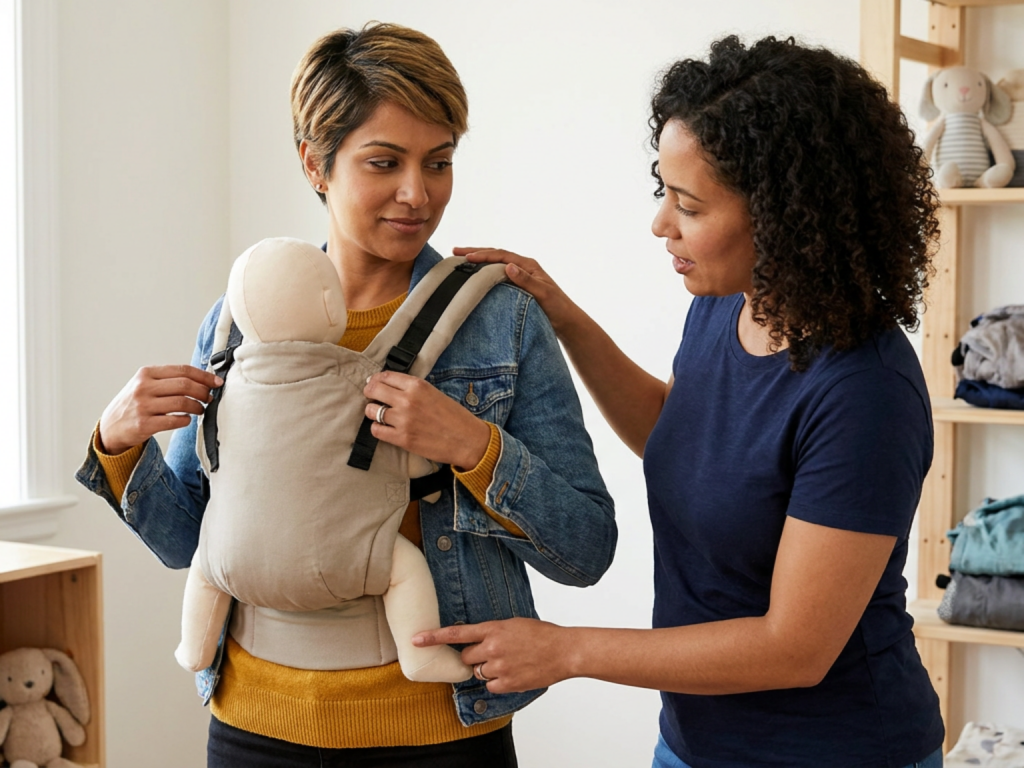
When trying a carrier, put it on slowly and check your body. Can you breathe comfortably? Are your shoulders relaxed? Is the baby’s weight close to your center of gravity? Can you squat or hinge at the hips rather than bending forward from the waist? If pain, numbness, tingling, dizziness, or pelvic pressure develops, stop and reassess. A physiotherapist or occupational therapist can help adapt carrying choices for caregivers with pain, disability, or postpartum recovery concerns.
Match the carrier to your daily life
The best carrier is the one that fits your routines. For short indoor soothing, a soft wrap or ring sling may be ideal. For long walks, errands, or travel, many caregivers prefer a soft structured carrier with padded straps and a waistband. If you plan to breastfeed or chestfeed in the carrier, choose a design that allows controlled lowering and retightening, while still keeping the baby’s airway visible. Feeding in a carrier should be considered an active task, not a hands-free sleep setup.
Climate also matters. Thick fabric, multiple wrap layers, newborn inserts, caregiver body heat, and warm weather can increase baby carrier overheating risk. Choose breathable materials when possible, dress the baby lightly in warm conditions, and remember that the carrier counts as a layer. Check the back of the baby’s neck or chest for excessive warmth, sweating, flushed skin, or lethargy.
Think about maintenance and transport. Can the carrier be machine washed after spit-up or diaper leaks? Does it fit in a diaper bag? Are the buckles intuitive enough for tired nighttime use? Can you put it on without dragging fabric on a wet parking lot floor? Practical details are not superficial; they influence whether you will use the carrier correctly when you are sleep-deprived, rushed, or caring for a crying baby.
Evaluate quality, instructions, and secondhand options
Before buying, read the full instruction manual, not only the marketing summary. A good carrier should clearly explain age and weight ranges, safe positions, adjustment steps, cleaning, and warnings. Check stitching, seams, buckles, rings, fabric integrity, and labels. If the carrier feels unstable, slips during normal movement, or requires improvised tying not described by the manufacturer, choose another option.
Secondhand carriers can be a sensible way to manage cost, but inspect them carefully. Avoid carriers with cracked buckles, warped rings, torn fabric, stretched elastic, missing labels, unknown history, or absent instructions. Be cautious with counterfeit products, as they may not meet the same material or construction standards. If a carrier has been recalled, do not use it.
It can help to borrow before buying through a local sling library, parent group, lactation service, or babywearing educator. Bring your baby if possible and ask someone trained to check positioning. Using baby carriers correctly often comes down to small adjustments: tightening the top rail of a sling, narrowing or widening the seat, raising the waistband, or changing strap tension. A few minutes of skilled guidance can prevent frustration and improve safety.
When to be extra cautious
- Seek professional advice before babywearing a premature, low-birth-weight, medically fragile, or hypotonic baby.
- Stop using the carrier if your baby’s face is covered, chin drops to the chest, breathing seems difficult, or color changes.
- Do not use a baby carrier during cooking, driving, cycling, running, or any activity with fall, heat, or impact risk.
- Watch for overheating, especially with newborn inserts, thick wraps, warm weather, or caregiver body heat.
- Do not ignore caregiver pain, numbness, dizziness, or wound discomfort while carrying.
Tools & Assistance
- A local sling library or babywearing educator for hands-on fitting support.
- Your pediatrician or neonatal follow-up team for babies with medical or developmental concerns.
- A pelvic health physiotherapist or musculoskeletal physiotherapist for caregiver pain or postpartum recovery.
- The carrier manufacturer’s instruction manual and safety videos for your exact model.
- A simple mirror check to confirm face visibility, high positioning, and even strap tension.
FAQ
Can I use a baby carrier from birth?
Sometimes, if the carrier is designed for newborns and your baby can be positioned upright with a visible airway and adequate head support. Premature or medically fragile babies need clinician guidance first.
Is forward-facing carrying necessary?
No. Many babies never need to face outward. If used, it should generally wait until the baby has strong head and trunk control, and it should be brief, well supported, and stopped if the baby seems overstimulated or tired.
Which carrier is best for breastfeeding?
There is no single best option. Some caregivers like ring slings or adjustable buckle carriers, but feeding must still allow visible airway monitoring and retightening after the feed.
How do I know if the carrier seat is too narrow?
If the baby’s thighs are not supported and the legs hang straight down from the crotch, the seat may be too narrow. Look for knee-to-knee support and a comfortable M-shaped position.
Should a carrier replace a stroller?
Not necessarily. Many families use both. A carrier offers closeness and hands-free movement, while a stroller may be better for longer outings, heavy bags, caregiver fatigue, or hot weather.
Sources
- Australian Breastfeeding Association — Choosing a baby carrier
- Infantino — How to Choose a Baby Carrier: Finding The Right Fit
- BabyGearLab — The Best Baby Carriers | Tested & Ranked
Disclaimer
This article is for general educational purposes and does not replace medical advice. Consult a qualified healthcare professional for concerns about your baby’s breathing, development, prematurity, hip health, or your own pain while babywearing.
















Please log in to leave a comment.