
Intro
The pushing stage is not a contest of endurance; it is a coordination problem. The uterus, pelvis, fetal head, and your own energy all interact, and position can make that work easier or harder. In the second stage of labor, the most useful posture is often the one that helps you breathe, relax the pelvic floor, and direct force efficiently rather than one perfect position for everyone.
Evidence reviews support delayed pushing when appropriate, spontaneous pushing in labor, and maternal choice of position. Upright positions during labor may shorten the time to birth, but comfort, fetal status, monitoring needs, and any epidural effects matter too. The practical question is not which position is ideal in theory; it is which position is safe, sustainable, and effective at the moment.
Highlights
Upright, side-lying, hands-and-knees, and kneeling positions can all be appropriate during pushing, depending on comfort and clinical context.
Supine positioning is generally less favored because it can work against gravity and may be less comfortable for many people.
The best posture often changes as fatigue, fetal descent, pain relief, and monitoring needs change.
Short, deliberate position shifts can improve efficiency more than staying fixed in one posture for the whole stage.
Why position matters in the pushing stage
During the pushing stage of labor, the goal is not simply to push harder. It is to convert the force of contractions and your own effort into effective descent through the pelvis while preserving enough energy to keep going. That is why second stage of labor positioning matters. Even small changes in hip angle, trunk angle, and support can change how well the fetal head aligns with the pelvic outlet.
Gravity can help when you are upright, and many people find that upright positions during labor feel more natural than lying flat. In contrast, supine positioning is not recommended in many evidence summaries because it can be less comfortable and less mechanically helpful. The most useful position is also the one you can maintain without bracing your whole body. If you are tensing your jaw, shoulders, or thighs, you may be spending energy that should be reserved for the pelvic floor and the next contraction.
For that reason, the pushing stage of labor is often managed as a sequence of positions rather than a single posture. A person may begin upright, rest on the side, then return to an upright or hands-and-knees posture as the baby descends. That flexibility is usually more practical than trying to stay in one classic position from start to finish.
Upright positions that use gravity well
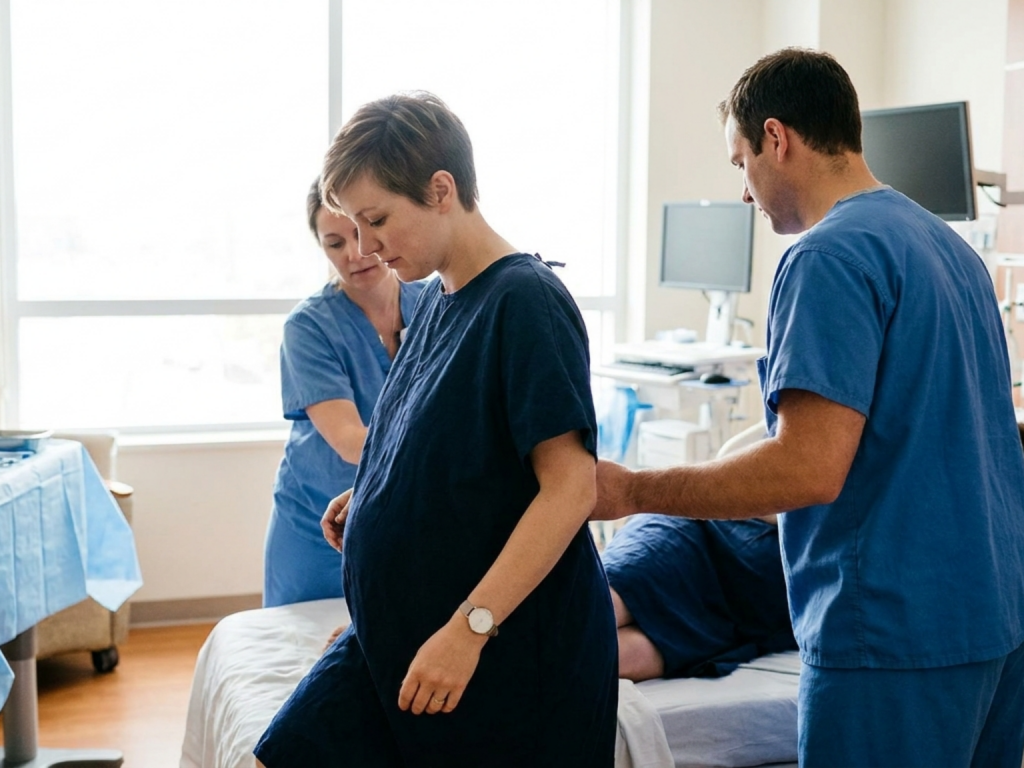
Upright positions are often the first place to start if you have the strength and the room to move. Standing with support, kneeling, upright-kneeling, semisitting, and squatting can all help the pelvis open and can make use of gravity. The review literature and clinical handouts both support maternal choice here, and many people prefer these positions because they feel active without being rigid.
A supported squat, including squatting on a squat bar, can widen the pelvic outlet and may feel effective when the baby is low and the legs are strong enough to hold the posture. Standing or leaning forward onto a bed, a partner, or a birth ball can also be useful if you need to change angle without fully resting. These positions can pair well with spontaneous pushing in labor because they let you respond to the urge rather than force a pattern that does not match your contractions.
Upright does not have to mean strenuous. A shallow squat, one foot raised on a stool, or a kneeling posture with the upper body supported can still give you many of the mechanical benefits while reducing fatigue. If the position makes you feel shaky, dizzy, or overly tense, it is probably too demanding for the moment.
Side-lying and semi-sitting when rest matters
The side-lying pushing position is one of the most practical choices when you need recovery between contractions. It can reduce the work required from your legs, protect energy if labor has been long, and make it easier to relax your abdomen and pelvic floor. Many maternity teams also use side-lying when blood pressure, fatigue, or limited mobility makes a more upright posture harder to sustain.
Side-lying is not passive in the sense of being ineffective. You can still generate strong pushes from this position, especially if your top leg is well supported by pillows or a nurse, partner, or bed adjustment. Some people do best alternating between side-lying and a more active posture so that they can rest without losing progress. Semi-sitting can serve a similar purpose when you want a little more access for pushing but do not want the full load of standing or squatting.
Among birth positions during labor, side-lying is often the simplest way to balance comfort and function. It is also easier to return to repeatedly if you need a position you can hold through several contractions. If the team is using perineal support during birth, side-lying may give them enough access while still letting you keep your pelvis relatively open and relaxed.
Hands-and-knees and forward-leaning options
The hands-and-knees birth position is a useful option when you want to unload pressure from the sacrum or vary the angle of the baby’s descent. It is often described as a gravity-neutral posture because it neither fully depends on upright weight bearing nor places you flat on your back. For some people, it feels especially helpful when the back or tailbone is the most uncomfortable part of labor.
Forward-leaning positions, such as leaning over the bed, a pile of pillows, or a birth ball, can also be effective. They let the abdomen hang forward, reduce direct pressure on the lower spine, and give the pelvis room to shift. If the fetal head is not descending as expected, changing into a hands-and-knees or forward-leaning posture may improve comfort and may assist rotation, although no position can guarantee that outcome.
These postures are usually easiest when the shoulders and wrists are supported. A nurse can help you move from bed to ball to kneeling without wasting strength during a contraction. If you want a position that feels active but not exhausting, forward-leaning is often a good middle ground between upright work and side-lying rest.
How to switch positions without losing rhythm
The best positioning plan is usually dynamic. A single posture can work well for a few contractions, then become less effective as fatigue, pain, or fetal descent changes the mechanics. The practical goal is to keep the pelvis open, the hips flexible, and your effort coordinated with the contraction pattern. That may mean staying upright while the baby is moving down, then shifting to a resting posture to recover, then returning to a more active position when the next wave of pressure builds.
Communication with your maternity team matters here. Tell them if a position increases pain, makes you feel faint, or is hard to hold long enough to complete a contraction. Tell them as well if a position suddenly feels better; small changes can matter. In many settings, a nurse or midwife can adjust the bed, add pillows, place a squat bar, or support one leg so that you can keep working without overusing your arms or thighs.
Spontaneous pushing in labor often pairs well with this kind of flexibility. When the body gives a strong urge, the position should help you release that force rather than fight it. If pushing is coached, the same principle applies: the posture should support relaxation between efforts, not trap you in an awkward angle that wastes energy.
When to be flexible or ask for a different plan
There is no single position that is best for every birth. The safest choice depends on fetal status, your blood pressure, pain relief, how well the baby is descending, and whether the team needs better access for monitoring or perineal support during birth. In some situations, a position may need to change quickly even if it was working well a minute earlier.
If you have an epidural, reduced leg strength, numbness, or limited balance, an upright posture may still be possible, but it may need more assistance. Side-lying, semi-sitting, and supported kneeling are often easier than unassisted squatting in that setting. If the team is concerned about fetal heart rate patterns or is preparing for an assisted vaginal birth, they may recommend a position that improves access and safety rather than one that is most comfortable in the abstract.
Report dizziness, heavy pressure that feels wrong, severe pain that does not match the contraction, or any sudden change that makes you feel unstable. Those are signs to ask for help, not to push through. Position choice is part of labor management, and good care means adjusting it as conditions change.
When to get help right away
- Do not stay in a position that makes you dizzy, weak, or unsafe to maintain.
- Supine pushing is generally less favored; ask the team if you are being kept flat without a clear reason.
- Report heavy bleeding, a sudden change in pain, or a feeling that something is not right immediately.
- If an epidural limits your movement, ask for supported alternatives instead of forcing a difficult posture.
- If the fetal heart rate changes or the team asks you to switch positions, follow that guidance promptly.
Tools & Assistance
- Ask your midwife, obstetric clinician, or labor nurse which positions are safest with your current monitoring and pain plan.
- Use a squat bar, birth ball, pillows, or a bed wedge if your unit offers them.
- Request help changing the bed, side rails, or leg supports before the next contraction starts.
- Review your birth plan with the labor team so position preferences are known in advance.
FAQ
Is squatting the best position for pushing?
Not always. Squatting can be effective if you have strength and support, but side-lying, kneeling, or semi-sitting may be better if you are tired, numb, or need more stability.
Is lying on my back ever okay?
Sometimes it is necessary briefly for an exam or a specific clinical reason, but routine supine pushing is generally less favored than upright or side-lying options.
What if I have an epidural?
You may still be able to use supported side-lying, semi-sitting, or kneeling positions. The team can help match the posture to your mobility and safety.
Should I push only when told to?
Follow your clinician’s guidance. Some people do best with spontaneous pushing in labor, while others need coached effort depending on the clinical situation.
Sources
- PubMed — A review of evidence-based practices for management of the second stage of labor
- PMC — Care Practice #5: Spontaneous Pushing in Upright or Gravity-Neutral Positions
- Northwestern Medicine — Positioning in the Pushing Stage of Labor
Disclaimer
This article is for general information only and does not replace individualized medical advice, examination, or intrapartum guidance from your obstetric, midwifery, or nursing team.


















Please log in to leave a comment.