
Intro
For many pregnant people, the honest answer is: often yes, but not automatically and not at any depth that feels forced. Squats and stretching can remain part of a healthy movement routine in an uncomplicated pregnancy, yet the safest version is the one you can control, breathe through, and recover from without pain, dizziness, or pelvic pressure.
Pregnancy changes balance, joint mobility, load distribution, and sometimes how the pelvic floor and abdomen respond to movement. That means the question is less about whether deep positions are universally forbidden and more about whether a particular squat or stretch fits your body, your trimester, and any obstetric advice you have received.
Highlights
Deep squatting is not automatically unsafe in pregnancy, but depth should be adjusted to your balance, mobility, and comfort.
Stretching deeply is usually best kept gentle and controlled; forcing end-range can irritate joints and soft tissues.
Breathing matters: avoid breath-holding and use steady exhalation to help manage pressure.
Symptoms matter more than labels. Pain, heaviness, dizziness, bleeding, or breathlessness mean you should stop and reassess.
If you have a complicated pregnancy or specific restrictions, a clinician should guide your movement plan.
What deep squats and deep stretches actually mean in pregnancy
A deep squat usually refers to a position where the hips sink below knee level or close to it, placing the ankles, knees, hips, trunk, and pelvis into a large range of motion. A deep stretch is similar in that it takes a muscle or joint toward the end of its range, where tension is high and the margin for error is smaller. In pregnancy, those end-range positions can feel different because the body is carrying more mass, the center of gravity shifts forward, and ligaments may feel less stiff than usual.
That does not mean deep positions are inherently unsafe. A biomechanical review of the squat shows that depth itself is only one variable; technique, spinal position, joint mobility, and control all matter. In practical terms, a squat that is deep but steady, well aligned, and comfortable may be preferable to a shallow squat that forces the knees, back, or pelvis into an awkward pattern. The same idea applies to stretching: a stretch should create tension, not strain.
This is why there is no single rule that fits every pregnancy. What matters most is whether the movement is symptom-guided, balanced, and compatible with your overall exercise in pregnancy plan.
Why squatting can still be helpful
Squats are often valuable in pregnancy because they train a movement pattern you use every day: sitting down, standing up, lifting, and lowering yourself with control. For many people, maintaining lower-body strength can make daily tasks feel easier as pregnancy progresses. Squatting also encourages hip, knee, and ankle mobility, which can be useful if you spend a lot of time sitting or if your body feels progressively stiffer.
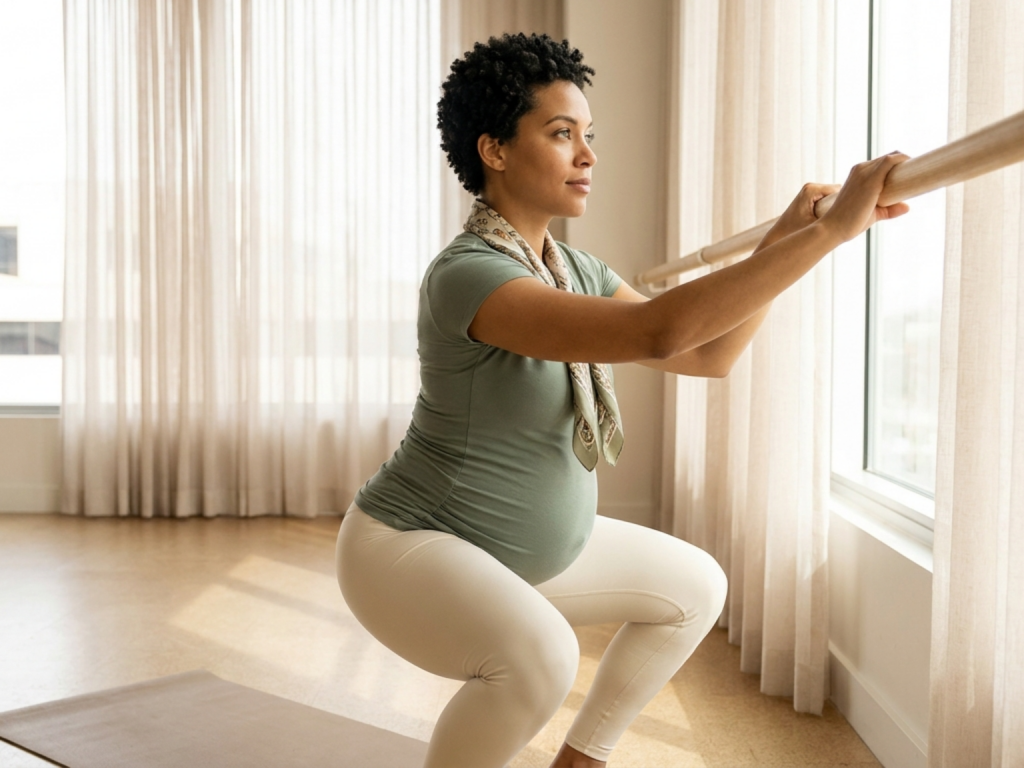
When done well, squat work can fit into pregnancy-safe strength training without needing maximal load or maximal depth. The goal is not to prove how low you can go. The goal is to move with stable alignment, keep the trunk organized, and avoid excessive strain. Some pregnant people naturally feel comfortable in a deep squat; others need a wider stance, a box, a chair, or a counter for support. Both can be valid.
If you already train regularly, you may be able to continue a version of your prior squat pattern. If you are newer to exercise, it is usually wiser to start with supported, moderate-depth variations and only increase depth if your balance, breathing, and pelvic comfort stay good.
When deep depth starts to matter
The main issue is not whether a squat or stretch looks deep on paper. The issue is whether depth causes you to lose control or creates symptoms. In pregnancy, the body may tolerate a movement one week and dislike it the next, especially as the abdomen grows and the pelvis adapts. Deep squats can become harder if your heels lift, your back rounds strongly, your knees cave inward, or you need to hold your breath to get through the movement.
Depth may also become a problem if you feel pelvic heaviness, pressure, pulling, or leaking. Those sensations do not automatically mean damage, but they are useful feedback that the current range may be too demanding. For some people, pubic symphysis pain, low back pain, or hip pain appears first as the squat gets deeper. In that case, a shallower squat, a wider stance, or a supported sit-to-stand may be a better choice. Stretching can create similar issues if you force the end range, bounce, or push through joint discomfort rather than muscle tension.
Think of depth as adjustable, not as a moral test. The safest option is the deepest position you can maintain with calm breathing, neutral control, and no concerning symptoms.
How to squat more safely and still move deeply when appropriate
A safe squat in pregnancy is usually built from a few simple principles. First, set up with a stable stance: feet planted, weight distributed evenly, and enough width that your belly and pelvis feel accommodated. Second, descend slowly enough that you can monitor balance. Third, keep breathing; exhale as you rise or as effort increases, and avoid breath-holding. Fourth, use support if needed. A countertop, rail, chair, or suspension support can make a deep squat much more manageable.
- Choose a depth that feels controlled rather than impressive.
- Pause or shorten the range if the trunk starts to collapse or twist.
- Keep the motion smooth; do not bounce at the bottom.
- Stop if you feel sharp pain, instability, or pelvic pressure.
If you want a deeper squat for mobility work, it is often better to use a slow descent and a brief, comfortable hold than to sink rapidly into the end range. This is especially true if you are doing pregnancy-safe strength training alongside the squat, because the combined demand can increase pressure and fatigue. A deep squat that is supported and deliberate is fundamentally different from a forced one.
How to stretch deeply without overstretching
Stretching during pregnancy is usually safest when it is gentle, gradual, and responsive to how the tissue feels that day. Many people find that their joints are a little more mobile, but more mobility is not always better. A deeper stretch can sometimes irritate lax structures, especially if you lean into the end range because it feels satisfying in the moment. Pregnancy stretching safety principles favor controlled tension over maximal range.
A good rule is to aim for a mild-to-moderate stretch sensation that you can breathe through comfortably. If the sensation shifts from muscle stretch to joint pain, nerve-like tingling, or a sense that something is being pulled sharply, back off. Props can help: a wall, chair, cushion, or strap may let you stretch the target tissue without needing to force the position. Seated or standing stretches are often easier to modify than floor-based positions as pregnancy advances.
Deep stretching also benefits from timing. A brief warm-up, even just walking or gentle mobility, can make the tissues feel less resistant. Avoid ballistic movements and avoid long, aggressive holds if they leave you more achy afterward. The best stretch is one that leaves you looser, not more irritated.
When to be more cautious or stop
Some pregnancy situations deserve extra caution, even if squats and stretching are usually well tolerated. If your clinician has advised activity limits because of placenta-related concerns, cervical issues, bleeding, contractions, or another obstetric complication, follow that advice first. The same is true if you have a history that makes exercise decisions more specialized, such as recurrent preterm labor or significant pelvic girdle pain.
Stop the movement and seek medical guidance if you notice vaginal bleeding, fluid leakage, regular contractions, chest pain, faintness, severe shortness of breath, severe headache, new calf pain or swelling, or a clear drop in fetal movement once you are at the stage when movement is usually felt. Also pause if you feel your abdomen bulging in a way that suggests poor pressure control, or if a stretch leaves you with lingering numbness, tingling, or pelvic heaviness.
For many people, the safest response is simple adjustment rather than avoidance. Reduce depth, slow down, add support, or switch to a more upright position. If you are unsure, a midwife, obstetric clinician, or pelvic health physiotherapist can help you decide whether deep squatting and stretching are appropriate for your specific pregnancy.
Warning signs that need prompt attention
- Stop exercising if you develop bleeding, fluid leakage, or regular painful contractions.
- Do not push through dizziness, faintness, chest pain, or marked shortness of breath.
- New pelvic heaviness, sharp joint pain, or a sense of instability means the movement should be modified.
- Breath-holding, shaking, or losing alignment are signs that the squat is too demanding right now.
- If your clinician has given you activity restrictions, follow them even if the movement feels easy.
Tools & Assistance
- Ask your obstetric clinician whether you have any movement restrictions before trying deep squats.
- See a pelvic health physiotherapist for individualized guidance on squat depth, pelvic floor load, and stretching.
- Use a stable chair, countertop, or rail to support safer squat practice at home.
- Keep a symptom log so you can notice whether certain positions trigger pain, pressure, or dizziness.
- Choose prenatal exercise classes that emphasize technique, breathing, and modifications.
FAQ
Can I do a full deep squat while pregnant?
Often yes in an uncomplicated pregnancy if it feels controlled, balanced, and symptom-free. The safest depth is the one you can maintain without pain, breath-holding, or pelvic pressure.
Is deep stretching harmful in pregnancy?
Not necessarily, but aggressive end-range stretching can irritate joints or soft tissues. Aim for gentle tension, steady breathing, and modifications if a stretch feels sharp or unstable.
Should I avoid squats in the third trimester?
Not automatically. Many people continue squatting with support and reduced depth. Third-trimester comfort, balance, and any medical advice from your clinician are the key factors.
What if squatting makes me feel pressure in my pelvis?
That is a useful sign to reduce depth, add support, or switch positions. Persistent pelvic pressure should be discussed with a clinician or pelvic health physiotherapist.
Sources
- NHS — Exercise during pregnancy: A guide to staying active
- Better Health Channel — Exercise safety
- PubMed Central / NIH — A Biomechanical Review of the Squat Exercise
Disclaimer
This article is for general information only and is not a substitute for personalized medical advice. If you have pregnancy complications, new symptoms, or uncertainty about exercise safety, speak with your obstetric clinician or another qualified healthcare professional.














Please log in to leave a comment.