
Intro
After conception, the body does not simply continue the menstrual cycle with a new label. It enters a tightly coordinated endocrine state in which progesterone and estrogen help the embryo implant, protect the uterine lining, and support the early maternal adaptations needed for pregnancy.
For many people, hormone discussions can feel abstract until they are linked to real physiology. In practice, these steroids are doing constant work: regulating uterine tone, shaping the endometrium, supporting breast tissue changes, and helping the immune system tolerate the pregnancy while still defending against infection.
Highlights
Progesterone is the main hormone that stabilizes the endometrium and keeps the uterus relatively quiet after conception.
Estrogen supports uterine growth, blood flow, and breast development, while also working with progesterone to maintain pregnancy.
The corpus luteum makes the earliest supply of these hormones, and the placenta gradually takes over production.
After birth, progesterone and estrogen fall sharply, which helps trigger lactation and uterine recovery.
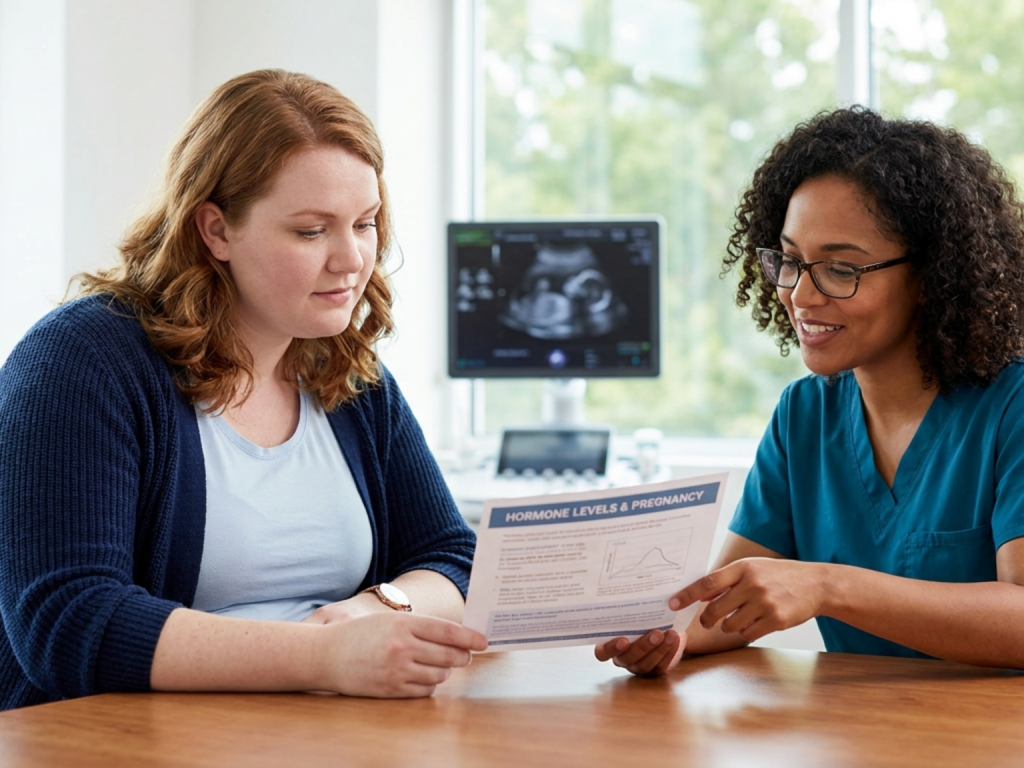
Symptoms alone cannot tell you whether hormone levels are normal; timing, ultrasound, and clinical context matter.
Why conception changes the hormonal balance
In a non-pregnant cycle, the corpus luteum forms after ovulation and then regresses if implantation does not occur. After conception, the developing trophoblast begins producing human chorionic gonadotropin (hCG), which rescues the corpus luteum and keeps it functioning. That early rescue is the bridge between ovulation and a sustained pregnancy.
This is where progesterone and early pregnancy maintenance become inseparable. Progesterone helps convert the endometrium into a secretory, nutrient-rich tissue that can support implantation and early placental development. Estrogen, especially estradiol, also rises and supports uterine and vascular adaptation. A useful way to think about the shift is that progesterone preserves stability while estrogen supports growth and remodeling. The sequence of implantation and hCG production explains why pregnancy becomes hormonally distinct only after the embryo is established in the uterus.
A broader overview of Hormonal changes in early pregnancy shows that these are not isolated hormone spikes. They are part of an integrated endocrine program that begins before the placenta is fully formed and continues to evolve as pregnancy progresses.
Progesterone: keeping the uterus calm and receptive
Progesterone is often described as the hormone of uterine quiescence, and that description is clinically useful. It reduces myometrial excitability, limits spontaneous contractions, and helps the uterus remain a hospitable environment for the embryo and later the fetus. It also supports decidualization, the transformation of the endometrium into a specialized tissue that nourishes and anchors early gestation.
Beyond the uterus, progesterone has immunologic effects that matter in pregnancy. The maternal immune system must tolerate the semi-allogeneic fetus without becoming globally suppressed. Progesterone contributes to that balance by modulating inflammatory signaling and supporting local immune tolerance at the uterine interface. This does not mean the body becomes defenseless; rather, the response becomes more selective.
Progesterone also affects the cervix and the breasts. It helps keep cervical mucus more viscous and promotes lobuloalveolar breast development, preparing the glands for later milk production. In practical terms, progesterone and early pregnancy maintenance is not just about preventing contractions; it is about creating a stable internal environment that can sustain implantation, placentation, and maternal adaptation at the same time.
Because progesterone physiology changes across gestation, a single blood test is rarely meaningful without knowing gestational age, symptoms, and ultrasound findings. That is one reason clinicians interpret progesterone in context rather than as a stand-alone marker.
Estrogen: growth, blood flow, and tissue remodeling
Estrogen, especially estradiol, is often associated with growth and proliferation, but in pregnancy its role is more nuanced than simple stimulation. It helps the uterus enlarge, supports uteroplacental blood flow, and contributes to vascular remodeling. These changes allow the mother’s circulation to meet the needs of the developing placenta and fetus.
Estrogen also plays a major part in breast preparation. It drives ductal growth and cooperates with progesterone to shape breast architecture for lactation. Many of the breast changes people notice in early pregnancy, such as tenderness, swelling, or a sense of fullness, reflect this combined hormonal influence. Still, symptoms are not precise indicators of hormone levels; some people feel very little despite typical physiology, while others feel pronounced changes.
Another important point is that estrogen does not act independently. It works in a dynamic partnership with progesterone, and the balance between them matters more than either hormone in isolation. Estrogen helps the uterus and maternal tissues grow and adapt, while progesterone restrains excessive contractility and preserves the pregnancy. Together, they coordinate the transition from a cycle designed for potential conception to a pregnancy designed for sustained fetal development.
This coordinated balance also explains why clinicians think about estrogen and progesterone as part of a broader endocrine network rather than as separate lab numbers.
The placental takeover
During the earliest weeks, hormone production depends mainly on the corpus luteum. As the placenta develops, it gradually becomes the main source of progesterone and estrogen. This is often called the luteal-to-placental shift or placental takeover, and in humans it usually occurs by the end of the first trimester. The change is normal and expected, not a sign that support is being withdrawn.
Once the placenta takes over, placental steroid hormone production becomes central to pregnancy maintenance. Progesterone continues to suppress uterine activity and support the decidua, while estrogens rise to support uterine growth, blood flow, and fetal-placental maturation. The placenta is not merely a conduit; it is an active endocrine organ that helps direct maternal physiology toward pregnancy maintenance.
This transition also explains why early pregnancy can be more vulnerable before placental steroid production is fully established. The pregnancy is initially dependent on the corpus luteum, which itself depends on hCG from the trophoblast. As the placental endocrine function matures, hormone production becomes more robust and less dependent on ovarian rescue.
For people tracking pregnancy medically, this is one reason that timing matters so much. A hormone value that is expected at five weeks may be completely different at nine weeks, even in a normal pregnancy.
From pregnancy to postpartum: the sharp hormonal drop
Delivery changes the endocrine picture very quickly. Once the placenta is expelled, the major source of estrogen and progesterone disappears, and circulating levels fall steeply. That abrupt decline is a normal physiologic event and marks the transition from pregnancy maintenance to postpartum recovery.
The fall in estrogen and progesterone matters because it removes the hormonal restraint on lactation. Prolactin can then act more effectively to support milk production, while the uterus begins involution, the process of shrinking back toward its pre-pregnancy size. Clinical references note that the postpartum decline in these hormones is closely linked to breastfeeding physiology and uterine recovery.
Observational data also show that estrogen and progesterone stay low during lactation, then rise again after weaning and the return of menstruation. That pattern is reassuring because it reflects normal recovery rather than a problem by itself. Still, postpartum health is broader than hormones alone. Sleep deprivation, blood loss, pain, thyroid changes, and mood symptoms can overlap with endocrine shifts, so a thoughtful clinical review is often more useful than assuming hormones explain everything.
The postpartum period can feel emotionally and physically disorienting, and that experience is valid. If symptoms persist or feel severe, care from an obstetric clinician, midwife, or primary care clinician can help distinguish normal recovery from something that deserves treatment.
When to discuss hormone concerns with a clinician
It is easy to overread pregnancy symptoms, especially when online information suggests that breast tenderness, spotting, fatigue, or nausea map neatly onto a specific hormone level. In reality, these symptoms are nonspecific. A person can have strong symptoms with normal physiology, mild symptoms with a normal pregnancy, or symptoms that reflect something else entirely.
That is why progesterone and estrogen testing is most useful when it is ordered in the right clinical setting. Interpretation depends on gestational age, ultrasound findings, hCG trends, and the overall picture. For example, a single progesterone result usually cannot confirm viability or exclude a problem on its own. If hormone support is being considered, the decision should be individualized rather than based on a generic threshold.
Seek prompt medical review for heavy bleeding, severe or one-sided pain, fainting, fever, or a sudden change in well-being. The same caution applies after birth if bleeding becomes excessive, breastfeeding is unexpectedly difficult, or mood symptoms are intense. Hormones are only one part of pregnancy and postpartum health, but understanding their roles can make the process feel less mysterious and more manageable.
In short, progesterone and estrogen are essential partners in the biology of conception, implantation, placental development, and postpartum transition. They do not act in isolation, and neither do you; pregnancy care works best when hormone information is interpreted with skilled clinical guidance.
When to seek medical advice
- Heavy bleeding, severe abdominal or one-sided pelvic pain, fainting, or shoulder pain need urgent assessment.
- Do not start progesterone or estrogen supplements on your own; treatment should be individualized by a clinician.
- A single hormone test rarely tells the full story without gestational timing, ultrasound, and hCG context.
- Postpartum mood changes, severe fatigue, or breastfeeding difficulties deserve medical review if they are intense or persistent.
- If you have a history of recurrent loss, ectopic pregnancy, or fertility treatment, ask early about follow-up planning.
Tools & Assistance
- Prenatal visit with an obstetrician, midwife, or family physician
- Ultrasound and hCG-based pregnancy dating when timing is uncertain
- Clinician-ordered progesterone or estradiol testing when medically indicated
- Postpartum follow-up and lactation support if milk supply or recovery is a concern
- Emergency care for heavy bleeding, severe pain, or fainting
FAQ
Does progesterone rise immediately after conception?
Not immediately. After implantation, hCG rescues the corpus luteum, which keeps making progesterone until the placenta can take over.
Why do pregnancy need both progesterone and estrogen?
Progesterone helps keep the uterus quiet and the lining stable, while estrogen supports growth, blood flow, and breast development. They work as a coordinated pair.
Can I tell my hormone levels from pregnancy symptoms?
Usually not. Symptoms like nausea, breast tenderness, or fatigue are common but nonspecific, so clinicians use gestational age and test results together.
What happens to these hormones after birth?
They fall quickly when the placenta is delivered. That drop supports lactation and uterine involution, and levels stay low during breastfeeding before rising again after weaning and menstruation.
Sources
- PubMed Central — Estradiol and progesterone from pregnancy to postpartum
- NCBI Bookshelf — Physiology, Postpartum Changes
- PubMed — Serum oestrogens and progesterone after normal delivery
Disclaimer
This article is for educational purposes only and is not a substitute for personalized medical care. If you have bleeding, pain, or concerns about pregnancy or postpartum recovery, please contact a qualified healthcare professional.














Please log in to leave a comment.