
Intro
Play is not an optional extra in a baby's day. It is a primary context for learning, relationship-building, movement, communication, and early self-regulation. Through repeated, enjoyable experiences, babies gather information about their bodies, caregivers, objects, and the wider environment.
For families, play does not require expensive equipment, formal lessons, or a perfectly organized schedule. Responsive attention during ordinary interactions can provide rich developmental support. The most useful approach is to follow the baby's cues, adapt activities to the baby's current abilities, and keep safety at the center.
Highlights
Play gives babies repeated practice with movement, attention, communication, and emotional regulation.
Warm, responsive relationships make playful experiences more meaningful and support early social learning.
Simple sensory and cause-and-effect activities can strengthen exploration and emerging problem-solving.
Play should be enjoyable and developmentally appropriate rather than a test of skills or a race toward milestones.
Play is an active form of early learning
During play, a baby is not simply being entertained. The baby is observing, predicting, moving, remembering, and testing the effects of different actions. These experiences help build neural connections across sensory, motor, language, and executive-function networks. Executive function refers to mental skills involved in attention, working memory, flexible thinking, and impulse control; in infancy, these abilities are still emerging and are supported through repeated interaction rather than formal instruction.
Play also gives babies a manageable way to encounter novelty. A familiar caregiver, predictable voice, or repeated song can provide a secure base while the baby explores something new. This combination of safety and variation helps the infant tolerate small challenges, recover from frustration, and gradually develop adaptability. The goal is not to make every activity educational in a narrow sense. Ordinary enjoyment, shared attention, and repetition are already valuable developmental experiences.
In this context, How play supports baby development is best understood through the quality of the interaction, not the price or complexity of the toy. A soft conversation during diapering, a pause that allows the baby to respond, or a game of copying facial expressions can all support learning.
Movement and sensory exploration build the body’s foundations
Infants learn through their bodies. Reaching toward a toy, turning the head toward a sound, grasping a safe object, kicking during floor time, and shifting weight while supported all provide practice in motor planning and coordination. These experiences contribute to gross motor skills, such as head and trunk control, as well as fine motor skills, such as grasping, releasing, and bringing objects toward the midline.
Sensory play supplies information about texture, temperature, sound, visual contrast, movement, and position in space. The nervous system integrates these signals to help the baby organize a response. This process, often described as sensorimotor integration, supports increasingly purposeful movement. A baby who repeatedly bats at a hanging object is learning about location, timing, effort, and the consequences of movement, even before the action appears precise.
Safe floor-based play is particularly useful because it allows infants to move within their current abilities. Caregivers can place a small number of safe objects nearby, vary their position, and allow the baby time to initiate movement. Babies should always be supervised, and activities should follow current guidance about positioning, head and neck support, choking hazards, and safe sleep. Play equipment should not be used as a substitute for attentive supervision or unrestricted opportunities for movement.
Back-and-forth play supports communication and relationships
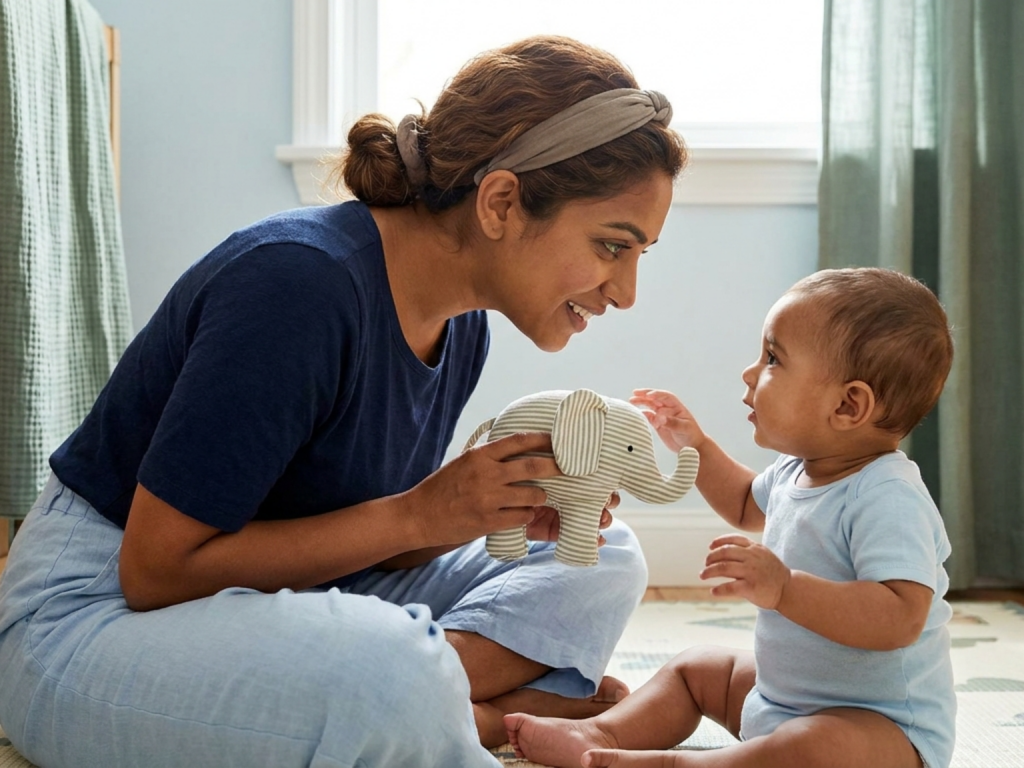
Early communication begins long before spoken words. A baby looks, vocalizes, smiles, pauses, turns away, reaches, and changes body movement to communicate. When an adult notices these signals and responds contingently, the infant learns that communication is reciprocal: one person acts, another responds, and the interaction continues. This back-and-forth interaction supports social attention, emotional connection, and the foundations of language.
Caregivers can respond by imitating a baby’s sound, naming what the baby is looking at, waiting briefly for a response, or matching the baby’s pace. These simple exchanges support early language reciprocity and help the baby associate sounds and gestures with shared meaning. Songs, rhythmic speech, picture books, and repetitive games are useful because their predictable patterns make it easier for an infant to anticipate what may happen next.
Play also strengthens responsive relationships. The caregiver’s face, voice, touch, and timing help the baby regulate arousal and return to a calm state after excitement. Over time, these repeated experiences contribute to trust and social development. A caregiver does not need to respond perfectly every time. Repairing an interrupted interaction, slowing down, and reconnecting are normal parts of healthy relationships.
Play develops attention, memory, and early problem-solving
Many infant games contain the basic structure of scientific inquiry: observe, act, notice the result, and try again. When a baby shakes a rattle, presses a button, drops an object, or moves a cloth to reveal something underneath, the baby is exploring cause and effect. Cause-and-effect play supports early problem-solving by showing that actions can produce predictable changes in the environment.
Peekaboo and hiding games also support memory and object permanence, the developing understanding that people and objects continue to exist when temporarily out of sight. At first, a baby may simply enjoy the surprise of the caregiver reappearing. With repetition, the infant begins to anticipate the sequence and may participate through vocalization, movement, or a smile. This is an early example of attention, memory, prediction, and social enjoyment working together.
Caregivers can support cognitive development by offering time rather than immediately solving every small challenge. If a toy is just beyond reach, a brief pause may allow the baby to experiment with movement. The challenge should remain manageable; prolonged distress is not a developmental requirement. The adult can then adjust the object, offer encouragement, or simplify the task. This approach preserves the baby’s agency while maintaining emotional safety.
Play helps babies experience and regulate emotion
Infants rely heavily on caregivers to regulate arousal. Play provides repeated opportunities to move between alert engagement and calm recovery. A lively song may increase excitement, while a slower voice, gentle rocking, or quiet face-to-face contact may help the baby settle. Through these cycles, babies gradually learn patterns of activation and recovery that later support self-regulation.
Emotional learning also occurs when play includes manageable frustration. A toy that is difficult to grasp or a game that pauses briefly can prompt a baby to persist, seek help, or communicate a need. The caregiver’s calm presence demonstrates that frustration can be tolerated and that support is available. This does not mean ignoring crying or expecting a young infant to calm independently. It means staying attentive to the baby’s cues and providing co-regulation when the infant’s nervous system needs assistance.
Play can be especially meaningful during periods of stress, illness, hospitalization, or disruption, although a baby’s energy and tolerance may change. Quiet singing, looking at a book, gentle touch, or familiar routines may be more appropriate than active games. The scientific literature describes play as contributing to resilience and adaptability, but individual responses vary. A healthcare professional can help families decide how to support an infant whose medical condition affects activity, feeding, sleep, or alertness.
Choose play that follows the baby’s cues
Effective play is responsive rather than performance-based. Signs of engagement may include steady eye contact, relaxed movements, reaching, smiling, vocalizing, or turning toward the caregiver. Signs that the baby needs a pause may include looking away, yawning, hiccupping, frantic movements, fussing, stiffening, or becoming unusually quiet. These signals are not diagnostic on their own, but they provide useful information about the baby’s current state.
When a baby looks away, the caregiver can pause and give the infant time to recover. Reducing noise, changing position, removing an object, or returning to a familiar voice may help. Short periods of play spread across the day are often more realistic and better tolerated than one long session. Feeding, dressing, bathing, and ordinary caregiving can also become playful moments when the adult uses eye contact, narration, songs, and pauses for the baby’s response.
Use clean, intact, age-appropriate toys without small detachable parts, loose strings, sharp edges, or accessible batteries. Keep plastic packaging, water hazards, and objects small enough to fit through a toilet-paper tube away from infants. Avoid placing a baby to sleep with toys or soft objects. Families of premature babies may need to consider corrected age and individualized guidance when interpreting developmental expectations. The pediatric clinician can provide advice tailored to gestational age, medical history, mobility, vision, hearing, and current developmental profile.
Development is supported by connection, not comparison
Babies develop at different rates, and a single play behavior does not define a child’s overall development. Progress is usually more informative than a one-time performance. A caregiver might notice that a baby gradually sustains attention longer, uses both hands more often, responds more consistently to voices, or recovers more easily after a brief frustration. Sharing these observations with a healthcare professional can provide useful context during routine visits.
Families should seek professional advice if they are concerned about a loss of previously acquired skills, marked difficulty seeing or hearing, persistent feeding or breathing problems, unusual stiffness or floppiness, or a lack of expected responsiveness. These observations do not establish a diagnosis, but they deserve timely discussion. A clinician may recommend developmental screening or referral to services such as physical therapy, occupational therapy, speech-language therapy, or early-intervention programs.
The central message is reassuring without minimizing concern: babies do not need constant stimulation to develop. They need safe opportunities to move and explore, predictable caregiving, and repeated moments of warm attention. When play is adapted to the baby’s cues and abilities, it becomes a practical way to support the whole child while protecting rest, comfort, and relationship.
Safety and medical cautions
- Supervise babies closely during every play activity, especially around water, elevated surfaces, pets, and siblings.
- Keep small parts, loose cords, magnets, button batteries, plastic bags, and other choking or injury hazards out of reach.
- Do not use playtime guidance as a replacement for safe-sleep recommendations or individualized medical advice.
- Stop an activity if the baby shows distress, breathing difficulty, color change, unusual lethargy, or a sudden change from usual behavior.
- Discuss developmental regression or persistent concerns with a pediatrician or other qualified healthcare professional.
Tools & Assistance
- A small set of washable, age-appropriate toys with no detachable hazards
- A clear floor area for supervised movement and sensory exploration
- Board books, songs, nursery rhymes, and familiar family voices
- A brief observation log for noting new responses, preferences, and concerns
- Routine pediatric visits and local early-intervention services
FAQ
Does play need to involve special educational toys?
No. A caregiver's voice, face, hands, songs, and safe household objects can provide rich developmental experiences. The quality of responsive interaction is generally more important than cost or novelty.
How long should a baby play each day?
There is no single ideal duration for every infant. Offer brief, frequent opportunities when the baby is alert and comfortable, and pause for feeding, sleep, or signs of overstimulation.
What if my baby does not seem interested in toys?
Try face-to-face interaction, singing, movement, or a simpler object, and consider the baby's alertness and environment. Persistent concerns about vision, hearing, responsiveness, or movement should be discussed with a healthcare professional.
Can play help a baby who is experiencing stress or illness?
Gentle, familiar play may support comfort and connection, but tolerance can vary during illness or medical treatment. Follow the clinical team's guidance and prioritize rest, feeding, safety, and symptom monitoring.
Should I compare my baby's play skills with other babies?
Comparison can create unnecessary anxiety because development varies. Track patterns over time and discuss specific concerns, loss of skills, or lack of progress with the baby's clinician.
Sources
- PubMed — The Power of Play: A Pediatric Role in Enhancing Development in Young Children
- PubMed — The importance of play for the development of children in health and disease
- NIH News in Health — It’s a Kid’s Job
Disclaimer
This article provides general educational information and is not a diagnosis or a substitute for individualized medical advice. Consult a pediatrician or other qualified healthcare professional about your baby's development, safety, or medical needs.













Please log in to leave a comment.