
Intro
Screen time in the toddler years can feel emotionally loaded. Many families use screens during meals, travel, illness, sibling care, work calls, or simply to get through an exhausting day. The goal is not to shame caregivers, but to understand how screen exposure interacts with toddler neurodevelopment, sleep, vision comfort, communication, and family routines.
Highlights
For toddlers under 18 months, most expert guidance discourages screen media except live video chatting with an engaged caregiver.
From 18 to 24 months, if screens are introduced, high-quality content and active co-viewing matter more than simply turning on a program.
For ages 2 to 3 years, many recommendations use a practical ceiling of about one hour per day of high-quality programming, with less time often preferable.
Background TV, fast-paced content, and screens near bedtime can affect attention, language opportunities, and sleep routines.
Screen time works best when it is planned, limited, shared, and balanced with sleep, movement, outdoor play, reading, and responsive human interaction.
Why toddler screen time is different from adult screen time
Between 1 and 3 years, the brain is undergoing rapid synaptogenesis, pruning, myelination, and refinement of neural circuits for language, motor planning, social attention, and emotional regulation. Toddlers learn most efficiently through contingent interaction: they do something, a responsive person reacts, and the child adjusts. Screens can offer sounds, images, and repetition, but most programs do not respond to the child’s gaze, gestures, uncertainty, or emotional state in the same way a caregiver does.
This is why toddler screen time is not only about minutes. The context matters: whether the child is alone or co-viewing, whether the content is slow and meaningful or fast and fragmented, whether the screen replaces sleep or active play, and whether it becomes the main tool for managing distress. A short, shared video call with grandparents is developmentally different from an hour of background cartoons while a child wanders around the room.
Families also deserve realism. Screens exist in modern homes, and caregivers may need them occasionally. A medically sensible approach focuses on risk reduction: choose higher-quality content, avoid background TV, protect sleep, and preserve the core developmental experiences toddlers need every day, including face-to-face conversation, safe movement, pretend play, reading, outdoor time, and predictable routines.
Age-by-age guidance from 1 to 3 years
For children younger than 18 months, guidance from pediatric and early childhood organizations generally discourages screen media except live video chatting. The exception matters because video chatting can be socially meaningful when an adult helps the toddler participate: naming the person, waving, pointing, singing, and responding to the child’s attention span. Even then, the adult scaffolding is what makes the experience more relational.
From 18 to 24 months, some families begin introducing limited high-quality media. At this age, toddlers still have difficulty transferring what they see on a two-dimensional screen into real-world understanding, sometimes called the video deficit. Active caregiver participation helps bridge that gap. For example, if a program shows a dog, the caregiver might say, “That dog is barking. Remember the dog we saw at the park?” This turns passive viewing into a language and memory activity.
For children 2 to 3 years old, many recommendations advise no more than one hour per day of high-quality programming, and less is often better. This should not be interpreted as a required daily allowance. It is a ceiling, not a goal. Some days may have no screens; other days, such as travel or illness, may involve more. The pattern over time is usually more important than a single imperfect day.
A practical family plan might include: no screens during meals, no screens in the bedroom, no screens in the hour before bedtime, and screen use only after sleep, outdoor play, meals, and caregiver-child interaction have been protected. These limits can be adjusted for children with medical needs or developmental differences in discussion with a pediatrician, developmental specialist, or therapist.
What counts as high-quality toddler media
High-quality toddler media is slow enough for a young child to process, uses simple language, avoids overstimulation, and connects to everyday experiences. Good content tends to show familiar routines, songs, animals, emotions, gentle problem-solving, or early concepts such as colors and shapes. It should not rely on rapid scene changes, aggressive sound effects, frightening images, manipulative advertising, or autoplay loops that make stopping difficult.
Caregivers can preview content before showing it. This is not just about avoiding obviously inappropriate material; it is about checking pace, emotional tone, commercial pressure, and whether the program encourages imitation you actually want. Toddlers imitate actions without understanding consequences, so content involving unsafe climbing, hitting, weapon play, or chaotic behavior may be confusing even if it looks cartoonish.
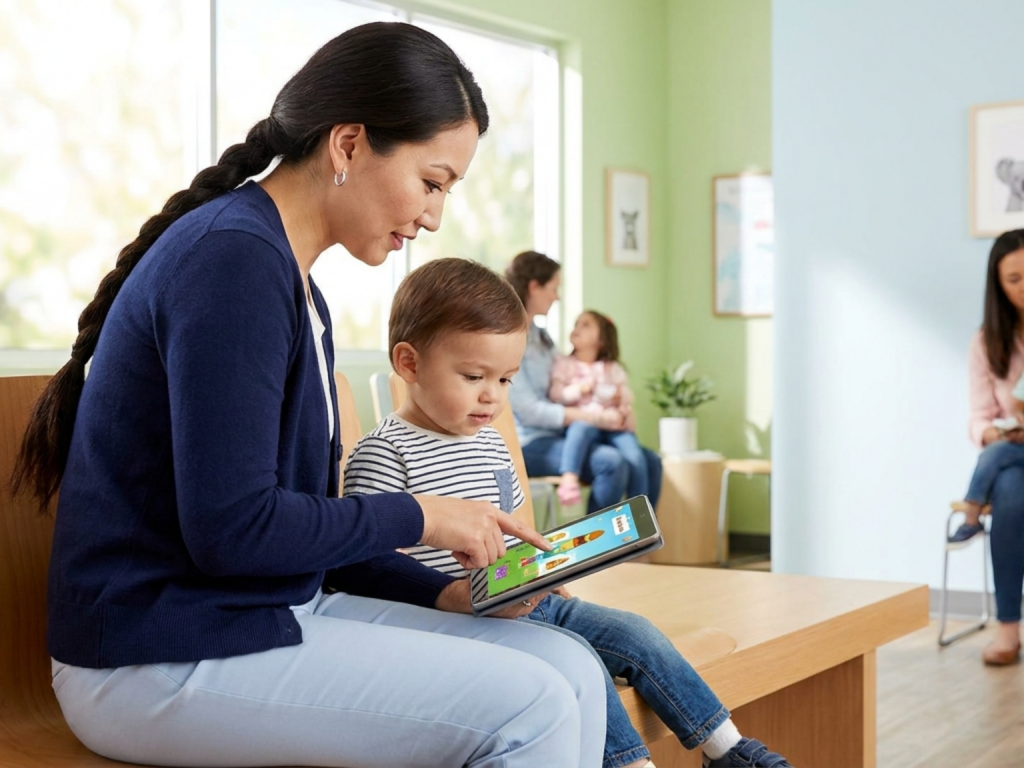
Co-viewing is one of the strongest protective strategies. When adults sit with toddlers, label what is happening, ask simple questions, and connect scenes to real life, the screen becomes closer to a shared picture book. A caregiver might pause a song to clap together, point to a banana on screen and then to a banana in the kitchen, or name emotions: “She looks sad because the toy broke.” This supports language-building toddler activities rather than replacing them.
High-quality also means age-appropriate. Apps marketed as educational are not automatically beneficial. For toddlers, open-ended physical play, sensory play for toddlers, reading, music, and ordinary household participation often teach more than a digital quiz. If an app is used, it should be simple, ad-free when possible, not punitive, and easy for the adult to supervise.
How screen time can affect sleep, behavior, language, and eyes
Sleep is one of the clearest reasons to be cautious. Screens can delay bedtime by displacing calming routines, increasing arousal, or creating bedtime resistance when a child is asked to stop. Bright light exposure in the evening may also interfere with circadian signaling, although the behavioral stimulation and habit formation are often just as important in toddlers. Keeping devices out of bedrooms and avoiding pre-bedtime screen use in toddlers are practical first steps.
Language development depends heavily on back-and-forth interaction. A toddler needs pauses, responses, facial expressions, gestures, and repetition tailored to their interest. When screen time displaces conversation, shared reading, singing, or pretend play, language opportunities can decrease. This does not mean a single program causes a speech delay; development is multifactorial. However, if a child has limited words, reduced pointing, limited response to name, or loss of skills, caregivers should discuss developmental screening with a healthcare professional rather than relying on educational videos.
Behaviorally, screens can become difficult because toddlers have immature executive function. Stopping a preferred video requires impulse control, time awareness, and emotional regulation, all of which are still developing. Meltdowns at turn-off do not mean a child is manipulative; they often mean the transition is too abrupt or the content is too reinforcing. Predictable toddler daily routine strategies, visual timers, and consistent rules can reduce conflict.
Vision comfort is another consideration. Prolonged near work can contribute to eye strain symptoms such as rubbing eyes, blinking, irritability, or looking away, although toddlers may not describe discomfort. Practical steps include holding screens at least about 30 cm away, taking frequent breaks, avoiding very small screens for long sessions, ensuring good room lighting, and prioritizing outdoor play. If caregivers notice persistent squinting, eye turning, headaches, or concerns about visual attention, an eye care professional should assess the child.
Building a realistic screen plan without guilt
A realistic plan starts with your family’s actual stress points. Screens often appear during meal preparation, long car rides, nursing a sibling, work-from-home moments, or early mornings. Instead of setting an idealized rule that collapses by Wednesday, choose a few boundaries that are simple, visible, and repeatable. For example: screens only in the living area, only after breakfast, never during meals, and always off 60 minutes before bed.
Transitions are easier when toddlers know what is coming. Use concrete language: “One song, then bath,” or “When the timer beeps, tablet sleeps.” Avoid negotiating repeatedly, because intermittent extensions can make future stopping harder. Some families create a device parking place where the tablet charges after use. Others pair screen endings with a predictable next activity, such as snack, blocks, a walk, or water play.
It can also help to prepare alternatives before reducing screens. Toddlers cannot simply “go entertain themselves” for long periods. Rotate a few safe options: board books, chunky crayons, nesting cups, toy animals, kitchen containers, push toys, or a small sensory bin supervised by an adult. Gross motor activities for toddlers are especially useful after screen time because movement helps reset arousal and supports sleep pressure later in the day.
Caregivers should also consider their own device use. Toddlers notice when adults are frequently interrupted by phones. This is not about perfection; parents need communication, work access, and support. But small changes, such as putting phones away during meals or narrating why you are using a device, can model intentional use. “I am checking the map, then the phone goes away” teaches that screens are tools, not constant companions.
Special situations: travel, illness, neurodevelopmental differences, and childcare
There will be days when screens are a coping tool. During a long flight, a medical appointment, or a feverish afternoon, more screen time may be a reasonable harm-reduction choice. One difficult day does not erase a child’s developmental foundation. After the situation passes, return to the usual routine without punishment or shame.
Children with developmental differences, sensory processing challenges, chronic illness, or communication delays may use screens differently. Some may benefit from visual supports, augmentative communication tools, or carefully selected therapeutic media. Others may become more dysregulated by fast-paced videos or transitions. In these cases, caregivers should work with the child’s pediatrician, occupational therapist, speech-language pathologist, developmental-behavioral pediatrician, or other relevant clinician to individualize limits and supports.
Childcare settings also matter. Families can ask providers how screens are used, how often, what content is shown, and whether adults co-view and discuss it. Ideally, screen use in childcare for toddlers should be rare, purposeful, and not a substitute for active play, music, reading, outdoor time, or social interaction. If screens are used frequently, a respectful conversation about routines and alternatives may be needed.
It is also worth watching for patterns that suggest screen use is crowding out essential needs. Red flags include consistently shortened sleep, intense distress at every transition, loss of interest in play, meals dominated by videos, or caregiver concern that screens are the only way the child can calm. These situations are common enough to discuss openly with a healthcare professional. Supportive guidance can help families rebuild routines without blame.
A practical daily balance for toddlers
A healthy toddler day is not defined only by the absence of screens. It is defined by the presence of sleep, movement, nutrition, attachment, language, exploration, and safety. A child who has daily outdoor play, shared meals, books, affectionate caregiving, naps or rest, and opportunities for pretend play and emotional regulation is receiving the experiences most strongly aligned with early development.
When screens are used, aim for the “three C” approach: content, context, and caregiver. Content should be age-appropriate and calm. Context should protect sleep, meals, and active play. Caregiver involvement should transform viewing into conversation and connection. If a toddler watches a 15-minute animal song with a parent who sings, points, and later looks for birds outside, that is different from hours of unattended autoplay.
Finally, remember that toddlers test limits because their brains are built to explore cause and effect. Consistency is kinder than constant renegotiation. If your family is reducing screen time, expect a transition period. Offer empathy: “You wanted more video. It is hard to stop.” Then hold the boundary and move to the next activity. Over time, many toddlers adjust when the routine is predictable and their need for connection, movement, and autonomy is being met in other ways.
When to seek extra guidance
- Consult a pediatrician if your toddler has language regression, loss of social skills, or reduced response to name.
- Seek professional advice if screen transitions cause severe, prolonged distress or safety concerns.
- Discuss persistent sleep disruption, snoring, or extreme bedtime resistance with a healthcare professional.
- Arrange an eye evaluation for persistent squinting, eye turning, suspected poor vision, or frequent eye discomfort.
- Ask for individualized guidance if your child has developmental delays, autism-related concerns, chronic illness, or sensory processing difficulties.
Tools & Assistance
- Create a written family media plan with screen-free meals, bedrooms, and bedtime routines.
- Preview toddler programs before use and turn off autoplay when possible.
- Use a visual timer and a consistent device parking place for transitions.
- Ask your pediatrician about developmental screening if communication or behavior concerns arise.
- Offer prepared non-screen alternatives such as books, blocks, music, outdoor play, and supervised sensory activities.
FAQ
Is video chatting okay for a 1-year-old?
Yes, live video chatting is generally treated differently from passive media, especially when a caregiver helps the toddler interact, wave, sing, and respond.
Does educational screen time count toward the daily limit?
Usually yes. Even high-quality educational content can displace sleep, movement, conversation, and play, so it should still be limited and co-viewed.
What if my toddler has a meltdown when the tablet turns off?
This is common because emotional regulation is immature. Use predictable limits, a timer, one clear warning, empathy, and a planned next activity.
Are background TV and adult programs a problem?
They can be. Background TV may reduce caregiver-child conversation and can expose toddlers to confusing or inappropriate content, even when they seem not to watch.
Should screens be avoided before bedtime?
Yes, it is wise to keep the hour before bedtime screen-free and use calming routines such as bath, books, songs, and dimmer light.
Sources
- Zero to Three — Screen-Time Recommendations for Children Under Six
- Mayo Clinic — Screen time and children: How to guide your child
- My Kids Vision — Screen time for babies and toddlers: what is ok?
Disclaimer
This article is for informational purposes only and does not replace medical, developmental, or vision care advice. Consult your child’s healthcare professional for concerns about sleep, behavior, language, vision, or development.

















Please log in to leave a comment.