
Intro
When a child refuses a routine, it can feel as if the whole household is being pulled into a daily conflict: shoes, teeth, meals, homework, bath, bedtime, and every transition in between. Refusal is rarely just “bad behavior.” It often reflects fatigue, anxiety, sensory overload, immature executive function, a need for autonomy, unclear expectations, or a routine that is too demanding for the child’s developmental stage.
Highlights
Routine refusal is a communication signal, not simply a discipline problem. Look for the unmet need behind the resistance.
Children often cooperate better when routines are visible, specific, realistic, and practiced repeatedly with calm adult support.
Validation, limited choices, visual cues, timers, and reduced transitions can lower conflict without giving up the routine entirely.
Persistent, escalating, or developmentally unusual refusal may warrant discussion with a pediatrician, psychologist, occupational therapist, or other qualified clinician.
Start by decoding the refusal
A child who refuses a routine is usually telling you something through behavior before they can explain it with language. The first step is to slow down and ask: what is this refusal protecting the child from, or helping the child obtain? Some children refuse because the task is unpleasant, such as toothbrushing, hair washing, leaving a screen, or separating at school drop-off. Others resist because the sequence is unclear, the pace is too fast, or they do not understand why the task matters.
Developmental stage matters. Toddlers and preschoolers have limited inhibitory control, short time horizons, and a strong drive for autonomy. School-age children may understand the routine but struggle with initiation, sequencing, working memory, or emotional flexibility. Adolescents may resist routines that feel controlling, especially if sleep debt, mood symptoms, academic stress, or family conflict are present.
Before changing consequences, look at physiology. Hunger, constipation, pain, poor sleep, medication effects, sensory sensitivities, and anxiety can all make ordinary routines feel unbearable. A child who refuses only at bedtime may be overtired, afraid, overstimulated, or seeking connection. A child who refuses only in the morning may be waking from insufficient sleep, anticipating school stress, or finding the number of tasks too cognitively demanding.
Try tracking patterns for a week: time of day, task refused, sleep duration, meals, screen transitions, sensory triggers, adult wording, and what happens afterward. This is not about blame; it is clinical problem-solving. Patterns often show that the child is not refusing everything, but refusing specific tasks under specific conditions.
Make the routine visible, realistic, and specific
Many routines fail because they live only in the adult’s mind. Children often need external structure. A spoken instruction such as “get ready” may include eight hidden steps: stop playing, put toys away, use the bathroom, wash hands, get dressed, eat, brush teeth, find shoes. For a child with immature executive function, that is not one instruction; it is a complex task load.
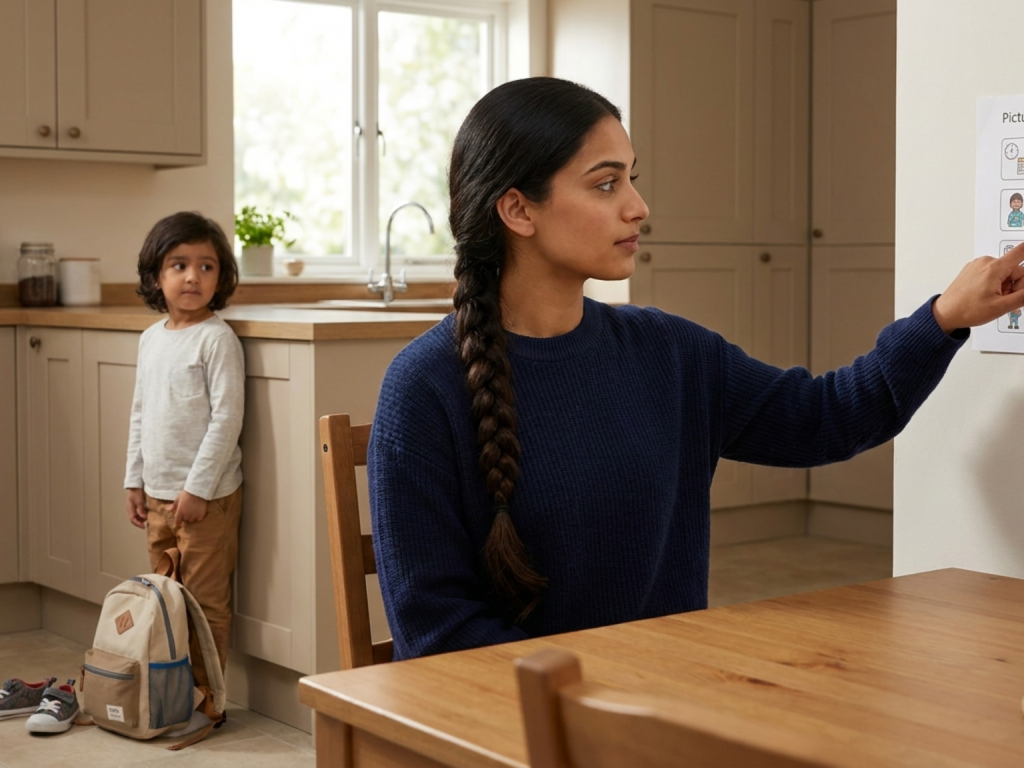
Create a visible plan. For younger children, use pictures or simple drawings; for older children, a short written checklist can work. A Preschool visual schedule can reduce the need for repeated verbal prompting because the child can see what comes next. Keep it concrete: “put pajamas on,” “brush teeth,” “choose two books,” “lights out,” rather than broad words like “bedtime.”
Be realistic about duration. If the morning routine takes 45 minutes on a calm weekend, it will not reliably fit into 20 minutes on a school day. Build in transition time, slow processing time, and a small buffer for spills, lost socks, or emotional protest. A minimum viable routine may be more effective than an ideal routine that collapses under stress.
Useful design principles include:
- Reduce the number of steps: remove nonessential tasks from high-pressure times.
- Put difficult tasks before preferred tasks: for example, teeth before story, backpack before tablet.
- Use stable order: the same sequence lowers cognitive demand over time.
- Give one direction at a time: especially for young children or children with attention, language, or neurodevelopmental differences.
- Post the routine at the point of use: bathroom steps in the bathroom, morning steps near the bedroom or kitchen.
Respond to refusal with validation before direction
When a child says “no,” the adult nervous system often reacts quickly: correcting, persuading, warning, or raising the volume. Yet many children escalate when they feel misunderstood. Validation does not mean agreement or permissiveness; it means naming the child’s experience before holding the boundary.
A helpful sequence is: connect, clarify, then cue the next step. For example: “You really want to keep building. Stopping is hard. The timer rang; now blocks go in the bin.” This approach respects the child’s emotional state while keeping the routine intact. It also models self-regulation rather than turning the routine into a contest of wills.
Keep language brief during distress. A dysregulated child has reduced access to higher-order reasoning, so long explanations often become more noise. Use a calm tone, fewer words, and consistent phrases. For some children, especially those with autistic traits, language processing differences, or high anxiety, pausing between phrases can help. Repetitive, predictable wording may be more effective than new arguments each day.
Offer controlled choices where the boundary remains stable: “Do you want the blue cup or the green cup?” “Walk to the bathroom or hop?” “Brush teeth before or after pajamas?” Avoid choices that are not real. If leaving for school is non-negotiable, do not ask, “Are you ready to go?” Instead say, “It is time to go. Shoes first, then backpack.”
Try not to overuse rewards or threats. Praise effort specifically: “You stopped the game when the timer rang; that was hard and you did it.” Gentle reminders and repeated practice are usually necessary. Most children do not internalize a routine immediately, even when the plan is sensible.
Use transition supports, timers, and sensory-aware adjustments
Refusal often appears at transitions, especially when a child must move from a preferred activity to a less preferred one. Screens, imaginative play, outdoor play, and special interests can be particularly difficult to interrupt because they are highly engaging and neurologically rewarding. Reducing abrupt shifts can prevent many battles.
Use transition warnings that are concrete and consistent: “Five minutes, then bath,” followed by “One minute, then bath.” Timers, music cues, or a short cleanup song can be more neutral than a parent’s repeated reminders. Audiovisual cues work well for many children because they move the signal outside the parent-child power dynamic.
Minimize transitions between fun and boring tasks when possible. For example, in the morning, avoid starting a highly preferred activity before essential tasks are complete. If play must happen, make it brief and structured: “Two minutes of cars, then shoes,” rather than open-ended play that will be painful to stop.
Sensory factors deserve careful attention. A child may refuse routine steps because toothpaste burns, socks have seams, water feels too hot or too cold, the bathroom fan is loud, hair brushing hurts, or the kitchen is visually overwhelming. These are not trivial preferences for a sensory-sensitive child; they can be experienced as genuine distress. Adjustments might include a different toothbrush, unscented products, softer clothing, dimmer lighting, noise reduction, or doing grooming in smaller steps.
For autistic children or children with strong focused interests, incorporating a special interest can increase engagement. A dinosaur-loving child might “stomp” to the bathroom; a train-focused child might follow a “station schedule.” The goal is not to trick the child, but to build a bridge between the child’s motivation and the required task.
When to hold firm and when to revise the plan
Supportive parenting is not the same as unlimited flexibility. Children need predictable routines, and adults need to protect health, safety, school attendance, sleep, hygiene, and family functioning. The art is distinguishing a necessary boundary from an unnecessary battle.
Hold firm on core needs: medication as prescribed by a clinician, car seat or seat belt safety, sleep opportunity, school attendance expectations, basic hygiene, and safety rules. Even then, the method can be compassionate. “I will help your body into the car seat if you cannot do it yourself” is different from shaming or threatening. Physical assistance should be calm, safe, and proportionate, and if restraint or force is becoming frequent, professional guidance is important.
Revise the plan when refusal is predictable, intense, or persistent. If bath time causes a meltdown every night, the answer may not be stricter bath rules; it may be changing the time, water depth, lighting, shampoo, sequence, or frequency according to hygiene needs. If homework refusal happens after a long school day, the child may need food, movement, connection, and a shorter first work interval before academic demands.
Collaborative problem-solving can be powerful with older children. Choose a calm time and say: “Mornings are not working. I want to understand what feels hardest and make a plan that still gets us out on time.” Let the child help create the routine. This increases ownership and may reveal practical barriers adults missed, such as embarrassment about clothing, fear of being late, or difficulty finding materials.
Consistency means the child can predict the adult response. It does not mean the routine can never change. A good routine is stable enough to feel safe and flexible enough to remain humane.
Consider developmental, emotional, and medical contributors
Most routine refusal is common and improves with structure, practice, and emotional support. Still, some patterns deserve closer attention. Refusal that is extreme, sudden, associated with regression, or causing major impairment may reflect more than ordinary resistance.
Possible contributors include anxiety disorders, attention-deficit/hyperactivity disorder, autism spectrum differences, developmental language disorder, learning difficulties, sleep disorders, trauma-related stress, depression, obsessive-compulsive symptoms, chronic pain, gastrointestinal discomfort, or sensory processing differences. This list is not a diagnosis. It is a reminder that behavior can be the visible part of an underlying developmental or health issue.
Seek professional input if refusal is accompanied by loss of previously acquired skills, persistent sleep disruption, school avoidance, panic-like symptoms, aggression that endangers anyone, self-injury, severe food restriction, toileting regression, or marked family distress. A pediatrician can screen for medical contributors and refer to appropriate specialists. A child psychologist, developmental-behavioral pediatrician, occupational therapist, speech-language pathologist, or school support team may help depending on the pattern.
For children with known neurodevelopmental differences, neurodevelopmental routine support should be individualized. Visual supports, simplified language, extra processing time, predictable phrasing, sensory accommodations, and interest-based motivation may be essential rather than optional. Families should not be expected to solve complex behavioral patterns alone, particularly when daily routines are causing repeated distress.
Build cooperation gradually, not perfectly
Parents often feel pressure to fix routine refusal quickly, especially when mornings are late or evenings are exhausting. But routine learning is a developmental process. The aim is not instant obedience; it is helping the child’s brain practice sequencing, emotional regulation, transition tolerance, and shared responsibility.
Choose one routine to improve first. Bedtime, morning departure, homework, and hygiene are common starting points, but trying to overhaul all of them at once can overwhelm everyone. Define success narrowly: “puts pajamas on with one reminder” or “gets shoes after the timer” may be a meaningful first step.
Use rehearsal outside the crisis moment. Practice the backpack routine on Sunday afternoon, or role-play bedtime steps with a stuffed animal. Children learn routines better when their stress physiology is not already activated. Celebrate partial progress and narrate competence: “Yesterday you needed me beside you for every step. Today you checked the chart and did the first two.”
Repair after difficult moments. If everyone yelled, return later and say, “That was hard. I got too loud. Tomorrow we will try the timer and the picture list again.” Repair teaches accountability and reduces shame. It also shows the child that routines are not about parental dominance; they are about helping family life work.
Finally, protect connection. A child who feels connected is not always cooperative, but connection increases the likelihood of cooperation over time. Five minutes of warm attention before a demanding routine can sometimes prevent 30 minutes of resistance. The child still needs the routine; they also need to feel that the adult is on their side.
When to seek urgent or professional help
- Seek urgent help if refusal includes self-injury, threats of self-harm, or behavior that places the child or others in immediate danger.
- Contact a pediatrician if routine refusal appears suddenly with pain, fever, sleep change, appetite change, regression, or marked fatigue.
- Ask for school or mental health support if refusal leads to repeated school avoidance or severe morning distress.
- Consult an occupational therapist or qualified clinician when sensory distress makes hygiene, dressing, eating, or transitions persistently unmanageable.
- If physical force is becoming a regular part of routines, pause and seek professional guidance on safer strategies.
Tools & Assistance
- A one-page visual schedule with pictures or short written steps
- A neutral timer, music cue, or visual countdown for transitions
- A weekly pattern log noting sleep, meals, refused tasks, triggers, and successful supports
- A calm-time family problem-solving meeting for older children
- Pediatrician, child psychologist, occupational therapist, or school support team consultation when refusal is persistent or impairing
FAQ
Should I ignore my child when they refuse a routine?
Ignoring may help for minor stalling, but intense refusal usually needs connection plus structure. Validate feelings, keep directions brief, and guide the next step.
Are rewards a good idea for routine refusal?
Small rewards can help some children, but they should not replace clear routines, realistic expectations, praise for effort, and support for underlying difficulties.
What if my child only refuses routines with one parent?
This is common. The child may associate each adult with different limits, attention patterns, or emotional responses. Align the routine language and expectations between caregivers.
How long should it take for a new routine to work?
Many children need repeated practice over days or weeks. If there is no improvement despite a realistic visual routine and calm consistency, consider professional advice.
Could routine refusal be a sign of autism or ADHD?
It can be associated with neurodevelopmental differences, but refusal alone is not diagnostic. Look at the broader pattern and discuss concerns with a qualified healthcare professional.
Sources
- Understood — Child won't follow a routine or schedule? Try these 5 tips
- Today's Parent — Morning Routine Problems Solved
- Autism Parenting Magazine — Autistic Child Refuses To Do Anything? Here's How to Help
Disclaimer
This article is for informational purposes only and does not diagnose or treat medical, developmental, or mental health conditions. Consult a qualified healthcare professional for concerns about your child’s behavior, safety, development, or health.


















Please log in to leave a comment.