
Intro
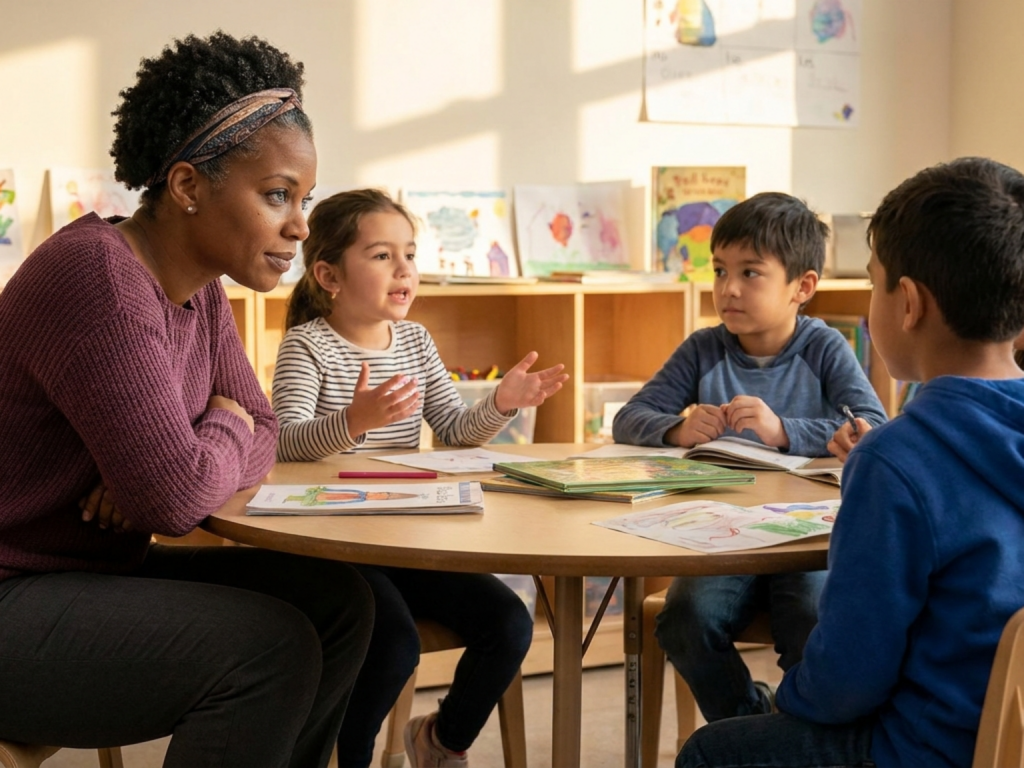
School communication skills are the everyday abilities children use to understand lessons, ask for help, join peer activities, explain ideas, manage conflict, and participate in classroom routines. These skills are not limited to “talking well.” They include listening, expressive language, receptive language, reading, writing, pragmatic language, emotional regulation, and the confidence to communicate across different settings.
Children develop these abilities at different rates, and temporary struggles are common during stress, illness, school transitions, bilingual language development, or changes in family life. A supportive approach focuses on observing patterns, strengthening skills through practice, and seeking professional guidance when concerns are persistent or affect learning, friendships, or wellbeing.
Highlights
School communication includes listening, speaking, reading, and writing, plus the social rules that help children use language with teachers and peers.
Expressive language in early childhood is linked with later school support needs, including speech therapy at kindergarten entry.
Communication difficulties can look like inattention, avoidance, frustration, disruptive behavior, or social withdrawal, not only unclear speech.
Parents, educators, speech-language professionals, pediatricians, and mental health clinicians can work together to understand a child’s needs without blame.
What school communication skills mean
School communication skills are a broad set of neurodevelopmental and learned abilities that allow children to receive information, process it, and respond in ways that match the situation. In school-age children, communication is often described through four core components: listening, speaking, reading, and writing. These are closely connected. A child who struggles to understand spoken instructions may also have difficulty following a written task, telling a story in sequence, or explaining why they are upset.
Listening is more than hearing. It involves auditory attention, working memory, language comprehension, and the ability to filter distractions. Speaking includes articulation, vocabulary, grammar, narrative skills, and the ability to adjust tone or detail depending on the listener. Reading and writing add visual decoding, spelling, sentence structure, organization, and academic language.
Pragmatic language, sometimes called social communication, is another key layer. It includes turn-taking, staying on topic, interpreting facial expression and tone, knowing when to ask for clarification, and using language to negotiate. These skills help children manage group work, playground rules, classroom discussion, and peer disagreement.
It is important to separate skill from motivation. A child who does not answer may not be ignoring adults; they may not have understood the question, may need more processing time, or may feel anxious about speaking in front of others. Supportive adults look for the communication demand underneath the behavior.
Why communication affects learning and confidence
Communication is a foundation for academic participation. Children use language to learn new concepts, describe observations, ask for repetition, explain reasoning, and show what they know. Even subjects that seem less language-based, such as mathematics, require comprehension of directions, word problems, comparison terms, and multi-step explanations.
Research on early communication has shown that stronger expressive language skills at age 3 are associated with a reduced likelihood of needing speech therapy at kindergarten entry. In one study, each standard increase in expressive skills was associated with a 44.8% decreased probability of speech therapy at kindergarten entry. The same study distinguished expressive language from receptive language and found that expressive language was the significant predictor in that model. This does not mean a single score determines a child’s future, but it does emphasize the value of early communication support.
Communication also influences self-esteem. When children can express needs, tell stories, join conversations, and repair misunderstandings, they are more likely to feel competent. When they cannot, they may experience shame, frustration, or avoidance. Some children become quiet; others appear oppositional or silly to escape tasks that require language. Over time, repeated communication failures can affect peer relationships and classroom identity.
For medically literate readers, it may help to think of school communication as an interaction between language systems, executive function, social cognition, emotional regulation, sensory processing, and environmental demands. A child’s performance may vary significantly depending on fatigue, noise, anxiety, teacher style, and task complexity.
How children use communication during a school day
A typical school day is full of communication demands. On arrival, a child may greet adults, interpret schedule changes, and respond to informal peer comments. During lessons, they must listen, inhibit unrelated responses, hold instructions in memory, and contribute at the right time. In group activities, they need to negotiate roles, disagree respectfully, and ask for help before frustration escalates.
Reading and writing create additional demands. A child may understand a concept orally but struggle to write it down because written expression requires planning, spelling, grammar, fine motor or keyboarding skills, and self-monitoring. Another child may decode words accurately but miss implied meaning, figurative language, or the emotional tone of a text.
Social communication differences can become especially visible during unstructured times such as lunch, recess, and transitions. The rules are less explicit, the sensory environment may be louder, and peer language is often fast, joking, or indirect. A child who communicates well one-to-one with an adult may still find group play challenging.
Communication repair is a valuable school skill. Children benefit from learning phrases such as “Can you say that another way?”, “I heard the first part, but not the second,” or “I need a minute to think.” These phrases reduce guessing and help adults identify where comprehension breaks down.
Signs a child may be struggling
Communication difficulties may be subtle. They do not always appear as speech sound errors or late talking. In school-age children, warning signs often appear as patterns across settings, especially when demands increase.
- Frequently misunderstanding instructions, especially multi-step directions.
- Giving very short answers, vague answers, or unrelated responses.
- Difficulty retelling events in order or explaining what happened during conflict.
- Limited participation in class discussions despite knowing the material.
- Frustration, shutdowns, clowning, or refusal during speaking, reading, or writing tasks.
- Trouble joining peer play, staying on topic, or understanding jokes and implied meaning.
- Persistent social withdrawal in children, especially when paired with academic stress or anxiety.
- Writing that is much less developed than spoken ideas, or oral explanations that are much weaker than visual problem-solving.
These signs are not a diagnosis. They can be associated with many factors, including hearing problems, developmental language disorder, speech sound disorder, learning disorders, attention-deficit/hyperactivity disorder, autism spectrum differences, anxiety, trauma exposure, selective mutism, sleep problems, or bilingual language-learning patterns. Vision and hearing should be considered when a child seems not to respond or avoids literacy tasks.
Concern is higher when difficulties are persistent, occur in more than one environment, interfere with friendships or learning, or cause significant distress. A careful evaluation considers the child’s developmental history, language exposure, school context, health status, and emotional wellbeing.
Supportive strategies at home and in the classroom
Children build communication through repeated, meaningful interaction. The goal is not to correct every error, but to create safe practice opportunities with clear models. Adults can model calm conversation by taking turns, naming feelings, asking open questions, and showing how to repair misunderstandings.
Active listening with children is especially powerful. This means giving attention, reflecting the child’s message, and checking understanding before correcting. For example, an adult might say, “You are saying the group changed the rules and you felt left out. Did I understand?” This validates the child while supporting narrative organization and emotional vocabulary.
Classroom strategies can include collaborative learning, structured partner talk, public speaking opportunities that are gradually scaffolded, visual supports, and accessible writing materials. Teachers can make communication expectations explicit: who speaks first, what a good explanation includes, how to ask for help, and how peers should respond.
- Use short, clear instructions, then ask the child to repeat or show the first step.
- Provide wait time after questions, especially for children who process language slowly.
- Pair spoken directions with visual schedules, checklists, or examples.
- Read together and pause to predict, summarize, and discuss characters’ intentions.
- Play communication games that require describing, guessing, sequencing, or giving directions.
- Encourage group activities with defined roles so the child knows how to participate.
Feedback works best when it is specific and encouraging. Instead of “Speak clearly,” an adult might say, “Start with who was there, then tell what happened first.” Instead of “Listen better,” try “Your job is to listen for the two materials we need.”
Working with professionals and the school team
If concerns persist, families can begin by discussing observations with the child’s teacher and pediatric clinician. Useful information includes when the difficulty occurs, what helps, whether the child performs differently at home and school, and whether there are concerns about hearing, sleep, anxiety, attention, or literacy.
A speech-language pathologist can assess speech production, receptive and expressive language, narrative skills, pragmatic language, fluency, and communication repair strategies. Depending on the concern, other professionals may be involved, such as an audiologist, psychologist, occupational therapist, pediatrician, developmental-behavioral pediatrician, or educational specialist.
School-based support may include classroom accommodations, targeted language intervention, speech therapy, literacy support, social communication groups, or broader educational evaluation. The appropriate pathway depends on local systems and the child’s functional needs. Families should not feel pressured to label a child quickly; the priority is to understand barriers and match support to the child’s profile.
Collaboration is most effective when adults share concrete goals. For example, a goal might be: “The child will ask for clarification when directions are unclear,” or “The child will tell a three-part account of a playground event.” Goals like these are observable, teachable, and relevant to daily life.
Protecting emotional safety while building skills
Communication support should never humiliate a child. Public correction, forced eye contact, repeated demands to “use your words” during distress, or comparison with siblings and peers can increase anxiety and reduce participation. Children communicate best when they feel safe enough to try, pause, make mistakes, and try again.
Emotional regulation and listening are closely linked. A child in a high-arousal state may have reduced access to verbal reasoning and working memory. In those moments, the first intervention is often co-regulation: lowering voice volume, reducing language load, offering choices, and allowing time. After the child is calmer, adults can help them reconstruct the event and practice alternative phrases.
For children with social communication differences, explicit teaching can be kinder than expecting them to infer unwritten rules. Scripts, role-play, visual maps of conversation, and rehearsed repair phrases can reduce uncertainty. For children who are shy or anxious, gradual exposure to speaking demands, paired with warmth and predictability, is often more helpful than sudden performance pressure.
Families and schools can celebrate progress in small steps: asking one question, staying in a group for five minutes, writing a clearer first sentence, or telling a story with a beginning and end. These moments are not small to the child; they are evidence that communication can become safer and more successful.
When to seek extra help
- Consult a pediatrician or qualified clinician if a child loses previously acquired speech, language, or social communication skills.
- Seek hearing and vision evaluation when a child frequently misses instructions, seems inattentive, or avoids reading and writing.
- Ask for professional support if communication struggles cause persistent distress, school refusal, aggression, or social isolation.
- Do not assume bilingualism is the cause of major language difficulty; bilingual children can still need assessment and support.
- If a child speaks in some settings but consistently cannot speak in school, discuss anxiety and selective mutism concerns with a qualified professional.
Tools & Assistance
- Teacher-parent communication log focused on specific situations, not blame
- Speech-language pathology evaluation when language, speech, or social communication concerns persist
- Hearing and vision screening through pediatric or school health services
- Visual schedules, checklists, and sentence starters for classroom participation
- Shared reading routine with prediction, retelling, and feeling-word discussions
FAQ
Is school communication only about speaking clearly?
No. It includes understanding language, listening, reading, writing, social communication, emotional expression, and knowing how to ask for help.
Should parents correct every grammar or pronunciation mistake?
Usually no. Frequent correction can make children self-conscious. Modeling the correct form naturally and praising successful communication is often more supportive.
Can a child communicate well at home but struggle at school?
Yes. School has more noise, group dynamics, academic vocabulary, time pressure, and performance demands. Context can strongly affect communication.
When is professional assessment worth considering?
Consider assessment when difficulties are persistent, affect learning or friendships, cause distress, or are noticed by both family and school staff.
Do communication problems mean a child has a disorder?
Not necessarily. Many factors can affect communication. A qualified professional can help distinguish temporary challenges from needs requiring targeted support.
Sources
- National Center for Biotechnology Information (NCBI) / PubMed Central — Early Communication Skills and Special Education Outcomes at Kindergarten Entry
- Corrigan Institute / Virtual Lab School — Communication: School-Age Children
- Achieve Psychology — Helping Children Build Strong Communication Skills
Disclaimer
This article is for general educational information and is not a diagnosis or treatment plan. Consult a pediatrician, speech-language pathologist, psychologist, or other qualified professional for concerns about a child’s communication, learning, or mental health.















Please log in to leave a comment.