
Intro
Teaching empathy to children is not about asking them to be “nice” on command. It is the gradual, developmentally sensitive process of helping a child recognize emotions, understand that other people have separate thoughts and feelings, and choose caring actions even when they are frustrated, disappointed, or unsure what to do.
For medically literate caregivers, it may help to think of empathy as a set of interrelated socio-emotional skills rather than a fixed personality trait. A child draws on emotion recognition, interoception, executive function, language, attachment security, perspective-taking, and behavioral inhibition. These capacities mature over time, and they can be supported through modeling, coaching, play, stories, routines, and repair after conflict.
Highlights
Empathy is teachable. Research on structured instruction, including work with young children with autism, shows that empathy-related behaviors can improve with deliberate teaching and practice.
Children need both emotional safety and clear limits. Warm validation does not mean permissiveness; it helps the child’s nervous system settle enough to learn.
Daily family habits matter more than occasional lectures. Modeling, active listening, gratitude, cooperative tasks, and community involvement make empathy concrete.
Empathy develops unevenly. A child may be caring toward a pet but impulsive with a sibling; this often reflects developmental capacity, stress level, and context rather than moral failure.
What empathy is, developmentally speaking
Empathy is often described as “feeling with” another person, but in children it is more useful to separate it into three related abilities. Affective empathy is the capacity to resonate emotionally with someone else, such as looking worried when another child cries. Cognitive empathy, sometimes called perspective-taking or theory of mind, is the ability to infer that another person may think, want, know, or feel something different from oneself. Compassionate behavior is the action component: offering help, comfort, space, or repair.
These abilities do not appear fully formed. Infants may become distressed when they hear another baby cry, but that is not the same as mature empathy. Toddlers may offer their own comfort object because they cannot yet distinguish what would comfort them from what would comfort someone else. Preschoolers begin to link facial expressions, tone of voice, and situations with feelings. School-age children can increasingly understand mixed emotions, hidden feelings, social rules, and the consequences of their behavior.
Neurodevelopmentally, empathy depends on multiple systems: language comprehension, social attention, emotional regulation, working memory, impulse control, and learned scripts for what to do next. This is why a tired, hungry, overstimulated, or dysregulated child may appear “uncaring” even when they are capable of empathy at other times. The goal is not to shame the child into caring, but to build the neural and relational pathways that make caring behavior more accessible.
Start with modeling: children learn empathy by watching it
Children are highly sensitive to caregiver behavior. They observe how adults speak to servers, respond to a crying baby, talk about neighbors, handle mistakes, and treat the child during difficult moments. Modeling respectful behavior is one of the strongest ways to make empathy visible.
Modeling does not require perfection. In fact, repair after parent-child conflict is often more instructive than a polished lecture. A caregiver might say, “I was frustrated and I spoke too sharply. I’m sorry. You still need to put the toy away, and I’m going to try again in a calmer voice.” This teaches accountability, emotional labeling, and relational repair at the same time.
Children also learn from how their own feelings are handled. Validating a feeling does not mean approving every behavior. “You were angry that your block tower fell. It makes sense to feel upset. I won’t let you throw blocks at your sister.” This combination of empathy and limit-setting helps a child internalize two essential lessons: feelings are understandable, and behavior still has boundaries.
Teach emotion language before expecting mature behavior
A child cannot reliably respond to another person’s distress if they cannot recognize distress. Emotional labeling in children supports self-awareness and social understanding. During ordinary moments, caregivers can name visible cues: “His shoulders are down and he’s quiet; he might be sad,” or “You’re jumping and laughing; your body looks excited.”
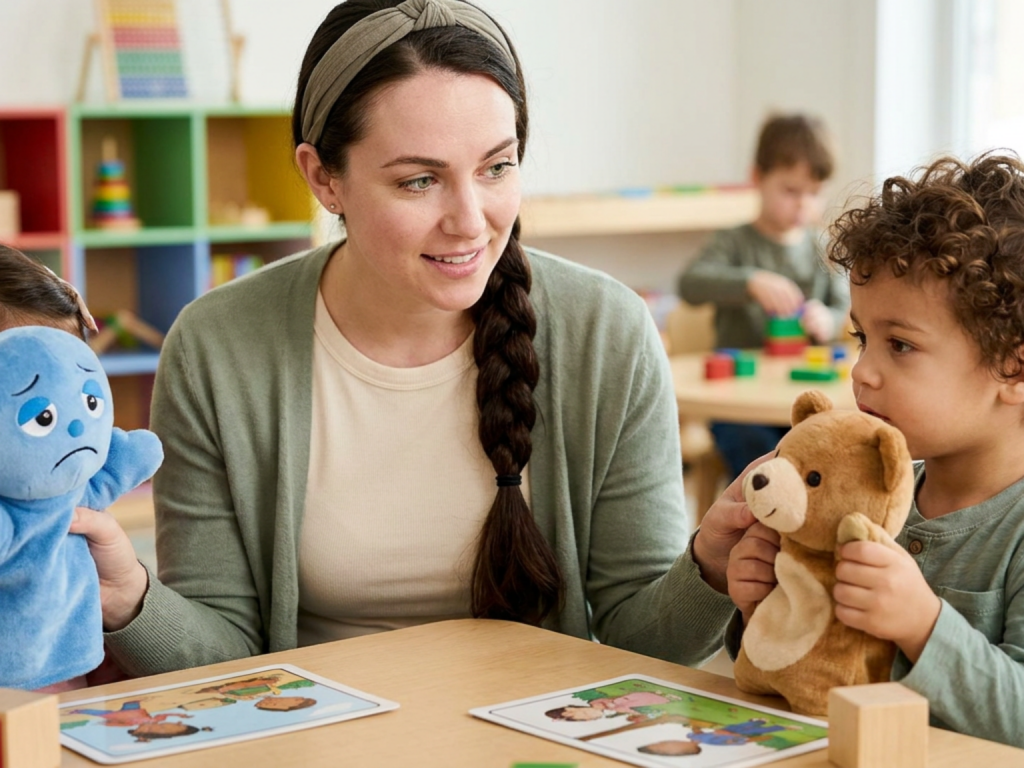
Books, pictures, dolls, puppets, and pretend play are especially useful because they slow down social situations. A caregiver can pause a story and ask, “What do you think she feels?” “How can you tell?” “What might help her?” This form of story talk builds cognitive empathy without putting the child in the spotlight during a real conflict.
Structured teaching can be effective, including for children who need more explicit social instruction. A National Institutes of Health-hosted study on teaching empathy skills to children with autism used tools such as vignettes, dolls, puppets, and pretend play to teach empathy-related responses. The findings support a hopeful and clinically important idea: empathy-related behaviors can be practiced, learned, and generalized beyond the training setting. This does not mean all children learn in the same way, but it does argue against the assumption that empathy is simply present or absent.
Use perspective-taking in small, concrete steps
Perspective-taking is cognitively demanding. It requires the child to inhibit their own viewpoint long enough to consider someone else’s. Young children often need concrete prompts rather than abstract moral questions.
Useful prompts include:
- “What happened from your brother’s point of view?”
- “What did Maya want when she reached for the crayon?”
- “If you were new to the class, what might help you feel included?”
- “What do you know that he doesn’t know yet?”
- “What could we do that is kind and still fair?”
It is important not to force a child to perform empathy while flooded with emotion. During a tantrum or intense sibling conflict, the limbic system and stress physiology may dominate the child’s behavior. First support regulation: reduce stimulation, use a calm voice, ensure safety, and wait. Later, when the child is physiologically calmer, revisit the situation with simple language.
Perspective-taking should not be used to pressure a child into ignoring their own needs. For example, “Think how sad Grandma will be if you don’t hug her” can confuse empathy with compliance. A more balanced script is, “Grandma loves greeting you. You don’t have to hug. Would you like to wave, give a high-five, or say hello?” This teaches care for others while preserving bodily autonomy.
Build helping behavior through practice, not praise alone
Empathy becomes meaningful when children know what to do with it. Some children feel another person’s distress intensely but freeze, laugh nervously, become avoidant, or escalate. They may need explicit behavioral scripts.
Simple helping scripts include:
- “Ask: Are you okay?”
- “Get an adult if someone is hurt.”
- “Offer a tissue, space, or help rebuilding.”
- “Say: I’m sorry I knocked it over. Can I help fix it?”
- “Invite someone who is left out to join, if they want to.”
Caregivers can create repeated low-pressure opportunities for prosocial behavior: feeding a pet with supervision, helping set the table, drawing a card for a sick relative, choosing a toy to donate, or checking on a sibling after a fall. Specific feedback is more useful than global praise. Instead of “You’re such a good child,” try, “You noticed Dad was carrying heavy bags and held the door. That was helpful.”
Gratitude routines can also support empathy. A family might name one person who helped them that day and one way they helped someone else. The point is not forced positivity; it is training attention toward interdependence, effort, and care.
Handle unkind behavior without shaming the child
Children will sometimes lie, grab, exclude, tease, hit, or say something hurtful. These behaviors need limits, but shame rarely teaches empathy well. Shame narrows attention toward self-protection: “I’m bad,” “I’m in trouble,” or “I need to hide this.” Empathy teaching works better when the adult separates the child’s worth from the behavior.
A useful sequence is: stop the behavior, regulate, name the impact, support repair, and plan for next time. For example: “I won’t let you call him that. Take a breath with me. He looked hurt when you said it. What can we do to repair? Next time, you can say, ‘I’m mad that you took my turn.’”
Repair should be meaningful but not theatrical. Forcing an immediate apology can teach children to say words without understanding. A child might instead help rebuild, return an item, draw a repair note, or practice the sentence they can use next time. Over time, genuine apologies can develop from repeated experiences of accountability that preserve connection.
This approach overlaps with gentle parenting and other non-punitive discipline strategies, but it is not the same as having no consequences. Natural and logical consequences may still be appropriate: a toy used to hurt someone is put away, a child who spills intentionally helps clean, or a playdate pauses when safety cannot be maintained.
Adapt empathy teaching for different children
Some children are naturally socially observant; others need direct instruction. Some are temperamentally cautious, highly reactive, sensory-sensitive, language-delayed, or impulsive. Neurodevelopmental conditions, anxiety, trauma exposure, sleep problems, hearing or vision issues, and chronic stress can all affect social-emotional behavior. These factors do not excuse harmful behavior, but they do influence how adults should teach and support.
Children with autism, for example, may care deeply while missing conventional cues such as facial expressions, tone shifts, or indirect requests. They may benefit from explicit teaching, visual supports, role-play, and predictable scripts. Children with attention-related difficulties may understand another person’s feelings after the fact but struggle to inhibit an impulsive action in the moment. Children with anxiety may appear self-focused because threat monitoring consumes cognitive resources.
If a child persistently seems unable to recognize emotions, shows extreme aggression, lacks remorse across many settings, loses previously acquired social skills, or has social difficulties that impair school, friendships, or family safety, caregivers should consult a pediatrician or qualified child mental health professional. The purpose is not to label a child casually, but to assess developmental, sensory, emotional, medical, and environmental contributors and to identify appropriate supports.
Everyday empathy routines that fit real family life
Empathy teaching works best when it is embedded into daily routines rather than saved for crisis moments. Short, repeated practices are more realistic and more developmentally effective than long lectures.
Practical routines include:
- At meals: “Who helped you today? Who did you help?”
- During reading: “What does this character think is happening? What do they not know yet?”
- After school: “Was anyone having a hard time today? What did others do?”
- During conflict: “What were you feeling? What do you think they were feeling? What can repair look like?”
- In the community: involve children in age-appropriate helping, such as making a card, carrying a small item, or participating in a supervised service activity.
Active listening with children is especially powerful. When adults listen before problem-solving, children experience what empathy feels like in the body: being heard, understood, and not immediately judged. That internal experience becomes a template they can gradually offer to others.
Keep expectations realistic. A preschooler may need hundreds of repetitions. A school-age child may understand empathy but still need help applying it under peer pressure. An adolescent may be capable of complex moral reasoning yet still become defensive when ashamed. Empathy is not a one-time lesson; it is a lifelong relational practice.
When to seek professional guidance
- Consult a pediatrician or child mental health professional if aggression is severe, escalating, or creating safety concerns.
- Seek evaluation if a child loses social, language, or emotional skills they previously had.
- Ask for help if social difficulties significantly impair school participation, friendships, or family functioning.
- Do not assume lack of visible empathy means lack of caring; hearing, language, sensory, anxiety, or neurodevelopmental factors may be involved.
- If a child talks about self-harm, harming others, or seems unsafe, seek urgent professional or emergency support.
Tools & Assistance
- Use emotion-labeling during everyday moments, not only during conflict.
- Practice role-play with dolls, puppets, stories, or social scenarios.
- Create a simple family repair routine: calm down, name the impact, fix what can be fixed, plan for next time.
- Ask your pediatrician, school counselor, or child psychologist for guidance if empathy-related concerns are persistent or impairing.
- Use cooperative chores, gratitude rituals, and supervised community helping to make caring behavior concrete.
FAQ
At what age can children learn empathy?
Foundations begin in infancy, but mature empathy develops gradually through childhood and adolescence. Even very young children can learn simple emotion recognition and helping behaviors when adults model and coach them.
Should I make my child apologize immediately?
Not always. Safety and repair matter, but a forced apology may become a script without understanding. It is often better to help the child calm down, understand the impact, and then choose a meaningful repair.
What if my child laughs when someone gets hurt?
Some children laugh from anxiety, surprise, discomfort, or poor social understanding rather than cruelty. Calmly state what happened, teach the expected response, and watch for patterns that may need professional input.
Can empathy be taught to neurodivergent children?
Yes, many neurodivergent children benefit from explicit, structured teaching such as visual cues, role-play, stories, and concrete scripts. Support should be individualized and respectful of the child’s communication and sensory profile.
Is empathy the same as being obedient?
No. Empathy involves understanding and caring about others’ experiences. Obedience is compliance with instructions. A child can be empathic while still needing boundaries, autonomy, and protection from coercion.
Sources
- National Institutes of Health, PMC — Teaching Empathy Skills to Children With Autism
- Children’s Hospital Colorado — Raising a Caring and Empathetic Child: Tips for Families
- Parenting Science — Teaching empathy: Evidence-based tips
Disclaimer
This article is for general educational purposes and is not a substitute for medical, developmental, or mental health advice. Consult a qualified healthcare professional for concerns about your child’s behavior, safety, development, or emotional wellbeing.

















Please log in to leave a comment.