
Intro
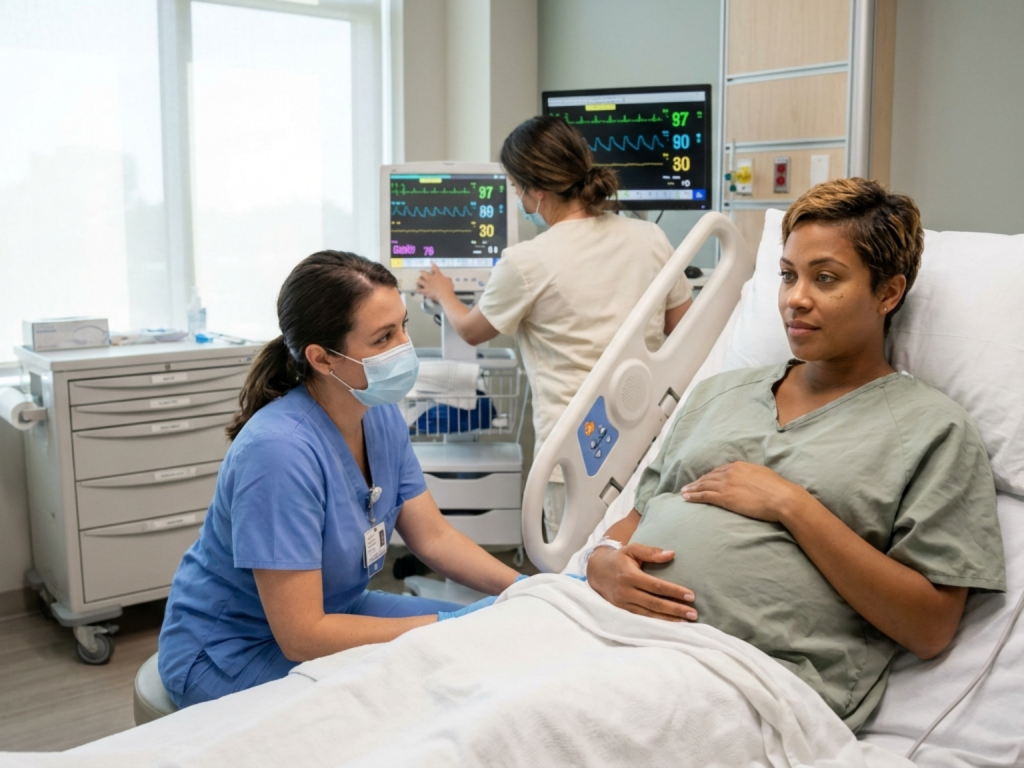
For most people asking whether home or hospital birth is safer, the real question is not simply where labor happens. It is how much clinical risk is present, how quickly help can be delivered if something changes, and how well the birth setting is connected to higher-level care.
For a medically literate reader, the best evidence supports a nuanced answer. In carefully selected low-risk pregnancies, planned home birth can have similar major outcome rates to planned hospital birth in well-integrated systems. But hospitals still offer the broadest safety margin because they provide immediate access to obstetric intervention, neonatal resuscitation, anesthesia, blood products, and emergency surgery.
Highlights
Hospital birth is usually the safer default when risk is uncertain, because escalation is immediate and the full obstetric team is already in place.
In low-risk pregnancies, research has not shown a clear mortality advantage for either planned home birth or planned hospital birth when systems are well integrated.
The safety of home birth depends heavily on careful candidate selection, skilled attendance, and a fast transfer route to hospital care.
Safety is not only about location; it also depends on fetal position, prior cesarean birth, multiple gestation, and other clinical factors.
Accredited birth centers may offer a middle ground for some families, but they still rely on transfer protocols and hospital backup.
What safety means in childbirth
Safety in childbirth is not a single number. It includes perinatal mortality, neonatal morbidity, maternal hemorrhage, shoulder dystocia, unplanned operative delivery, infection, and the time needed to respond to an emergency. A setting can reduce one type of intervention while increasing exposure to delayed escalation if a complication develops.
That is why a birth setting has to be judged against the individual pregnancy. A person with placenta previa, a prior classical cesarean, severe preeclampsia, or a non-cephalic fetus is not comparing two equal options. In those cases, the safer setting is usually the one with immediate obstetric, anesthetic, and surgical capability. For a straightforward low-risk pregnancy, the comparison becomes more balanced, but it still depends on the local care system.
What the evidence shows
The best available evidence does not give a simple universal winner for every low-risk pregnancy. The Cochrane review found that strong randomized evidence favoring either planned hospital birth or planned home birth is lacking, and observational studies are shaped by differences in patient selection and care systems. Some studies report fewer interventions at home, including fewer inductions, epidurals, and continuous monitoring, but fewer interventions are not the same thing as better safety.
A large systematic review and meta-analysis found no overall increase in perinatal or neonatal mortality among low-risk women who intended home birth at labor onset, provided home birth was well integrated into the health system. That qualifier matters. Outcomes were tied to factors such as midwife integration, transfer pathways, and the ability to move quickly to hospital care when the labor course changed.
ACOG’s position is more cautious. It states that hospitals and accredited birth centers are the safest settings overall and emphasizes that planned home birth requires careful selection and a well-resourced system with rapid transport. The practical message is that the evidence does not support blanket claims that home birth is either inherently unsafe or equivalent in every context.
When hospital birth is safer
Hospital birth is the safer choice when the pregnancy is not clearly low risk or when risk becomes dynamic during labor. Examples include hypertensive disorders, diabetes requiring medication, fetal growth restriction, suspected macrosomia with other risk factors, malpresentation, preterm labor, multiple gestation, and a prior uterine scar that may complicate labor management. The threshold for hospital care should also be lower when there is no reliable neonatal team or no immediate transfer infrastructure.
The main advantage of the hospital is not comfort or routine intervention. It is immediate access to emergency cesarean capability, operative vaginal birth if indicated, blood transfusion, anesthesia, and neonatal resuscitation. Those resources matter most in time-sensitive events such as placental abruption, cord prolapse, shoulder dystocia, severe postpartum hemorrhage, or non-reassuring fetal status. In those situations, minutes matter.
For many families, the hospital also reduces uncertainty. If the labor becomes prolonged, fetal monitoring raises concern, or maternal status changes, escalation is already available. That does not mean intervention will occur, only that it can occur without avoidable delay.
When planned home birth can be reasonable
Planned home birth can be a reasonable option for a carefully screened low-risk pregnancy when the birth is attended by a qualified professional and the system around that professional is strong. The literature does not support casual or isolated home birth models. It supports planned care within integrated health systems, where the clinician can identify when the pregnancy remains low risk and can transfer rapidly if it does not.
A suitable home birth plan usually depends on a singleton fetus in cephalic presentation, no major maternal or fetal complications, and a birthing person who understands the tradeoffs. The home setting may reduce the likelihood of some interventions and can be attractive for people who strongly value continuity, privacy, and a low-intervention birth plan. That said, home birth does not remove the possibility of emergency transfer, and transfer is part of the safety model rather than a failure of it.
People sometimes ask whether home birth is safer because it feels calmer. Comfort matters, but calm does not substitute for capacity. The key question is whether the home birth is embedded in a system that can identify trouble early, manage initial stabilization, and move the patient without delay to higher-acuity care.
What makes any setting safer
Several system features have a direct impact on safety, regardless of location. The first is qualified professional attendance. That includes a midwife or clinician who can recognize the difference between normal labor variation and a developing emergency. The second is consistent intrapartum assessment, including fetal assessment when indicated and ongoing maternal monitoring. The third is equipment and medications that can address immediate problems while transfer is arranged.
For home birth, the transfer plan is central. A rapid hospital transfer pathway should be practical, rehearsed, and geographically realistic. The route should not depend on improvisation during an obstetric emergency. A phone call and a car are not enough if the nearest labor unit is far away or if there is no receiving team expecting the transfer.
Postpartum risks also deserve attention. Severe postpartum hemorrhage can develop after apparently uncomplicated births, and the safety advantage of the hospital is often greatest in the first minutes after bleeding begins. At home, a skilled attendant can start initial management, but definitive care may require rapid access to postpartum hemorrhage management in a hospital.
How to decide with your clinician
The most useful decision process starts with risk stratification rather than ideology. Ask whether your pregnancy is truly low risk, whether any risk factors could emerge during labor, and how likely transfer would be if those risks became relevant. If the answer involves uncertainty, hospital birth usually becomes the more defensible choice.
If you are considering home birth, ask detailed questions about the attendant’s training, emergency drugs and equipment, transfer criteria, and prior transfer experience. Ask where the receiving hospital is, how transfer is coordinated, and whether the care team has established relationships with obstetric services. Those details are not administrative trivia; they are part of the safety profile.
Some families may prefer an intermediate option such as accredited birth centers. These settings can preserve a lower-intervention environment while still operating within a formal transfer structure. They are not a substitute for hospital care in higher-risk pregnancies, but they can be a reasonable compromise for selected low-risk patients who want more than a home setting and less than a labor ward.
The bottom line is practical: the safest birth setting is the one that matches the pregnancy’s risk profile and the local system’s ability to respond to trouble quickly.
When to be cautious
- Do not treat home birth as appropriate if there are major obstetric risk factors or an unstable pregnancy course.
- Do not assume that low intervention automatically means lower risk.
- Do not choose a home setting unless emergency transfer is realistic and rehearsed.
- Do not rely on birth setting alone to manage hemorrhage, fetal distress, or neonatal depression.
- Do not make the decision without a qualified obstetric clinician or midwife reviewing the full clinical picture.
Tools & Assistance
- Discuss birth setting and risk factors with your obstetrician, midwife, or maternal-fetal medicine specialist.
- Review the hospital's labor and delivery unit capabilities, including anesthesia, blood bank, and neonatal resuscitation.
- Ask a home birth midwife for the written transfer protocol and receiving hospital plan.
- Check whether local birth centers are accredited and how quickly they can transfer to hospital care.
FAQ
Is home birth safer than hospital birth for low-risk pregnancies?
Not clearly. In well-integrated systems, evidence does not show a consistent mortality advantage for either setting, but the hospital still offers a larger margin if an emergency develops.
Why do medical societies still favor hospital birth?
Because hospitals can respond immediately to obstetric and neonatal emergencies, and that capability matters when risk is uncertain or changes during labor.
Can home birth be safe at all?
Yes, for carefully selected low-risk pregnancies with qualified attendance, reliable monitoring, and fast transfer access. Safety depends on the system around the birth, not only the location.
Are birth centers safer than home birth?
They can be for some people because they provide a structured setting with transfer protocols and often better access to escalation, but they are still not the same as a hospital.
Sources
- American College of Obstetricians and Gynecologists — Committee Opinion No. 669: Planned Home Birth
- Cochrane — Planned hospital birth versus planned home birth
- PLOS Medicine / PubMed Central — Perinatal or neonatal mortality among women who intend at the onset of labour to give birth at home compared to women of low obstetrical risk who intend to give birth in hospital: A systematic review and meta-analyses
Disclaimer
This article is for general information only and is not medical advice. Birth setting decisions should be made with a qualified healthcare professional who can review your individual risk factors and local emergency resources.

















Please log in to leave a comment.