
Intro
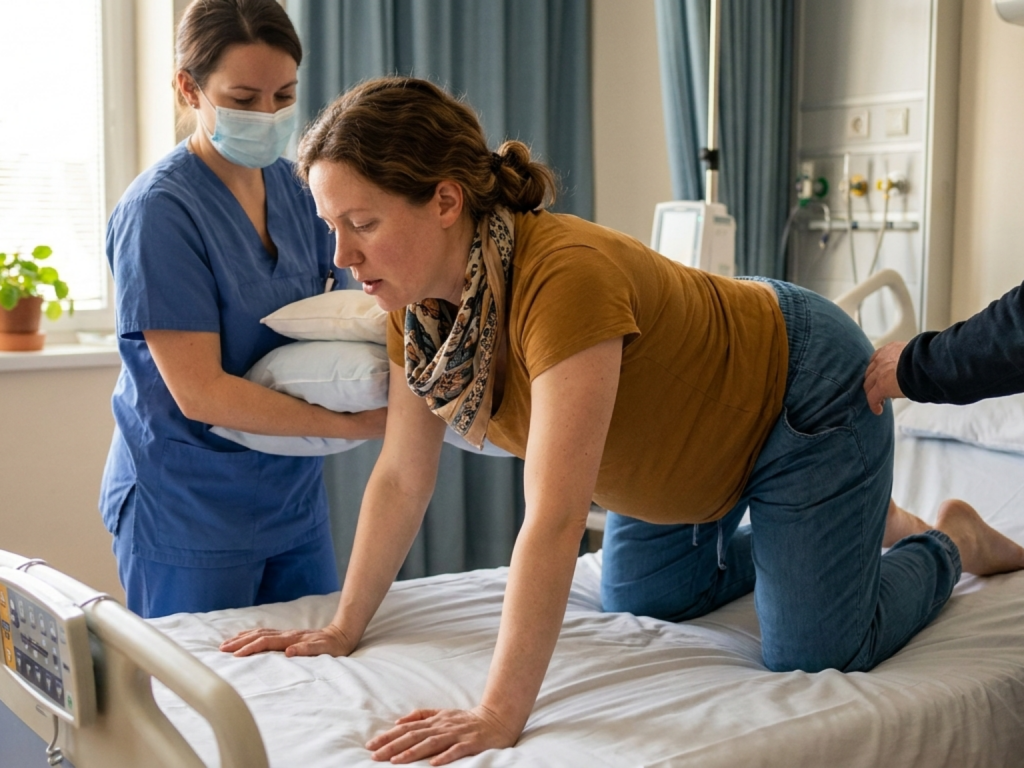
The hands-and-knees position is a simple labor posture that can be useful when a person needs relief from back pain, a change in pelvic mechanics, or a more comfortable way to cope with contractions. It is not a universal answer, and it is not mandatory for any labor pattern. The practical question is whether it fits the moment, the monitoring setup, and the birthing person's comfort.
Used well, it can be a low-risk comfort measure and sometimes a helpful part of labor management. The best approach is usually flexible: try it, assess whether it improves pain or ease of movement, and adjust with the support of the labor team.
Highlights
Hands-and-knees is most often tried in the first stage of labor, especially when back pain is prominent.
It may be particularly helpful when the fetus is in an occipitoposterior fetal position, because that pattern often intensifies back labor.
The position can be adapted on a bed, floor mat, birth ball, or padded surface, with pillows or staff support.
Evidence suggests comfort benefits are real for some people, but it is not a guaranteed way to change labor outcomes.
Mobility, epidural status, fetal monitoring, and IV access all influence how practical the position will be.
When the position is worth trying
Hands-and-knees is most often useful during the first stage of labor, when contractions are building and the person is still exploring positions that reduce pain or make labor feel more manageable. It is especially worth trying when there is strong hands-and-knees position for back labor pain, because pressure in the sacrum and lower back can become the dominant symptom. In that setting, moving off the back may be more relieving than staying upright or supine.
One common scenario is an occipitoposterior fetal position, where the baby’s head is oriented toward the parent’s back rather than the front. This is the kind of labor pattern described in the randomized trial that found reduced persistent back pain and good acceptability. That does not mean the position will turn the baby every time, but it does mean the posture can be a rational comfort strategy when back pain and fetal malposition seem to be part of the picture.
It can also be reasonable to try hands-and-knees simply because the current position has become intolerable. Labor is dynamic. A position that felt fine an hour ago may now feel restrictive, and a short trial of a new posture can reveal whether movement itself helps. The key is not to force it. If the posture worsens pain, strains wrists or knees, or interferes with monitoring, another option may be better.
How to set it up safely and comfortably
The basic posture is straightforward: knees under the hips, hands or forearms under the shoulders, and the spine kept in a neutral or gently relaxed curve. The surface matters. A bed, mattress, floor mat, birthing mat, or even the edge of the bed can work if the birthing environment allows it. Mayo Clinic notes that pillows, folded blankets, or a birth ball can be used to reduce strain and make the position sustainable.
A useful way to think about it is stability first, depth second. The goal is not a perfect yoga shape. The goal is a labor posture that the person can maintain through contractions without extra muscle guarding. If wrists are sore, the person can come down onto forearms. If knees are sensitive, more padding helps. If the back feels better with the chest lower, leaning over a ball or stacked pillows can provide support while preserving the forward-leaning angle.
Many people also use gentle movement once they are down there. Small shifts, swaying, and pelvic rocking during contractions can make the posture feel more active and less static. Those movements are not required, but they may reduce stiffness and give a sense of control. The practical rule is simple: the position should help the person breathe and relax, not create a second set of problems in the shoulders, wrists, or knees.
What the position may help
The most consistent reason people choose this posture is comfort. The randomized controlled trial reported less persistent back pain, and women generally found the position acceptable. That aligns with common labor experience: taking pressure off the sacrum can make contractions easier to tolerate when pain is concentrated in the low back rather than the abdomen alone.
There are also plausible mechanical reasons the posture may help. By shifting weight away from the spine and changing the angle of the pelvis, hands-and-knees may give the fetus more room to rotate or descend. Mayo Clinic also notes that the posture may help open the pelvis and could improve the baby’s oxygen supply, although that should be understood as a potential physiologic benefit rather than a promised outcome. The evidence is not strong enough to treat it as a cure-all.
The most defensible clinical framing is this: hands-and-knees can support labor comfort, may reduce back pain, and may sometimes improve the mechanics of labor. It is low technology and adaptable, which makes it a useful option to have available. But it should be treated as one tool among many, not as a test of whether labor is progressing correctly.
How to use it with epidurals, monitors, or IV lines
A common misconception is that hands-and-knees only works for people who are unmedicated and highly mobile. The review on repeated hands-and-knees positioning during labour shows that the posture can still be used with epidurals, monitoring equipment, or IV lines when the clinical team helps adapt it. In practice, that usually means choosing a supported version rather than a fully unsupported one.
With an epidural, the person may not have enough strength or balance to hold the classic position alone. A nurse, partner, or doula may help with turning, bracing, or repositioning. A supported kneeling setup, leaning over a birth ball, or resting the upper body on pillows can reduce the effort required. The same logic applies to external monitors: if the tracing permits movement, staff may temporarily adjust straps or reposition the transducers so the person can change posture and then reassess the tracing afterward.
When IV access is present, the line itself is usually not the main obstacle, but tubing length and pump placement can be. The practical issue is coordination, not prohibition. Labor teams are used to repositioning around devices. If the posture is giving real relief, it is worth asking whether the equipment can be managed around it rather than abandoning the position immediately.
When to change course
Hands-and-knees should be treated as a trial, not a commitment. If the posture eases back pain, improves relaxation, or makes contractions more tolerable, it can be continued or returned to later. If it does not help after a reasonable attempt, there is no reason to insist on it. Labor comfort is not linear, and a position that works early may stop working later.
There are also times when a different posture is more appropriate. If the person develops wrist pain, knee pain, numbness, dizziness, or worsening fatigue, the team should help transition to another setup. If monitoring becomes difficult or there are concerns about fetal status, clinicians may ask for a different position that allows better assessment. That is a medical coordination issue, not a failure of the posture.
It is also worth being realistic about evidence. Hands-and-knees has supportive data for comfort, and it is widely acceptable, but it does not reliably shorten labor or correct fetal position in every case. The most useful question is not, “Did it fix labor?” It is, “Did it help this person cope and move through labor with less distress?” That is a clinically meaningful outcome in its own right.
A practical decision framework
A sensible way to decide is to use the posture when the pattern suggests it might help and when the environment allows it. Back-dominant pain, suspected fetal malposition, or a strong need to unload the sacrum are good reasons to consider it. So is a simple desire to change pressure points and reset between contractions. The posture can be used briefly, repeatedly, or in combination with other comfort measures such as breathing, massage, or sacral counterpressure.
Before settling in, it helps to ask a few concrete questions: Can the person get down and up safely? Is the bed, mat, or ball stable? Are the monitors compatible with movement right now? Does the person want more active support or more rest? Those questions keep the focus on function rather than idealized labor positions.
In the end, the best use of hands-and-knees is individualized. It is a comfort-first posture with a plausible physiologic rationale and some research support, especially for back labor in first-stage labor. Used with flexibility and professional guidance, it can be one of the simplest ways to make labor more manageable.
When to get clinical guidance
- Ask the labor team before changing position if there are fetal monitoring concerns or movement restrictions.
- Do not persist with the posture if it causes dizziness, severe pain, numbness, or loss of balance.
- Use extra caution with epidurals, because strength and coordination may be reduced.
- If the fetus is being closely monitored, staff may need to help adjust equipment before and after repositioning.
- A posture that helps comfort should still fit the clinical situation and the birthing person's safety.
Tools & Assistance
- Speak with the labor nurse, midwife, or obstetric clinician about whether the position is suitable right now.
- Use a birth ball, pillows, folded blankets, or a padded mat to reduce pressure on wrists and knees.
- Ask support people to help with timing, balance, and transitions between positions.
- Request a quick reassessment if the posture no longer improves pain or becomes physically tiring.
FAQ
Is hands-and-knees best for everyone in labor?
No. It is often helpful for back pain or fetal malposition, but some people prefer upright, side-lying, or kneeling positions.
Can it be used with an epidural?
Often yes, but usually in a supported form and with staff assistance because balance and leg strength may be limited.
Does it always turn the baby?
No. It may help with comfort and sometimes labor mechanics, but it is not a guaranteed way to rotate the fetus.
How long should it be tried?
There is no fixed time. A short trial is reasonable, then the position can be continued, modified, or stopped based on comfort and clinical guidance.
Sources
- PubMed — Randomized controlled trial of hands-and-knees positioning during labor
- Mayo Clinic — Labor positions
- PubMed Central — Repeated hands-and-knees positioning during labour
Disclaimer
This article is for general information only and does not replace individualized medical advice, diagnosis, or treatment. Labor position choices should be reviewed with qualified maternity care professionals.

















Please log in to leave a comment.