
Intro
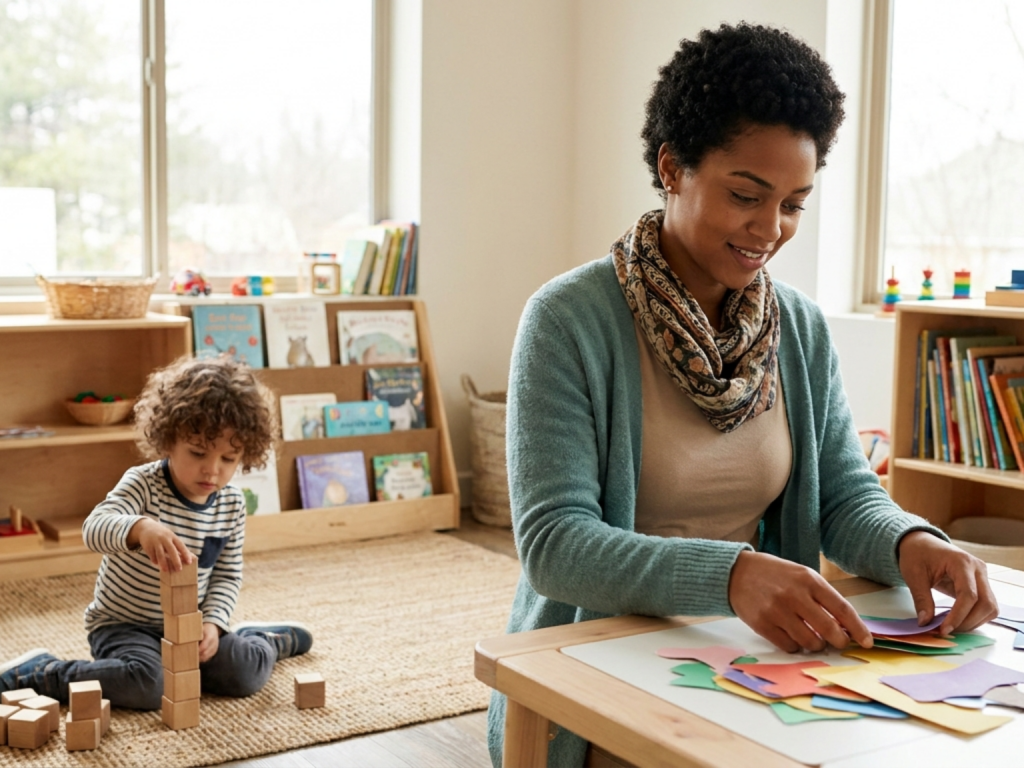
Independent play is not the same as ignoring a child or expecting them to manage beyond their developmental capacity. It means giving a child safe, age-appropriate space to explore, imagine, problem-solve, and tolerate small frustrations while a caring adult remains available in the background.
For many parents and caregivers, independent play can bring up mixed feelings: relief, guilt, uncertainty, or worry that a child will feel lonely. In reality, when introduced gently and safely, independent play can support cognitive, emotional, social, and motor development while also protecting family routines and caregiver wellbeing.
Highlights
Independent play helps children practice self-regulation, sustained attention, problem-solving, and emotional flexibility.
The adult role is not to disappear, but to provide safety, predictable boundaries, and developmentally appropriate materials.
Short, successful play periods are more helpful than long sessions that overwhelm a child.
Some children need extra support because of temperament, neurodevelopmental differences, anxiety, sensory sensitivities, or medical needs.
What independent play really means
Independent play is child-led activity in which the child chooses what to do, how to do it, and when to shift direction, within safe limits set by an adult. It may look like a toddler filling and dumping cups, a preschooler creating a pretend restaurant, or a school-age child building a complex block structure. The defining feature is not solitude; it is autonomy. A child may play independently while a parent cooks nearby, while another child plays in the same room, or during quiet time after school.
This kind of play sits on a continuum. At one end is co-regulated play, where an adult closely supports attention, language, and emotional regulation. In the middle is guided play, where the adult sets up the environment and occasionally scaffolds learning. At the more autonomous end is independent play, where the child carries most of the mental work: planning, experimenting, self-correcting, pretending, persisting, and deciding when to stop.
Independent play is not a test of obedience or maturity. A baby cannot be expected to entertain themselves for long. A toddler may need frequent reassurance. A child with developmental delay, chronic illness, sensory processing differences, autism, attention-deficit/hyperactivity disorder traits, anxiety, or trauma exposure may need more structure and adult proximity. The goal is not to create a child who never needs adults; it is to help the child gradually internalize skills that adults first provide from the outside.
Why independent play supports the developing brain
Play is biologically serious work. Pediatric and developmental research describes play as a powerful context for healthy brain development, resilience, and social-emotional growth. During independent play, children repeatedly practice executive function: working memory, inhibitory control, cognitive flexibility, planning, and attention shifting. These are the same neurocognitive systems that later support classroom learning, frustration tolerance, peer negotiation, and self-care.
Free play predicts self-regulation years later in longitudinal evidence, especially when adults protect children’s autonomy and choice. This is clinically meaningful because self-regulation includes impulse control, emotional modulation, and sustained attention. A child who decides how to use blocks, adapts when a tower falls, and tries again is rehearsing a small version of coping with everyday stress.
Independent play also supports symbolic thinking. When a cardboard box becomes a boat or a stuffed animal becomes a patient, the child is using representational thought, language, sequencing, and emotional processing. Pretend play and emotional regulation often overlap: children may act out separations, medical visits, sibling rivalry, fears, or caregiving roles in ways that help them metabolize experience.
Importantly, play does not need to be academically packaged to be beneficial. A child sorting stones, inventing rules for toy animals, or making a blanket fort may be integrating sensory information, spatial reasoning, motor planning, and narrative thinking. The adult may not see a measurable product, but the child’s nervous system is actively learning.
How independent play changes by age
Expectations should match developmental stage. In infancy, independent play may be only a few minutes of looking at a mobile, mouthing a safe teether, or reaching for objects during tummy time while an adult watches closely. The infant’s capacity for independent attention is brief, and responsive caregiving remains essential.
In toddlerhood, independent play is often repetitive and sensory-rich. Toddlers may line up cars, transfer objects between containers, scribble, stack, knock down, and repeat. This is not meaningless behavior. Repetition helps toddlers consolidate motor patterns, cause-and-effect learning, and early problem-solving. Many toddlers are also in a stage of parallel play, where they play beside other children rather than truly with them.
Preschoolers usually show longer pretend sequences and more elaborate problem-solving. They may create stories, negotiate imaginary roles, and use open-ended toys for toddlers and preschoolers, such as blocks, scarves, animal figures, art materials, and pretend household items. Preschoolers still need supervision because judgment, impulse control, and hazard awareness are immature.
School-age children may use independent play for deeper construction, reading, creative writing, outdoor exploration, sports practice, crafts, or invented games. At this age, independent play begins to connect with Independent learning skills kids need later: planning, monitoring progress, tolerating boredom, and using materials without constant adult prompting. However, school-age children still benefit from unstructured time that is not performance-based or overscheduled.
The adult role: safety, connection, and autonomy
Independent play works best when it grows from secure connection. Children are more willing to explore when they trust that a caregiver is emotionally available. A simple rhythm can help: first connect, then step back. For example, spend five minutes joining the child’s play, describe what you notice, then say, “I’m going to fold laundry nearby while you keep building.” This approach reassures the child without taking over.
The adult’s main tasks are to prepare the environment, reduce hazards, and protect the child’s right to lead. This may include rotating toys, limiting overwhelming clutter, setting up safe zones, and choosing materials that can be used in multiple ways. Open-ended items usually support longer engagement than toys that perform a single scripted function.
Helpful adult behaviors include:
- Staying nearby for younger children or children who need more co-regulation.
- Using brief observations rather than constant questions, such as “You made the bridge taller.”
- Allowing mild frustration before stepping in, as long as the child is safe and not becoming overwhelmed.
- Offering one small prompt if needed, then returning control to the child.
- Avoiding the urge to correct the child’s play unless safety or respect is at risk.
Independent play is undermined when adults micromanage, quiz constantly, or turn every activity into a lesson. It can also be undermined by excessive praise that shifts the child’s attention from intrinsic curiosity to adult approval. Warm interest is valuable; constant evaluation is not necessary.
How to build independent play gently
If a child is used to continuous adult participation, start small. A realistic first goal may be two to five minutes, not an hour. Predictability helps the nervous system: “I will sit here while you start your puzzle, then I will make tea, and I’ll come back when the timer rings.” A visual timer, song, or routine cue can make time feel more concrete.
Choose the right moment. Independent play is harder when a child is hungry, tired, overstimulated, ill, or needing attachment reassurance. Many children do best after a period of connection, a snack, and a clear transition. Morning or early afternoon may be easier than late evening, when fatigue reduces emotional regulation.
A simple progression can look like this:
- Play together briefly and help the child become engaged.
- Move into a nearby observing role without directing.
- Step away for a short, specific task while staying within safe range.
- Return before the child is distressed when possible, so separation feels successful.
- Gradually lengthen the interval as the child’s confidence grows.
Some children engage better with fewer choices. Instead of asking, “What do you want to do?” offer two safe options: blocks or drawing, sensory bin or toy animals. Others need a “play invitation,” such as a few blocks arranged as a bridge or a small tray with paper, crayons, and stickers. The invitation should spark ideas without dictating an outcome.
Screen time is not the same as independent play, although families may use screens at times. Digital media often supplies rapid stimulation and external structure, while independent play asks the child to generate ideas, regulate pace, and tolerate pauses. If screens are part of family life, it may help to protect some daily non-screen play time for slower, self-directed exploration.
Common barriers and when to seek support
Difficulty with independent play is common and usually not a sign that anything is “wrong.” Some children have more intense attachment needs, lower frustration tolerance, high sensory seeking, sensory avoidance, language delays, sleep problems, or anxiety. Family stress, recent moves, a new sibling, parental illness, bereavement, or changes in childcare can also temporarily reduce a child’s ability to separate and play alone.
It is worth seeking professional guidance if a child shows persistent loss of previously acquired play skills, very limited interest in people or objects, absence of pretend play when developmentally expected, extreme distress with brief caregiver distance, frequent aggression during ordinary play, or marked sensory responses that interfere with daily life. Parents should also discuss concerns if play is repeatedly disrupted by pain, fatigue, breathlessness, seizures, motor regression, feeding problems, sleep disturbance, or developmental delays.
A pediatrician, health visitor, developmental-behavioral pediatrician, child psychologist, occupational therapist, speech-language pathologist, or early intervention service may help clarify what support is appropriate. This does not mean labeling a child unnecessarily. It means understanding the child’s developmental profile and reducing avoidable stress for both the child and family.
For many families, the most compassionate approach is incremental. Independent play is not a moral achievement; it is a developmental capacity shaped by brain maturation, temperament, relationships, environment, and health. A child who needs more adult support today may still grow into rich independent play with time, safety, and responsive scaffolding.
When to be more cautious
- Never leave babies, toddlers, or medically vulnerable children unsupervised in unsafe environments.
- Seek medical advice for regression, persistent lethargy, pain, seizures, breathing difficulty, or sudden changes in behavior.
- Ask for developmental guidance if a child has very limited play, no emerging pretend play, or persistent social communication concerns.
- Avoid using independent play as punishment or forced isolation.
- If separation causes severe distress, build gradually and consider professional support.
Tools & Assistance
- Create a safe play zone with age-appropriate, open-ended materials.
- Use a short visual timer to make independent play predictable.
- Rotate a small number of toys to reduce overstimulation.
- Speak with a pediatrician or early intervention service if play concerns persist.
- Schedule daily non-screen play time when the child is rested and fed.
FAQ
How long should a child play independently?
It depends on age, temperament, health, and practice. Some toddlers manage only a few minutes, while older children may play much longer. Start with short, successful periods.
Is independent play harmful if my child wants me nearby?
No. Many children need adult proximity while they build confidence. Being nearby without directing the play can still support autonomy.
What toys are best for independent play?
Open-ended materials such as blocks, dolls, animal figures, art supplies, sensory bins, simple vehicles, books, and pretend play objects often encourage creativity and sustained attention.
Should I worry if my child does not like playing alone?
Not automatically. Consider age, stress, sleep, hunger, and temperament. If concerns are persistent, intense, or accompanied by developmental or medical red flags, consult a healthcare professional.
Sources
- ScienceDirect — Free play predicts self-regulation years later: Longitudinal evidence
- American Academy of Pediatrics — The Power of Play: A Pediatric Role in Enhancing Development in Children
- National Institute for Play — The Science of Play: Neuroscience & Research
Disclaimer
This article is for general educational purposes and does not replace medical, developmental, or mental health advice. Consult a qualified healthcare professional for concerns about your child’s development, behavior, or safety.

















Please log in to leave a comment.