
Intro
Walking, swaying, rocking, and using a birthing ball are simple forms of movement that can support comfort and physiologic progress during labor. They are not magic techniques, and they do not replace skilled clinical care, but they can help many birthing people feel more active, grounded, and responsive to contractions.
For a medically literate reader, these strategies make sense because labor is dynamic: the uterus contracts, the cervix effaces and dilates, the fetus rotates and descends, and the pelvis changes shape with posture. Movement may influence pain perception, fetal positioning, pelvic dimensions, maternal circulation, and emotional coping, while still needing to be adapted to maternal and fetal status.
Highlights
Upright and mobile labor positions are associated in the evidence base with shorter labor, less pain, fewer interventions, and greater satisfaction for many people.
Swaying and rocking can provide rhythmic, nonpharmacologic sensory input that may make contractions feel more manageable.
A birthing ball can support pelvic mobility, forward-leaning rest, and gentle movement when standing or walking becomes tiring.
Movement should be individualized, especially with epidural analgesia, fetal monitoring, dizziness, bleeding, preeclampsia, or other clinical concerns.
The most useful labor position is often the one that feels safe, sustainable, and adaptable from one contraction to the next.
Why movement matters in labor
Labor is not only a cervical process; it is also a musculoskeletal, neurologic, circulatory, and emotional process. During contractions, the uterus applies downward and rotational force to the fetus, while the cervix softens and opens. At the same time, the pelvis is not a fixed ring. Maternal posture can change the relationship between the sacrum, coccyx, pelvic inlet, midpelvis, and outlet. This is one reason movement during natural childbirth and medically supported labor can feel intuitive rather than decorative.
Evidence summarized in maternity-care literature supports encouraging people to walk, move around, and change positions throughout labor when it is safe to do so. Upright positions in labor use gravity, may reduce pressure on major maternal blood vessels compared with flat supine positioning, and may help the birthing person feel less confined. Many people also report that being able to choose positions increases confidence and satisfaction, even when pharmacologic pain relief or continuous monitoring is also used.
The goal is not constant activity. Labor movement is most effective when it alternates with rest. A person may walk between contractions, lean forward during contractions, sit on a birth ball for a few minutes, then move to side-lying or hands-and-knees. The benefit often comes from responsiveness: changing the mechanical and sensory input as labor changes.
Walking and upright mobility
Standing and walking during labor are among the most recognizable upright and ambulant positions. In early labor, walking can help some people manage discomfort, reduce the sense of waiting, and use contractions productively without feeling trapped in bed. The combination of gravity, alternating hip movement, and gentle weight shifting may support fetal descent and encourage the baby to negotiate the pelvis.
From a physiologic perspective, walking produces repeated asymmetrical pelvic motion. Each step involves hip flexion, extension, rotation, and subtle sacroiliac movement. This can be useful when the fetus is rotating from a less favorable position toward a more efficient flexed and anterior position. Walking may also help the birthing person assess contraction rhythm, hydration needs, fatigue, and coping capacity.
In active labor, walking may become less appealing, but upright mobility can still be adapted. Short trips to the bathroom, standing beside the bed, slow pacing, or leaning into a partner may provide enough movement without exhausting the person in labor. With mobility-compatible fetal monitoring, intravenous access, or an epidural that still allows supported movement, the care team can help preserve some mobility while maintaining safety.
Walking is not appropriate for every situation. It may be limited by significant dizziness, heavy bleeding, nonreassuring fetal status, severe hypertension symptoms, ruptured membranes with concern for cord prolapse, dense neuraxial blockade, or clinician-recommended bed rest. The practical question is not whether walking is universally good, but whether it is safe and useful in the specific clinical moment.
Swaying and rhythmic comfort
Swaying is often a low-effort alternative to walking. A person may stand with feet apart, hold a partner, lean over the bed, or place hands on a wall while shifting weight from side to side. This rhythmic movement can feel stabilizing because it gives the nervous system a predictable sensory pattern during contractions. Rhythmic motion is commonly used in pain coping because it competes with threat-focused attention and can support breathing cadence.
Swaying can also reduce the stillness that makes contractions feel more intense. When pain peaks, many people instinctively move the pelvis in small arcs, circles, or figure-eight patterns. These movements may reduce guarding in the pelvic floor, lower back, gluteal muscles, and hip rotators. Less guarding does not mean labor is painless, but it may help the body work with contractions rather than resisting them.
For back labor, swaying while leaning forward may be especially useful. Forward-leaning labor positions can shift abdominal weight away from the spine, make room for sacral counterpressure, and encourage the fetus to rotate. A partner, doula, nurse, or midwife can apply firm pressure to the sacrum during contractions if that feels helpful and is approved within the care setting.
Because swaying is easy to stop quickly, it is often compatible with many clinical environments. Even a person who cannot walk freely may be able to sway beside the bed, sit and sway, or perform small pelvic circles with support. The key is stability: non-slip socks or shoes, a steady surface, and someone nearby if balance is uncertain.
Rocking, pelvic motion, and birth balls
Rocking is another form of rhythmic movement that can be done standing, sitting, kneeling, or using equipment. Mayo Clinic guidance describes gentle rocking on a sturdy chair, bed edge, or birthing ball as a practical labor comfort measure. Pelvic rocking during contractions may help the birthing person stay engaged with the contraction wave while avoiding rigid bracing.
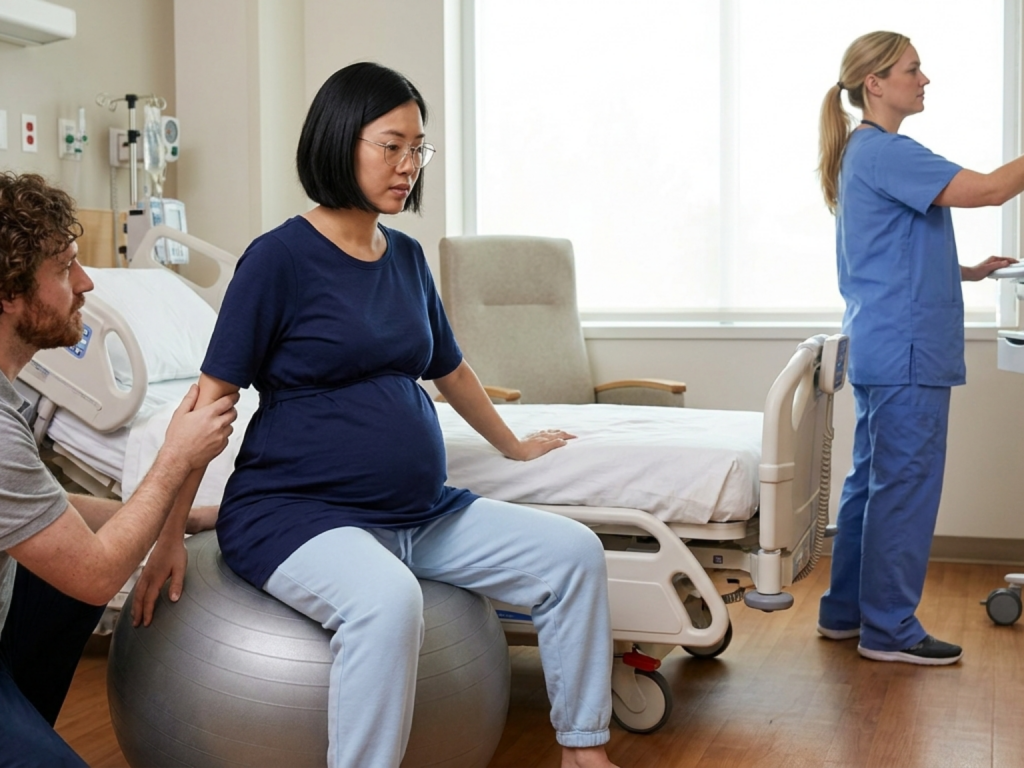
Birth ball positions in labor can be particularly useful because the ball supports upright sitting while allowing the pelvis to move. Sitting on a properly sized, anti-burst birthing ball allows gentle bouncing, anterior-posterior tilting, side-to-side rocking, and circular pelvic motion. This can combine the benefits of upright sitting for fetal descent with less leg fatigue than standing. The ball also makes it easier to lean forward over a bed, table, or support person, which may reduce lumbar pressure and encourage pelvic relaxation.
A birthing ball can also serve as a tool for rest. Labor is physically demanding, and standing for long periods may be unrealistic. Sitting on the ball between contractions, leaning the upper body onto stacked pillows, or kneeling while hugging the ball can provide a middle ground between activity and recovery. These options may be helpful for people who want mobility but need to conserve energy.
Safety matters. The ball should be the right height so the hips are at least level with, and often slightly higher than, the knees. It should be placed on a non-slip surface, kept away from clutter, and used with a support person nearby if the laboring person feels unsteady. A birthing ball is a mobility aid, not a substitute for clinical assessment, fetal monitoring when indicated, or assistance after medications that affect strength or balance.
Pain modulation and emotional control
Walking, swaying, rocking, and birth ball use are nonpharmacologic pain strategies. They do not block nociceptive input in the way neuraxial analgesia can, but they may change how pain is experienced. Labor pain is influenced by tissue stretch, uterine ischemia during contractions, cervical dilation, pelvic pressure, fear, fatigue, and prior experience. Movement can reduce the feeling of being immobilized and may support a sense of agency, which is clinically meaningful even when pain remains intense.
Rhythmic movement can pair well with breathing, vocalization, massage, hydrotherapy, heat, cold, sterile water injections for selected back pain, or pharmacologic options. Some people use movement to delay or reduce medication; others use movement before, during, or after medication. These are not competing philosophies. A person with an epidural may still benefit from position changes after epidural analgesia, including supported side-lying, sitting, peanut ball use, or assisted upright positioning if permitted by the care team.
Movement also helps caregivers read labor coping. A person who becomes suddenly unable to move, talk, breathe rhythmically, or recover between contractions may need additional support, evaluation, or pain relief options. Conversely, a person who finds a repetitive rocking pattern may appear calmer because the body has found a workable rhythm. Supportive care means observing, asking, and adjusting without forcing any single technique.
Emotional control should not be interpreted as quietness. Some people sway silently; others vocalize deeply, grip a support person, or change positions frequently. The clinical aim is not performance. It is safety, progress when possible, and coping that respects the person’s preferences and medical circumstances.
Supporting fetal rotation and descent
Fetal descent is not a straight vertical drop. The fetus flexes, rotates, descends, and extends through the pelvis in response to uterine contractions, pelvic shape, soft tissue tone, and maternal position. Movement may help by changing available pelvic space and by varying pressure on the cervix. Lamaze education notes that movement, rocking, rubbing, swaying, squatting, and position changes may help babies rotate and descend more effectively.
For example, walking creates alternating pelvic motion, while swaying can encourage lateral mobility. Rocking on a ball can mobilize the sacrum and hips without requiring continuous weight-bearing. Forward leaning can reduce sacral pressure and may be useful when the fetus is occiput posterior or when the birthing person feels intense back pressure. These strategies are supportive, not diagnostic; fetal position concerns should be evaluated by qualified clinicians.
In early and active labor, upright positions during labor may improve comfort and help contractions feel purposeful. During pushing, the best position may change depending on fetal station, maternal energy, epidural density, fetal heart rate patterns, perineal support needs, and clinician guidance. Sitting, side-lying, kneeling, supported squatting, or semi-recumbent positions can all be appropriate in different contexts.
Movement can also be combined with other modalities. Some people alternate birth ball work with warm showers, water immersion during labor, side-lying rest, or hands-and-knees positioning. The pattern should remain flexible: if a position increases pain in a concerning way, worsens dizziness, or interferes with monitoring or urgent care, the plan should change promptly.
Practical setup and clinical caution
A useful movement plan begins before labor becomes intense. People can ask their clinician or birth setting what equipment is available, whether wireless monitoring is offered, how mobility works after epidural placement, and whether birthing balls are provided or must be brought from home. If bringing a ball, it should be anti-burst, properly inflated, and sized to the person’s height.
During labor, the simplest sequence is often best: walk when contractions are mild enough, sway or lean when they intensify, sit or rock on the ball when legs tire, then rest in a side-lying or supported position. Hydration, bladder emptying, and energy conservation are part of safe mobility. The support team should watch for fatigue, loss of balance, nausea, pallor, excessive pain between contractions, or changes in bleeding or fetal status.
Movement should always be coordinated with clinical recommendations. People with high-risk pregnancies, preeclampsia, placenta concerns, significant bleeding, fetal heart rate abnormalities, induction medications requiring closer monitoring, or restricted mobility after anesthesia may need modified positions. Even then, complete immobility is not always necessary; supported repositioning in bed may provide some of the same benefits without unsafe walking.
The central message is compassionate flexibility. Walking, swaying, rocking, and birthing ball use can support labor physiology and emotional coping, but they should remain tools rather than rules. A safe birth environment honors both bodily intuition and medical information.
When to pause movement
- Seek immediate clinical guidance for heavy bleeding, severe headache, visual symptoms, chest pain, fainting, or sudden shortness of breath.
- Do not walk unassisted after medications, epidural analgesia, dizziness, leg weakness, or any loss of balance.
- Stop using a birthing ball if it feels unstable, slides, is underinflated, or cannot be supervised safely.
- Follow clinician guidance if fetal monitoring, induction medications, hypertension, placenta concerns, or fetal heart rate changes require modified mobility.
- Report severe continuous pain, fever, abnormal discharge, or a major change in fetal movement before or during labor.
Tools & Assistance
- Discuss mobility preferences with an obstetrician, midwife, or labor nurse before active labor.
- Ask the birth facility about birthing balls, wireless fetal monitoring, showers, tubs, and epidural mobility policies.
- Practice supported swaying, forward leaning, and ball sitting during late pregnancy if cleared by a clinician.
- Use a properly sized anti-burst birthing ball on a non-slip surface with support nearby.
- Invite a partner, doula, or support person to help with balance, counterpressure, hydration, and position changes.
FAQ
Can walking really make labor shorter?
Evidence on upright and ambulant labor positions suggests they are associated with shorter labor for many people, but individual results vary and depend on medical context, fetal position, contraction pattern, and fatigue.
Is a birthing ball safe during labor?
A birthing ball can be safe when it is sturdy, properly sized, placed on a non-slip surface, and used with support as needed. It should be avoided or modified if balance, anesthesia, monitoring, or clinical status makes it unsafe.
Can I use these movements with an epidural?
Often, yes, but mobility depends on epidural density, leg strength, facility policy, and monitoring needs. Many people can still use assisted position changes, sitting, side-lying, or bed-based pelvic support.
What is better: walking, swaying, rocking, or sitting on a ball?
No single option is best for everyone. Walking may help early labor, swaying may help contraction coping, rocking may ease back or pelvic tension, and a birthing ball may support upright rest and pelvic mobility.
When should I stop moving and call for help?
Stop and get help for dizziness, faintness, heavy bleeding, severe continuous pain, sudden weakness, concerning fetal monitoring changes, or any instruction from the clinical team to pause movement.
Sources
- PubMed Central — Healthy Birth Practice #2: Walk, Move Around, and Change Positions Throughout Labor
- Mayo Clinic — Labor positions
- Lamaze International — Healthy Birth Practice: Walk, Move Around and Change Positions Throughout Labor
Disclaimer
This article is for informational purposes only and does not replace medical advice, diagnosis, or treatment. Always follow guidance from your obstetrician, midwife, or labor care team for your specific pregnancy and birth setting.
















Please log in to leave a comment.