
Intro
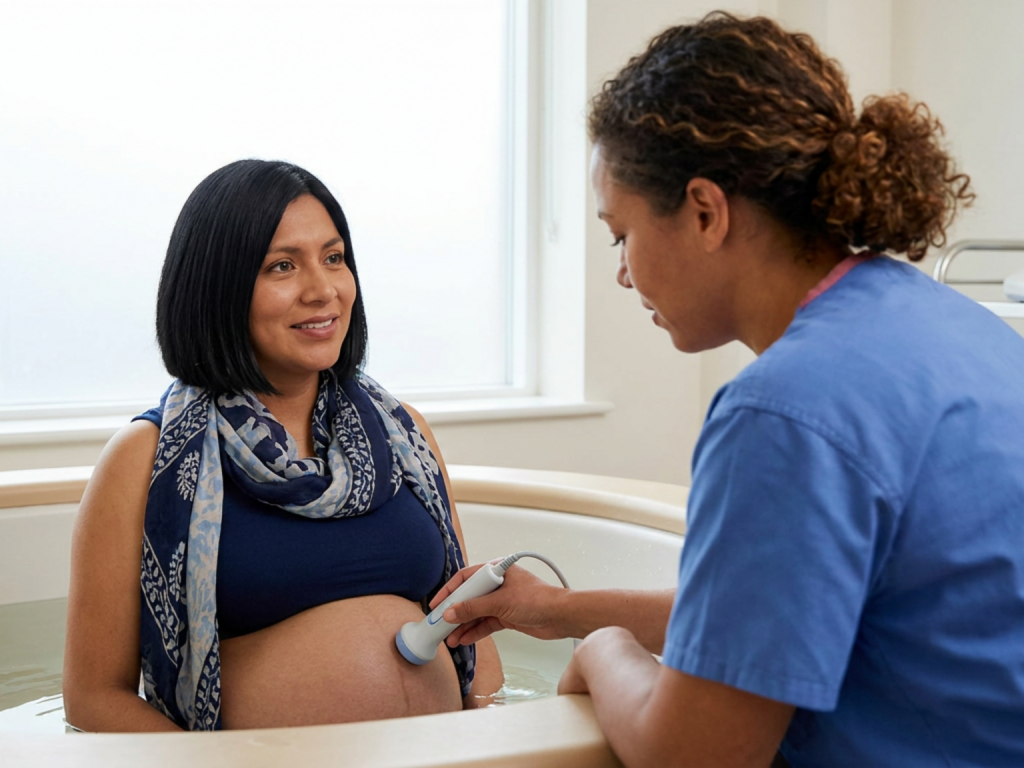
Water birth positions combine two forms of physiologic support: immersion in warm water and freedom to move into postures that feel protective, spacious, and effective. For many laboring people, the tub becomes a place where contractions feel more manageable and the body can shift between kneeling, squatting, side-lying, or hands-and-knees with less strain.
Safety depends on careful selection, skilled clinical attendance, infection-control practices, continuous assessment, and a clear plan for leaving the tub if concerns arise. The evidence is encouraging for water immersion in the first stage of labor, while professional guidance is more cautious about actual underwater birth, especially because high-quality randomized data for the second stage are limited.
Highlights
Warm-water immersion may reduce pain perception, support relaxation, and decrease the need for epidural or other pharmacologic analgesia in appropriately selected labors.
Water can make position changes easier by buoyancy, especially kneeling, supported squatting, hands-and-knees, and side-lying positions.
Safety planning includes eligibility screening, maternal and fetal monitoring, clean equipment, controlled water temperature, and rapid access to land birth or transfer if needed.
Professional organizations differ in how strongly they support underwater delivery, so shared decision-making with a qualified maternity clinician is essential.
How water supports physiologic labor
Water birth positions are not a single technique; they are a set of adaptable postures used while the laboring person is immersed in a warm tub or pool. The central physiologic advantage is buoyancy. Immersion reduces the effective load on joints and muscles, allowing easier movement during natural childbirth and less effort when changing from upright kneeling to hands-and-knees, a supported squat, or a side-lying rest.
Warm water can also modulate pain through relaxation of skeletal muscle, reduced sympathetic arousal, and sensory input that competes with contraction pain pathways. Many people describe fewer sensations of being “watched” or exposed, which may support oxytocin release in a calm environment. Observational research and reviews report associations with decreased pain, less pharmaceutical analgesia, shorter labor, improved maternal satisfaction, and lower rates of some interventions in low-risk populations.
Clinically, water is best understood as one part of a monitored labor plan, not as a guarantee of an uncomplicated birth. Its benefits are strongest when the person can enter and leave the tub freely, maintain hydration, void regularly, and receive timely assessment of maternal vital signs, fetal heart rate, labor progress, and coping.
Common water birth positions and why they help
Several positions can be used in water, and the “best” one often changes as labor changes. In early active labor, reclining with the back supported against the tub wall may encourage rest between contractions. As labor intensifies, forward-leaning positions during labor often become more useful because they allow the abdomen to hang freely, reduce strain on the lower back, and create space for sacral movement.
Hands-and-knees is especially valued for back labor or an occiput posterior fetal position because it can reduce sacral pressure and allow gentle rocking. Upright kneeling, with the arms supported on the tub edge, may combine gravitational assistance with a sense of stability. Supported squatting during childbirth can widen pelvic outlet dimensions, but it may be tiring; in water, buoyancy can make the squat more sustainable, provided the person can maintain balance and the birth team can observe safely.
Side-lying in the tub can be a restorative option during transition or pushing, particularly when fatigue, rapid descent, or perineal stretching calls for a slower, more controlled approach. No position should be forced. The safest position is one in which the person can breathe well, communicate clearly, keep the head above water, avoid slipping, and be quickly assisted if monitoring or emergency care is needed.
Maternal benefits reported in the evidence
Evidence on water immersion during labor consistently points to maternal comfort as a major benefit. The American College of Obstetricians and Gynecologists notes that immersion during the first stage may shorten labor and reduce epidural use without increasing adverse maternal or neonatal outcomes in appropriately selected pregnancies. Evidence Based Birth summarizes observational data associating waterbirth with lower rates of episiotomy, postpartum hemorrhage, maternal infection, and higher rates of intact perineum, though study design and setting matter.
Water may support a low-intervention birth plan by helping the laboring person cope without immediate escalation to pharmacologic analgesia. Reduced pain does not mean the contractions are painless; rather, the environment may make them feel more workable. Some studies also report decreased perineal trauma, possibly because warm water softens tissues, the person can choose instinctive positions, and pushing may be less directed.
Another benefit is psychological. Feeling private, mobile, and less restricted can reduce fear and improve the sense of agency. For many families, this matters deeply, even when the final birth location changes. A person who uses water during active labor may still choose or need to give birth on land, and the time spent in water can remain clinically and emotionally valuable.
Newborn safety and the limits of the data
Newborn safety is the area where counseling must be especially precise. Available observational studies of well-screened, low-risk waterbirths with trained attendants often show low rates of neonatal respiratory distress, infection, hospital transfer, or adverse outcomes. Some large datasets summarized in scientific reviews report no increase in adverse neonatal outcomes when strict protocols are used.
However, professional guidance remains cautious because randomized evidence for underwater delivery itself is limited. ACOG distinguishes first-stage immersion from second-stage delivery: it supports offering immersion during the first stage to healthy people with uncomplicated term pregnancies, but states that data are insufficient to prove the benefits and risks of giving birth underwater. ACOG therefore recommends that birth occur on land, citing rare but serious concerns such as water aspiration, infection, and umbilical cord avulsion.
Families may encounter different recommendations from midwifery-led services, birth centers, hospitals, and obstetric practices. This does not mean one source is “ignoring” safety; it reflects different interpretations of imperfect evidence and different clinical settings. A careful conversation should include the local team’s outcomes, emergency procedures, neonatal resuscitation equipment, criteria for leaving the tub, and how the baby will be brought gently and promptly to the surface if underwater birth is supported.
Who may be a good candidate for water labor or waterbirth
Eligibility criteria vary, but water immersion is generally considered for low-risk, term pregnancies with a singleton fetus in cephalic presentation, reassuring fetal status, clear amniotic fluid, stable maternal vital signs, and no need for intensive monitoring or immediate operative capability. Many protocols require spontaneous labor or uncomplicated induction, absence of fever, and no active infection that could increase risk.
Water may not be appropriate when there is significant bleeding, suspected chorioamnionitis, nonreassuring fetal heart rate patterns, heavy meconium, shoulder dystocia risk requiring heightened readiness, preterm labor, multiple gestation, breech presentation, severe hypertension, or a need for continuous interventions that cannot be safely managed in the tub. Prior cesarean birth, high body mass index, or medical conditions such as diabetes may be handled differently by different institutions; these situations require individualized counseling rather than assumptions.
Planned home birth or birth-center water use adds another layer of planning. The team should have a rapid hospital transfer pathway, sterile or properly disinfected equipment, trained neonatal support, and a rehearsed plan for postpartum hemorrhage management. Even in a low-risk pregnancy birth setting, risk can change during labor, and leaving the pool should be treated as a safety step, not a failure.
Practical safety measures in the tub
Safe water use is practical and protocol-driven. The water should be clean, maintained at an appropriate temperature, and deep enough for comfort without impairing access. Overheating can contribute to maternal tachycardia, dehydration, hypotension, or fetal heart rate changes, so temperature checks matter. The laboring person should drink fluids, avoid prolonged immobility, and leave the tub periodically if the team recommends reassessment.
Monitoring remains essential. Depending on setting and risk profile, fetal heart rate assessment may be intermittent with waterproof Doppler or more continuous if clinically indicated and technically feasible. Maternal pulse, temperature, blood pressure, bleeding, contraction pattern, and overall alertness should be observed. The birth team should be able to visualize the perineum when needed and assist position changes without unsafe lifting or slipping.
Infection prevention includes appropriate tub cleaning, disposable liners when used, hand hygiene, and avoidance of immersion if there are contraindications such as fever or certain infections. If membranes have ruptured for a prolonged time, protocols may differ. The cord should not be pulled, and if the baby is born in water, trained attendants must prevent submersion after the first breath and minimize cord traction during emergence.
When to leave the water
A well-designed water birth plan includes clear reasons to leave the tub. These may include maternal fever, dizziness, excessive sedation, heavy bleeding, significant hypertension, abnormal fetal heart rate, thick meconium, prolonged second stage without descent, need for closer examination, request for epidural analgesia, or any situation in which the clinician cannot safely monitor or assist. Needing to leave the water is common and should be normalized in advance.
During pushing, some people find water positions empowering; others feel more secure on a bed, birth stool, or mat where clinicians have better access. If perineal tears after vaginal birth are a concern, the team may suggest a position that supports controlled crowning and clear visualization. If shoulder dystocia, cord concerns, or neonatal compromise is suspected, rapid movement to land allows standard emergency maneuvers and newborn care.
The most supportive approach is flexible. Water can be used for comfort in active labor, paused for assessment, resumed if appropriate, or discontinued entirely. A safe plan protects both autonomy and clinical judgment: the laboring person’s preferences are honored while the team remains ready to act quickly if physiology deviates from normal.
Discussing water birth positions with your care team
Before labor, ask how your hospital, birth center, or home-birth team defines water labor versus waterbirth. Some units allow immersion only before pushing; others allow delivery in water under specific criteria. Clarify whether your clinician is credentialed for waterbirth, how emergencies are managed, and what documentation or consent process is used.
It can help to practice movements before labor: kneeling at a firm surface, hands-and-knees rocking, supported squatting, and side-lying rest. These rehearsals are not about performance; they build confidence in how your body may want to move. Discuss how fetal monitoring will be done, who helps you enter and exit the tub, and what clothing or coverings preserve comfort while allowing clinical access.
Finally, make room for feelings. Some people hope strongly for waterbirth and feel disappointed if circumstances change. Others enter the tub expecting relief and discover they prefer land. Both experiences are valid. The goal is not to achieve a particular image of birth, but to support a safe, responsive, and compassionate process for the person giving birth and the newborn.
Seek immediate clinical guidance
- Leave the tub and alert your care team for heavy bleeding, faintness, fever, or chest pain.
- Abnormal fetal heart rate findings require prompt reassessment and may require land birth.
- Thick meconium, suspected infection, or nonreassuring labor progress can change water eligibility.
- Never use a birth pool without a qualified maternity professional and emergency plan.
- A newborn who has breathed must not be resubmerged under water.
Tools & Assistance
- Ask your hospital or birth center for its written water immersion and waterbirth protocol.
- Create a flexible birth plan that includes reasons to leave the tub.
- Discuss eligibility with your obstetrician or midwife before labor begins.
- Confirm availability of waterproof fetal monitoring and neonatal resuscitation equipment.
- Tour the birth setting and practice safe entry and exit from the tub if offered.
FAQ
Is water birth the same as laboring in water?
No. Laboring in water means using immersion for comfort during contractions; waterbirth means the baby is delivered underwater. Evidence and policies are often more supportive of first-stage immersion than underwater delivery.
Can I use water if I want an epidural?
Usually, a person leaves the tub before epidural placement because monitoring, mobility, and fall risk change. Ask your local team how they manage timing and alternatives.
Which position is safest in a birth pool?
There is no universally safest position. The safest choice is stable, comfortable, observable, and easy to exit from if clinical concerns arise.
Does water prevent perineal tearing?
Water may be associated with less perineal trauma in some studies, but it cannot guarantee prevention. Fetal size, tissue stretch, pushing pattern, position, and birth speed all matter.
Can a high-risk pregnancy use a birth pool?
Sometimes water may still be used for comfort, but many high-risk situations require closer monitoring or land birth. This should be individualized with an obstetric or midwifery clinician.
Sources
- Evidence Based Birth — Evidence on Waterbirth
- American College of Obstetricians and Gynecologists — Immersion in Water During Labor and Delivery
- National Institutes of Health / PubMed Central — Birth, Bath, and Beyond: The Science and Safety of Water Immersion in Pregnancy, Labor, Birth, and Early Parenting
Disclaimer
This article is for informational purposes only and does not replace individualized medical advice. Discuss water labor or waterbirth with a qualified obstetrician, midwife, or maternity care team.













Please log in to leave a comment.