
Intro
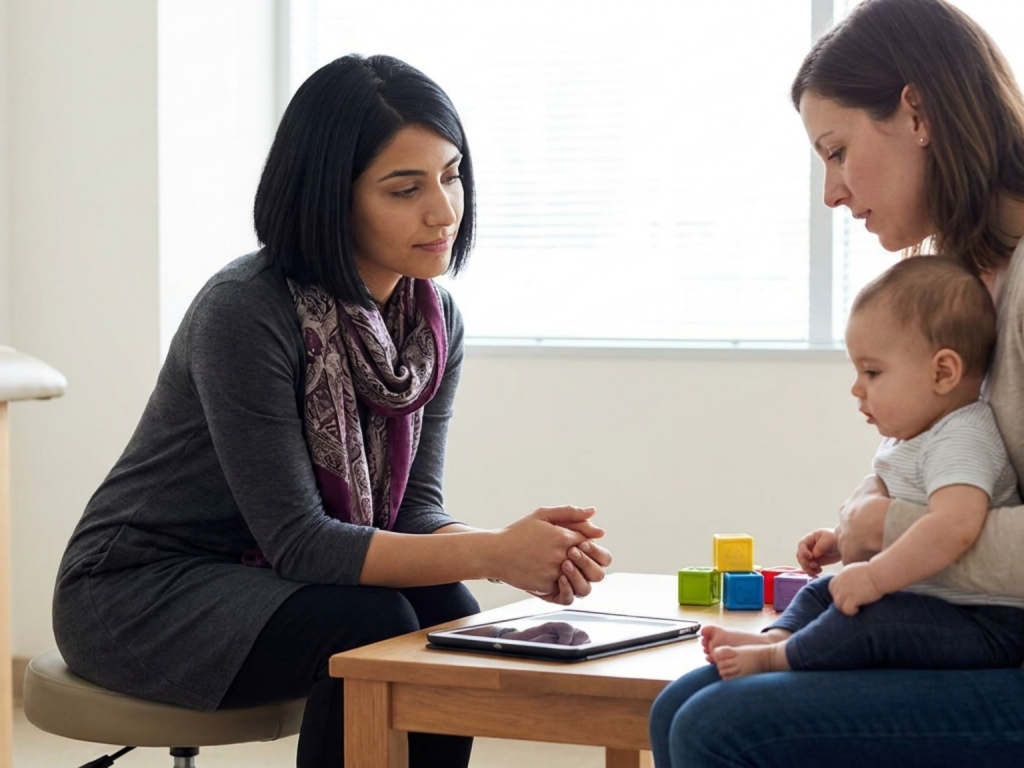
Questions about screens can create understandable anxiety for parents and caregivers. Phones, televisions, video calls, and tablets are woven into daily life, and occasional exposure is difficult to avoid. The central issue is not parental perfection but whether screen media is displacing experiences that are especially important during infancy: responsive relationships, movement, exploration, sleep, and language-rich interaction.
Evidence suggests that frequent or poorly timed screen exposure in infancy may be associated with differences in language, communication, sleep, cognition, motor development, emotional regulation, and social reciprocity. Associations do not prove that screens alone cause developmental difficulties, and family circumstances, content, timing, and caregiver interaction all matter. A practical approach is to reduce unnecessary exposure, protect essential routines, and discuss concerns with a pediatrician or other qualified healthcare professional.
Highlights
Infants learn primarily through responsive human interaction, sensory exploration, movement, and sleep rather than passive screen viewing.
Early screen exposure has been associated with developmental risks in observational research, but associations should not be interpreted as proof of individual causation.
Video chatting with an engaged adult is different from solitary viewing because it can involve eye contact, turn-taking, and contingent responses.
Reducing background television and keeping screens away from sleep and feeding routines can improve opportunities for interaction without requiring perfect screen avoidance.
Why infancy is a sensitive developmental period
Infancy is marked by rapid neurodevelopment. Neural circuits supporting sensory processing, motor control, attention, language, and social cognition are being strengthened through repeated, contingent experiences. A baby watches a caregiver’s face, hears an unfamiliar sound, reaches toward an object, receives a response, and gradually learns that actions have consequences. These exchanges help organize emerging skills more effectively than stimulation that is rapid, predetermined, or unrelated to the infant’s own behavior.
Human interaction also provides multimodal information. During a conversation, a baby can coordinate facial expression, voice, gesture, touch, pauses, and shared attention. Caregivers adjust their pace and complexity in response to the baby’s cues. This responsiveness is often described as serve-and-return interaction: the infant signals through gaze, movement, vocalization, or crying, and an adult responds in a timely and meaningful way. Repeated exchanges support early communication and attachment.
A screen may provide sound and visual movement, but most infant-directed media cannot match the flexibility of a live partner. This does not mean every brief exposure is harmful. It means that screen use should be evaluated in relation to what it replaces. A short video while a caregiver manages an urgent task has a different developmental context from hours of background television that reduces talking, floor play, or face-to-face attention.
What research suggests about development
Research on infant screen exposure is complex because randomized long-term studies are difficult and often inappropriate. Much of the evidence is observational, meaning researchers identify patterns between reported screen use and later outcomes while attempting to account for factors such as socioeconomic conditions, parental education, sleep, childcare, and the home environment. Residual confounding can remain, so an association should not be treated as a diagnosis or a prediction for a particular child.
A prospective study indexed in PubMed reported that screen exposure at 6 and 12 months was associated with a higher risk of language and communication deficits at 36 months among children with moderate or high socioeconomic status. Findings such as these support caution about routine early exposure, while also showing why researchers interpret results at the population level rather than assigning blame to individual families.
A recent review likewise synthesized links between early screen-based media exposure and several developmental domains, including sleep, cognition, language, motor skills, emotional regulation, and social reciprocity. Proposed pathways include reduced caregiver talk, fewer opportunities for physical exploration, high-arousal content, and interference with sleep. The review also indicates that effects vary according to the amount and type of exposure, whether an adult participates, and the child’s broader environment. More research is needed to clarify causality and identify which patterns are most consequential.
Language, attention, and social communication
Language develops through reciprocal communication, not simply through hearing words. Babies benefit when adults describe routines, imitate their sounds, pause for a response, and follow their interests. This responsive caregiving gives an infant repeated practice with turn-taking, joint attention, and the emotional meaning of communication.
Background media can reduce these opportunities even when a baby is not actively looking at the screen. Television or streaming audio may interrupt caregiver speech, shorten interactions, or compete with a baby’s attention. Rapid scene changes can also be difficult for an immature attentional system to organize. These mechanisms are plausible contributors to the language and communication associations reported in research, but they do not establish that screen exposure caused a particular child’s outcome.
Video communication is a distinct situation. A live video call with an attentive adult can allow greeting, imitation, pauses, and responses to the baby’s movements. The caregiver nearby may need to support the exchange by naming the person on screen, helping the baby notice turn-taking, and ending the call when the infant becomes tired or disengaged. A prerecorded program generally cannot respond contingently to the child and should not be considered equivalent to a live social interaction.
Parents can protect communication opportunities through ordinary activities: feeding while making eye contact when practical, reading aloud, singing, narrating diaper changes, and responding to vocalizations. Routine care developmental moments are valuable because they are frequent, predictable, and naturally connected to the infant’s needs.
Sleep, movement, and sensory regulation
Sleep is fundamental to infant health and neurodevelopment. Screens used near bedtime may increase arousal, delay settling, or displace a predictable wind-down routine. The content itself, the brightness of the display, and the disruption caused by notifications or caregiver media use may all contribute. Keeping screens out of the infant’s sleep space and protecting consistent calming cues can support healthier routines.
Movement is another major developmental pathway. Infants need supervised opportunities to move freely, change position, reach, grasp, roll, and eventually crawl. Time spent watching a screen is usually sedentary and may replace floor-based exploration. It is therefore useful to prioritize supervised tummy time while awake, varied positions appropriate to the infant’s abilities, and safe opportunities for active play. Caregivers should follow current safe-sleep guidance and should never place an infant to sleep with a device or use a screen as a substitute for supervision.
Some babies become more irritable, highly alert, or difficult to settle after stimulating media. Others may appear unusually absorbed while missing social cues. These behaviors are nonspecific and can also reflect hunger, fatigue, illness, temperament, or ordinary developmental variation. Families may find it helpful to observe patterns, reduce background media, and provide a low-stimulation settling space. For broader context about overstimulation, see Baby overstimulation behavior explained and Signs baby is overstimulated.
How to make screen use more developmentally supportive
The most realistic media plan is specific, flexible, and centered on the infant’s needs. For young infants, many pediatric recommendations emphasize avoiding routine screen media and prioritizing direct interaction. When screen exposure occurs, consider the following principles:
- Choose live video chatting over passive programming when a screen is used for social contact.
- Stay nearby and co-view when developmentally appropriate, commenting on what is happening and responding to the infant’s signals.
- Turn off background television and limit adult scrolling during feeding, play, and face-to-face routines.
- Keep screens away from naps, nighttime sleep, and the infant’s sleep environment.
- Use audio-free or screen-free alternatives when the goal is simply to occupy the baby, such as a safe floor space, singing, talking, or looking at board books.
- Set device notifications to reduce interruptions and model the attention you hope to give your child.
These steps are not intended to create guilt. A caregiver may need a screen while expressing milk, contacting support, managing illness, or completing an essential task. Development is shaped by repeated patterns across time, not by one isolated exposure. The goal is to preserve a high overall proportion of warm, responsive, screen-free experiences.
Building a practical family media plan
Start by identifying when screens are most likely to appear: early morning, during meals, while a caregiver is exhausted, or during transitions. Then decide which situations matter most to protect. Families often begin with screen-free sleep routines, screen-free feeding when feasible, and daily periods of uninterrupted floor play. A written plan can include where devices are kept, when notifications are silenced, and how adults will handle necessary use without leaving the infant unsupervised.
Consider the needs of every caregiver. A plan is more sustainable when it accounts for work schedules, older siblings, disability, mental health, limited childcare, and the practical realities of solo caregiving. Asking another adult for help may be more useful than imposing an unrealistic standard. Healthcare professionals can help families adapt guidance to prematurity, neurodevelopmental conditions, sensory differences, sleep problems, or other medical circumstances.
Track observations rather than judging yourself. Note whether screen use seems to coincide with shorter sleep, less vocal interaction, difficulty transitioning, or reduced active play. Such notes can support a focused conversation with a pediatrician, developmental specialist, speech-language pathologist, or other qualified clinician. They should not be used to label a child or replace formal developmental surveillance.
When to seek professional guidance
Screen exposure alone does not explain every developmental concern. If a baby is not meeting expected milestones, loses a skill, has persistent feeding or sleep difficulties, or seems consistently unresponsive to voices, faces, or social interaction, contact the child’s healthcare professional. Concerns about hearing, vision, motor control, communication, regulation, or interaction may require assessment across several domains.
Parents do not need to wait for a routine appointment if they are worried. A clinician can review the child’s medical history, corrected age when relevant, sleep and feeding patterns, screen context, and observed behavior. Depending on the concern, the clinician may recommend hearing or vision evaluation, developmental screening, early-intervention services, or specialist referral. Early support is not a judgment about parenting; it is a way to understand a child’s needs and strengthen the family’s resources.
Caregivers should also seek urgent medical attention for acute symptoms such as breathing difficulty, a seizure, significant lethargy, or sudden loss of responsiveness. These situations should not be attributed to screen exposure without medical evaluation.
Important cautions
- Screen exposure associations do not prove that screens caused an individual child’s developmental difference.
- Do not use screens to replace supervision, safe sleep, feeding support, or medical care.
- A baby’s apparent distress, withdrawal, or delayed skill may have many causes and warrants professional assessment when persistent.
- Avoid shame-based rules; caregiver stress and practical constraints are relevant to a sustainable media plan.
Tools & Assistance
- Create a family media plan with protected screen-free sleep, feeding, and play periods.
- Track screen timing, sleep, interaction, and behavior for discussion with a pediatrician.
- Use board books, songs, conversation, and supervised floor play as accessible screen-free activities.
- Ask a pediatrician, developmental specialist, or early-intervention service about milestone concerns.
- Silence nonessential notifications and keep adult devices outside the infant’s sleep space.
FAQ
Is any screen exposure harmful to a baby?
Brief, occasional exposure does not establish that harm has occurred. The main concern is routine or substantial exposure that displaces sleep, movement, play, or responsive interaction. Discuss individual circumstances with a pediatrician.
Is video chatting different from watching a program?
Yes. Live video chatting can support social reciprocity when an engaged adult participates, pauses, and responds to the infant. It is still best kept brief and adjusted to the baby’s cues.
Can a television play in the background while my baby plays?
Background television may reduce caregiver speech and interrupt attention even when the baby is not watching directly. Turning it off during interaction and play protects opportunities for communication.
What should I do if my baby becomes unsettled after screen exposure?
Stop the media, reduce stimulation, and offer calm interaction and a predictable routine. If distress is persistent, severe, or accompanied by other concerns, contact a healthcare professional.
Should I be worried about past screen exposure?
Past exposure does not determine a child’s future development. Focus on current routines and share concerns about milestones, sleep, communication, or behavior with the child’s clinician.
Sources
- PubMed — Infant screen media and child development: A prospective study
- PubMed — The impact of screen-based media exposure on infant and toddler development
- American Academy of Pediatrics — Screen Time for Infants
Disclaimer
This article is for general educational purposes and does not diagnose, treat, or replace advice from a qualified healthcare professional. Consult your pediatrician or clinician about your baby’s individual development and screen exposure.

















Please log in to leave a comment.