
Intro
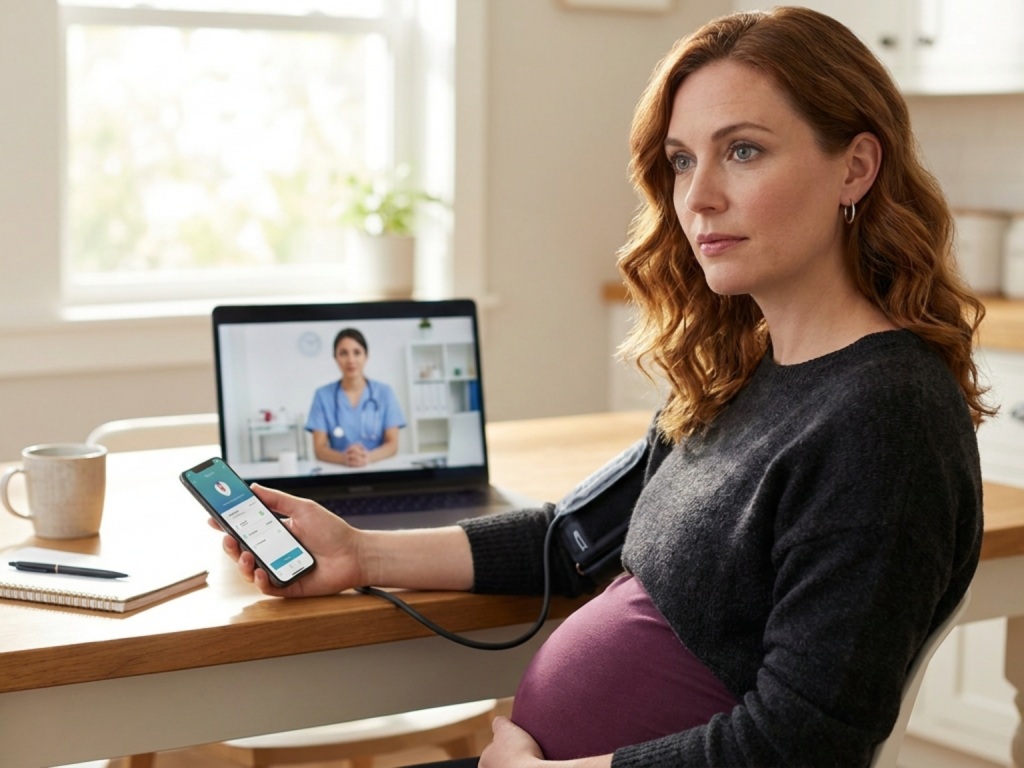
Remote monitoring can be a useful extension of pregnancy care, especially when it helps clinicians follow blood pressure, glucose, symptoms, or recovery without requiring an office visit for every data point. For many pregnant people, that convenience feels reassuring and may improve access to timely support.
At the same time, remote monitoring has real limits. Devices can misread data, people can feel overwhelmed by alerts or unclear instructions, and clinicians may receive too much information to triage safely. In pregnancy, where clinical decisions often depend on context and subtle changes over time, it is important to understand that remote monitoring is a tool, not a complete substitute for in-person assessment.
Highlights
Remote monitoring can extend care, but it cannot fully replace physical examination, history-taking, and clinical judgment.
Technical problems such as poor connectivity, inaccurate readings, and missing data can reduce reliability.
Human factors matter: digital health literacy, anxiety, and unclear escalation pathways can make the system harder to use safely.
In pregnancy, false reassurance is a serious concern because some complications evolve quickly and need in-person evaluation.
A good remote monitoring plan still needs clear thresholds, staff review, and a plan for urgent symptoms.
Why remote monitoring is helpful, but not definitive
Remote monitoring in pregnancy is often introduced with good intentions: it can reduce travel, support early detection of trends, and make follow-up more convenient. For some patients, it also improves continuity between scheduled visits, which is especially valuable when clinic access is limited or symptoms change between appointments.
The limitation is that a stream of home data is not the same as a clinical assessment. A single reading rarely tells the whole story. Blood pressure, weight, glucose, symptom scores, and fetal-related data all require interpretation in context: gestational age, comorbidities, medication exposure, baseline values, and the presence or absence of warning signs. Remote monitoring may capture a number, but it does not automatically explain why that number changed or whether the change is clinically meaningful.
This is why remote care should be understood as complementary. It can improve surveillance, but it cannot replace the bedside conversation that explores pain, bleeding, headache, visual changes, swelling, or reduced fetal movement in a nuanced way. In pregnancy, those details can matter as much as the device reading itself.
Technical limitations: device accuracy, validation, and missing data
A major limitation is simple but important: the device may not be accurate enough for the task. Home devices are not all validated for pregnancy, and some measurements are less reliable when body position, cuff size, sensor placement, or user technique are suboptimal. Even a well-designed device can produce misleading values if it is used incorrectly or if the physiology it is measuring changes faster than the system can track.
Data loss is another problem. Poor connectivity, low battery, software glitches, synchronization delays, and incomplete uploads can create gaps that are easy to underestimate. In practice, missing data is not neutral; it can make a high-risk trend look stable when it is not. If a patient records values inconsistently, the care team may receive a distorted picture of the clinical situation.
Validation matters even more in pregnancy because small errors can have larger consequences. For example, blood pressure monitoring is only as useful as the accuracy of the reading and the appropriateness of the device. When a pregnancy-validated blood pressure monitor is not used, the risk of false reassurance or unnecessary alarm increases. That does not mean home data is worthless; it means it should be interpreted cautiously and paired with clinical review.
Human factors: literacy, confidence, and emotional burden
Remote monitoring assumes that patients can understand the device, follow instructions, and know what to do when the numbers change. In real life, that is not always straightforward. Digital health literacy varies widely, and even highly educated patients may struggle with app navigation, Bluetooth pairing, portal logins, or interpreting trend graphs. When instructions are too technical or inconsistent, people may enter the wrong value, skip a reading, or abandon the system altogether.
There is also an emotional side. Some pregnant patients feel reassured by frequent contact, but others feel watched, pressured, or anxious when every value appears to carry urgent meaning. Repeated alerts can turn a helpful tool into a source of stress. That stress may be especially pronounced when the patient has a complicated pregnancy history, prior loss, or a high-risk diagnosis.
Clinicians can also experience burden. Reviewing home data takes time, and large data streams may create expectations for rapid response that are difficult to meet. If communication is unclear, patients may not know whether to message the clinic, wait for a call, or seek urgent care. A remote system works best when the instructions are simple, the thresholds are explicit, and both sides understand the plan.
Workflow, staffing, and alert fatigue
One of the most practical limitations of remote monitoring is the amount of work it creates behind the scenes. Data does not review itself. Someone must verify transmissions, sort normal from abnormal values, document the findings, and decide which results need escalation. In busy pregnancy practices, this can become a substantial operational burden.
Alert fatigue is a well-described risk. When a system generates too many notifications, clinicians may spend time reviewing low-value messages and become less responsive to the truly important ones. That problem is not unique to pregnancy, but it matters a great deal in obstetric care, where timely recognition of deterioration can be critical. If an alert queue is large, the most urgent finding may sit alongside many less meaningful ones, making triage slower and less reliable.
Some clinics also depend on third-party platforms or separate data-management systems to organize remote information. That adds another layer of coordination and another point of failure. If staff are not specifically assigned to monitor the program, review can become inconsistent. In other words, remote monitoring may shift work away from in-person visits, but it does not remove the work; it redistributes it, and sometimes it increases it.
Pregnancy-specific safety limits and the risk of false reassurance
Pregnancy has unique safety concerns because some complications evolve quickly and may not be obvious from home readings alone. A patient may transmit a seemingly acceptable value while still developing a serious condition. Conversely, a single abnormal reading may reflect technique error, stress, or transient change rather than a true complication. The challenge is deciding which signal matters, and that often requires an experienced clinician.
Remote monitoring is especially limited when symptoms are dynamic. Headache, visual disturbance, abdominal pain, vaginal bleeding, swelling, shortness of breath, and reduced fetal movement cannot be fully understood through a device screen. A patient may need prompt in-person assessment even if remote values look only mildly abnormal or appear unchanged. That is why preeclampsia warning symptoms should always be taken seriously in context, not deferred simply because a dashboard appears reassuring.
Remote tools are also poor substitutes for examination when the care team needs to assess uterine tenderness, fetal heart rate patterns, maternal volume status, or other findings that cannot be captured remotely. For the same reason, urgent warning signs in pregnancy deserve immediate attention rather than prolonged home observation. The safest approach is to treat remote data as one piece of the picture, never the entire picture.
Equity, privacy, and how to use remote monitoring more safely
Access is not equal. Some patients do not have stable internet, reliable cellular service, or a private place to use the device. Others may share phones, rotate chargers, work irregular schedules, or have limited ability to pay for data plans and equipment. These barriers can turn remote monitoring into an intervention that works well for some people and poorly for others, widening existing disparities in pregnancy care.
Privacy is another real concern. Home monitoring often involves sensitive health information moving through apps, portals, or third-party systems. Patients deserve clear information about who can see their data, how long it is stored, and what happens if a device is lost or hacked. Trust matters, especially in pregnancy, when people may already feel vulnerable.
The most realistic way to improve remote monitoring is to use it selectively and with safeguards. That means confirming device validation, teaching patients how to use the system, setting explicit escalation rules, assigning staff to review data, and scheduling periodic in-person checks when appropriate. It also means acknowledging limits honestly. Remote monitoring can support safer care, but it should not be asked to do the work of a full prenatal evaluation on its own.
When remote monitoring should not be the only plan
- Do not rely on home readings alone if symptoms are worsening or changing quickly.
- A normal number does not rule out a serious pregnancy complication.
- Any concern for bleeding, severe pain, reduced fetal movement, or severe headache needs prompt clinical attention.
- Poor connectivity or missing uploads can hide clinically important trends.
- If the instructions are unclear, ask the care team before trusting the data.
Tools & Assistance
- Obstetric care team or maternal-fetal medicine clinic
- Device onboarding support from the monitoring program
- Patient portal or secure messaging system
- Written escalation plan with emergency contact numbers
- In-person prenatal visits and same-day triage access
FAQ
Is remote monitoring reliable enough to replace prenatal visits?
Usually no. It can complement prenatal care, but it cannot replace the physical exam, symptom review, and judgment that happen during in-person visits.
Why do home readings sometimes look different from clinic readings?
Technique, cuff fit, device validation, timing, posture, and stress can all affect results. Some differences are expected and should be interpreted by the care team.
What is the biggest safety risk of remote monitoring in pregnancy?
False reassurance is a major concern. A normal or mildly abnormal transmission may still miss a developing complication that needs direct assessment.
What should a patient do if alerts or instructions are confusing?
Contact the obstetric team or monitoring program for clarification. It is safer to confirm the plan than to guess.
Sources
- PubMed Central / National Library of Medicine — Benefits and Challenges of Remote Patient Monitoring in the U.S.: A Systematic Review
- PubMed Central / National Library of Medicine — Challenges in managing a remote monitoring device clinic
- Agency for Healthcare Research and Quality — Remote Patient Monitoring
Disclaimer
This article is for general educational purposes and does not replace individualized medical advice. In pregnancy, new or worsening symptoms should be reviewed promptly with a qualified healthcare professional.















Please log in to leave a comment.