
Intro
If you are pregnant and hearing that all skincare is off-limits, that message can feel alarming and unnecessarily restrictive. The better evidence does not support a blanket ban. Most skincare products are applied to the skin, act locally, and produce minimal systemic exposure, so they are generally not expected to increase fetal risk.
That does not mean every product is automatically fine. Pregnancy is a time to be more selective, especially with certain active ingredients and some cosmetic procedures. The goal is not fear; it is informed caution, ideally guided by your obstetric clinician, midwife, pharmacist, or dermatologist.
Highlights
The myth is that every skincare product is unsafe in pregnancy; the evidence says most topical products have minimal systemic exposure.
A few ingredients deserve extra caution, especially topical retinoids and hydroquinone.
Dose and exposure matter: salicylic acid and some procedures are not all-or-nothing decisions.
A simplified, ingredient-aware routine is often a practical and reassuring approach.
If you are unsure about a product, bring the exact label to a healthcare professional rather than guessing.
Why the myth is so common
Pregnancy naturally makes people more alert to possible exposures, and that caution is understandable. Unfortunately, it can also lead to oversimplified advice such as “stop everything.” Social media, family anecdotes, and outdated product warnings can make it sound as if any cream, serum, or facial treatment is dangerous to the fetus.
The more accurate picture is narrower. Most skincare products are designed for local use on the skin, not for significant entry into the bloodstream. The skin barrier limits absorption, and for many over-the-counter products the amount that reaches systemic circulation is very small. That is why a blanket statement that skincare is unsafe in pregnancy is a myth rather than a medical rule.
Still, the myth persists because some ingredients do matter. When people hear that one product category can be risky, they sometimes generalize that concern to all skin care. A better approach is to separate routine topical care from ingredients and procedures that need review.
How dermatology thinks about risk: absorption, dose, and formulation
Safety in pregnancy is usually assessed by asking several practical questions: How much of the ingredient is used? How often is it applied? Is it left on the skin or washed off? Is the skin intact, inflamed, or broken? These details matter because they influence percutaneous absorption, the degree to which a substance passes through the skin and into the body.
Many skincare products have low bioavailability from the skin, meaning only a small fraction becomes systemically available. A cleanser that is rinsed off quickly generally creates less exposure than a leave-on treatment used over a large body surface area. Likewise, products applied to irritated, cracked, or recently treated skin can absorb more than products used on intact skin.
This is why medical guidance is usually ingredient-specific rather than category-based. The best question is not “Is skincare unsafe?” but “Which ingredient, at what dose, on what skin, and for how long?” That framing is much closer to how clinicians evaluate actual risk.
Ingredients that deserve extra caution
Two ingredients are repeatedly highlighted in pregnancy guidance because they raise more concern than ordinary moisturizers or cleansers: topical retinoids and hydroquinone. Retinoids are vitamin A derivatives used in acne and anti-aging products. Hydroquinone is used for hyperpigmentation. Both are commonly discussed as ingredients to avoid or to review carefully with a clinician during pregnancy.
Salicylic acid is another ingredient that is not automatically forbidden, but it is not a product to use casually without thinking about concentration, body surface area, and duration of use. A small wash-off cleanser is not the same as a high-strength peel, repeated treatment, or widespread application. The point is not that salicylic acid is always unsafe; the point is that the exposure profile matters.
Some cosmetic treatments also deserve individualized discussion. Strong peels, aggressive exfoliating regimens, and certain in-office procedures may be appropriate for some people and not for others, depending on the exact method and the person’s pregnancy context. If a clinician has not reviewed the product or procedure, it is reasonable to pause and ask before proceeding.
- Topical retinoids: discuss and usually avoid unless a clinician specifically advises otherwise.
- Hydroquinone: commonly avoided because of greater absorption concerns.
- Salicylic acid: consider concentration, frequency, and whether it is a wash-off or leave-on product.
- Unclear cosmetic procedures: get individualized medical advice before scheduling them.
What skincare is often reasonable to continue
For many pregnant people, the safest and most realistic plan is a simplified routine built around products with minimal systemic exposure. The review literature and clinical factsheets both support the idea that most cosmetics and over-the-counter skincare products are generally considered safe when the skin absorption is low. That includes many basic cleansing and moisturizing products used as directed.
A pregnancy-safe skin care routine is usually less about buying an entirely new set of products and more about reducing unnecessary complexity. If a product is gentle, used in a modest amount, and does not contain an ingredient of concern, it may be reasonable to keep it in the routine. This is especially true when the product is part of everyday maintenance rather than a high-intensity treatment.
There is also a practical benefit to simplification. Pregnancy can bring nausea, sensitivity to smells, skin irritation, and fatigue. A short routine is easier to tolerate and easier to evaluate if a reaction occurs. When in doubt, fewer products make it easier to identify the one that is causing problems.
If you are already using skincare without issues, that is reassuring, but it is still worth checking labels. Reassurance does not mean ignoring ingredients; it means making thoughtful, proportionate choices instead of reacting to every product as though it were dangerous.
How to review your products with a clinician
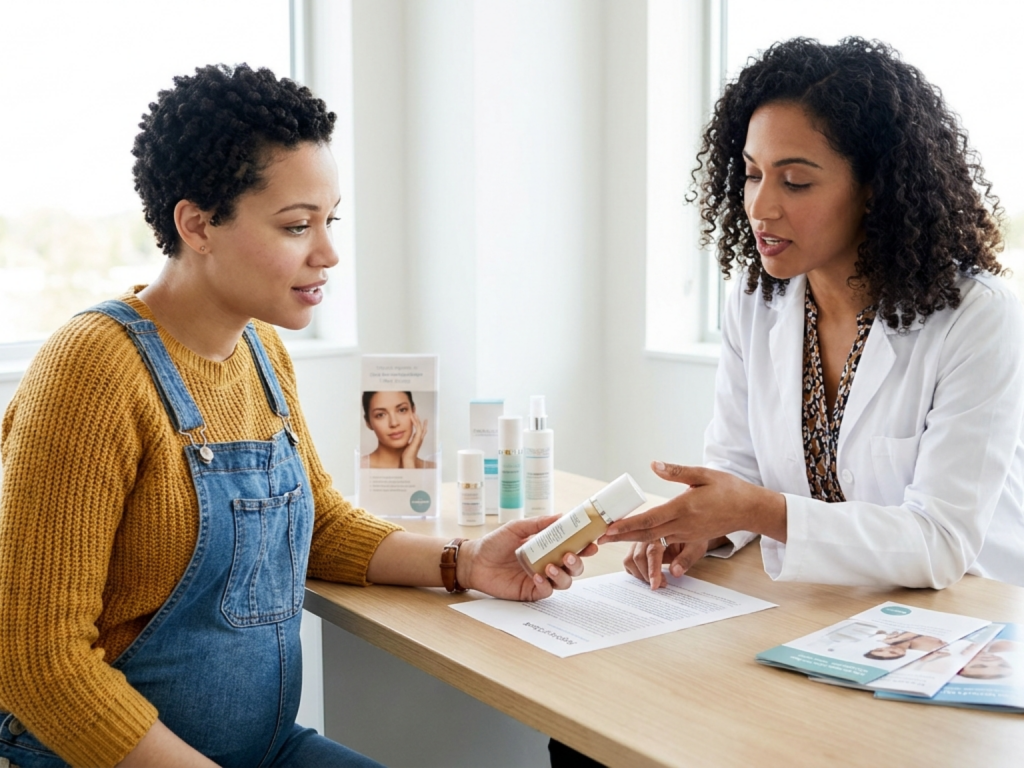
The most useful next step is often a label review. Bring the actual product names, ingredient lists, or photos of the packaging to your obstetric clinician, dermatologist, midwife, or pharmacist. This is especially helpful if your routine includes acne treatments, pigment-correcting creams, or anything marketed as a peel, resurfacing treatment, or anti-aging regimen.
Be specific about how you use the product: where it is applied, how often, whether it is left on or washed off, and whether you are using it on the face only or over a larger area. Those details help a professional estimate exposure. A product used sparingly on intact facial skin is very different from repeated application over large, irritated areas.
It can also help to think in terms of total exposure. One ingredient in one cream may be less concerning than several overlapping products that all contain similar actives. If you are trying to decide whether to continue a routine, a broader pregnancy-safe skin care routine review is often more useful than asking about a single item in isolation.
Do not hesitate to ask about acne, melasma, eczema, or cosmetic procedures during prenatal care. These concerns are common, and clinicians are used to helping patients separate myth from medically meaningful risk.
When to stop, seek advice, or get prompt review
Stop a product and seek advice if you develop a significant rash, swelling, blistering, intense burning, or eye exposure. Those reactions are not proof of fetal harm, but they can signal irritation, contact dermatitis, or a chemical injury that deserves prompt assessment.
It is also wise to ask for medical input if you accidentally used a product containing retinoids or hydroquinone before realizing you were pregnant. Panic is rarely helpful. In most cases, the most useful response is to stop the product, note the ingredient list, and discuss it with a clinician who can interpret the actual exposure rather than the label alone.
If your acne, pigmentation, or itching becomes severe, you may need a tailored plan rather than simply stopping all skincare. Pregnancy-safe management is often about balancing maternal comfort, skin barrier health, and fetal caution. You deserve a plan that addresses your symptoms without unnecessary risk.
The bottom line is reassuring: skincare itself is not inherently unsafe in pregnancy. The real work is identifying which ingredients and procedures need caution and which routine products can continue with confidence.
When to pause and ask for help
- Do not assume every product is safe just because it is sold over the counter.
- Avoid or review topical retinoids and hydroquinone with a clinician.
- Use salicylic acid cautiously; concentration and area of use matter.
- Stop any product that causes a severe rash, swelling, blistering, or burning.
- If you are unsure, bring the exact label to your prenatal or dermatology visit.
Tools & Assistance
- Medication and skincare label review at your prenatal clinic
- Dermatology consultation for acne, pigmentation, or eczema in pregnancy
- Pharmacist ingredient check for over-the-counter creams and cleansers
- A written list of every topical product you use, including peels and spot treatments
FAQ
Is all skincare unsafe during pregnancy?
No. Most topical skincare has minimal systemic exposure and is not expected to increase fetal risk, but specific ingredients and procedures should be reviewed.
Which skincare ingredients are most often discussed as concerns?
Topical retinoids and hydroquinone are common examples. Salicylic acid may require dose-based caution, especially when used in stronger or leave-on forms.
Can I keep my current routine if I am pregnant?
Often yes, especially if it is a simple routine. It is still smart to review the labels with your obstetric clinician or dermatologist.
Should I panic if I used a product before I knew I was pregnant?
Usually no. Stop the product if needed and speak with a healthcare professional about the exact ingredient and exposure rather than guessing.
Sources
- National Center for Biotechnology Information (NCBI) / PubMed Central — Safety of skin care products during pregnancy
- American Academy of Dermatology — Dermatologist-approved pregnancy skin care
- Royal Hospital for Women / Motherrisk (South Eastern Sydney Local Health District) — Skin Care, Hair Care and Cosmetic Treatments in Pregnancy and Breastfeeding
Disclaimer
This article is for general education only and does not replace individualized medical advice. If you are pregnant, discuss skincare products and procedures with your obstetric clinician or dermatologist before starting, stopping, or continuing them.

















Please log in to leave a comment.