
Intro
Screen dependency can feel frightening for caregivers, especially when a child becomes distressed, irritable, or withdrawn when devices are limited. It is also common: screens are designed to capture attention, and children’s developing self-regulation systems are still learning how to pause, shift focus, tolerate boredom, and choose alternatives.
The goal is not to shame families or demand perfect screen avoidance. A healthier aim is to protect sleep, movement, learning, relationships, and emotional well-being while helping children build flexible, age-appropriate digital habits. If screen use is causing major family conflict, mood changes, school problems, or loss of interest in usual activities, professional guidance can be very helpful.
Highlights
Reducing screen dependency works best when the plan is predictable, gradual, and shared by the whole family.
Screens in bedrooms, late-night use, and unstructured autoplay can reinforce compulsive use and disrupt sleep.
Parents and caregivers are powerful models; children respond more to consistent routines than to lectures.
The most effective replacement for screens is not simply “less screen time,” but more connection, movement, rest, and meaningful offline activity.
Understanding screen dependency in children
Screen dependency is not defined only by the number of hours a child spends on a device. Clinically, the more useful question is whether screen use is interfering with functioning: sleep, schoolwork, physical activity, family relationships, peer interaction, mood regulation, and the ability to stop when asked. A child who uses screens for school, creativity, video calls, or structured entertainment may be very different from a child who cannot disengage from short videos, gaming rewards, or social media without intense distress.
Many digital platforms use persuasive design: variable rewards, autoplay, notifications, infinite scroll, streaks, and social reinforcement. These features activate reward pathways and make stopping harder, especially for children and adolescents whose executive functions are still developing. This does not mean a child is “bad” or that parents have failed. It means the environment is neurologically powerful, and children need external structure while internal self-control matures.
A supportive approach begins with curiosity. Ask what the screen is doing for the child. Is it soothing anxiety, avoiding homework, maintaining friendships, relieving boredom, or offering a sense of competence? When caregivers understand the function, they can build replacements that meet the same need in healthier ways. For example, a child using videos to calm down may need sensory regulation without screens; a teen gaming for connection may need support with real-world peer relationships, not only stricter limits.
Start with a calm family media plan
A family media plan for children works best when it is specific, visible, and discussed before conflict begins. Vague rules such as “use it less” often lead to bargaining. More effective rules state when screens are allowed, where they are allowed, what content is acceptable, and what must happen first. For example: homework, outdoor play, chores, and dinner happen before recreational screens.
Involve children in the plan when developmentally appropriate. Preschoolers can choose between two screen-free activities. School-age children can help create a weekly routine. Adolescents can participate in discussions about privacy, social connection, sleep, and academic responsibilities. Collaboration does not mean the child sets all limits; it means the rules are easier to accept because they are predictable and respectfully explained.
Useful elements include:
- Clear daily or weekly recreational screen time expectations, adjusted by age and family needs.
- Tech-free zones, especially meals, bedrooms overnight, and family conversation times.
- A daily device curfew, ideally with no recreational devices during the hour before bedtime.
- Rules about autoplay, notifications, in-app purchases, and social media access.
- A plan for what happens when limits are reached, including calm transitions and replacement activities.
Caregivers should avoid introducing new rules during an argument. Instead, hold a short meeting at a neutral time. Acknowledge that change may feel hard: “Your brain is used to stopping after one more video, so the first week may feel frustrating. We will help you.” This validates the child’s experience while maintaining boundaries.
Protect sleep by keeping devices out of bedrooms
Sleep is one of the most important medical reasons to reduce screen dependency. Evening screen use can delay bedtime through psychological arousal, social interaction, gaming intensity, and “one more” content loops. Light exposure may also affect circadian timing, although the behavioral stimulation of screens is often just as important as the light itself. Poor sleep can then worsen attention, irritability, impulse control, appetite regulation, and emotional resilience, creating a cycle in which the child seeks more screens to cope with fatigue.
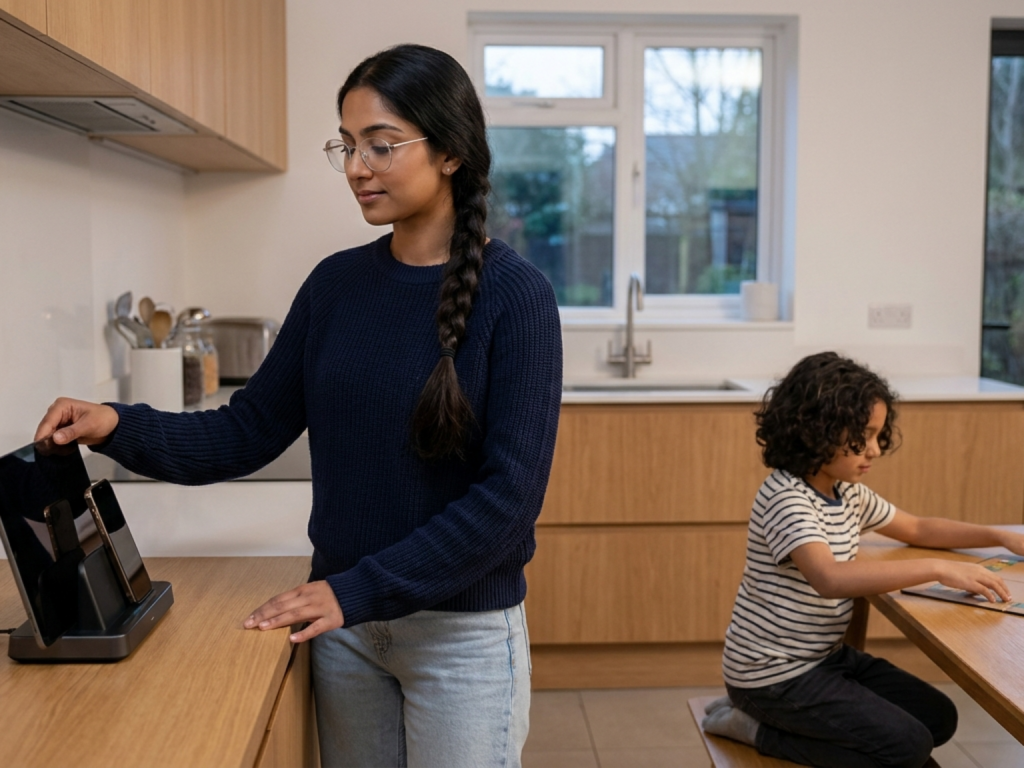
A bedroom screen-free overnight routine is a high-yield intervention. Families can create a central charging station in the kitchen, hallway, or caregiver’s room so phones, tablets, handheld gaming devices, and laptops stay out of bedrooms. This is especially helpful for adolescents, who may receive late-night messages or feel social pressure to remain available.
Try a consistent sequence: devices charge outside the bedroom, pajamas and hygiene begin, then reading, quiet music, drawing, or another calming activity. For younger children, a visual bedtime chart can reduce negotiations. For teens, explain the health rationale rather than framing the rule as punishment: the goal is neurobiological recovery, learning consolidation, and mood stability.
If a child says they need a device as an alarm, use a simple alarm clock. If they use music or white noise, consider a non-internet audio device. If school laptops must be in the home, store them outside the bedroom overnight. The fewer exceptions, the easier the habit becomes.
Use limits, monitoring tools, and gradual reduction
Electronic monitoring tools can support boundaries, but they should not replace caregiver involvement. Built-in device settings and parental-control apps can set time limits, block mature content, pause internet access, and schedule downtime. These tools are most effective when children know what is being monitored and why. Secret surveillance can erode trust, particularly with adolescents, unless there is an urgent safety concern that warrants professional guidance.
For a child with very high use, abrupt removal may trigger intense dysregulation. A gradual plan may be safer and more sustainable. For example, reduce recreational screen time by 15 to 30 minutes every few days while adding a specific replacement at the same time. If the child usually watches videos after school for two hours, begin with a snack, 20 minutes of outdoor play, then a shorter planned screen period. The replacement must come before the restriction, not as an afterthought.
Age-based guidance can help families set expectations. Research summaries often cite discretionary recreational screen limits that are lower for toddlers and higher for teens, such as approximately 30 minutes for toddlers, about one hour for preschool and school-age children, and up to two hours for adolescents, depending on context. These are not rigid medical prescriptions; educational use, disability accommodations, family circumstances, and mental health needs may alter the plan. The clinical priority is functional status: sleep, mood, activity, learning, and relationships.
Some families benefit from a brief “TV Turn-off” or screen-reduction challenge. This can be framed positively: a one-week experiment to discover what the family enjoys offline. Track sleep, mood, arguments, physical activity, and homework completion, not only minutes saved.
Replace screen time with connection and movement
Children usually cannot succeed with a vacuum. If screens are removed without alternatives, boredom and conflict escalate. A screen time replacement plan should include options that match the child’s temperament, developmental stage, energy level, and sensory needs. High-energy children may need running, cycling, playground time, dancing, or sports. Quiet children may prefer drawing, audiobooks, puzzles, construction toys, cooking, crafts, or a cozy reading nook for children.
Movement is especially important because heavy screen use can increase sedentary time. Even when screens remain part of the day, structured breaks with physical movement can reduce the health burden. A child might do stretches between episodes, take a walk after gaming, or use a stationary movement activity while watching a short program. This does not make unlimited screen time healthy, but it helps shift the body out of prolonged sitting.
Connection is another powerful replacement. Many children reach for screens when they want attention, predictability, or relief from stress. Ten minutes of undistracted caregiver time can reduce later battles. This may be board games, reading together, throwing a ball, walking the dog, helping with dinner, or simply talking. For teens, connection may look like a car ride, a shared show followed by discussion, or interest in their online world without immediate criticism.
It is helpful to prepare a menu of choices before the child is upset. Keep visible bins for art supplies, puzzles, building materials, cards, jump ropes, books, or sensory tools. For waiting rooms and car rides, pack waiting-room activities for children so the phone is not the default solution every time boredom appears.
Co-view, discuss, and teach digital self-regulation
Not all screen use has the same developmental meaning. Co-viewing high-quality content allows caregivers to ask questions, connect stories to real life, and help children interpret what they see. A child watching alone may passively continue through autoplay; a child watching with a caregiver can pause, reflect, laugh, learn, and then transition more easily. Co-viewing also gives caregivers insight into content quality, advertising exposure, social comparison, and emotional triggers.
For younger children, choose slow-paced, age-appropriate content and turn off autoplay when possible. Use simple narration: “The episode is finished. Now the tablet rests, and we go outside.” For school-age children, teach them to notice body cues: tired eyes, irritability, hunger, restlessness, or the feeling of not being able to stop. These are early self-regulation skills.
Adolescents need more nuanced coaching. Social media may be central to peer belonging, but it can also intensify comparison, sleep delay, cyberbullying, and compulsive checking. Discuss how algorithms work, why notifications are designed to pull attention, and how short-form video can distort time perception. Encourage teens to set app timers, remove nonessential notifications, keep devices away during homework, and use intentional check-in times rather than constant availability.
Screen time and emotional regulation are closely linked. If a child uses screens to escape every uncomfortable feeling, they may not practice frustration tolerance, problem solving, or self-soothing. Teach alternatives such as breathing exercises, movement, journaling, talking to an adult, sensory play, or taking a brief break before returning to a difficult task.
Model the habits you want to see
Children notice adult behavior. If caregivers ask children to stop scrolling while adults check phones throughout dinner, bedtime, and conversations, the rule feels unfair and confusing. Modeling does not require perfection. It means narrating healthy choices: “I am putting my phone on the charger so I can focus on dinner,” or “I am taking a break because I have been sitting too long.”
Parents can create shared screen-free quality time, even in small doses. Meals without devices, a walk after dinner, a Sunday morning outing, or 20 minutes of reading together can become protective rituals. The emotional message is: life away from screens is not merely a punishment; it is a place where connection and enjoyment happen.
Adults should also examine their own use of screens as calming tools. Many caregivers rely on phones during exhaustion, stress, feeding, commuting, or household demands. Self-compassion matters. Rather than guilt, aim for one visible change at a time: no phone during the first 10 minutes after school pickup, no device during bedtime reading, or a family charging station at night.
When adults and children make changes together, resistance often decreases. A family might agree that everyone parks devices during dinner, everyone has a nighttime charging location, and everyone protects outdoor time. Shared rules reduce the feeling that the child is being singled out.
When to seek professional support
Caregivers should consider professional help when screen use is associated with persistent sleep deprivation, declining grades, aggression during limit-setting, withdrawal from offline relationships, loss of interest in previous activities, anxiety, depressed mood, exposure to unsafe content, or suspected cyberbullying. A pediatrician can screen for sleep disorders, vision concerns, headaches, attention difficulties, anxiety, depression, neurodevelopmental conditions, and family stressors that may be contributing to excessive use.
A mental health professional can help when screens are functioning as avoidance, compulsive soothing, or a major source of family conflict. Therapy may focus on emotional regulation, parent-child communication, anxiety management, behavioral routines, or problem-solving skills. If attention-deficit/hyperactivity disorder, autism spectrum-related needs, trauma, depression, or anxiety are present, screen strategies may need individual adaptation.
Schools can also be partners. If digital distraction during homework is severe, ask about assignment structure, learning supports, or device management strategies. Some children need paper-based planning, supervised homework blocks, website blockers, or scheduled breaks. The aim is not to pathologize normal childhood interest in technology, but to restore balance and protect development.
Change often takes weeks, not days. Expect protest, especially if screens have been the main source of stimulation or comfort. Consistency, empathy, and replacement activities are more effective than escalating punishments. Celebrate functional wins: earlier sleep, fewer arguments, more outdoor play, improved mood, or a child who stops after one reminder.
Seek help promptly if screen use is linked to serious impairment
- A child becomes physically aggressive, threatens self-harm, or cannot calm after limits are set.
- Screen use is causing persistent sleep loss, school failure, or marked social withdrawal.
- You suspect cyberbullying, exploitation, unsafe sexual content, or contact with unknown adults.
- The child shows sustained depressed mood, severe anxiety, or loss of interest in usual activities.
- Caregivers feel unable to set limits safely or consistently despite repeated attempts.
Tools & Assistance
- Create a written family media plan with device-free times, places, and bedtime rules.
- Use built-in parental controls or reputable monitoring apps to set time limits and downtime.
- Set up a central family charging station outside bedrooms overnight.
- Prepare a basket of screen-free activities for after school, travel, and waiting rooms.
- Consult a pediatrician, child psychologist, or school counselor if screen use is impairing daily function.
FAQ
Should I remove all screens if my child seems dependent?
Usually the goal is healthier functioning, not total elimination. Gradual reduction, predictable limits, and replacement activities are often more sustainable. Seek professional advice if reactions are extreme.
Is educational screen time safer than entertainment?
Educational content can be useful, especially when age-appropriate and co-viewed, but it can still displace sleep, movement, and interaction. Quality, context, and timing matter.
What is the most important rule to start with?
Keeping devices out of bedrooms overnight is often a high-impact first step because it protects sleep and reduces unsupervised late-night use.
How can I reduce tantrums when screen time ends?
Give advance warnings, use a visual timer, keep the limit consistent, and immediately transition to a planned activity. Avoid bargaining after the limit has already been reached.
When should a teen have privacy online?
Privacy should grow with maturity, but safety still matters. Discuss expectations openly, monitor proportionately, and seek guidance if there are risks such as cyberbullying, unsafe contacts, or major mood changes.
Sources
- PubMed Central (National Institutes of Health) — Screen Use and Social Media “Addiction” in the Era of TikTok
- PubMed Central (National Institutes of Health) — Effects of Excessive Screen Time on Child Development
- Mayo Clinic — Screen time and children: How to guide your child
Disclaimer
This article is for informational purposes only and does not diagnose or treat any condition. Consult a pediatrician or qualified mental health professional for concerns about your child’s screen use, mood, sleep, or behavior.

















Please log in to leave a comment.