
Intro
The fertile window is the short part of the menstrual cycle when conception is biologically possible. It is centered on ovulation, because sperm can survive for several days in the reproductive tract, while the egg is usually viable for only a brief time after release.
For many people, the challenge is not understanding the concept but determining the timing. The fertile window can be estimated from cycle history, ovulation signs, and at-home testing, but no single method is perfectly precise.
Highlights
The fertile window is usually a brief six-day span centered on ovulation.
Calendar estimates are helpful, but they are only estimates because ovulation can shift from cycle to cycle.
Ovulation predictor kits, cervical mucus changes, and basal body temperature tracking each offer different clues.
Irregular cycles, recent hormonal changes, and some medical conditions make timing harder to predict.
If the pattern is unclear, clinicians can use more direct methods to assess ovulation.
The biology behind the fertile window
The fertile window is determined by two short-lived events: sperm survival and egg survival. After ovulation, the egg generally remains fertilizable for about 12 to 24 hours. Sperm, by contrast, may stay viable for up to five days under favorable conditions in cervical mucus and the upper reproductive tract. That overlap creates the practical window in which pregnancy can occur.
Because sperm can arrive before ovulation and still remain capable of fertilization, the fertile window begins before the egg is actually released. In clinical terms, it is not a single day but a short interval centered on ovulation. Public-health sources often describe this as about six days per cycle, although the exact edges can vary depending on the person and the cycle.
This is why the fertile window is best thought of as a moving biological target rather than a fixed calendar slot. The timing depends on where ovulation falls in that particular cycle, and ovulation itself can shift even when cycles seem fairly regular.
How calendar counting estimates ovulation
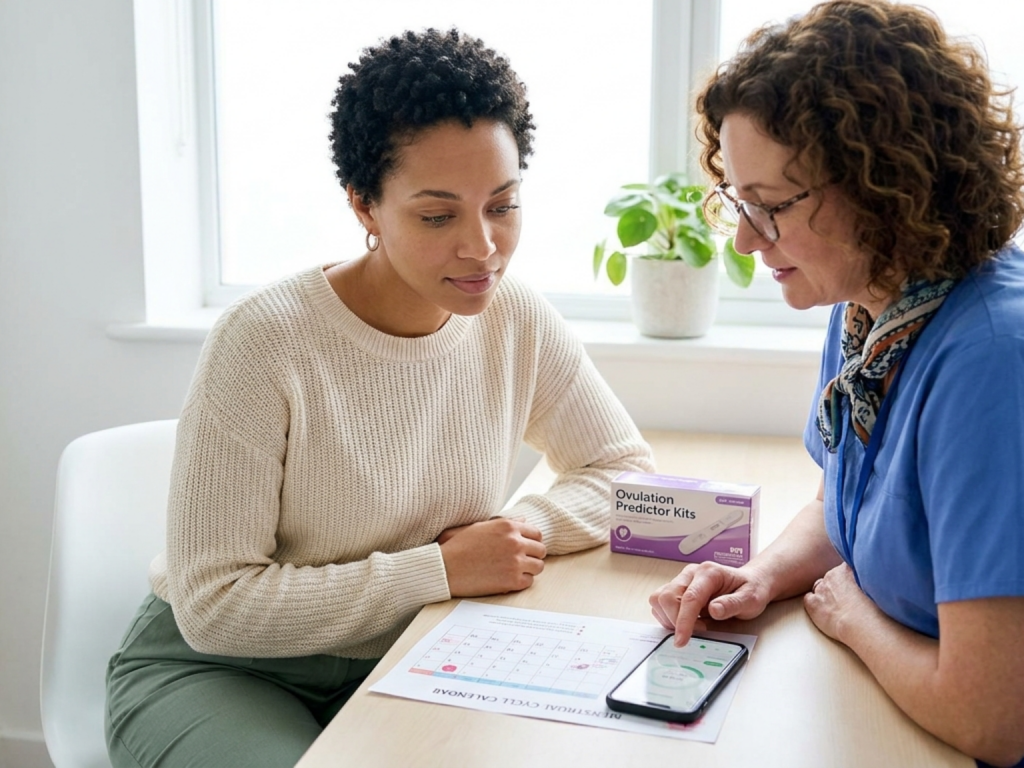
The most familiar method is calendar counting for ovulation. It starts with the first day of menstrual bleeding as day 1, then estimates ovulation by counting backward from the next expected period. A common clinical rule of thumb is that ovulation occurs about 12 to 14 days before the next period begins. If a cycle is 28 days long, that often places ovulation around day 14; in a 32-day cycle, it may fall closer to day 18.
Once ovulation is estimated, the fertile window is mapped around it. In practical terms, that means the days leading up to ovulation, the ovulation day itself, and sometimes the day after. This calculation is simple and often useful for people with fairly regular cycles who want a broad estimate.
The limitation is that a calendar can only predict from past pattern. If the follicular phase changes from one month to the next, the whole estimate shifts. That is why calendar counting is a starting point, not a guarantee.
Tracking signs that ovulation is approaching
Physiologic signs can make the fertile window easier to identify. One of the most accessible clues is cervical mucus before ovulation. As estrogen rises, mucus often becomes clearer, wetter, and more stretchy, which supports sperm movement. Many people notice this change in the days just before ovulation.
Another common method is using ovulation predictor kits. These home tests detect the luteinizing hormone surge, which usually occurs about 24 to 36 hours before ovulation. A positive test does not prove that ovulation has already happened, but it does signal that the fertile window is opening or already underway.
Basal body temperature tracking looks at the small rise in body temperature that follows ovulation. This rise is caused by progesterone after the egg has been released. Because the temperature increase happens after ovulation, it is most useful for confirming that ovulation likely occurred, not for predicting it in advance.
Many people use more than one sign at the same time. A combined approach is usually more informative than any single clue alone.
Why the fertile window can shift from cycle to cycle
Research shows that fertile window timing varies substantially across cycles and between individuals. Even when cycle length appears stable, ovulation may happen a little earlier or later than expected. That variation is why prediction based only on averages can be inaccurate.
Several everyday and medical factors can change timing. Stress, illness, sleep disruption, travel, weight changes, postpartum recovery, breastfeeding, and coming off hormonal contraception can all alter ovulation. Conditions such as polycystic ovary syndrome, thyroid disease, or perimenopause may also make the pattern less predictable.
These shifts do not mean anything is wrong by themselves. They do mean that a person who sees a fertile window on one app or in one month should not assume the same dates will apply every cycle. Apps are only as good as the data entered and the assumptions behind them, especially when the cycle is irregular.
For that reason, calendar estimates are most reliable when they are treated as a range and updated with real-time signs from the body.
How clinicians confirm timing when more precision is needed
When cycle history and home tracking are not enough, clinicians can use more direct methods to assess ovulation. These may include ultrasound follicle monitoring, blood tests such as progesterone measurement, or hormone testing in selected situations. Those tools are not necessary for everyone, but they can be useful when the timing matters and the pattern is unclear.
In a fertility or gynecology setting, the goal is usually not to force a single perfect day. It is to identify whether ovulation is occurring, how consistently it happens, and whether the fertile window can be estimated with reasonable confidence. That can be especially helpful for people with irregular periods, a history of anovulation, or prior difficulty conceiving.
If you are trying to understand your pattern, bringing a record of cycle length, bleeding dates, mucus changes, and ovulation test results can make the discussion more efficient. Those details help a healthcare professional interpret whether the fertile window is regular, delayed, or difficult to detect.
When to be cautious about self-calculation
Self-calculation is often helpful, but it has limits. A missed period does not always mean ovulation happened late, and a positive ovulation test does not guarantee that ovulation occurred. Likewise, a temperature rise can confirm that ovulation likely already happened, but it cannot predict it ahead of time.
People with very irregular cycles may need extra caution because the fertile window may be difficult to estimate from a calendar alone. The same is true after recent miscarriage, during breastfeeding, around perimenopause, or after stopping hormonal contraception. In these situations, the cycle pattern may be temporarily unstable and less predictable than usual.
If you are concerned about absent periods, persistent pelvic pain, unusually heavy bleeding, or repeated difficulty identifying ovulation, it is appropriate to talk with a healthcare professional. They can help distinguish normal variation from a pattern that deserves further evaluation.
The main takeaway is reassuring: the fertile window is determined by predictable biology, but the way it shows up in daily life can vary. Using more than one method usually gives the clearest picture.
What to keep in mind
- Calendar apps can be inaccurate when ovulation shifts from month to month.
- A positive ovulation test points to an LH surge, not guaranteed ovulation.
- Basal body temperature confirms ovulation only after the fact.
- Very irregular, absent, or painful cycles deserve medical review.
- If timing remains unclear, ask a clinician about more direct ovulation assessment.
Tools & Assistance
- A menstrual cycle calendar or fertility tracking app
- Ovulation predictor kits from a pharmacy
- A basal body temperature thermometer
- An obstetrics and gynecology or reproductive health appointment
- A symptom and cycle log to bring to a clinician
FAQ
What is the fertile window?
It is the short period in each cycle when pregnancy is possible, centered on ovulation and typically lasting about six days.
Can I determine the fertile window with only a calendar?
A calendar can give a rough estimate, but it is less reliable if your cycles vary or ovulation shifts from month to month.
Which sign is most useful for prediction?
Ovulation predictor kits and cervical mucus changes can help predict timing, while basal body temperature mainly confirms ovulation afterward.
Why does the fertile window change?
Stress, illness, hormonal changes, breastfeeding, perimenopause, and some medical conditions can shift the timing of ovulation.
Sources
- National Center for Biotechnology Information (PMC) — The timing of the fertile window in the menstrual cycle
- Johns Hopkins Medicine — Calculating Your Monthly Fertility Window
- Office on Women's Health — Ovulation calculator
Disclaimer
This article is for general information only and is not a substitute for personalized medical advice, diagnosis, or treatment. If you have concerns about your cycle or fertility, please consult a qualified healthcare professional.















Please log in to leave a comment.