
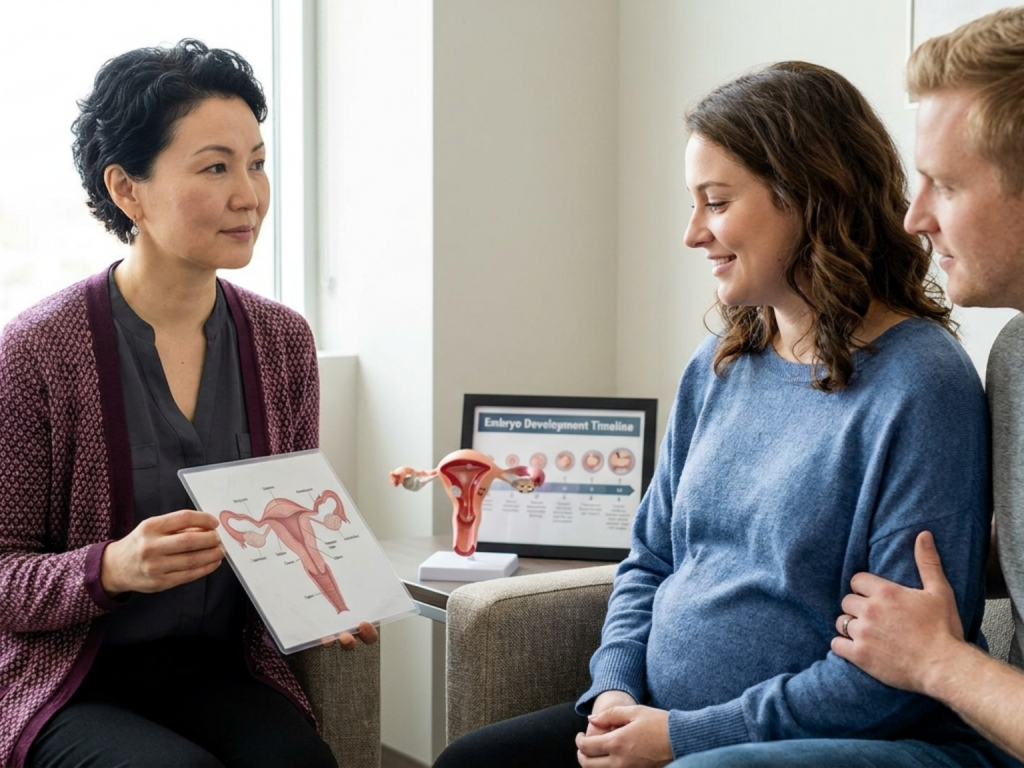
Intro
Fertilization and implantation are two closely linked but distinct stages that begin a pregnancy. Fertilization is the moment when a sperm and egg combine to form a zygote; implantation is the later step when that early embryo attaches to and begins embedding in the uterine lining.
Although these events are often spoken about as if they happen at once, they unfold over several days and require precise coordination between the gametes, the embryo, and the maternal reproductive tract. Understanding the biology can make the process feel less mysterious, especially if you are trying to conceive or waiting for a pregnancy test.
Highlights
Fertilization usually happens in the fallopian tube, not in the uterus, and it requires sperm to pass several biological checkpoints before fusion can occur.
After fertilization, the embryo divides repeatedly while traveling toward the uterus, eventually becoming a blastocyst.
Implantation can happen only during a short window when the endometrium is receptive to attachment and invasion.
A fertilized egg does not always become an implanted pregnancy; timing, embryo quality, and uterine receptivity all matter.
Early pregnancy tests detect hCG, a hormone that rises only after implantation has started.
Fertilization starts in the fallopian tube
After ejaculation, sperm travel through the cervix and uterus toward the fallopian tube, where an ovulated oocyte may be waiting. This journey is selective: many sperm never reach the tube, and those that do must first undergo capacitation, a functional maturation process in the female reproductive tract that prepares them for fertilization.
When a sperm reaches the oocyte, it must cross the cumulus cells and bind to the zona pellucida, the glycoprotein coat that surrounds the egg. That binding triggers the acrosome reaction, in which enzymes and membrane changes help the sperm penetrate the zona. Only after this does the sperm membrane fuse with the oocyte membrane.
Fusion is not just a mechanical event. It activates the egg, triggers changes that prevent additional sperm from entering, and allows the paternal and maternal genetic material to come together. Once the pronuclei unite, the cell is now a zygote, the first embryonic stage of a new pregnancy. This is the biological starting point, but it is still far from implantation.
From zygote to blastocyst
After fertilization, the zygote does not immediately grow larger. Instead, it undergoes rapid cleavage divisions, which split one cell into many smaller cells without increasing the overall size. These early divisions produce a compact ball of cells called the morula.
As the embryo continues moving through the fallopian tube toward the uterus, fluid enters the cell mass and a cavity forms. At that point the embryo becomes a blastocyst, with two important parts: the inner cell mass, which will form the fetus, and the outer trophoblast layer, which will help form the placenta.
Before the embryo can implant, it must also escape the zona pellucida. This step is called hatching from the zona pellucida. Hatching matters because the blastocyst has to make direct contact with the uterine lining in order to attach. If the zona remains intact for too long, implantation cannot proceed normally.
In practical terms, this means there is a biologically timed handoff: the fallopian tube supports fertilization and early cleavage, while the uterus must be ready by the time the blastocyst arrives.
The uterus opens a narrow implantation window
The uterine lining, or endometrium, is not equally receptive every day. Under the influence of estrogen and progesterone, it becomes secretory, more vascular, and temporarily capable of supporting attachment. This short period is often called the implantation window.
During this window, the blastocyst can move from loose contact to a more stable interaction with the uterine surface. The classic sequence is often described as apposition, adhesion, and invasion. In apposition, the blastocyst aligns with the endometrial surface. In adhesion, molecular signals strengthen the attachment. In invasion, trophoblast cells begin to move into the endometrial stroma.
This is why timing is so important. A healthy embryo arriving too early or too late may fail to attach simply because the endometrium is not synchronized with it. In reproductive medicine, that timing relationship is a major focus because endometrial receptivity can determine whether the embryo is able to proceed with the implantation process.
You may also see implantation described as the moment when the embryo “burrows” into the lining. That image is useful, but the reality is a highly coordinated exchange of signals between embryo and uterus, not a passive sinking motion.
What actually happens during implantation
Once the blastocyst attaches, the outer trophoblast layer differentiates into specialized cells. Some of these cells remain more cellular, while others fuse into a multinucleated layer known as the syncytiotrophoblast. This tissue is the main invasive component and is essential for establishing pregnancy.
The syncytiotrophoblast penetrates the endometrial surface and remodels local maternal tissue. This invasion is controlled rather than destructive; the goal is to establish a stable interface where nutrients, oxygen, and signaling molecules can be exchanged. At the same time, the embryo begins building the early foundations of the placenta.
One of the earliest signs of successful implantation is production of human chorionic gonadotropin (hCG). hCG helps maintain the hormonal environment needed to support the pregnancy, especially by preserving progesterone production in the early weeks. This hormone is also what home and blood pregnancy tests detect.
So when people talk about a positive pregnancy test, they are really detecting a downstream result of implantation rather than fertilization itself. That distinction matters, because fertilization can occur without implantation, and implantation can occur before the embryo produces enough hCG to be measurable.
For readers comparing the stages, the phrase blastocyst implantation in the uterus captures this transition well: a free-floating early embryo becomes anchored in the uterine lining and starts communicating with maternal tissue.
Why fertilization does not always lead to pregnancy
It is completely normal for fertilization and implantation to be discussed together, but biologically they are separate hurdles. Many fertilized eggs never implant. That does not mean anything was “wrong” in a simple sense; it means pregnancy depends on several conditions aligning at the same time.
One common reason is timing. If ovulation, sperm transport, embryo development, or endometrial receptivity are out of sync by even a small margin, implantation may not occur. Another reason is embryo quality. Chromosomal abnormalities can stop development before or just after implantation, even when fertilization itself was successful.
Transport problems in the fallopian tube, inflammation, uterine abnormalities, or hormonal factors can also interfere. In some cases, implantation occurs outside the uterus, most often in the fallopian tube; this is an ectopic pregnancy and requires urgent medical attention.
If conception is taking longer than expected, or if you have had repeated early losses, a fertility specialist or OB-GYN can help evaluate the likely causes. That evaluation may include menstrual history, ovulation timing, semen analysis, ultrasound, or hormonal testing. The main point is that fertility is not determined by one event alone; it is a sequence with several points of possible interruption.
How fertilization and implantation show up in early pregnancy
Because hCG rises only after implantation begins, a pregnancy test will usually not turn positive immediately after fertilization. Most home tests are most reliable after the missed period, when hCG has had time to accumulate. Testing earlier can produce a false negative even if implantation has occurred.
Some people notice mild cramping or light spotting around the time implantation happens, but these symptoms are not specific and cannot confirm pregnancy on their own. Many people have no noticeable symptoms at all during this stage.
It can help to think of early pregnancy as a biologic transition rather than a single moment. Fertilization creates the embryo, cleavage divisions prepare it, the blastocyst stage enables arrival in the uterus, and implantation initiates the hormonal and structural changes that support ongoing pregnancy.
If you want a day-by-day overview, the Timeline from fertilization to implantation can be a helpful way to place these events in sequence. For many people, seeing the steps laid out makes the waiting period feel a little less uncertain.
Most importantly, if you are trying to conceive and feel anxious while waiting, you are not alone. These early stages are invisible from the outside, but they are biologically active and tightly regulated.
When to seek medical care
- Severe one-sided pelvic pain, shoulder pain, fainting, or dizziness can be a warning sign of ectopic pregnancy.
- Heavy bleeding or worsening pain should be assessed promptly by a healthcare professional.
- A positive pregnancy test with significant pain or bleeding needs urgent evaluation.
- Repeated early losses or long-standing difficulty conceiving deserve medical review, not self-diagnosis.
- Fever or foul-smelling discharge is not typical of implantation and should be checked.
Tools & Assistance
- A menstrual cycle tracker or calendar to estimate ovulation timing
- A home pregnancy test used according to the package instructions
- An appointment with an OB-GYN, midwife, or fertility specialist
- Trusted patient education from Mayo Clinic or peer-reviewed medical sources
FAQ
What is the difference between fertilization and implantation?
Fertilization is the fusion of sperm and egg to form a zygote. Implantation happens later, when the blastocyst attaches to and invades the uterine lining.
How long after fertilization does implantation happen?
In humans, implantation usually begins several days after fertilization, after the embryo has divided and reached the blastocyst stage.
Can you feel implantation?
Some people notice mild cramping or spotting, but many feel nothing. These symptoms are not specific enough to confirm implantation.
Why can a pregnancy test be negative right after conception?
Pregnancy tests detect hCG, which is produced after implantation starts. If hCG has not risen enough yet, the test can still be negative.
Is implantation the same as a pregnancy becoming established?
Implantation is the key step that allows pregnancy to continue, but it is still early and vulnerable. Many biological factors must still work together after implantation begins.
Sources
- National Center for Biotechnology Information (PMC) — The cell biology of fertilization: Gamete attachment and fusion
- National Center for Biotechnology Information (PMC) — Human embryo implantation
- Mayo Clinic — Fertilization and implantation
Disclaimer
This article is for educational purposes only and does not replace personalized medical advice, diagnosis, or treatment. If you have pain, heavy bleeding, or concerns about fertility or pregnancy, contact a healthcare professional.


















Please log in to leave a comment.