
Intro
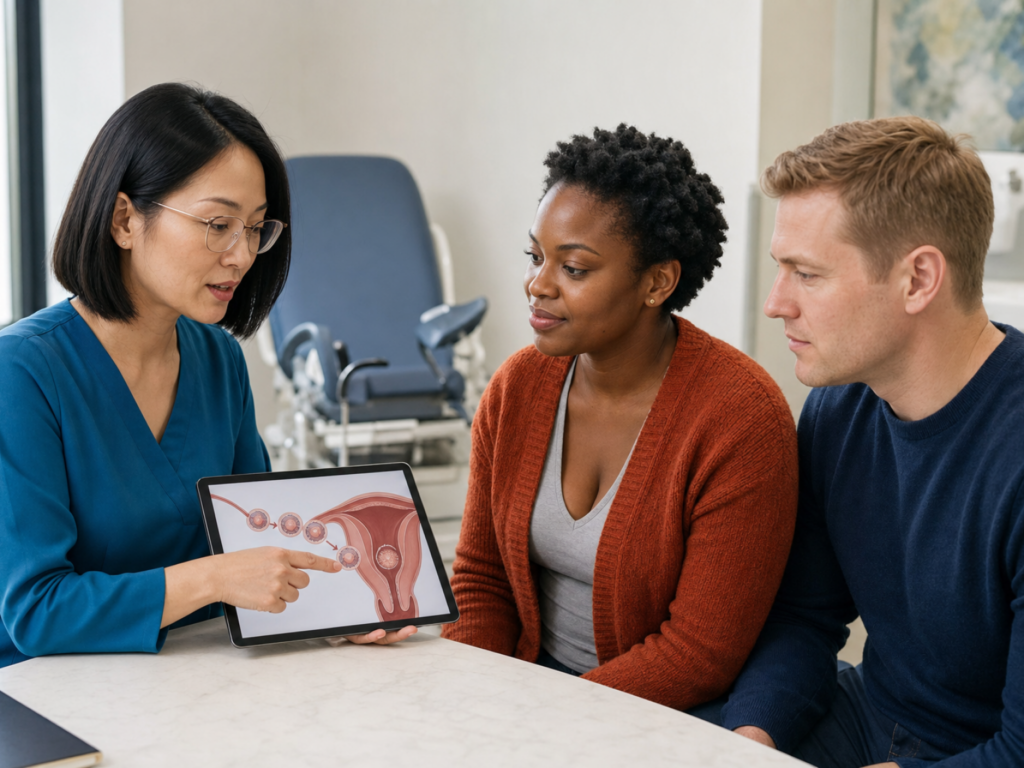
Implantation is one of the earliest and most biologically complex steps in pregnancy. It is the stage when a developing embryo, now called a blastocyst, attaches to and begins to embed within the lining of the uterus. For many people, this happens before a pregnancy test can reliably confirm anything, which can make the waiting period feel emotionally intense and uncertain.
At a cellular level, implantation is not a single event but a coordinated sequence involving embryo development, endometrial receptivity, hormonal signaling, immune tolerance, and tissue remodeling. Understanding what is known, and what cannot be known from symptoms alone, can help you interpret this early window with more calm and realistic expectations.
Highlights
Implantation usually occurs several days after fertilization, when the blastocyst reaches a receptive endometrium and begins to embed in the uterine lining.
The classic biological stages are apposition, adhesion, and invasion, each involving specific interactions between embryonic trophoblast cells and endometrial tissue.
Human implantation is interstitial, meaning the embryo becomes buried within the endometrium rather than remaining on the surface.
Mild cramping or light spotting may occur around the time implantation is possible, but symptoms are nonspecific and cannot confirm pregnancy.
If you have severe pain, heavy bleeding, dizziness, or risk factors for ectopic pregnancy, prompt medical assessment is important.
What implantation means in early pregnancy
Implantation is the biological transition from a free-floating early embryo to an embryo physically connected with the maternal uterine lining. After fertilization, the single-celled zygote divides repeatedly as it travels through the fallopian tube toward the uterus. By roughly day 5 to day 6 after fertilization, it typically reaches the blastocyst stage, a fluid-filled structure with an inner cell mass that will contribute to the embryo and an outer layer of trophoblast cells that will help form the placenta.
The blastocyst must then interact with a prepared endometrium, the inner lining of the uterus. If the endometrium is receptive and the embryo is developmentally competent, implantation can begin. This is the earliest point at which the future placenta starts establishing a relationship with maternal tissue, although a clinically recognized pregnancy is usually confirmed later by rising human chorionic gonadotropin, or hCG.
It can be reassuring to remember that implantation is microscopic. Most people cannot feel it happening in a specific, reliable way. Even in cycles that lead to pregnancy, there may be no noticeable sensations at all.
Timing: when implantation usually occurs
In a natural conception cycle, fertilization occurs shortly after ovulation if sperm are present and an egg is successfully fertilized. The embryo then spends several days dividing and traveling before it reaches the uterine cavity. Implantation most often begins around 6 to 10 days after ovulation, though timing varies among individuals and cycles.
The endometrium is not equally receptive throughout the entire cycle. Under the influence of progesterone after ovulation, the lining undergoes secretory transformation and becomes capable of supporting embryo attachment for a limited interval often called the implantation window. Many scientific descriptions place this window in the mid-luteal phase, approximately days 20 to 24 of a typical 28-day cycle, though real cycles are often shorter, longer, or hormonally variable.
In assisted reproduction, timing is deliberately coordinated. For example, in embryo transfer cycles, clinicians match the embryo stage with the number of days the endometrium has been exposed to progesterone. This coordination is one reason timing matters so much in fertility treatment, but it should be interpreted by the treating team rather than self-adjusted.
The receptive endometrium: preparing the uterine lining
Implantation depends not only on the embryo but also on the endometrium. After ovulation, progesterone changes the uterine lining from a proliferative tissue into a secretory, receptive environment. Glands become more active, blood flow changes, and stromal cells begin decidualization, a transformation that makes the tissue more supportive of implantation and early placental development.
Decidualization involves structural, biochemical, and immune changes. Endometrial stromal cells enlarge and alter their secretory profile; immune cells such as uterine natural killer cells and macrophages participate in tissue remodeling and immune regulation; and molecular signals help distinguish a receptive state from a non-receptive one. This does not mean the immune system is simply “turned off.” Rather, early pregnancy requires carefully regulated immune tolerance and controlled inflammation.
At the surface of the endometrium, specialized epithelial changes also occur. The blastocyst and the endometrial epithelium communicate through cytokines, growth factors, hormones, and adhesion molecules. If the timing or biology is misaligned, the embryo may not attach successfully, even if fertilization occurred.
Stage 1: apposition, the first loose contact
Apposition is the initial, relatively unstable positioning of the blastocyst against the endometrial surface. At this stage, the embryo is oriented so that the trophoblast can make contact with the uterine lining. The blastocyst has also “hatched” from the zona pellucida, the protective outer shell that surrounded it during the earliest days of development. Hatching is necessary because the embryo cannot implant while enclosed within that shell.
This first contact is delicate. The blastocyst is not yet deeply attached, and the interaction may be reversible. Molecular mediators on both the embryonic and maternal surfaces help guide recognition. Scientific reviews describe roles for selectins, integrins, cadherins, immunoglobulin superfamily molecules, mucins, and other signaling systems in this early dialogue.
Although these mechanisms are often described step by step, in the body they overlap. The embryo and endometrium are continuously exchanging signals, and successful apposition depends on both correct timing and a receptive tissue environment.
Stage 2: adhesion, firmer attachment to the uterine lining
Adhesion follows apposition and represents a more stable binding between trophoblast cells and the endometrial epithelium. During this stage, cell-surface adhesion molecules become especially important. Integrins, for example, are transmembrane receptors that help cells bind to extracellular matrix components and transmit signals across the cell membrane. Cadherins help mediate cell-to-cell adhesion. Selectins and immunoglobulin-like molecules also contribute to the carefully regulated attachment process.
The endometrium must allow attachment without triggering a destructive immune response. This is biologically remarkable because the embryo contains genetic material from both parents and is not identical to maternal tissue. Local immune modulation, hormonal support, and decidual transformation help create an environment where attachment can proceed.
For someone trying to conceive, this stage is still invisible. There is no home method to detect apposition or adhesion directly. A pregnancy test becomes positive only after implantation has progressed enough for trophoblast-derived hCG to enter maternal circulation and then urine in detectable amounts.
Stage 3: invasion and early placental formation
Invasion is the stage in which trophoblast cells penetrate beyond the surface epithelium and into the endometrial stroma. Human implantation is described as interstitial because the embryo becomes embedded within the endometrium. As implantation advances, the surface epithelium closes over the conceptus, placing it within the uterine lining rather than merely attached on top of it.
Trophoblast cells differentiate into specialized populations. Cytotrophoblast cells serve as proliferative precursors, while syncytiotrophoblast cells are invasive and contribute to early maternal-fetal exchange. The syncytiotrophoblast also produces hCG, the hormone detected by pregnancy tests. Early hCG supports the corpus luteum, helping maintain progesterone production until the developing placenta can take over more of that endocrine role.
Invasion must be balanced. Too little invasion may be associated with failed implantation or early pregnancy loss; abnormal invasion patterns later in pregnancy are linked with placental disorders. However, these are complex medical issues that cannot be inferred from mild symptoms or a single cycle outcome. If you have concerns about repeated losses, infertility, or prior placental complications, a reproductive endocrinologist or obstetric clinician can guide appropriate evaluation.
What implantation may feel like
Many people search for signs of implantation during the luteal phase. Some report mild pelvic cramping, brief spotting, breast tenderness, bloating, or fatigue around the time implantation could occur. However, these experiences overlap strongly with normal progesterone effects before a period. They can happen in both pregnant and non-pregnant cycles.
Implantation bleeding, when it occurs, is usually described as light spotting rather than heavy bleeding. It is not a reliable diagnostic sign. Similarly, cramping that is mild and brief can be nonspecific. Severe pain, one-sided pain, shoulder-tip pain, fainting, or heavy bleeding should not be assumed to be implantation and warrants medical advice, especially if pregnancy is possible.
The most practical way to assess pregnancy is testing at the right time. Urine pregnancy tests are generally more reliable after a missed period, though some sensitive tests may detect hCG earlier. Testing too soon can produce a false negative simply because implantation and hCG rise have not yet progressed enough.
Why implantation may not happen
Not every fertilized egg implants. This can be emotionally difficult, particularly when you are closely tracking ovulation or undergoing fertility treatment. Biologically, failed implantation may relate to embryonic chromosomal abnormalities, embryo developmental arrest, inadequate endometrial receptivity, hormonal factors, uterine cavity issues, inflammatory or immune factors, or timing mismatch. Often, a single unsuccessful cycle does not mean anything is “wrong.”
In natural cycles, many fertilization and implantation failures occur before a person knows conception may have happened. In IVF, the process is more visible because embryos are observed and transferred, making unsuccessful implantation feel more concrete. Even then, clinicians interpret outcomes in context: age, embryo quality or genetic testing results, uterine findings, transfer technique, endocrine environment, and prior history all matter.
If you have been trying to conceive for 12 months if under 35, 6 months if 35 or older, or sooner if you have irregular cycles, known reproductive conditions, recurrent pregnancy loss, or a history of ectopic pregnancy, it is reasonable to consult a healthcare professional. Evaluation can be supportive and clarifying, but testing and treatment should be individualized.
Implantation in IVF and embryo transfer cycles
In IVF, implantation biology is broadly similar once an embryo reaches the uterus, but the route to that point differs. Eggs are retrieved, fertilized in the laboratory, and embryos are transferred into the uterus at a defined stage, often cleavage-stage or blastocyst-stage. In frozen embryo transfer cycles, the endometrium may be prepared through a natural ovulatory cycle, a modified natural cycle, or a medicated cycle using estrogen and progesterone.
The goal is synchrony: the embryo’s developmental stage should match the endometrium’s progesterone exposure and receptivity. A blastocyst transferred into an appropriately prepared uterus still must hatch if needed, appose, adhere, and invade. Transfer itself does not guarantee implantation.
Patients often ask whether bed rest, certain foods, supplements, or activity restrictions can make implantation happen. Evidence for many popular practices is limited, and some supplements or medications may be inappropriate. Follow your fertility clinic’s instructions, take prescribed medications exactly as directed, and ask before adding over-the-counter products.
When to seek medical advice urgently
- Heavy bleeding, passing large clots, or bleeding with weakness or fainting needs prompt medical assessment.
- Severe pelvic pain, one-sided pain, shoulder-tip pain, or dizziness can be concerning if pregnancy is possible.
- A positive pregnancy test with worsening pain or bleeding should be discussed with a clinician to rule out ectopic pregnancy or other complications.
- Fever, foul-smelling discharge, or severe abdominal tenderness should not be attributed to implantation.
- If you have recurrent pregnancy loss, prior ectopic pregnancy, or fertility treatment complications, contact your care team early.
Tools & Assistance
- Track ovulation dates, menstrual cycle length, and test dates to interpret timing more accurately.
- Use a home pregnancy test after a missed period or as advised by your clinician or fertility clinic.
- Contact an obstetrician, midwife, reproductive endocrinologist, or primary care clinician for individualized guidance.
- Keep a concise symptom log if you have bleeding, pain, or recurrent cycle concerns.
- Seek urgent care or emergency services for severe pain, fainting, or heavy bleeding when pregnancy is possible.
FAQ
Can I feel implantation happening?
Usually, no. Some people notice mild cramps or light spotting around the possible implantation window, but these signs are nonspecific and can also occur before a period.
How soon after implantation will a pregnancy test be positive?
hCG begins rising after implantation progresses, but urine tests may not detect it immediately. Testing after a missed period is generally more reliable than very early testing.
Is implantation bleeding common?
Light spotting can occur in early pregnancy, but not everyone has it, and spotting does not confirm implantation. Heavy bleeding or significant pain should be assessed medically.
Does failed implantation mean infertility?
Not necessarily. Many fertilized eggs do not implant, often because of embryo factors. Repeated unsuccessful cycles or specific risk factors are reasons to seek professional evaluation.
Is implantation different after IVF?
The embryo still needs to attach and invade the endometrium, but IVF allows clinicians to control embryo transfer timing and endometrial preparation more precisely.
Sources
- PubMed Central (PMC) — A Review of Mechanisms of Implantation
- Development (The Company of Biologists) — Human embryo implantation
- Mayo Clinic — Fertilization and implantation
Disclaimer
This article is for general medical education only and does not diagnose, treat, or replace care from a qualified healthcare professional. If you may be pregnant and have pain, heavy bleeding, dizziness, or concerning symptoms, seek medical advice promptly.
















Please log in to leave a comment.