
Intro
School attendance can become emotionally complicated when a child feels unable to enter the building, stay for the day, or even begin the morning routine. For many families, this is not defiance in the ordinary sense; it is a distress pattern that can involve anxiety, depression, social stress, learning difficulties, neurodevelopmental needs, family strain, or a combination of factors.
Highlights
School refusal is usually a sign of distress, not a parenting failure or a child being deliberately difficult.
Early, coordinated support from caregivers, school staff, and healthcare professionals improves the chance of a calm return to attendance.
Avoidance can become self-reinforcing, so compassionate firmness and predictable routines matter.
Medical, psychological, learning, bullying, and family factors should all be considered before deciding on a plan.
What school refusal means
School refusal describes a pattern in which a child or teenager has significant difficulty attending school because of emotional distress. The child may plead, cry, freeze, become angry, complain of physical symptoms, or repeatedly seek reassurance. Some children make it to the school gate but cannot enter; others attend part of the day and then ask to go home. Unlike truancy, school refusal is often known to caregivers, and the child may want relief rather than secrecy or rule-breaking.
Clinically, it is helpful to view school refusal as a behavior with a function. The child may be trying to escape panic, separation distress, social humiliation, academic failure, bullying, sensory overload, or depressive exhaustion. The outward behavior can look oppositional, but the internal experience may be fear, shame, or overwhelm. Yale Medicine notes that an estimated 10–15% of children are chronically absent because of anxiety, depression, social issues, or learning problems, and anxiety is often a root cause.
School refusal can occur at any age, but it is common around transitions: starting school, changing grades, moving schools, returning after illness, or shifting from primary to middle school. Families may notice that mornings become the crisis point, with escalating bargaining, stomachaches, headaches, or panic-like symptoms. The goal is not to force a child without understanding them; it is to combine empathy, assessment, and gradual re-engagement with school.
Why a child may refuse school
There is rarely a single cause. Anxiety disorders, separation anxiety, panic symptoms, depression, trauma responses, and social anxiety can all make school feel unsafe. A child may fear being called on, eating in front of peers, using the bathroom, being separated from a caregiver, or having another panic episode in class. School refusal linked to anxiety can become stronger when staying home brings immediate relief, even if everyone wants attendance in the long term.
Learning and neurodevelopmental factors also matter. A child with reading, writing, mathematics, attention, language, executive functioning, or autism-related needs may experience school as a repeated exposure to failure or overstimulation. If the child is punished for unfinished work without understanding the underlying difficulty, avoidance may be a protective response. School accommodations for learning difficulties can be essential when academic demands are part of the trigger.
Social factors require careful attention. Bullying, exclusion, conflict with a teacher, racism, discrimination, cyberbullying, or fear of violence can make school genuinely unsafe. Family circumstances can also amplify nonattendance: inconsistent routines, parental distress, housing instability, illness, bereavement, or high conflict may reduce the structure that helps children face difficult mornings. None of these explanations means blame. They guide the team toward a safer, more specific plan.
First steps at home: calm, clear, and consistent
The morning of a refusal episode is not the best time for long arguments. A useful stance is warm but firm: acknowledge the child’s distress, state the expectation, and move to the next step. For example, a caregiver might say, “I can see your stomach feels tight and you are scared. We are still going to school, and I will help you take the first step.” This kind of response validates emotion without making avoidance the solution.
Predictability reduces negotiation. Prepare clothes, bags, food, transport, and medication routines the night before. Use a visual schedule for younger children or a written checklist for older children. Keep instructions brief. Praise brave behavior specifically: getting dressed, entering the car, walking through the gate, attending one lesson, or speaking to a trusted staff member. Bravery is not the absence of fear; it is doing the next manageable step while fear is present.
It is also important not to accidentally make staying home more rewarding than school. If a child is too distressed to attend, the home day should be calm, supervised, and low stimulation: no gaming, streaming, social media scrolling, or special treats during school hours. This is not punishment. It prevents the brain from learning that distress leads to a more appealing day. If physical symptoms are prominent or new, seek medical advice rather than assuming they are “just anxiety.”
Working with the school as a team
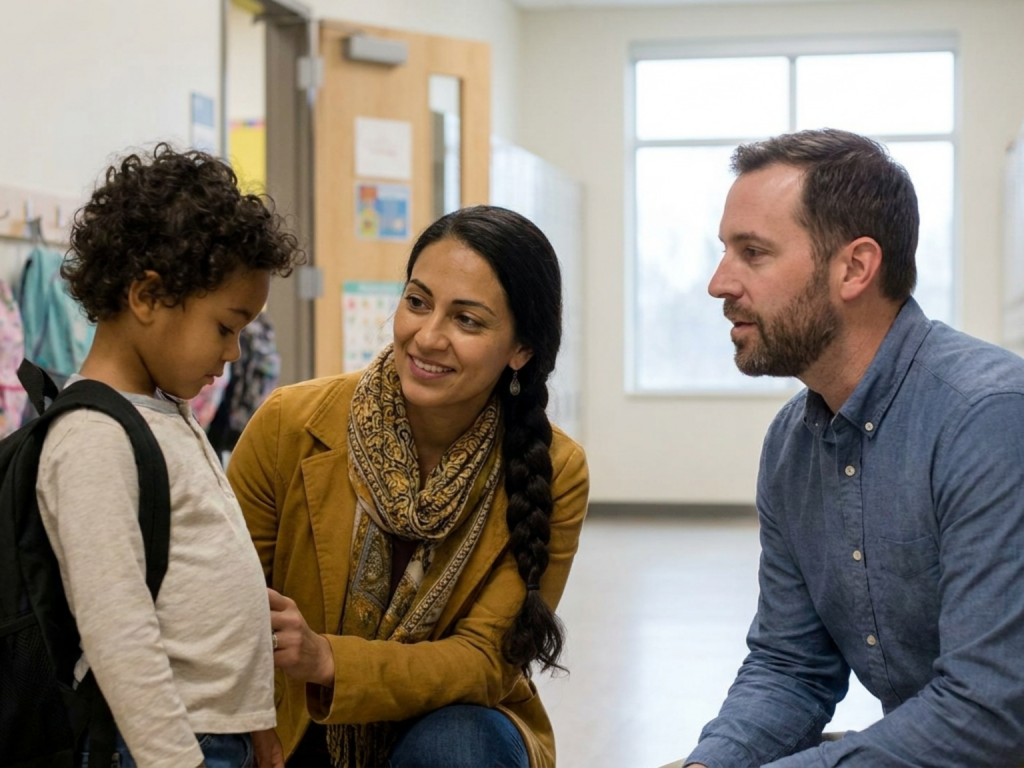
School refusal is best managed through collaboration. Parents should contact the school early and ask for a meeting with a teacher, counselor, pastoral lead, nurse, attendance officer, or administrator. The first purpose is to identify triggers: a particular lesson, hallway, peer group, assessment, bus ride, lunchtime, sensory environment, or staff interaction. The second purpose is to agree on a practical return plan so the child is not expected to solve the problem alone.
A reintegration plan may include a named safe adult, a calm arrival point, reduced morning demands, check-ins, permission to use a quiet space, modified workload, supported transitions between classes, or a graded timetable that increases attendance over days or weeks. For children with disability, chronic illness, neurodevelopmental needs, or mental health impairment, formal supports such as an IEP or 504 plan may be relevant depending on the education system. Mental health services in schools can also provide counseling, skills practice, and monitoring.
The plan should reduce barriers without making avoidance the default. For example, a child might start by attending the first two periods, then add lunch, then add afternoon classes, with clear criteria for progression. If bullying or safety concerns are identified, the priority is protection and accountability, not exposure to harm. School transitions in children need extra planning because even capable students can regress when routines, relationships, and expectations change abruptly.
When professional help is needed
Seek professional support when refusal persists for more than a few days, attendance is worsening, distress is intense, physical symptoms are frequent, or the family feels trapped in a daily crisis. A GP or pediatrician can assess medical contributors such as gastrointestinal illness, migraine, sleep disorders, medication effects, endocrine concerns, chronic pain, or fatigue. They can also screen for anxiety, depression, trauma, eating concerns, substance use in adolescents, and safety risks.
A child psychologist, psychiatrist, or appropriately trained mental health clinician can help clarify the maintaining cycle and offer evidence-based treatment. Cognitive behavioral approaches often involve psychoeducation, gradual exposure, coping skills, emotion regulation, parent coaching, and problem-solving with the school. Treatment may focus on tolerating uncertainty, reducing reassurance loops, managing panic sensations, improving sleep, or rebuilding confidence after academic or social setbacks. Families should not start or stop medication without a qualified prescriber’s guidance.
Urgent help is needed if the child talks about wanting to die, self-harms, appears severely depressed, is not eating or sleeping adequately, has psychotic symptoms, is unsafe at home or school, or if caregivers fear they cannot keep the child safe. In these situations, contact emergency services, a crisis line, or urgent mental health care according to local pathways.
Building a sustainable return to attendance
A sustainable plan is usually gradual, measurable, and compassionate. Begin with the smallest meaningful attendance target that interrupts avoidance: entering the building, attending homeroom, staying until recess, or completing one preferred class. Record what was achieved, what was hard, and what helped. Progress may be uneven; a setback after illness, holidays, exams, or peer conflict does not mean the plan has failed.
Families can support the return by protecting sleep, morning nutrition, movement, and screen boundaries. Evening reassurance rituals should be brief and consistent rather than expanding into hours of problem-solving. It can help to create a “coping card” with the child’s own phrases: “Anxiety is uncomfortable but not dangerous,” “I can ask my safe adult for help,” or “I only need to do the next step.” Older children and teenagers should be included in planning so they retain dignity and agency.
Review the plan frequently with the school and clinician if involved. If the child’s distress decreases but attendance remains low, the team may need to reduce accommodations that have become unnecessary. If distress remains high, reassess for missed factors such as bullying, trauma, learning disorder, autism, ADHD, depression, or family stress. The aim is not perfect attendance at any cost; it is safe, developmentally appropriate participation in learning and relationships.
Warning signs to take seriously
- Any talk of suicide, self-harm, or feeling unable to stay safe needs urgent professional help.
- New, severe, or persistent physical symptoms should be medically assessed.
- Bullying, threats, abuse, or discrimination require immediate safeguarding action.
- Rapidly worsening sleep, eating, mood, or functioning warrants prompt clinical review.
- Do not use threats, humiliation, or physical force to get a distressed child into school.
Tools & Assistance
- Create a written morning routine with one small brave step at a time.
- Ask the school for a meeting to identify triggers and agree on a return plan.
- Consult a GP, pediatrician, psychologist, or child mental health clinician if refusal persists.
- Request assessment for learning, attention, language, or neurodevelopmental needs when indicated.
- Keep home during school hours calm, supervised, and low reward if the child is absent.
FAQ
Is school refusal the same as truancy?
Not usually. In school refusal, caregivers often know the child is absent, and the child’s behavior is driven by distress rather than hidden rule-breaking.
Should I let my child stay home until they feel ready?
Occasional rest may be necessary for illness or acute crisis, but open-ended avoidance can reinforce fear. Seek help to plan a gradual, supported return.
Can stomachaches or headaches be part of school refusal?
Yes, anxiety and stress can produce real physical symptoms. New, severe, or persistent symptoms should still be assessed by a healthcare professional.
What if school is genuinely unsafe?
If bullying, threats, abuse, or discrimination are present, safety planning and school accountability come first. A child should not simply be exposed to harm.
Do accommodations make avoidance worse?
Well-designed accommodations reduce barriers while preserving attendance goals. They should be reviewed and adjusted so they support participation rather than long-term withdrawal.
Sources
- Yale Medicine — Avoiding and Refusing to Go to School | Fact Sheets
- Raising Children Network — School refusal: children & teenagers
- Effective School Solutions — School Refusal Interventions: Evidence-Based Solutions
Disclaimer
This article is for general educational purposes and is not a diagnosis or treatment plan. Consult a qualified healthcare professional for concerns about a child’s attendance, mental health, physical symptoms, or safety.


















Please log in to leave a comment.