
Intro
Many families think of bedtime as the most difficult hour of the day, especially when a child is tired, overstimulated, or worried about separating from a caregiver. A predictable bedtime routine can soften that transition. When the sequence is familiar and the timing is steady, the child’s nervous system gets a reliable cue that sleep is coming.
This does not mean every night will be perfect. Illness, travel, late events, and family stress all happen. But a consistent bedtime routine can still reduce the amount of struggle, support better sleep continuity, and make bedtime feel safer and more manageable for everyone.
Highlights
Consistency helps children anticipate sleep, which can reduce protest, arousal, and nighttime waking.
The most effective routine is usually simple, repeatable, and calming rather than long or elaborate.
Regular sleep timing supports circadian rhythm stability, which is the body’s internal clock for sleep and wakefulness.
Inconsistency can make bedtime negotiations harder because children learn that resistance sometimes changes the outcome.
Why consistency matters
In early childhood, sleep is shaped by both biology and behavior. A consistent bedtime routine gives the child repeated cues that it is time to shift from alertness to rest. Over time, those cues become familiar enough that the child’s brain begins to expect sleep at roughly the same point each evening. That expectation can lower pre-sleep arousal and make the transition smoother.
Longitudinal research in children has found that more consistent bedtime routines are associated with fewer nighttime awakenings and fewer sleep problems over time. In practical terms, the routine does not only help children fall asleep; it can also improve how sleep is maintained through the night. The goal is not perfection. The goal is reliable repetition.
Families often worry that a short routine will not be enough, but a predictable sequence is usually more useful than a long one. A child does not need ten different steps. They need the same few steps, in the same order, repeated often enough to become reassuring. That is the heart of consistent bedtime routines.
What a steady bedtime routine looks like
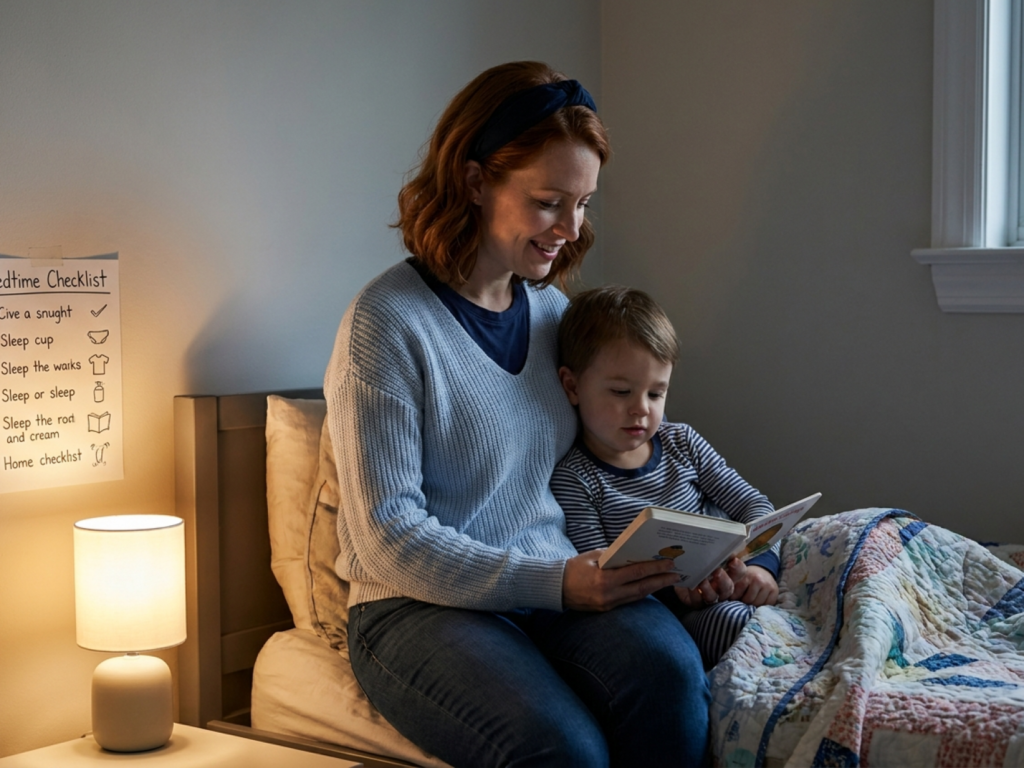
A good bedtime routine is calm, brief, and boring in the best possible way. The exact steps can vary by age and family preference, but many routines include the same basic pattern: a warning that bedtime is approaching, a quiet wash-up or toileting step, pajamas, tooth brushing, one short story or song, and lights out. The sequence matters more than any single activity.
For many children, calming bedtime activities work best when they happen in the same order each night. This is where a screen-free bedtime routine often helps, because screens can be mentally activating and can delay sleep onset by increasing alertness and shifting attention away from winding down. The room does not need to be silent or perfect; it just needs to feel predictable.
It can help to think of the bedtime routine as a bridge between the busy part of the day and sleep. A bridge works because it is stable and repeatable. If the child knows what comes next, there is less room for negotiation, more room for co-regulation, and a gentler handoff into rest.
How consistency works on a biological level
Sleep is regulated by two major systems: the circadian rhythm, which is the body’s 24-hour timing clock, and sleep pressure, which builds across the day the longer a child stays awake. A consistent bedtime routine supports both. Regular timing strengthens the circadian signal, while the repeated wind-down sequence helps the child move from high arousal to lower arousal.
Young children also learn through conditioning. If the same cues appear every night, their bodies begin to associate those cues with sleep. Over time, brushing teeth, dimmed lights, and a favorite book can become powerful sleep signals. When those signals change constantly, the brain has more work to do, and sleep can become harder to initiate or sustain.
Although the child-focused evidence is strongest in early childhood, the same general principle appears in adult research as well. Greater sleep variability is linked with worse health outcomes, while earlier and more regular sleep timing is associated with better health. That broader pattern reinforces a simple point: regularity is biologically meaningful, not just behaviorally convenient.
Making consistency realistic for busy families
Many caregivers feel discouraged when life makes a perfect routine impossible. But consistency does not require rigidity. It means protecting the core structure of bedtime even when the day is messy. The core usually includes a similar time, the same general order, and a calm caregiver response. If those three pieces stay stable, the routine can survive a surprising amount of disruption.
Families with shift work, multiple homes, or frequent travel may need a portable version of the routine. A favorite book, a short song, or a familiar phrase can travel well. In some homes, a visual checklist helps children follow the sequence without repeated prompting. In others, the best strategy is simply to keep the steps short enough that all adults can repeat them the same way.
The routine also works best when caregivers are aligned. If one adult allows a long extension and another expects lights out immediately, the child has a moving target. Predictable family routines reduce that ambiguity. They also reduce the emotional energy spent on bedtime negotiations, which matters for both the child and the adult who is trying to end the day.
When bedtime resistance keeps happening
Some bedtime resistance is developmentally expected. Children may protest separation, seek another story, or ask for repeated reassurance. That does not automatically mean the routine is failing. Sometimes it reflects normal separation distress at bedtime, especially in younger children or during stressful transitions. In those cases, the answer is usually not more complexity, but more steadiness.
However, some patterns deserve closer attention. If a child remains highly distressed despite repeated consistency, if sleep is persistently fragmented, or if the child seems unusually sleepy, irritable, or behaviorally dysregulated during the day, it is reasonable to discuss the pattern with a pediatrician or other qualified clinician. Sleep difficulty can reflect pain, anxiety, snoring-related breathing problems, medication effects, or another medical issue that needs review.
Some families also face difficulty maintaining routine in children because of neurodevelopmental differences, household instability, or significant stress. That is not a failure of parenting. It is a signal to simplify the routine, lower the number of transitions, and seek tailored support when needed.
Supporting sleep without turning bedtime into a battle
The emotional tone of bedtime matters. Children usually settle better when adults remain calm, predictable, and brief. Gentle repetition is often more effective than escalation. Co-regulation, meaning the child borrows calm from the adult, is especially important when a child is overtired or anxious. A steady voice and a familiar sequence can do more than repeated explanations.
It can also help to separate the bedtime goal from the child’s behavior in the moment. A child may still cry, delay, or test boundaries even when the routine is good. That does not mean the routine has no value. It may simply mean the child is learning the limit. Keep the response short, return the child to the routine, and avoid adding new negotiations that only appear when the child resists.
Over time, the aim is for bedtime to feel boring, safe, and unsurprising. That kind of predictability supports sleep architecture, which is the structure of sleep across the night, and it helps both the child and the caregiver end the day with less friction. If the routine remains difficult despite consistent effort, a professional review is appropriate rather than more self-blame.
When to seek medical advice
- New snoring, gasping, or pauses in breathing during sleep.
- Persistent night waking with daytime sleepiness, poor growth, or major behavior change.
- Severe bedtime distress, panic, or worsening separation anxiety that does not improve.
- Sleep changes after illness, medication changes, trauma, or a major family disruption.
Tools & Assistance
- Pediatrician or family doctor
- Bedtime log for 1 to 2 weeks
- Visual bedtime checklist
- NHS sleep advice for young children
FAQ
How strict should bedtime consistency be?
Aim for a stable routine and a fairly regular bedtime, but allow some flexibility for illness, travel, or unusual family events.
What matters more, the exact time or the order of steps?
Both matter, but the sequence of calming steps is often easier to protect than an exact minute on the clock.
Do screens before bed really make a difference?
They often do. Screens can increase alertness and make it harder for children to wind down, so a screen-free bedtime routine is usually helpful.
When should I ask for help?
If sleep problems are persistent, severe, or linked with snoring, breathing concerns, pain, or daytime impairment, speak with a clinician.
Sources
- PubMed — Bedtimes, bedtime routines, and children's sleep across early childhood
- PubMed — Sleep timing, sleep consistency, and health in adults
- NHS — Sleep and young children
Disclaimer
This article is for general information only and is not a substitute for individualized medical advice, diagnosis, or treatment. If a child has persistent sleep problems or concerning symptoms, please consult a qualified healthcare professional.


















Please log in to leave a comment.