
Intro
Making baby food at home can feel both practical and high-stakes. The right equipment can reduce preparation time, improve consistency, and make it easier to offer varied textures as your baby develops. However, a specialized appliance is not essential for every family: many caregivers can prepare simple foods safely with ordinary kitchen tools.
The best choice depends on your baby's developmental stage, the foods you plan to prepare, your available storage space, cleaning tolerance, and whether convenience is worth the additional cost. This guide compares dedicated baby food makers with versatile kitchen basics while keeping food safety, texture progression, and responsive feeding at the center.
Highlights
A dedicated baby food maker may combine steaming and blending, reducing transfers between appliances.
A standard blender, food processor, steamer basket, knife, fork, and storage containers can cover many household needs.
Ease of cleaning, batch capacity, and texture control often matter more than the number of programmed settings.
Food texture should follow developmental readiness and guidance from your baby's healthcare professional.
What a baby food maker actually does
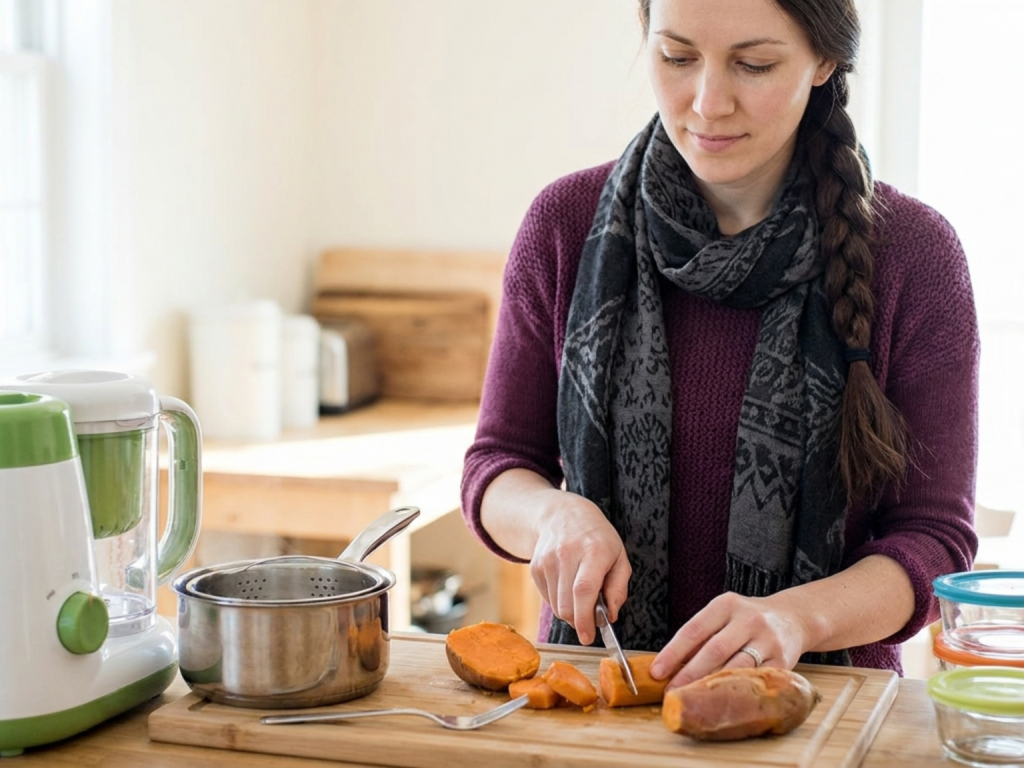
Dedicated baby food makers are designed to streamline several steps of preparation. Depending on the model, a single vessel may steam ingredients, blend them, or perform both functions in sequence. This can reduce the need to move hot food between a saucepan, steamer, blender, and storage bowl. Some current products are marketed around automatic steaming and blending in one step, a feature intended to simplify routine preparation for busy caregivers.
The main advantage is workflow efficiency rather than a unique nutritional effect. Steaming can soften vegetables, fruit, and other ingredients before blending, while the blending stage can produce a smoother or more textured consistency. A combined unit may be particularly useful when preparing small portions frequently, when counter space is limited, or when a caregiver values programmed cooking more than maximum appliance versatility.
There are trade-offs. A specialized appliance can have a smaller working capacity than a full-size food processor, and its components may still require careful disassembly and washing after every use. Some families use the steaming function regularly but rarely use the blending function, or vice versa. Before buying, consider whether the appliance solves a recurring problem in your kitchen or simply duplicates equipment you already own.
The essential tools for a flexible kitchen setup
Many families can prepare baby food without a dedicated machine. A sharp kitchen knife and a stable cutting board are useful for trimming and cutting ingredients into pieces suitable for cooking. A saucepan with a steamer basket can soften foods without requiring a separate appliance. A fork or potato masher can create a coarse mash, which may be preferable to a completely smooth puree as texture progresses.
A countertop blender or food processor is helpful for larger batches and a broad range of household recipes. An immersion blender can be convenient for blending directly in a deep container, although hot-food handling instructions should be followed carefully. A fine-mesh sieve may help refine a mixture when a smoother consistency is clinically or developmentally appropriate, but it is not necessary for every preparation.
Small, airtight food-storage containers or freezer trays support portioning and reduce repeated handling. Choose containers intended for food use and suitable for the storage method you plan to use. A silicone spatula helps scrape food from bowls and reduces waste, while measuring spoons can support consistency when combining ingredients. These ordinary tools are often enough for caregivers who prepare food in family-sized batches or already own reliable kitchen equipment.
Choosing tools by texture and developmental stage
The most useful tool changes as feeding develops. Early spoon-fed foods may require a blender, food processor, or fine mashing tool, but an ultra-smooth texture is not necessarily the long-term goal. As a baby becomes ready for more varied consistencies, a fork, masher, or pulsing function may offer better control than continuous high-speed blending. Being able to stop and inspect the mixture is important because texture can change quickly.
Texture decisions should be individualized. Readiness for complementary foods depends on developmental factors, and babies differ in oral-motor skills, medical history, and feeding needs. A pediatric clinician, pediatric dietitian, or feeding therapist can offer specific guidance, particularly for a baby born prematurely or a child with dysphagia, neuromuscular conditions, reflux concerns, or a history of feeding difficulty.
Tools should support safe preparation rather than determine what a baby is given. A powerful blender may produce a smooth puree, but it cannot assess whether a food is appropriate for a particular developmental stage. Avoid assuming that a manufacturer’s preset automatically creates a safe texture for every baby. Inspect each portion, remove hard or unsafe pieces, and follow professional advice about progression from purees to mashed, lumpy, and appropriately soft finger foods.
Safety features that deserve close attention
Heat, sharp blades, steam, and small detachable parts create the principal equipment hazards. Look for secure lids, stable bases, clear locking mechanisms, and controls that reduce the chance of accidental activation. Steam can cause serious burns, so allow the vessel to cool as directed and open lids away from your face and hands. Keep blades covered or stored safely when they are not in use, and never reach into a container while a motor is connected to power.
Food safety also depends on the preparation environment. Wash hands, clean work surfaces, and use equipment that can be fully disassembled for washing. Inspect gaskets, blades, valves, and concealed channels for trapped food residue. Damaged seals or cracked containers should be replaced because they may leak, harbor contamination, or fail during heating.
Preparation tools cannot remove all feeding risks. A smooth blend may still contain a hard fragment, seed, peel, or bone, and a food that is nutritious may still be inappropriate in a particular shape or texture. Follow current guidance from your healthcare professional on choking prevention, allergen introduction, food storage, reheating, and ingredients such as honey, added salt, and added sugar. Seek urgent medical help for a suspected choking event or a severe allergic reaction.
Cleaning, capacity, and daily usability
Cleaning is one of the strongest predictors of whether a tool will be used consistently. An appliance with several narrow tubes, hinges, or difficult-to-remove seals may take longer to clean than a simple saucepan and fork. Check which parts are removable, whether they are dishwasher-safe according to the manufacturer, and whether the working bowl can be inspected easily after blending. Dishwasher compatibility is helpful, but it does not replace checking for residue in blades, seams, and seals.
Capacity should match your actual routine. A small bowl may be convenient for a single serving but inefficient for batch cooking. A large food processor may save time for family meals, although it can be cumbersome when preparing a small amount. Consider the entire workflow: ingredient preparation, cooking, blending, cooling, portioning, labeling, refrigeration or freezing, and washing.
Noise and storage can also affect usability. A machine that is difficult to access may be abandoned in a crowded cupboard, while a compact tool that remains available may become part of the daily routine. Choose equipment with controls you can operate safely and confidently. The best tool is usually the one that makes safe preparation repeatable when you are tired, rushed, or caring for a baby who needs attention.
When a dedicated appliance is worth buying
A specialized baby food maker may be worthwhile when it reduces repeated work that your household genuinely performs. It can be convenient for caregivers who want an integrated steaming and blending process, prepare small batches often, or prefer automated timing. It may also help organize a kitchen in which a full-size blender is too large or inconvenient for modest portions.
Before purchasing, compare the machine with tools you already own. Ask whether you need steaming, blending, reheating, defrosting, or only one of those functions. Consider the bowl size, texture control, noise level, cleaning process, replacement-part availability, warranty, and counter footprint. Read the operating instructions for limits on ingredients, hot liquids, and continuous run time.
A dedicated machine is less compelling when you already have a dependable blender or food processor, a saucepan with a steamer basket, and suitable storage containers. Standard kitchen equipment can be more versatile because it continues to serve the whole family after the baby-food stage. A modest setup may also leave more room in the budget for fresh ingredients and storage supplies. Convenience is valuable, but it should be evaluated against frequency of use and total maintenance rather than marketing claims alone.
A practical starter kit for most families
For many households, a balanced starter kit includes a stable cutting board, a sharp knife used by an adult, a saucepan with a steamer basket, a fork or masher, one reliable blending option, and several small food-storage containers. This arrangement supports steamed foods, mashed preparations, smooth purees, and gradual texture changes without requiring a large collection of single-purpose devices.
Add specialized equipment only when a specific limitation becomes clear. If blending small portions is difficult, a compact processor or immersion blender may help. If steaming is the bottleneck, a dedicated steamer or integrated baby food maker may be useful. If storage is the problem, portion containers and freezer-safe labels may have greater practical value than another cooking appliance.
Prepare one ingredient at a time when introducing unfamiliar foods if that matches your clinician’s advice, and keep portions identifiable. Observe your baby during feeding and respond to signs of readiness, fatigue, discomfort, or refusal. Food preparation is only one part of feeding: a calm, supervised routine and a responsive relationship remain more important than achieving a perfectly uniform puree.
Important safety reminders
- Never leave a baby unattended while eating, regardless of the tool used to prepare the food.
- Handle steam, hot liquids, and recently cooked food cautiously to prevent burns.
- Inspect purees and mashed foods for hard fragments, pits, bones, skins, or other unexpected pieces.
- Clean and dry equipment thoroughly, including blades, seals, valves, and narrow channels.
- Ask a healthcare professional about texture progression, allergens, prematurity, dysphagia, or feeding difficulties.
- Replace cracked, warped, leaking, or damaged components.
Tools & Assistance
- A saucepan with a steamer basket for softening ingredients
- A fork, potato masher, or immersion blender for texture control
- A countertop blender or food processor for larger batches
- Small airtight, food-safe containers or freezer trays for portioning
- A pediatric clinician or pediatric dietitian for individualized feeding guidance
FAQ
Do I need a dedicated baby food maker?
No. Many families can prepare suitable foods with a saucepan, steamer basket, fork, blender, food processor, and storage containers. A dedicated appliance is mainly a convenience choice.
Is steaming better than boiling for baby food?
Both methods can soften ingredients. Steaming may fit a compact workflow and can reduce the need to transfer hot food, but the appropriate method depends on the ingredient and your routine.
What is the best tool for changing food texture?
A fork or masher offers gradual control for coarse textures, while a blender or food processor is useful for smoother preparations. Texture should be matched to developmental readiness and professional guidance.
How do I choose between a blender and a food processor?
A blender may be convenient for smooth mixtures, whereas a food processor often handles larger batches and pulsed textures well. Compare the minimum working volume, cleaning requirements, and controls.
Can I prepare baby food in advance?
Many caregivers batch-cook and portion food, but storage, cooling, reheating, and discard rules must be followed carefully. Use current food-safety guidance and ask your healthcare professional about your baby's specific needs.
Sources
- BabyGearLab — The Best Baby Food Makers | Tested & Ranked
- Baby Brezza — Baby Food Blenders & Steamers
- CafeMom — 16 Baby Food–Making Tools You Already Have in Your Kitchen
Disclaimer
This article is for general informational purposes and is not medical advice, diagnosis, or treatment. Consult your baby's healthcare professional for individualized guidance on feeding readiness, textures, allergens, food safety, and medical conditions.














Please log in to leave a comment.