
Intro
In labor, the question is usually not whether a birthing ball is universally better than every other movement option. The practical question is which movement technique helps this person, at this moment, in this labor pattern. A birthing ball can support pelvic mobility, reduce the effort of staying upright, and offer a steady base for small position changes. Walking, swaying, rocking, squatting, and hands-and-knees positions each solve different problems.
For a medically literate reader, the useful frame is functional rather than idealized: what improves comfort, preserves energy, supports physiologic labor, and stays within the care plan. The best approach often changes across labor stages, and it may change again if monitoring, an epidural, fatigue, or back pain enters the picture.
Highlights
A birthing ball is a support tool for movement, not a treatment on its own.
Walking, standing, swaying, and rocking all load the body differently and serve different labor goals.
The best movement technique often changes with fatigue, pain location, monitoring, and whether an epidural is in place.
Good labor movement is usually a sequence of positions, not loyalty to one method.
What the ball contributes in labor
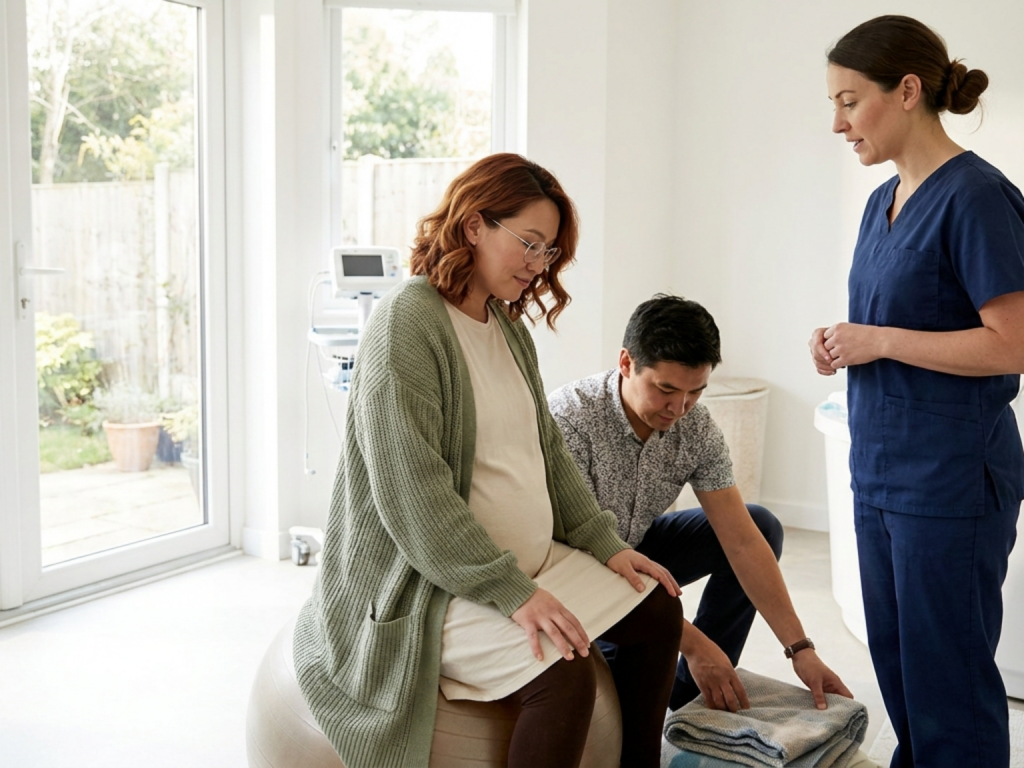
A birthing ball is best understood as a supported movement surface. It lets the pelvis move while giving the trunk a stable base, which can make it easier to stay upright without exhausting the legs. For many laboring people, that matters more than any single technical advantage. The ball can support small circles, gentle bouncing, side-to-side shifts, and subtle changes in pelvic angle without requiring constant walking.
That makes it different from other movement techniques. Walking adds forward motion and uses gravity, but it also uses energy. Standing and swaying are more grounded than walking, yet they still demand more muscle work than sitting on a ball. Rocking on the ball can feel rhythmic and controlled, while still preserving enough motion to keep the body from stiffening.
The main value is not dramatic. It is the ability to keep movement available when the person wants support, comfort, and some degree of pelvic freedom at the same time. That is why a birthing ball often appears in conversations about movement during natural childbirth, especially when the goal is to stay active without becoming physically depleted.
How it compares with walking, standing, swaying, and rocking
Each movement technique changes load, rhythm, and fatigue in a different way, so the comparison is less about superiority and more about fit.
- Walking can feel natural early in labor because it uses gravity and gives a sense of forward progress, but it often becomes tiring as contractions intensify.
- Standing and swaying provide upright posture and can be emotionally grounding, yet they still require leg strength and may be hard to sustain for long periods.
- Rocking and gentle hip circles can be done on the ball or on the edge of the bed, and they are useful when the person wants motion without a lot of exertion.
- Squatting may open the hips more, but it usually asks more of the thighs and balance system than sitting on a ball does.
The ball sits in the middle of this spectrum. It gives more support than standing, more controlled motion than walking, and often less strain than repeated squatting. It is especially useful when someone wants to keep moving but cannot comfortably pace the room or hold an upright posture for long. That practical tradeoff is why the birthing ball is often chosen as a bridge between active movement and rest.
When the ball may be the better fit
The ball is often most useful when the person wants to stay mobile without full ambulation. It can support rest between contractions, help the hips stay loose, and make it easier to shift weight from side to side if one area feels more strained than another. Some people also find that it is easier to tolerate for longer than standing, especially after a long early labor.
It may also fit well when the care team allows position changes after epidural analgesia. In that setting, the goal is not forceful activity. It is to preserve some pelvic mobility, reduce stiffness, and avoid being locked into one posture for hours. Small changes still matter when the body is less responsive than it was before the epidural.
For back discomfort, the ball is sometimes only part of the answer. The body may respond better when the ball is combined with forward-leaning labor positions, hands-and-knees for back labor, or a side-lying pushing position. In other words, the ball is one tool in a larger movement toolkit, not the only tool worth considering.
When other movement techniques are better
Other movement techniques become more useful when the ball is not enough or not practical. Walking can be a strong choice early in labor when a person still has energy and wants to stay upright. Swaying with a support person can be more reassuring when emotional grounding matters as much as physical position. Supported squatting during childbirth can feel helpful when the hips need more room, although it usually demands more strength than sitting on a ball.
If monitoring is in place, the team may encourage safe movement during fetal monitoring rather than free roaming. That can mean shorter position changes, a few steps to the bathroom, or using the ball only when the monitor stays in range. The point is to keep movement possible without creating avoidable friction with the care environment.
The right choice can also change hour by hour. A technique that felt excellent earlier may become tiring later. Labor is dynamic, and flexibility matters more than loyalty to one pattern. A person who started with walking may later do better with the birthing ball; someone who began on the ball may later prefer standing, leaning, or side-lying rest.
Using movement as a sequence, not a test
It helps to think of labor movement as a sequence. Many people move from walking to sitting on the birthing ball, then to leaning over the bed, then to side-lying rest, and back again. That pattern is normal. It reflects shifting needs for comfort, cervical progress, fatigue management, and monitoring rather than inconsistency or failure.
Support people and clinicians can make this easier by watching for tension, reminding the person to breathe, and helping with transitions between positions. Small details matter: the right ball height, a stable floor, non-slip footwear, and enough room for safe transfers. The safest plan is the one the person can actually maintain.
This is where movement and posture become more than comfort measures. They help the person conserve energy for later labor, stay oriented to the body, and preserve a sense of agency. That is one reason the comparison between a ball and other movement techniques should stay practical. The question is not which technique looks best in theory. The question is which one works well enough right now.
A practical way to choose
A simple decision framework can keep things clear. If the main issue is rest, the ball or side-lying may help more than walking. If the main issue is stiffness, standing, swaying, or short walks may be better. If the main issue is back pressure, hands-and-knees for back labor or a forward-leaning posture may be more effective than sitting upright. If the main issue is limited mobility because of treatment or monitoring, the best option may be the safest available option rather than the most active one.
That perspective is especially useful because it avoids treating movement as a moral choice. In labor, the goal is not to be active for its own sake. The goal is to find a body position that supports physiologic labor, preserves energy, and respects the care plan. For many people, that means blending techniques rather than using only one.
When in doubt, ask the labor nurse, midwife, or obstetric clinician what movement range is appropriate at that moment. Good guidance is usually specific: what is allowed, what is not, and what should be reassessed after the next contraction or exam. The best labor movement plan is one that can adapt cleanly when the situation changes.
When to pause movement
- Stop and ask for help if movement causes dizziness, chest pain, shortness of breath, or a sudden worsening of pain.
- Do not use a ball if it feels unstable, is the wrong height, or you cannot get on and off safely.
- Follow the labor team’s guidance if monitoring, IV access, or epidural effects limit mobility.
- Seek urgent clinical attention for heavy bleeding, severe abdominal pain, fluid leakage, or decreased fetal movement.
Tools & Assistance
- Obstetric clinician or midwife consultation
- Childbirth education class
- Labor and delivery unit mobility policy review
- Pelvic health physical therapist if mobility is limited
FAQ
Is a birthing ball better than walking?
Not always. A birthing ball offers support and controlled motion, while walking uses gravity and may help early labor. The better choice depends on comfort, fatigue, monitoring, and clinical guidance.
Can the ball help if I have an epidural?
Sometimes, if the care team allows position changes after epidural analgesia. The aim is usually gentle repositioning rather than vigorous movement.
What if back pain is my main issue?
Some people do better with the ball, but others need hands-and-knees for back labor, forward-leaning support, or a side-lying position. The response is individual.
Should I stay on one movement technique once I find it?
No. Labor changes over time, so a technique that helps now may not help later. It is normal to switch between the ball, standing, swaying, walking, and resting.
Sources
- Breakthrough Basketball — Basketball Dribbling and Ball Handling Fundamentals, Drills, & Tips
- US Sports Camps — Basketball Ball Handling Drills - Tips
- Competitor: Jurnal Pendidikan Kepelatihan Olahraga — The Effect of Ball Handling Training on Improving Basic Dribbling ...
Disclaimer
This article is for general educational purposes only and does not replace medical advice, diagnosis, or care from your obstetric clinician, midwife, or emergency services.

















Please log in to leave a comment.