
Intro
Labor is dynamic: the uterus contracts, the cervix effaces and dilates, the fetus rotates and descends, and the pelvis adapts moment by moment. Maternal position is one of the few variables a birthing person can often adjust in real time, and it can influence both mechanical progress and perceived comfort.
There is no universally “best” labor position. The most helpful position depends on stage of labor, fetal position, pain location, mobility, monitoring needs, epidural use, fatigue, and medical circumstances. The goal is not to perform labor correctly, but to use movement and support safely, in partnership with the clinical team.
Highlights
Upright and active positions during the first stage of labor are associated with shorter labor, less pain, and higher maternal satisfaction in multiple evidence summaries.
Position affects labor through gravity, pelvic diameter changes, fetal rotation, uterine perfusion, pressure distribution, and the birthing person’s sense of control.
Hands-and-knees, forward-leaning, side-lying, standing, walking, and supported squatting can each be useful in different clinical situations.
Epidural analgesia, continuous fetal monitoring, intravenous lines, fatigue, or obstetric complications may limit mobility, but many people can still change positions safely with assistance.
Positioning should always be individualized; persistent severe pain, abnormal bleeding, fetal heart rate concerns, or instructions from the care team take priority.
Why position matters in labor
Labor progress is often described in centimeters of cervical dilation, but the physiology is broader than that. The fetus must usually flex the head, rotate through the pelvis, descend, and align with the maternal pelvic outlet. Maternal position can alter the relationship between the uterus, fetus, cervix, pelvic floor, sacrum, and soft tissues. Small shifts in posture may change where pressure is felt, how effectively contractions press the presenting part onto the cervix, and how easily the fetus can rotate.
Position also affects comfort through neurologic and musculoskeletal pathways. Contraction pain comes from uterine ischemia, cervical stretch, pelvic pressure, ligament tension, and sometimes sacral nerve irritation. When a birthing person changes position, the load on the sacrum, hips, back, pelvic floor, and abdominal wall changes. This may reduce a sharp focal pain, make contractions feel more productive, or help the person rest between contractions.
Psychological comfort matters too. Being able to move, choose, lean, sway, or rest can reduce helplessness and increase a sense of control. Maternal satisfaction is not merely emotional; reduced fear and muscle guarding may support more effective coping, breathing, and cooperation with contractions. Evidence summarized in clinical and research sources suggests that upright positions during the first stage are associated with faster labor progress, lower pain scores, and higher satisfaction compared with more recumbent positions for many people.
Upright positions and labor progress
Upright positions during labor include standing, walking, slow dancing with a support person, sitting upright, kneeling, lunging, and using a birth ball while the torso remains vertical or forward. These positions may help labor progress by using gravity to encourage fetal descent and by allowing the uterus to work in a more forward direction rather than pressing the fetus against the maternal spine.
Research comparing upright and recumbent positions has found that upright positioning in the first stage can significantly improve childbirth progress and reduce pain levels. Evidence summaries also report shorter labors among people who use upright and active positions, with one review discussed by Evidence Based Birth noting an average reduction of about 82 minutes in the first stage. These numbers should not be interpreted as a guarantee for an individual birth, but they support the principle that freedom of movement can be clinically meaningful.
Standing and walking may be especially helpful in early and active labor when contractions are regular but the birthing person still has enough energy to move. Walking can create rhythmic pelvic motion, and standing can allow the abdomen to hang forward, potentially improving fetal alignment. Some people instinctively sway or lean during contractions; this is often a useful response, not a loss of control.
Upright does not always mean strenuous. Sitting on a birth ball, leaning over the raised head of a bed, or kneeling with the chest supported can provide the advantages of verticality while conserving energy. The best upright positions are usually supported positions: the body is aligned, the shoulders can release, the jaw is relaxed, and the birthing person does not feel at risk of falling.
Recumbent, side-lying, and rest positions
Recumbent positions include lying on the back, semi-reclining, or lying flat. These positions are common in hospitals because they can make examinations, fetal monitoring, anesthesia care, and some interventions easier. However, prolonged flat-on-back positioning may be uncomfortable for some people and can reduce pelvic mobility. In late pregnancy, the heavy uterus may also compress major blood vessels when someone lies supine, which can affect maternal blood pressure and uteroplacental blood flow in susceptible individuals.
This does not mean that lying down is wrong. Rest is a legitimate labor tool. Labor can be long, and fatigue can interfere with coping, pushing effectiveness, and decision-making. Side-lying position during contractions may be helpful when the birthing person is exhausted, has an epidural, needs continuous monitoring, or is experiencing rapid labor and wants less intense downward pressure.
Side-lying can also keep the pelvis relatively open, especially when the upper leg is supported with pillows or a peanut ball. It may reduce pressure on the sacrum compared with lying flat on the back. For some fetal positions, alternating left and right side-lying, or using exaggerated side-lying with the upper knee elevated, may create asymmetry in the pelvis that helps rotation.
Semi-reclining may be a reasonable compromise when medical access is needed, but it can place weight on the sacrum. If progress seems slow or back pressure increases, the team may suggest adjusting the bed, tilting the body, placing a wedge under one hip, or changing to side-lying, hands-and-knees, or supported sitting if safe.
Pelvic mechanics, fetal rotation, and back labor
The pelvis is not a fixed ring during labor. The sacroiliac joints, coccyx, pelvic floor, and hip position all influence the space available at different pelvic levels. Wide knees may not always mean more room; sometimes internal rotation of the thighs or asymmetrical positions such as lunging can create better dimensions for a particular fetal position. This is why a position that helped at 5 centimeters may feel ineffective or overwhelming at 8 centimeters.
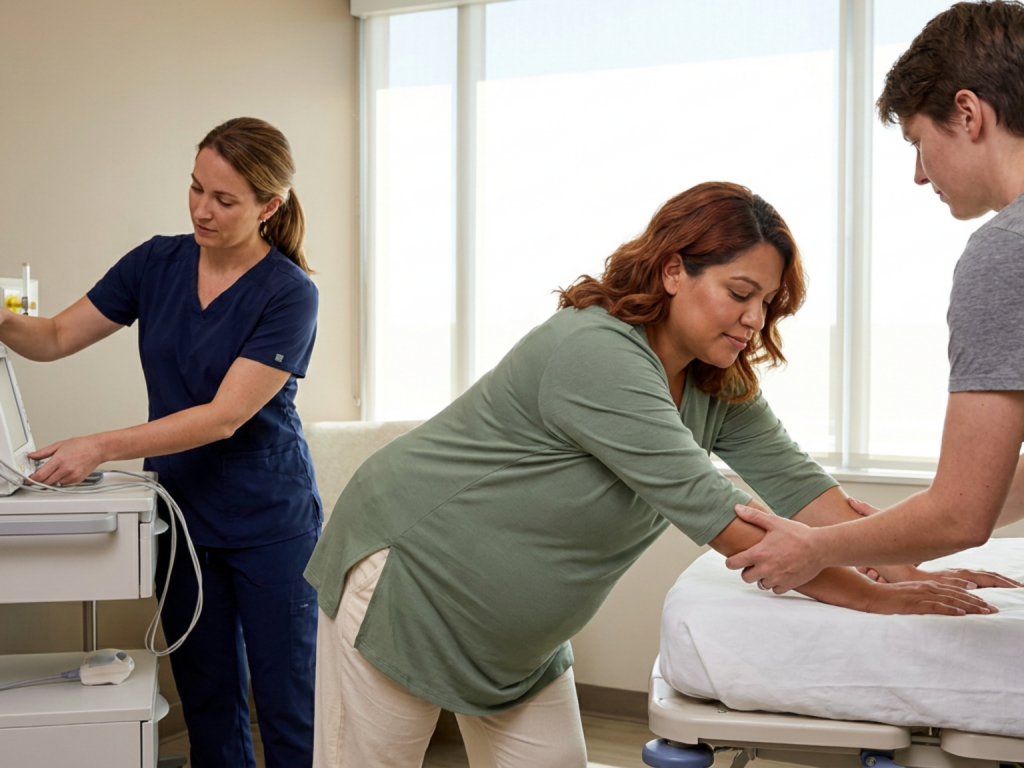
Back labor is often associated with pressure near the sacrum and may occur when the fetal occiput is posterior or when the presenting part presses strongly on posterior pelvic structures. Hands-and-knees position for back labor can be useful because it takes pressure off the sacrum, allows the abdomen to hang forward, and may give the fetus more space to rotate. Mayo Clinic notes that hands-and-knees may help with back pain and may also improve the baby’s oxygen supply in some circumstances.
Forward-leaning labor positions can also be helpful when the birthing person feels contractions mainly in the back. Leaning over a bed, counter, birth ball, or support person shifts the abdomen forward and may reduce spinal compression. A support person or doula may apply sacral counterpressure during contractions if the birthing person finds it relieving, but pressure should be guided by comfort and stopped if it worsens pain.
Asymmetrical positions, such as one foot on a stool, side-lying with a peanut ball, or a supported lunge, may encourage fetal rotation by changing the pelvic inlet and midpelvis. These should be used carefully, especially with epidural analgesia or balance concerns. The goal is to create space and comfort, not to force the fetus into position.
Positioning through the stages of labor
In early labor, comfort and conservation of energy are often the priorities. Many people benefit from normal activity, upright positions during labor, rest, hydration as allowed, warm showers if approved, and positions that feel sustainable. Gentle walking, sitting on a birth ball, leaning forward during contractions, or lying side-lying between contractions can all be appropriate depending on the situation.
In active labor, contractions intensify and cervical dilation usually progresses more rapidly. Changing positions in active labor may help the birthing person cope with stronger sensations and may support fetal descent. A practical approach is to reassess every 20 to 40 minutes, or sooner if the position stops helping. Some people prefer a predictable rhythm: stand and sway for several contractions, kneel and lean for several contractions, then rest on the side.
Transition, the late first stage before full dilation, can feel intense and disorganizing. At this point, complex position changes may feel like too much. Simple, supported positions often work best: hands-and-knees, side-lying, kneeling over the bed, or sitting upright with strong emotional support. If there is an urge to push before full dilation, the care team may suggest positions that reduce pressure, such as side-lying or hands-and-knees, while assessing cervical status.
During the second stage, pushing positions include upright kneeling, supported squatting, side-lying, semi-reclining, hands-and-knees, sitting on a birth stool where available, or using squat bars. Evidence summaries suggest that standing and squatting may shorten the second stage for some people and may be associated with less pain and greater satisfaction. However, pushing position must also account for fetal heart rate, maternal blood pressure, perineal assessment, clinician access, epidural density, and the birthing person’s stamina.
Epidurals, monitoring, and medical constraints
Many people worry that an epidural means they must remain in one position. In reality, position changes after epidural analgesia are often possible, but they usually require assistance because leg strength, sensation, and balance may be reduced. The degree of mobility depends on medication dose, institutional policy, monitoring equipment, and maternal and fetal status.
With an epidural, side-lying with a peanut ball, supported sitting, throne position, lateral tilt, and assisted hands-and-knees may be options in some settings. Nurses and midwives are often highly skilled at helping people rotate safely in bed. Frequent repositioning can reduce pressure points, improve comfort, and sometimes support fetal rotation or descent even when walking is not possible.
Continuous fetal monitoring can also affect mobility, but it does not always eliminate movement. Some units have wireless or telemetry monitors; others can adjust belts while the birthing person stands, sits on a ball, or leans forward. Safe movement during fetal monitoring depends on whether the tracing remains adequate and whether the clinical situation requires closer observation.
There are times when the safest position is the one recommended by the care team. For example, fetal heart rate abnormalities, significant bleeding, hypertensive emergencies, suspected cord complications, operative vaginal birth, or preparation for cesarean birth may temporarily limit positioning choices. In these moments, positioning becomes part of medical stabilization rather than comfort alone. It is reasonable to ask, “Can I change position safely?” and “What position would help the baby and me right now?”
Choosing positions with confidence and flexibility
The most effective positioning plan is flexible rather than rigid. A birth plan may list preferences such as mobility, birth ball use, hands-and-knees, shower, side-lying, or supported squatting in labor, but labor may require adaptation. The body’s feedback is valuable: a position that makes contractions feel more centered, reduces back pain, improves breathing, or allows relaxation between contractions is often worth continuing if clinically safe.
A simple framework is to match the position to the need. If labor feels slow and the birthing person has energy, upright movement may help. If back pain dominates, forward-leaning, hands-and-knees, or counterpressure may be useful. If exhaustion is rising, side-lying rest may be the best intervention. If pushing feels ineffective, a change in hip angle or pelvic asymmetry may help the fetal head descend.
Support people can assist by protecting the environment: keeping the floor dry, offering hands for balance, adjusting pillows, reminding the birthing person to soften the shoulders and jaw, and calling staff before major movements if monitoring, epidural tubing, or IV lines are present. The aim is not constant motion; it is responsive movement.
Finally, comfort is not a minor outcome. Feeling less pain, more agency, and more support can change the entire experience of birth. Positioning cannot guarantee a vaginal birth, prevent complications, or replace skilled clinical care, but it is a low-tech, physiologic tool that often helps labor feel more manageable and purposeful.
When to get immediate clinical guidance
- Do not change position without help if an epidural, dizziness, weakness, or fall risk is present.
- Call the care team promptly for heavy bleeding, sudden severe abdominal pain, chest pain, fainting, or shortness of breath.
- Follow urgent instructions if fetal heart rate concerns, cord issues, or blood pressure problems are suspected.
- Avoid forcing deep squats or lunges if they cause sharp pain, numbness, instability, or pelvic injury symptoms.
- If waters have broken and there is concern for cord prolapse or the baby is not engaged, follow emergency instructions immediately.
Tools & Assistance
- Discuss mobility preferences and monitoring options during prenatal visits.
- Ask the birth unit whether birth balls, peanut balls, squat bars, showers, or telemetry monitoring are available.
- Practice supported positions with a partner or doula before labor.
- Use the nurse, midwife, or physician as a safety guide when changing positions.
- Create a flexible birth preference list rather than a fixed sequence of positions.
FAQ
Is lying on my back always bad during labor?
Not always. Some people need or prefer semi-reclining positions, especially for assessment or rest. However, prolonged flat supine positioning may be less comfortable and may limit pelvic mobility for some.
Can I move if I have continuous fetal monitoring?
Often, yes, but it depends on the equipment, fetal tracing quality, and clinical situation. Ask the care team which movements are safe while maintaining adequate monitoring.
What position is best for back labor?
Many people find hands-and-knees, forward-leaning, side-lying, or sacral counterpressure helpful. The best option depends on fetal position, comfort, and safety.
Can positioning make labor shorter?
Evidence suggests upright and active positions can shorten labor on average, especially in the first stage, but individual outcomes vary and many factors affect labor duration.
What if I have an epidural?
You may still be able to change positions with assistance, such as side-lying with a peanut ball or supported sitting. Never stand or walk after an epidural unless your clinical team specifically confirms it is safe.
Sources
- National Center for Biotechnology Information / PubMed Central — Examining the impact of upright and recumbent positions on labor
- Evidence Based Birth — Positions during Labor and their Effects on Pain Relief
- Mayo Clinic — Labor positions
Disclaimer
This article is for informational purposes only and does not replace medical advice. Always consult your obstetric, midwifery, or labor care team about safe positioning for your individual situation.
















Please log in to leave a comment.