
Intro
Traveling with an infant can be exhausting, and hotel sleep often feels like a practical puzzle layered on top of jet lag, unfamiliar surroundings, and a worried parent’s instinct to keep a baby safe. The good news is that the core principles of infant safe sleep do not change just because you are away from home: the goal is a separate, firm, flat sleep surface, placed free of loose bedding and other hazards.
This article explains how to think about hotel sleep in a medically cautious way, what to do if a crib is unavailable, and how to preserve familiar routines without compromising safe sleep. It is written for parents and caregivers who want concrete guidance while still relying on established pediatric sleep-safety recommendations.
Highlights
Hotel sleep for babies should be planned around safe sleep, not convenience. The safest setup is still a separate crib, bassinet, or portable play yard with a firm, flat mattress.
Hotels are not legally required to provide cribs or other infant sleep products, so families should confirm availability before arrival and have a backup plan.
Routine matters in a hotel room because predictable bedtime cues can reduce overstimulation and help a baby settle, even in an unfamiliar space.
If no safe sleep surface is available, the answer is not to improvise with a soft bed, couch, or armchair; the priority is to create or find a safer alternative.
Any baby with medical fragility, prematurity, breathing concerns, or feeding difficulties deserves individualized advice from a pediatric clinician.
Why hotel sleep needs extra planning
A hotel room changes several variables at once: the room may be darker or brighter than home, the temperature may differ, noise can be unpredictable, and there may be less space for the usual crib or bassinet setup. For babies, these environmental shifts can disrupt settling and increase parental stress.
The medical priority, however, stays simple. Safe infant sleep is about the sleep surface and the sleep environment. A baby should sleep on the back, on a separate sleep surface, without pillows, blankets, bumpers, or other soft items. Convenience matters, but it cannot override safety.
What safe sleep still looks like away from home
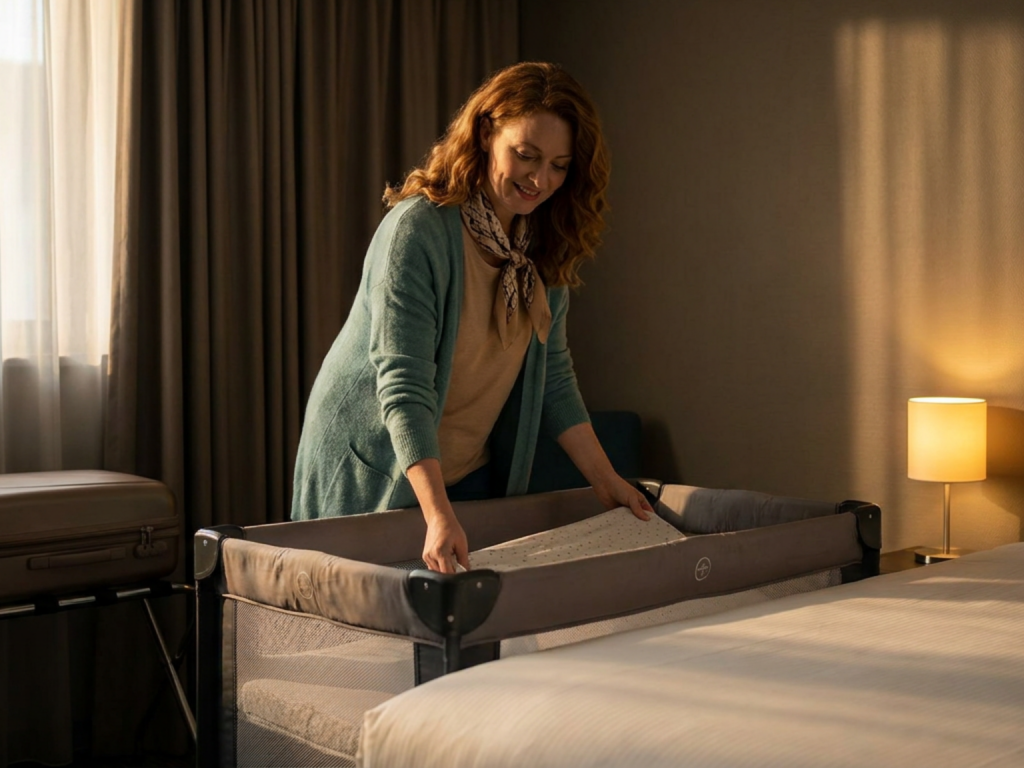
The safest hotel arrangement is the same general arrangement recommended anywhere else: place the baby on the back in a crib, bassinet, or portable play yard with a firm, flat mattress and no loose bedding. This is the standard regardless of whether the family is at home, visiting relatives, or staying overnight in a hotel.
A separate infant sleep surface also helps preserve the boundary between adult and infant sleep. That matters because couches, armchairs, and adult beds are not safe sleep environments for infants. If a room lacks a proper setup, the safest response is to troubleshoot the room itself or bring a portable option rather than adapt an unsafe adult surface.
How to prepare before you book or travel
Preparation reduces last-minute pressure. Before booking, call the hotel and ask specifically whether a crib, bassinet, or portable play yard is available, whether it is guaranteed, and whether it meets current safe sleep standards. Consumer guidance notes that hotels are not legally required to provide these items, so families should not assume one will be waiting in the room.
If your baby usually sleeps in a crib at home, bringing a familiar portable sleep solution can reduce uncertainty. Many families also pack a travel sheet sized for the baby’s approved sleep product, a familiar sleep sack if it is already used safely, and the baby’s usual bedtime items such as a pacifier or white-noise device. The goal is familiarity, not a complete bedroom makeover.
It also helps to prepare for logistics: confirm room type, ask about refrigerator access if feeds need storage, and think about whether you will have enough space to separate the baby’s sleep area from adult conversation, screens, and luggage. Small details can make a hotel room feel much more manageable.
What to do if the hotel has no crib
If the hotel does not have a crib, bassinet, or play yard, do not default to the adult bed, a sofa, or a cushioned chair. Those surfaces carry avoidable risk for infants. Instead, ask whether a safer portable sleep space can be borrowed, whether one can be delivered later, or whether you can switch rooms to create enough room for your own travel sleep equipment.
If a safe sleep surface truly is unavailable, the most appropriate action may be to change the sleeping arrangement rather than force a compromise. Families sometimes feel pressured to “make do,” but safe sleep guidance is specifically designed to prevent tragedies that are easy to underestimate in a tired, unfamiliar setting.
When a baby must stay in the same room as adults, room-sharing without bed-sharing remains the safer model. That means the baby sleeps separately, while caregivers stay nearby and responsive. The distinction is critical: proximity is not the same thing as sharing a sleep surface.
How to support bedtime routine in a hotel room
Babies generally do better when sleep cues are consistent. Even in a hotel, try to preserve the sequence your baby knows: dim lights, diaper change, feeding if due, quiet interaction, and then placement into the approved sleep surface while drowsy or ready for sleep. A predictable pattern can help orient a baby who is otherwise surrounded by novelty.
Environmental control matters too. Closing curtains, reducing screen exposure, lowering conversation volume, and using familiar low-stimulation bedtime cues can make a hotel room feel more sleep-friendly. If your baby is sensitive to light or noise, portable blackout shades or a white-noise device can be useful practical aids.
Think of these steps as behavioral scaffolding rather than a guarantee. A baby may still wake more often in a hotel because sleep is influenced by developmental stage, hunger, discomfort, and the ordinary unpredictability of infant sleep. The goal is not perfection; it is a safer, calmer transition to sleep.
Common mistakes to avoid
The most common error is trying to improve convenience at the expense of safety. A pillow nest, a blanket-heavy setup, or a nap on a couch may feel temporary, but temporary does not mean safe. The same applies to falling asleep with a baby on an armchair after a late feed; fatigue increases risk.
Another mistake is assuming that a commercial product or hotel-provided item is automatically safe. If a sleep surface looks unstable, soft, inclined, or poorly assembled, it should not be used. The standard to keep in mind is firm, flat, separate, and free of loose objects.
Finally, avoid overcompensating with too many sleep accessories. Babies do not need extra bedding, stuffed items, or padded sides to sleep securely. In fact, these additions create the hazards safe sleep guidance is designed to prevent.
When to ask for medical advice
Most travel sleep questions are practical, but some deserve individualized medical input. Ask your pediatric clinician if your baby was premature, has chronic lung disease, reflux concerns that are affecting feeding or positioning, a history of apnea, or any other condition that changes sleep or breathing risk. Babies with complex medical needs may have specific recommendations that should be followed closely.
It is also reasonable to ask for guidance if your baby has persistent difficulty sleeping in unfamiliar environments and the family is considering major changes to bedtime setup. A clinician can help you distinguish normal travel disruption from a pattern that may need broader evaluation.
For families managing exhaustion, remember that caregiver sleep deprivation can itself become a safety issue. If adults are too tired to maintain safe sleep practices, the solution is extra support and planning, not a less safe sleep surface.
When to stop and reset
- Do not place a baby to sleep on an adult bed, couch, or armchair if a separate sleep surface is unavailable.
- Do not use loose blankets, pillows, bumpers, or stuffed items in the baby’s sleep area.
- Do not assume a hotel crib or travel crib is safe unless it is stable, firm, flat, and complete.
- Do not improvise with soft cushions, folded quilts, or luggage as a sleep nest.
- Seek pediatric advice for premature infants or babies with medical complexity before travel.
Tools & Assistance
- Call the hotel before arrival to confirm crib or play yard availability
- Bring a portable approved infant sleep space if your family already uses one safely
- Pack familiar bedtime cues such as a sleep sack or pacifier if appropriate
- Use a white-noise device and blackout options to reduce stimulation
- Contact your pediatrician if your baby has special medical sleep needs
FAQ
Is a hotel crib required to be available?
No. Hotels are not legally required to provide a crib, bassinet, or working travel sleep product, so it is wise to confirm availability in advance and bring a backup plan.
Can my baby sleep in the adult hotel bed if I stay beside them?
That is not the safest option. Babies should sleep on a separate, firm, flat sleep surface without loose bedding or soft items.
What should I do if the room is too small for a crib?
Look for a portable play yard, request a different room, or adjust adult sleeping arrangements so the baby still has a separate safe sleep space.
Will keeping bedtime routine help in a hotel?
Usually, yes. Familiar low-stimulation cues can help a baby settle, even though travel may still increase night waking.
When should I ask a doctor about hotel sleep?
Ask if your baby was premature, has a breathing or feeding condition, or has other medical issues that change sleep safety or positioning.
Sources
- Consumer Reports — What to Do When Your Hotel Doesn't Have a Crib for Your Baby
- NICHD (National Institute of Child Health and Human Development) — Safe Sleep for Your Baby
- Helping Babies Sleep — How to Help Your Baby Sleep in a Hotel Room
Disclaimer
This article is for general educational purposes and does not replace individualized medical advice. If your baby has prematurity, breathing concerns, or other health issues, consult a pediatric clinician about safe sleep and travel arrangements.











Please log in to leave a comment.