
Intro
Car seat safety can feel like a lot to learn at once, especially when you are tired, recovering from birth, managing multiple children, or trying to interpret both a vehicle manual and a car seat manual. The reassuring part is that the core principles are consistent: choose the right restraint for your child’s size and developmental stage, install it correctly, use the harness or seat belt correctly every ride, and keep children in the back seat.
Highlights
The safest car seat is one that fits your child, fits your vehicle, and can be used correctly every time.
Rear-facing travel offers important protection for the head, neck, and spine, especially in infants and toddlers.
Correct harness fit, correct recline angle, and avoiding bulky clothing under the harness are small details that make a major safety difference.
Children should generally ride in the back seat through age 12, away from active frontal air bags.
Why car seat safety matters
Car crashes are a major mechanism of pediatric injury, and children’s anatomy makes proper restraint especially important. A baby’s head is proportionally large, the cervical spine is still developing, and the ligaments and bones that support the neck are more vulnerable to high-force motion. A correctly used restraint spreads crash forces across stronger parts of the body and limits dangerous excursion, meaning how far the child’s body moves during a sudden stop or collision.
Evidence reviews and national safety guidance consistently support age- and size-appropriate child restraints. Correct restraints reduce injury severity and mortality, and rear-seat placement improves safety. This does not mean parents must be perfect; it means that a few repeatable habits can meaningfully lower risk. Car seat safety is not about buying the most expensive seat. It is about matching the seat to the child and vehicle, then using it correctly on every ride, including short trips.
A helpful principle is: do not rush the next stage. Each transition, from rear-facing to forward-facing, from harness to booster, and from booster to adult seat belt, usually provides less built-in protection. Moving forward should happen only when the child has outgrown the current stage according to the car seat manufacturer’s height or weight limits, not simply because of age, convenience, or peer comparison.
Choosing the right seat for your child
Car seats are designed in stages, but children do not all grow at the same pace. Always check the car seat label and manual for height, weight, and use limits. The vehicle manual also matters because it explains approved seating positions, LATCH anchor limits, tether anchor locations, and air bag considerations.
- Rear-facing infant seat: Often used from birth, with a detachable carrier. It is convenient for newborns but has a maximum height and weight limit.
- Rear-facing convertible seat: Can remain rear-facing for a longer period and later convert to forward-facing. Many families use one after an infant seat is outgrown.
- Forward-facing seat with harness: Used after a child outgrows rear-facing limits. It should be installed with the top tether whenever the vehicle and seat allow it.
- Belt-positioning booster seat: Used when a child has outgrown the forward-facing harness but is not yet large enough for the adult seat belt to fit correctly.
- Adult seat belt: Appropriate only when the lap belt lies low across the upper thighs, the shoulder belt crosses the middle of the shoulder and chest, and the child can sit properly for the whole ride.
Secondhand seats require caution. A used seat should have a known history, no crash involvement unless the manufacturer specifically permits reuse after a minor crash, no missing parts, no recalls that remain uncorrected, visible labels, and an instruction manual. Check the expiration date; plastics and components can degrade over time, and older seats may not meet current instructions or standards.
Rear-facing car seat safety
Rear-facing car seat safety is one of the most important basics for babies and toddlers. In a frontal crash, which is a common and often severe crash type, a rear-facing seat supports the child’s head, neck, and spine as a unit. Instead of the head moving forward away from the torso, the back of the car seat absorbs and distributes forces across a broad area.
National guidance recommends keeping children rear-facing as long as possible, until they reach the maximum height or weight allowed by the car seat manufacturer. Legs touching the vehicle seat back, crossed legs, or a toddler looking cramped are not, by themselves, reasons to turn forward. Lower-extremity position is usually less concerning than the risk of head and cervical spine injury in a crash.
For newborns and young infants, recline angle deserves special attention. A seat that is too upright may allow the head to fall forward, which can narrow the airway, particularly in premature infants, babies with hypotonia, or infants with certain craniofacial or respiratory conditions. A seat that is too reclined may not perform as intended in a crash. Use the seat’s built-in angle indicator and follow the manual. If your baby was born premature or has medical complexity, ask the neonatal or pediatric team whether car seat tolerance screening or additional travel guidance is recommended.
Installation basics: LATCH, seat belt, and the inch test
Most car seats can be installed using either the LATCH system or the vehicle seat belt. LATCH stands for Lower Anchors and Tethers for Children. It is not automatically safer than a seat belt; the safer method is the one that gives a correct, tight installation and is permitted by both manuals. Do not use lower anchors and the seat belt together unless the car seat manufacturer specifically allows it.
After installation, check movement at the belt path, not at the top of the seat. Use your non-dominant hand and give a firm tug side-to-side and front-to-back. The seat should not move more than 1 inch at the belt path. Some motion at the top of a rear-facing seat can be normal, depending on the model.
For forward-facing seats, the top tether is a major safety feature. It reduces forward head movement in a crash and should be used when the vehicle has an approved tether anchor and the car seat instructions direct it. Confirm the correct anchor; cargo hooks or other hardware may look tempting but are not necessarily engineered for crash forces.
Installation can be emotionally frustrating. If you are unsure, seek help from a certified Child Passenger Safety Technician or a local inspection event. A good technician teaches you how to install and use the seat rather than simply doing it for you.
Harness fit for babies and young children
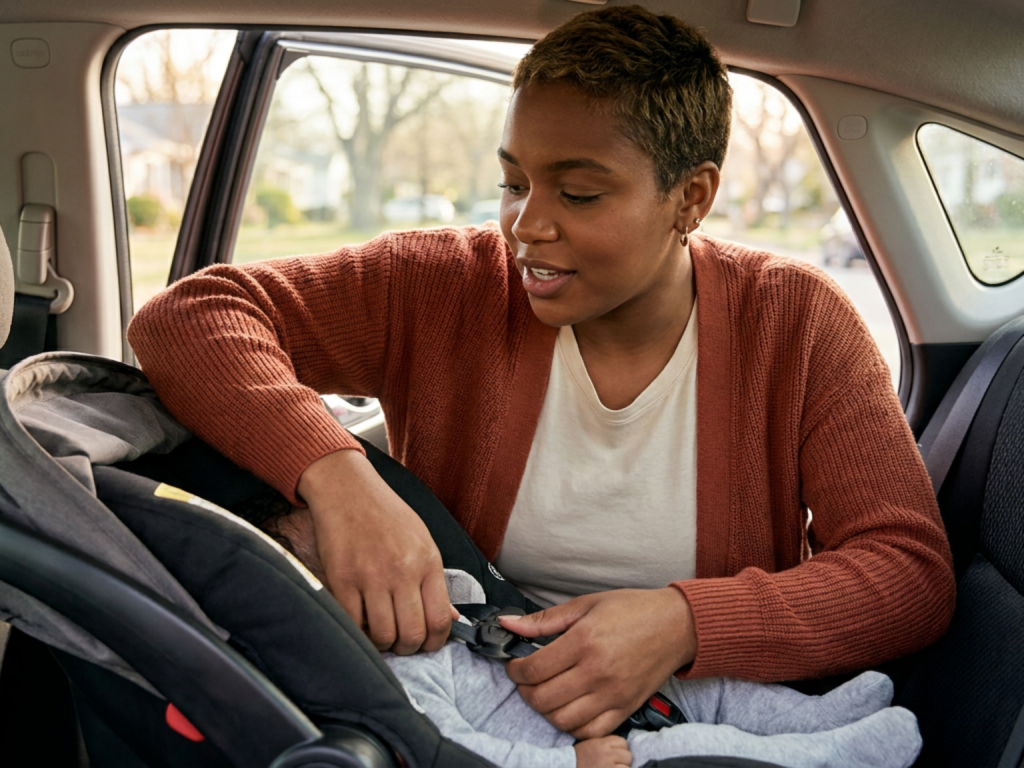
Correct infant car seat harness fit keeps the child positioned so the restraint can do its job. For rear-facing seats, harness straps should usually come from at or below the child’s shoulders. For forward-facing seats, they should usually come from at or above the shoulders. Always verify your specific seat’s instructions.
The harness should be snug. A practical check is the pinch test: after tightening, try to pinch the harness webbing vertically at the collarbone. If you can pinch excess webbing, it is too loose. The chest clip should be at armpit level, centered on the chest. A clip that is too low can allow the straps to spread; a clip near the neck may be uncomfortable and incorrectly positioned.
Avoid bulky coats under the harness. Puffy layers compress during a crash, creating extra slack. Instead, dress the child in thin, warm layers, buckle and tighten the harness, then place a blanket or coat over the harness if needed. Nothing should go behind the child or under the straps unless it came with the seat or is specifically approved by the car seat manufacturer.
For newborns, positioning inserts should be used only if they came with the seat or are manufacturer-approved. Rolled blankets around the sides may be allowed by some instructions, but they should never go behind the baby, under the harness, or interfere with buckle position.
Back seat placement and air bag cautions
Children should ride in the back seat through age 12 whenever possible. Rear seating reduces exposure to frontal air bags and generally provides a safer environment for child restraints. Air bags are designed for adult bodies and can injure children, especially when a child is close to the deployment zone or riding in a rear-facing car seat in front of an active passenger air bag.
Never place a rear-facing car seat in a front passenger seat with an active frontal air bag. If a child must ride in the front seat because of unusual vehicle constraints, consult the vehicle manual, car seat manual, and appropriate safety professionals first. Some vehicles have advanced air bag systems or shutoff switches, but assumptions can be dangerous.
The center rear seat is often thought of as the safest position because it is farthest from side impacts, but it is not always the best choice if the car seat cannot be installed securely there. The best seating position is one allowed by both manuals where the car seat installs tightly and can be used correctly. In families with multiple children, the safest arrangement may require balancing restraint type, tether anchor availability, school drop-off logistics, and the developmental ability of older children to avoid unbuckling or disturbing a younger child’s seat.
Booster seats and the adult seat belt test
A belt-positioning booster seat helps the vehicle seat belt fit a child’s smaller skeleton. Without a booster, the lap belt may ride up over the abdomen, increasing the risk of abdominal organ and lumbar spine injury in a crash. The shoulder belt may cross the neck or face, tempting a child to tuck it behind the back or under the arm, which removes upper-body restraint and can worsen injury risk.
A child is ready to move out of a booster only when the adult seat belt fits correctly without help. Use this simple fit check: the child’s back rests against the vehicle seat, knees bend naturally at the seat edge, the lap belt lies low across the upper thighs, the shoulder belt crosses the mid-shoulder and chest, and the child can maintain that posture for the entire ride, including while asleep. Many children do not achieve this fit until later in childhood.
Booster readiness is not only about height. Maturity matters. A child who leans, slouches, places the belt under the arm, or unbuckles is not ready for the adult belt alone. Supportive, calm explanations often work better than shame: the booster is not a baby item; it is equipment that helps the seat belt contact the strongest parts of the body.
Everyday habits that reduce risk
Most car seat errors happen during ordinary routines: a rushed morning, a crying baby, a quick ride to daycare, or a caregiver unfamiliar with the seat. Build a brief visual and tactile check into every trip. Confirm that the seat is locked in place, the harness is routed correctly, the chest clip is at armpit level, and the straps are snug.
Register your car seat with the manufacturer so you can receive recall notices. Keep the manual accessible, either in the seat’s storage slot or digitally. Check the expiration date, especially when reusing a seat for a younger sibling. Clean the seat according to the manual; harsh chemicals, soaking harness straps, or machine washing prohibited components can affect performance.
After any crash, follow the car seat and vehicle manufacturers’ guidance. Some seats must be replaced after any collision; others may follow specific minor-crash criteria. When in doubt, contact the manufacturer and your insurance company, and do not rely on appearance alone. A seat can look normal but still have stress to components that matters in a subsequent crash.
Finally, remember that car seats are for travel, not routine sleep outside the vehicle. If a baby falls asleep in the car, transfer them to a firm, flat sleep surface when you arrive, as soon as practical and safe to do so.
Safety warnings to take seriously
- Never place a rear-facing car seat in front of an active frontal air bag.
- Do not use a car seat with an unknown crash history, missing labels, missing parts, or an expired date.
- Avoid bulky coats under the harness because compression can create dangerous slack.
- Do not add unapproved inserts, strap covers, pillows, or positioning products to a car seat.
- Consult your pediatrician or neonatal team for premature infants or babies with airway, muscle tone, or medical complexity concerns.
Tools & Assistance
- Read both the car seat manual and the vehicle owner’s manual before installation.
- Schedule a check with a certified child passenger safety technician.
- Register the car seat with the manufacturer for recall notifications.
- Use the seat’s height, weight, recline, and expiration labels as routine check points.
- Keep a simple caregiver checklist for harness snugness, chest clip position, and back seat placement.
FAQ
When can my child turn forward-facing?
Turn forward-facing only after your child outgrows the rear-facing height or weight limit for their specific seat. Many children can remain rear-facing beyond age 2, depending on the seat.
Is LATCH safer than using the seat belt?
Not necessarily. LATCH and seat belt installation can both be safe when used correctly. Choose the method allowed by both manuals that gives a tight installation.
Can my baby sleep in the car seat after we get home?
Car seats are designed for travel. If your baby falls asleep in the car, move them to a firm, flat sleep surface when you arrive, as soon as practical and safe.
How tight should the harness be?
The harness should be snug enough that you cannot pinch excess webbing at the collarbone, with the chest clip positioned at armpit level.
When is a child ready to stop using a booster?
A child is ready when the adult seat belt fits correctly: lap belt low on the upper thighs, shoulder belt across the mid-shoulder and chest, knees bending at the seat edge, and proper posture maintained for the whole ride.
Sources
- Eastern Association for the Surgery of Trauma — Child Passenger Safety: An Evidence-Based Review
- National Highway Traffic Safety Administration — Car Seat & Booster Seat Safety, Ratings, Guidelines
- National Safety Council — Child Passenger Safety
Disclaimer
This article is for general educational purposes and is not a substitute for medical, safety, or legal advice. Consult your pediatrician, vehicle manual, car seat manufacturer, and a certified child passenger safety technician for guidance specific to your child and vehicle.


















Please log in to leave a comment.