
Intro
Choosing a stroller can feel deceptively simple until you are comparing folded sizes, harness systems, recline angles, wheel types, and weight limits while also thinking about your baby’s comfort and safety. The good news is that a stroller does not need to be perfect in every category. It only needs to fit your family’s daily routines, your storage space, and your child’s developmental stage.
This guide walks through the main stroller decisions parents face, with a focus on safety, practicality, and newborn suitability. It is designed for a medically literate reader, so you will see a few technical terms explained briefly and clearly. When in doubt about your baby’s individual needs, especially for infants with prematurity, reflux, or airway concerns, speak with your pediatric clinician or a child passenger safety professional.
Highlights
A stroller should match your real-life routes, storage limits, and transport needs, not just look good on paper.
For newborns, flat or near-flat positioning and age-appropriate support matter more than cosmetic features.
A five-point harness, reliable brakes, and good tip-over stability are core safety features.
Small conveniences such as one-handed folding or a roomy canopy can make daily use much easier.
Safe use habits matter as much as design: never leave a child unattended and avoid hanging heavy bags on the handle.
Start with your daily routine
The best stroller is the one that fits how you actually move through the day. Think about whether you will use it mainly on smooth sidewalks, in crowded stores, on public transit, in a car trunk, or on uneven paths. A compact model may be ideal if you have limited storage, while a sturdier stroller with larger wheels may be easier to steer outdoors.
It also helps to think about how often you will fold and lift the stroller. If you will handle it one-handed while holding a baby or a diaper bag, folding mechanism and total weight become very important. Consumer guidance consistently emphasizes this real-world fit: steering feel, folded footprint, and how easily the stroller stands when folded can matter just as much as the seat itself.
Choose the right stroller category
Strollers are often grouped by use case rather than by a single universal design. Full-size strollers tend to offer more features, storage, and a larger seat. Lightweight or umbrella-style strollers are easier to carry and store but may offer fewer comfort features. Travel systems can be convenient when you want a stroller that works with an infant car seat, although you still need to check the stroller’s independent safety and age recommendations.
If you are deciding between categories, ask a few practical questions: Will this stroller work for an infant, or only for an older baby? Does it fit in the car you actually drive? Can you open and close it without wrestling it on the sidewalk? Answering those questions usually narrows the field faster than comparing extra accessories.
Prioritize safety features
Safety is the foundation of stroller selection. A five-point harness is a key feature because it helps keep the child seated securely at the shoulders, waist, and between the legs. Reliable brakes are equally important, especially on sloped pavement or when you pause to tend to another child. A stable frame and wide enough wheel base can help reduce tip-over risk.
Look closely at pinch points when folding and unfolding the stroller. Small fingers can get caught in hinges or moving joints. It is also wise to register the product with the manufacturer so you can receive recall notices if needed. If the stroller has a storage basket, use it for light essentials and avoid overloading the handle with heavy bags, which can change balance and increase the chance of tipping.
Newborns need special attention
Newborn anatomy is different from that of an older infant. Neck control is still immature, and airway alignment can be more vulnerable if the baby is positioned too upright. For this reason, stroller compatibility with newborns matters a great deal. Many pediatric safety resources advise that newborns should be placed only in strollers that are specifically approved for infant use and that provide a flat or near-flat recline, bassinet-style attachment, or another appropriate newborn configuration.
For medically complex infants, premature babies, or babies with reflux, breathing issues, or other concerns, a stroller that seems acceptable for one child may not be ideal for another. In those situations, ask your pediatric clinician or rehabilitation specialist whether the stroller setup supports safe head, neck, and airway positioning. The most important principle is not speed or convenience; it is appropriate support for the baby’s developmental stage.
Think about comfort for parent and child
A stroller should be comfortable enough that you will actually use it. For the child, that may mean a padded seat, enough legroom, adjustable recline, and a canopy that offers meaningful shade and weather protection. For the caregiver, handle height, grip comfort, and steering effort can reduce strain during longer outings.
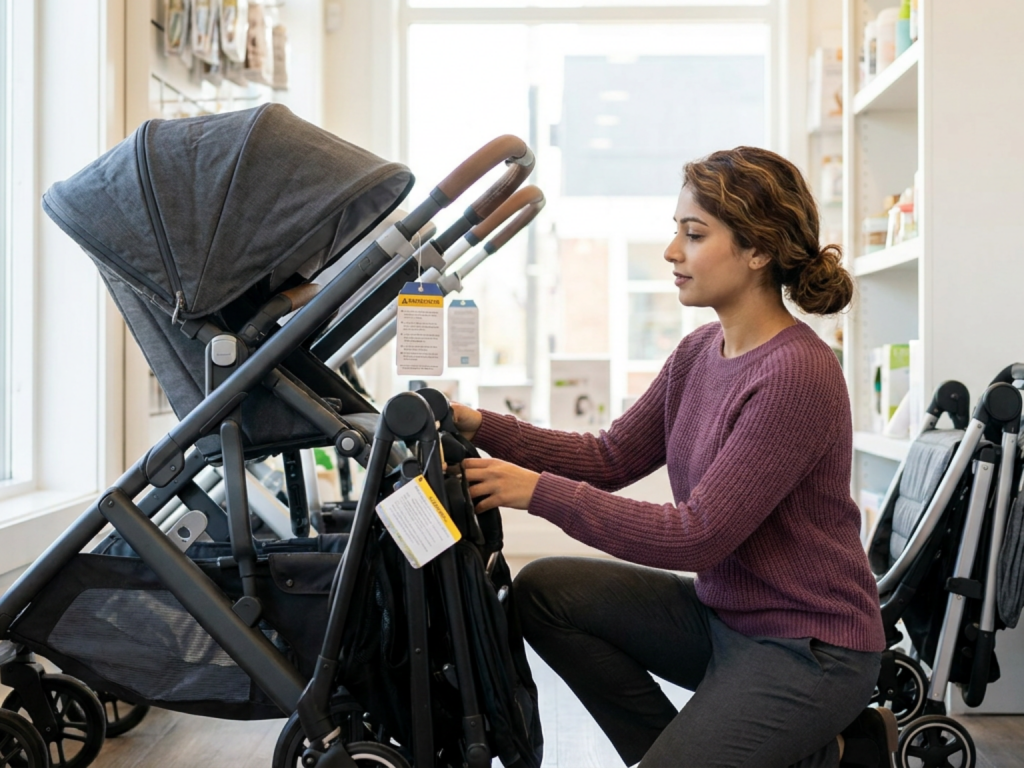
If you expect frequent walks, check whether the stroller handles curb cuts, uneven pavement, and turning in tight spaces. A well-designed stroller should feel predictable rather than wobbly. If possible, test it in the store with one hand and with a small amount of weight in the basket so you can judge real steering behavior.
Use it safely every day
Even a well-designed stroller can become unsafe if it is used carelessly. Never leave a baby unattended in a stroller, even briefly. Always fasten the harness properly, and make sure the baby is seated according to the manufacturer’s age and weight guidance. If the stroller is parked, engage the brakes before stepping away.
Avoid using the stroller as a sleep space unless the manufacturer and your pediatric clinician say it is appropriate, and be especially cautious with babies who fall asleep unexpectedly during walks. Keep the seating area and storage basket free of loose items that can shift or fall onto the child. Finally, watch for overheating in warm weather: use shade wisely, dress the baby appropriately for the temperature, and avoid covering the stroller in a way that reduces airflow.
Common mistakes to avoid
One common mistake is buying for the newborn stage only, without thinking ahead. Another is assuming that more features automatically mean better safety. In reality, a simpler stroller that fits your home, car, and routine may be safer in daily use because it is easier to operate correctly.
Other frequent errors include hanging a heavy diaper bag from the handle, forgetting to lock the brakes on slopes, ignoring the manual, and using a stroller that is not intended for the child’s current size or age. If a product feels awkward to fold, heavy to lift, or hard to steer in the store, those frustrations usually become more noticeable after several weeks of real use.
When to ask for expert advice
It is a good idea to ask for help if your baby was born early, has low tone, has a medical condition affecting breathing or posture, or needs a more specialized seating setup. A pediatric clinician, occupational therapist, physical therapist, or certified child passenger safety technician may help you think through fit and positioning.
Expert input is also useful if you are choosing between a stroller, travel system, or bassinet-style attachment and are unsure which setup is appropriate for your infant. That guidance can prevent guesswork and may reduce the chance of unsafe positioning or unnecessary product changes later.
Safety reminders
- Never leave a baby unattended in a stroller.
- Use the harness every time, even for short trips.
- Do not hang heavy bags from the handlebar.
- Check brake function before each outing.
- Use only age- and size-appropriate stroller configurations.
- Watch carefully for pinch hazards when folding and unfolding.
Tools & Assistance
- Your stroller’s instruction manual
- Manufacturer recall registration page
- Pediatrician or family doctor
- Certified child passenger safety technician
- Occupational or physical therapy consultation if positioning is a concern
FAQ
What is the most important stroller safety feature?
A secure five-point harness is one of the most important features, along with reliable brakes and a stable frame.
Can a newborn use any stroller?
No. Newborns need a stroller that is specifically suitable for infant use and provides appropriate flat or near-flat support or another approved newborn setup.
Is a more expensive stroller always better?
Not necessarily. The best stroller is the one that matches your route, storage space, lifting needs, and baby’s age while meeting core safety standards.
Should I hang my diaper bag on the handle?
It is better not to. Heavy bags can affect balance and increase tip-over risk.
What if my baby has reflux or was born premature?
Ask your pediatric clinician or a specialist for individualized advice about positioning and stroller type before relying on any setup.
Sources
- Nemours KidsHealth — Choosing Safe Baby Products: Strollers
- Consumer Reports — Choose the Right Stroller for Your Family
- Kids2Shop — How To Choose A Baby Stroller Guide For New Parents
Disclaimer
This article is for general educational purposes only and does not replace individualized medical or safety advice. If your baby has prematurity, breathing concerns, reflux, or other health issues, consult your pediatric clinician or a qualified child safety professional.















Please log in to leave a comment.