
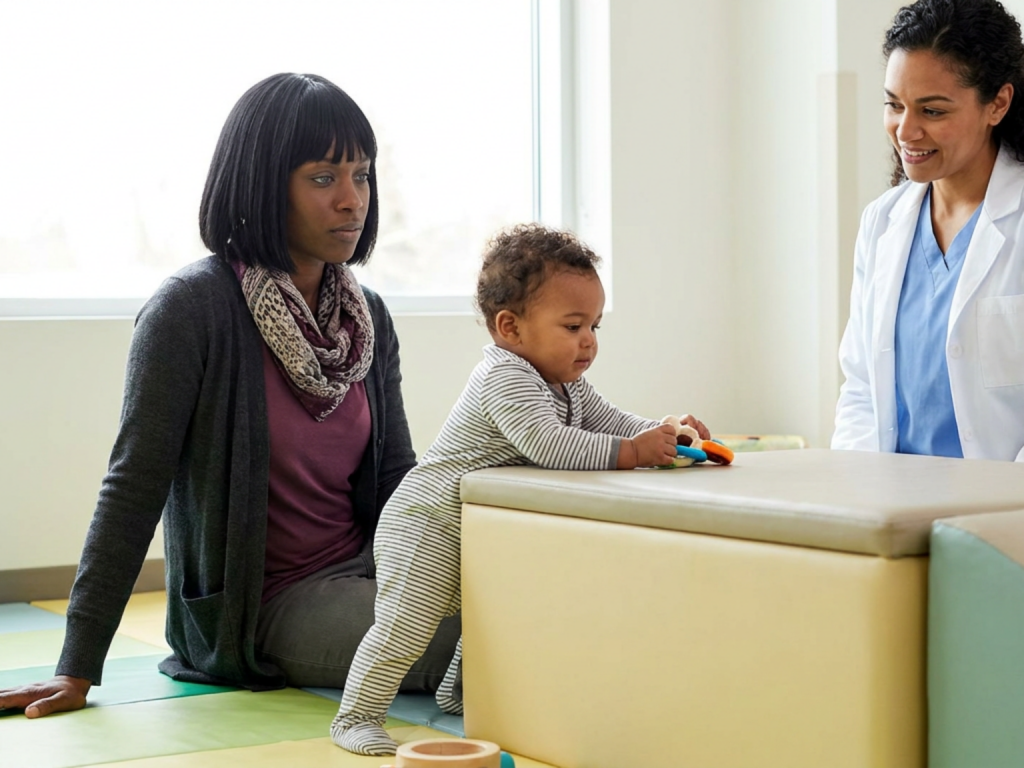
Intro
At 10 months, many babies are wonderfully busy: exploring the floor, testing sounds, studying faces, and learning that their actions can make things happen. This stage can feel exciting and exhausting at the same time, especially because development is rarely perfectly even. A baby may be very mobile but quieter with words, or highly social but cautious about pulling to stand.
Milestones are best understood as guideposts, not pass-fail tests. They reflect the maturation of the brain, muscles, sensory systems, communication pathways, and social-emotional regulation. If your baby was born preterm, clinicians may use corrected age for preterm babies when interpreting progress. If you are worried about skills your baby has not yet developed, or about any loss of previously acquired abilities, it is appropriate to discuss developmental screening with your pediatrician.
Highlights
By 10 months, many babies combine movement, curiosity, and early communication in increasingly purposeful ways.
Common skills include crawling or other floor mobility, pulling to stand, cruising, pincer grasp practice, babbling, and responding to familiar words.
Variation is normal, but developmental regression, persistent asymmetry, feeding concerns, or lack of social engagement should be discussed with a clinician.
Play, responsive conversation, safe floor time, reading, and predictable routines are powerful ways to support development.
What development looks like at 10 months
A 10-month-old is usually in a highly exploratory phase. The nervous system is integrating postural control, vision, balance, hand use, hearing, memory, and social cues. This is why development may look like a mix of physical effort and emotional intensity: your baby may crawl toward a toy, look back to check your reaction, vocalize with excitement, then protest when the toy is moved.
Many babies at this age understand more than they can say. They may recognize familiar names, pause when they hear “no,” look for a hidden object, or respond to simple routines such as waving goodbye. Object permanence, the understanding that people and things still exist when out of sight, is becoming stronger. This can make peekaboo delightful, but it can also contribute to separation anxiety when a parent leaves the room.
It is also normal for skills to emerge in clusters. Some babies crawl on hands and knees, some scoot, some roll efficiently, and some focus first on pulling up. The order of physical milestones can vary, although clinicians pay attention to quality of movement, symmetry, strength, tone, and whether skills are progressing over time.
Movement and body control
At 10 months, infant gross motor development often includes sitting steadily without support, moving in and out of sitting, crawling or using another form of floor mobility, pulling to stand, and beginning to cruise along furniture. Some babies lower themselves from standing with control; others get stuck standing and need help learning how to bend their knees and come down safely.
Core strength, hip stability, shoulder control, and balance are all developing together. You may notice your baby shifting weight from one hand to the other while crawling, reaching across the body, or rotating the trunk to grab a toy. These movements are small signs of maturing motor planning and bilateral coordination.
- Offer safe floor play for babies every day on a firm, open surface.
- Place toys slightly out of reach to encourage pivoting, crawling, or reaching.
- Use sturdy furniture for supervised pulling-to-stand practice, not unstable walkers.
- Keep stairs gated, furniture anchored, and cords or choking hazards out of reach.
Baby walkers with wheels are not recommended in many pediatric safety guidelines because they can increase injury risk and do not teach mature walking mechanics. If your baby is not crawling in the classic way but is moving purposefully, using both sides of the body, and gaining skills, that may still be within typical variation. Persistent infant movement asymmetry, unusually stiff or floppy tone, or a clear preference for one hand before the first birthday should be raised with a healthcare professional.
Hands, fingers, and problem-solving
Fine motor development in infancy becomes more precise around this age. Many 10-month-olds use a raking grasp less often and begin refining the pincer grasp, bringing the thumb and index finger together to pick up small safe pieces of food or toys. They may transfer objects between hands, bang two toys together, drop items repeatedly, poke with one finger, and explore containers by putting objects in and taking them out.
These actions are not random mischief. Dropping a spoon again and again teaches cause and effect, gravity, sound, and social response. Opening a flap in a book or searching for a toy under a cloth reflects memory and problem-solving. Your baby is learning that the world has patterns and that their own body can influence those patterns.
- Offer board books, stacking cups, soft blocks, and large rings.
- Let your baby practice self-feeding with safe textures if developmentally ready.
- Use containers for filling, dumping, hiding, and finding games.
- Avoid small objects, button batteries, magnets, beads, and hard round foods that can cause choking.
Because hand skills and feeding skills overlap, talk with your pediatrician if your baby has persistent difficulty bringing food to the mouth, frequently coughs or chokes during meals, seems unable to manage age-appropriate textures, or shows poor weight gain. These concerns do not automatically mean a serious disorder, but they deserve individualized assessment.
Communication and early language
Early communication milestones at 10 months are often rich, even before true words appear. Many babies babble with repeated syllables such as “mamama” or “bababa,” imitate speech rhythms, use gestures, raise arms to be picked up, wave, clap, point or reach, and turn toward familiar voices. They may understand simple phrases within routines, such as “come here,” “all done,” or “where is your cup?”
Babbling is neurologically important. It reflects coordination among hearing, oral-motor control, breath support, auditory feedback, and social motivation. A baby who looks at you, vocalizes, waits for your response, and vocalizes again is practicing conversational turn-taking.
You can support early language development without flashcards or pressure. Narrate ordinary activities in short, warm phrases: “You found the ball,” “The cup is empty,” “Daddy is washing your hands.” Read board books daily, sing repetitive songs, copy your baby’s sounds, and pause so your baby can respond. If your household is multilingual, continuing to use your home languages is beneficial; babies can learn more than one language, although the distribution of words across languages may differ.
Discuss hearing or communication concerns with a clinician if your baby does not respond to sound, does not babble, rarely makes eye contact, does not use gestures, or seems to lose communication skills. Hearing evaluation and pediatric developmental screening can clarify whether extra support is needed.
Social and emotional development
A 10-month-old’s social world is expanding, but the primary caregiver relationship remains the secure base. Many babies show clear preferences for familiar people, become wary of strangers, imitate expressions, enjoy interactive games, and protest when separated. Separation anxiety can peak during the second half of the first year because memory and attachment are stronger.
Empathy is helpful here. Your baby is not manipulating you by crying when you leave; they are expressing distress with the communication tools they have. Predictable goodbye routines, calm reassurance, and gradual practice with trusted caregivers can help. Avoid sneaking away if possible, because it may increase vigilance. A brief, consistent goodbye teaches that separations happen and reunions follow.
Social play also strengthens cognition. Peekaboo supports object permanence, pat-a-cake builds imitation and rhythm, and back-and-forth babbling supports social reciprocity. Babies learn through responsive relationships: when you notice their cues and respond consistently, you are helping regulate their stress physiology and supporting brain development.
Seek guidance if your baby rarely smiles or shares enjoyment, seems unusually difficult to soothe, does not seek interaction, or shows a sudden reduction in social engagement. These observations are not diagnoses, but they are meaningful reasons to ask for professional input.
Feeding, oral skills, and sleep at 10 months
Most 10-month-olds still receive breast milk or infant formula as a major nutrition source while practicing complementary foods. Many are working on thicker textures, soft finger foods, cup practice, and self-feeding. The goal is gradual skill-building, not perfect intake at every meal. Appetite often varies from day to day.
Offer developmentally appropriate foods that are soft, cut safely, and supervised closely. Avoid honey before 12 months because of botulism risk, and avoid choking hazards such as whole grapes, popcorn, nuts, hard raw vegetables, large chunks of meat, and sticky spoonfuls of nut butter. Allergen introduction and feeding plans should be individualized with your healthcare professional, especially if your baby has eczema, known food allergy, or other medical conditions.
Sleep patterns vary, but many babies around this age still need naps and may wake at night, especially during illness, teething discomfort, separation anxiety, or schedule transitions. A consistent bedtime routine, safe sleep space, and responsive settling approach can help. Babies should be placed to sleep on their backs in a safe sleep environment; once they can roll independently, they may choose their own position, but the sleep space should remain free of loose bedding and unsafe items.
How to support development day by day
The best developmental support is often simple, repetitive, and relationship-based. Babies learn through safe movement, sensory exploration, language exposure, and emotionally attuned caregiving. You do not need expensive toys; your face, voice, household routines, and safe objects are powerful learning tools.
- Create a safe area for supervised tummy time while awake, crawling, sitting, and pulling up.
- Read the same books often so your baby can anticipate sounds, pictures, and gestures.
- Use everyday caregiving for language: name body parts, foods, actions, and emotions.
- Encourage problem-solving by letting your baby try before stepping in, while staying close enough for safety.
- Rotate a few toys rather than offering too many at once, which can overwhelm attention.
Try to observe your baby’s effort rather than compare them constantly with other babies. Progress may be subtle: a steadier sit, a more accurate reach, a new consonant sound, or a calmer recovery after frustration. If you feel uncertain, keep notes or short videos to share with your pediatrician. This can be more useful than trying to describe a movement or behavior from memory.
When to ask for professional advice
Parents are often told not to worry, but thoughtful concern is not overreacting. Early support can be helpful, and asking questions does not label your baby. Contact your pediatrician or child health nurse if you notice a plateau, loss of previously acquired skills, feeding safety concerns, or differences in movement, hearing, vision, or social response.
Developmental screening questionnaires are commonly used in pediatric care to identify children who may benefit from closer follow-up or referral. Depending on the concern, a clinician may recommend hearing testing, vision assessment, physical therapy, occupational therapy, speech-language evaluation, nutrition support, or early intervention services for infants. These services are designed to support development during a period when the brain is especially adaptable.
For babies born early or with medical complexity, interpretation of milestones may require additional context. Corrected age for premature infants, neonatal history, muscle tone, feeding history, growth pattern, and family observations all matter. Your pediatric clinician can help distinguish normal variation from concerns that need evaluation.
Call your pediatrician promptly if you notice
- Loss of previously acquired skills, such as stopping babbling or no longer sitting as before.
- Persistent infant movement asymmetry, very stiff muscles, very floppy tone, or using one side much more than the other.
- No response to sounds, limited eye contact, no babbling, or very little interest in social interaction.
- Frequent choking, coughing with feeds, poor weight gain, or signs of dehydration.
- Any injury, seizure-like episode, breathing difficulty, or parental concern that feels urgent.
Tools & Assistance
- Keep a simple milestone note with dates, new sounds, movement changes, and feeding observations.
- Record short videos of concerning movements or behaviors to show your pediatrician.
- Ask about pediatric developmental screening at routine well-child visits.
- Use early intervention services for infants if your clinician recommends referral.
- Review home safety for crawling, pulling to stand, choking hazards, stairs, furniture, cords, and sleep space.
FAQ
Should my 10-month-old be crawling?
Many 10-month-olds crawl, scoot, or use another form of floor mobility, but patterns vary. What matters is whether your baby is gaining skills, using both sides of the body, and exploring safely. Ask your pediatrician if there is no progress, marked asymmetry, or unusual stiffness or floppiness.
How many words should a 10-month-old say?
Some babies say a meaningful first word near this age, but many do not. Babbling, gestures, response to familiar words, shared attention, and turn-taking sounds are also important early communication signs.
Is separation anxiety normal at 10 months?
Yes. Stronger memory and attachment can make separations upsetting. Brief predictable goodbyes, calm reassurance, and consistent reunions usually help, but severe or persistent distress can be discussed with a healthcare professional.
What toys are best for a 10-month-old?
Choose safe, simple toys that invite action: board books, stacking cups, soft blocks, balls, containers, and toys for cause-and-effect play. Avoid small parts, button batteries, magnets, and objects that could be choking hazards.
When should I worry about development?
Seek advice for developmental regression, no babbling, poor response to sound, limited social engagement, persistent movement asymmetry, feeding safety concerns, or any parental concern that continues. Early evaluation can provide reassurance or connect your baby with support.
Sources
- Centers for Disease Control and Prevention (CDC) — Milestones by 1 Year
- Texas Health Resources — Milestones at 10 Months
- Raising Children Network — Baby development at 10-11 months
Disclaimer
This article is for general educational purposes only and does not replace medical advice, diagnosis, or treatment. Consult your pediatrician or qualified healthcare professional about concerns specific to your baby.
















Please log in to leave a comment.