
Intro
Seven months is a wonderfully active stage: many babies are stronger, more curious, and increasingly social. You may notice your baby sitting with less support, reaching for objects with purpose, responding to familiar voices, and experimenting with new sounds. At the same time, development is not a checklist that every baby completes on the same day. Healthy infants often acquire skills in slightly different sequences, especially if they were born preterm or have had medical challenges.
This guide reviews typical 7 month baby milestones and development across motor, cognitive, communication, social-emotional, feeding, sleep, and safety domains. It is meant to help you observe patterns, support progress through everyday play, and know when it is wise to discuss concerns with your pediatrician or child health professional.
Highlights
At 7 months, many babies can sit with minimal support, roll both ways, bear weight on their legs when held upright, and reach accurately for toys.
Communication is expanding: babbling, turn-taking sounds, responding to name, and expressive facial cues become more noticeable.
Social development often includes enjoyment of interactive games, preference for familiar caregivers, and possible early stranger anxiety.
Variation is common, but persistent stiffness, floppiness, poor visual engagement, loss of skills, or no response to sounds deserves medical evaluation.
What development looks like at 7 months
By 7 months, the infant brain is rapidly integrating sensory input, motor planning, memory, and social learning. Your baby is not simply moving more; they are learning cause and effect, anticipating routines, and using relationships as a secure base for exploration. Development at this age is often uneven. A baby may be advanced in babbling but slower to sit independently, or highly mobile but less interested in vocal imitation.
Milestones are best viewed as population-based guideposts, not performance requirements. Pediatric clinicians look at the whole developmental picture: muscle tone, symmetry, feeding, vision and hearing responses, social engagement, and whether skills are progressing over time. If your baby was born prematurely, your clinician may use corrected age for preterm babies when interpreting milestones. Corrected age subtracts the number of weeks early from the baby’s chronological age, which can give a more accurate developmental expectation in the first years of life.
It can help to observe your baby during ordinary moments: diaper changes, feeding, floor play, bath time, and cuddling. Short, repeated observations are usually more meaningful than testing a baby when they are tired, hungry, or overstimulated.
Gross motor milestones: sitting, rolling, and early mobility
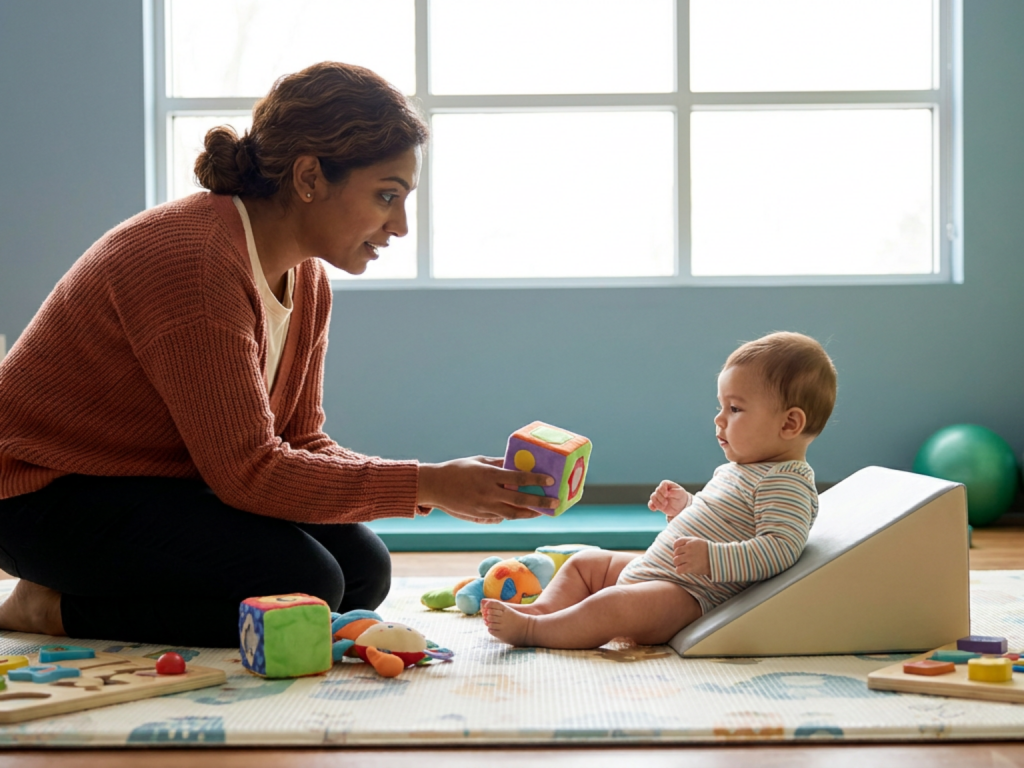
Gross motor development involves large muscle groups, postural control, balance, and coordinated movement. Around 7 months, many babies can sit briefly without using their hands for support, although they may still topple when reaching or turning. Some babies transition in and out of sitting later; others are already pivoting on the belly, creeping backward, rocking on hands and knees, or preparing to crawl.
Common 7-month motor abilities may include:
- Sitting with little or no support for short periods.
- Rolling from tummy to back and back to tummy.
- Holding the head steady in different positions.
- Bearing some weight on the legs when held upright.
- Reaching from the tummy or sitting position to get a desired object.
- Pivoting, scooting, or beginning early crawling movements.
Not every baby crawls in the same way, and some babies eventually skip traditional hands-and-knees crawling. What matters clinically is progressive strength, symmetry, coordination, and curiosity about movement. Offer safe floor play for babies every day on a firm, clear surface. Avoid prolonged time in seats, swings, or jumpers that limit natural movement practice. Supervised tummy time while awake remains useful at this age because it strengthens the shoulders, trunk, and neck, supporting later crawling and transitions.
Fine motor and hand skills
Fine motor development in infancy becomes more purposeful at 7 months. Babies often reach with better accuracy, transfer objects from one hand to the other, and explore by banging, shaking, dropping, and mouthing toys. Mouthing is not misbehavior; it is a sensory learning strategy. Because of this, choking prevention is essential.
At this age, many babies use a raking grasp, sweeping small safe objects toward the palm with the fingers. The mature pincer grasp, using the thumb and index finger tip, usually develops later. You may notice your baby visually inspecting objects, rotating them, and repeating actions to see what happens. These repetitions are early experiments in cause and effect.
Helpful activities include offering easy-to-grasp toys of different safe textures, placing a toy slightly out of reach during floor play, giving soft blocks to bang together, and playing simple container games such as putting a large ring into a bowl. Always choose toys too large to fit fully into the mouth, avoid loose parts, and supervise closely.
Communication and early language
Early communication milestones at 7 months are often joyful and noisy. Many babies babble with repeated syllables such as “ba,” “ma,” or “da,” though they may not attach consistent meaning yet. They may squeal, laugh, growl, blow raspberries, or vary pitch and volume. These sound experiments help develop oral motor coordination and social communication.
Your baby may respond to their name, turn toward familiar voices, notice emotional tone, and enjoy back-and-forth vocal play. This conversational rhythm is important even before real words appear. When your baby makes a sound, pause, smile, and answer as if it mattered—because it does. This teaches turn-taking, attention, and the emotional value of communication.
Support language by narrating daily routines in simple, warm phrases: “Now we wash your hands,” “Here is your spoon,” or “You found the ball.” Reading board books, singing, and naming objects during play all build receptive language. If your baby does not respond to sounds, rarely vocalizes, or seems to have lost previously used sounds, ask your pediatrician about hearing and developmental screening for babies.
Cognitive and sensory development
Cognitive growth at 7 months is closely tied to movement, sensory exploration, and responsive caregiving. Your baby may search briefly for a dropped toy, anticipate familiar routines, and show preference for certain games. Object permanence—the understanding that people and objects continue to exist when out of sight—is emerging. This is one reason games like peekaboo become so engaging.
Babies learn through repetition. Dropping a spoon again and again may test gravity, sound, caregiver response, and cause and effect. While this can be tiring, it is developmentally meaningful. You can set gentle limits while still supporting learning: “The spoon stays on the tray. Here is a soft block you can drop.”
Sensory-motor development includes vision, hearing, touch, vestibular balance, and proprioception, which is the body’s sense of position. A baby who reaches, rolls, mouths, and looks between caregiver and toy is combining many neurologic systems. Provide varied but not overwhelming experiences: floor time, songs, safe household sounds, textured books, outdoor light and shade, and calm face-to-face interaction.
Social and emotional milestones
At 7 months, social relationships are becoming more selective. Many babies recognize familiar caregivers clearly and may show anxiety or hesitation around strangers. This can be emotionally hard for relatives or friends, but it is usually a normal sign of attachment and memory development. Your baby is learning who is familiar and safe.
Social milestones may include smiling at familiar people, enjoying mirror play, responding to facial expressions, laughing during games, and seeking comfort from a trusted caregiver. Some babies begin lifting their arms to be picked up or leaning toward a preferred person. Others communicate needs through facial expressions, body tension, or vocal tone.
Responsive caregiving is one of the strongest supports for social-emotional development. This does not mean preventing all frustration. It means noticing cues, responding consistently, and helping your baby recover when upset. Gentle routines—feeding, sleep, play, and cuddling—help the nervous system predict what comes next.
Feeding, oral skills, and sleep at 7 months
Many 7-month-old babies are continuing breast milk or iron-fortified formula while gradually exploring complementary foods. Solid foods at this stage are for nutrition, sensory learning, oral motor practice, and family routine. Depending on readiness and your clinician’s guidance, babies may eat purees, mashed textures, or soft finger foods prepared safely. Iron-rich foods are often emphasized because infant iron stores decline during the second half of the first year.
Signs of feeding readiness and progress can include sitting with support, good head control, opening the mouth for a spoon, moving food within the mouth, and showing interest in food. Gagging can occur as babies learn textures, but choking is silent or ineffective breathing and requires emergency response. Avoid common choking hazards such as whole grapes, nuts, popcorn, hard raw vegetables, chunks of meat, and sticky spoonfuls of nut butter. Discuss allergen introduction, feeding difficulties, reflux concerns, constipation, or poor growth with your pediatrician.
Sleep varies widely. Some babies sleep longer stretches, while others wake due to hunger, teething discomfort, separation awareness, illness, or changes in routine. Continue safe sleep practices: place the baby on their back for every sleep, use a firm flat sleep surface, and keep loose bedding, pillows, and soft objects out of the sleep space.
How to support 7 month development day by day
The best developmental support is usually simple, repeated, and relationship-based. Babies do not need expensive equipment or constant stimulation. They need safe opportunities to move, attentive conversation, predictable care, and chances to explore.
Try these practical strategies:
- Offer daily floor time with toys placed just out of reach to encourage reaching, rolling, and pivoting.
- Read short board books and let your baby touch, mouth, and turn pages with help.
- Use serve-and-return communication: respond to babbles, gestures, and facial expressions.
- Play peekaboo, mirror games, and simple songs with hand motions.
- Rotate a few safe toys rather than offering too many at once.
- Give supervised practice sitting, but stay close because falls are common.
Follow your baby’s cues. If they turn away, arch, cry, rub their eyes, or become unusually still, they may need a break. Development is supported by balanced stimulation and rest, not by pushing a tired baby to practice skills.
When to talk with a pediatrician
Parents and caregivers are often the first to notice when something feels different. You do not need to wait for a severe problem to ask questions. Pediatric developmental screening can identify whether a baby would benefit from closer monitoring, hearing or vision evaluation, physical therapy, feeding support, or early intervention services for infants.
Consider contacting your baby’s healthcare professional if you notice persistent floppiness or stiffness, poor head control, strong preference for using one side of the body, no rolling or little interest in movement, poor visual tracking, no response to sounds, minimal social engagement, or feeding difficulties that interfere with growth. Developmental regression in babies, meaning loss of previously acquired skills, should always be discussed promptly.
Trust your observations, but try not to carry the worry alone. Many concerns turn out to be variations of normal, and when support is needed, earlier guidance can make daily care easier and more effective.
Seek medical advice promptly if you notice
- Loss of previously acquired skills, such as reduced babbling, weaker movement, or less social engagement.
- Persistent infant movement asymmetry, such as consistently using one hand or one side much more than the other.
- Marked stiffness, marked floppiness, poor head control, or inability to sit with support.
- No response to loud sounds, limited eye contact, or poor visual tracking.
- Feeding problems with coughing, choking, poor intake, dehydration signs, or poor weight gain.
- Any caregiver concern that your baby’s development has stalled or changed suddenly.
Tools & Assistance
- Write down new skills, concerns, feeding changes, and questions before well-child visits.
- Use your pediatric clinic’s developmental screening questionnaires when offered.
- Ask about early intervention services for infants if delays are suspected.
- Create a safe floor area for daily supervised movement practice.
- Discuss corrected age expectations if your baby was born preterm.
FAQ
Should my 7-month-old be crawling?
Not necessarily. Some babies crawl around this age, but many develop crawling later, use different mobility styles, or focus first on sitting and rolling. Ask your pediatrician if movement is not progressing or seems very asymmetric.
Is it normal for a 7-month-old to be afraid of strangers?
Yes. Stranger anxiety can begin around this period as memory and attachment develop. Offer reassurance, keep introductions gentle, and avoid forcing your baby into unfamiliar arms.
How can I encourage speech at 7 months?
Talk, sing, read, and respond to babbling in a back-and-forth way. Use simple words during routines and give your baby time to answer with sounds, gestures, or facial expressions.
What toys are best for a 7-month-old?
Choose safe, washable, easy-to-grasp toys such as soft blocks, textured teethers, board books, rattles, stacking rings, and simple containers. Avoid small parts and supervise mouthing.
When should I worry about sitting?
Many babies are still building balance at 7 months. Discuss concerns if your baby cannot sit with support, has poor head control, seems unusually stiff or floppy, or is not gaining motor skills over time.
Sources
- HealthyChildren.org, American Academy of Pediatrics — Developmental Milestones: 7 Months
- Mayo Clinic — Infant development: Milestones from 7 to 9 months
- Johns Hopkins Medicine — The Growing Child: 7 to 9 Months
Disclaimer
This article is for educational purposes only and does not replace medical evaluation, diagnosis, or treatment. Consult your pediatrician or qualified healthcare professional about concerns regarding your baby’s development, feeding, sleep, or health.















Please log in to leave a comment.