
Intro
Babies are often described as little sponges, but that image can underestimate how active and sophisticated early learning really is. From the first weeks of life, an infant is not passively receiving the world; they are organizing sounds, faces, touch, movement, smell, and repeated routines into patterns. Their brain is building neural networks through experience, especially through responsive relationships with caregivers.
Highlights
Babies learn through repeated, emotionally safe experiences: voices, touch, facial expressions, feeding routines, play, and sleep-wake patterns all become meaningful.
Understanding often appears before speech. Research shows that by 6 to 9 months, many infants already understand some common nouns even though they cannot say them.
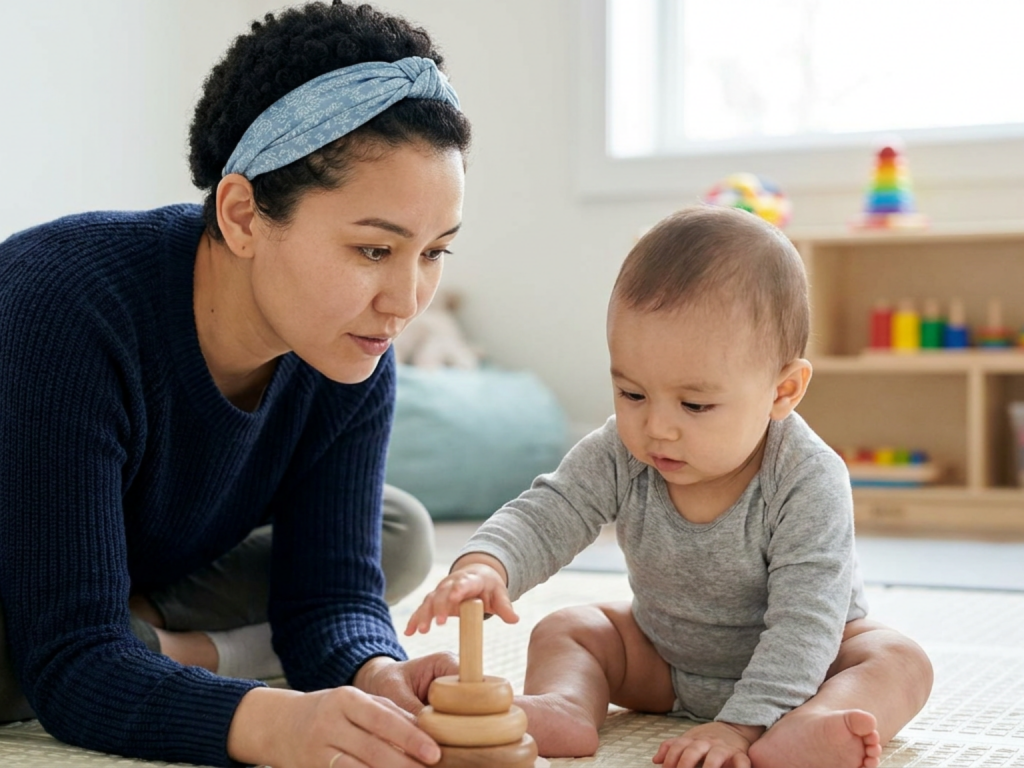
Play is not a break from learning; it is one of the main ways babies explore cause and effect, object permanence, motor control, and social communication.
Development varies widely. Concerns about hearing, vision, feeding, interaction, or delayed milestones should be discussed with a pediatrician, health visitor, or qualified clinician.
Learning begins before words
A baby’s first learning systems are sensory and relational. Newborns recognize familiar voices, calm to rhythmic movement, and respond to warmth, feeding, smell, and touch. These early experiences are processed by rapidly developing neural circuits in the cerebral cortex, limbic system, auditory pathways, visual pathways, and sensorimotor networks. In practical terms, a baby learns, “When I cry, someone comes,” “This voice is familiar,” and “This routine usually means feeding or sleep.”
This is why ordinary caregiving matters so much. Holding, feeding, changing, bathing, singing, and soothing are not just care tasks; they are repeated learning episodes. When a caregiver responds consistently, the baby’s stress-regulation systems are supported. The infant gradually learns that the world is predictable enough to explore. This sense of safety is not about perfection. Babies benefit from sensitive repair too: a caregiver may miss a cue, then notice, comfort, and reconnect.
The brain builds meaning through repetition
Infant learning depends heavily on repetition with variation. A baby hears the same name, sees the same bottle, feels the same sleep sack, or watches the same face appear during peek-a-boo. Over time, the brain detects regularities. Synapses that are used repeatedly become more efficient, while less-used connections may later be pruned as the nervous system specializes.
This does not mean parents need flashcards or constant stimulation. In fact, babies can become overwhelmed by too much noise, light, or handling. The most useful learning moments are often simple and paced to the baby’s state: alert, calm, and interested. A caregiver naming an object, waiting for the baby’s gaze or sound, then responding warmly creates a small but powerful loop of attention, language, and social reward.
Caregivers also learn from babies. Recognizing newborn feeding cues, tired signs, or a need for less stimulation is part of a two-way relationship. The baby sends signals; the adult interprets and responds; the baby gradually learns that their behavior can influence the social world.
How babies understand language before they speak
Speech production requires fine motor control of breathing, vocal cords, tongue, lips, jaw, and timing. Understanding can develop earlier because the baby can process sound patterns before they can produce words. During the first year, babies increasingly recognize familiar voices, turn toward sounds, respond to their name, enjoy back-and-forth vocal play, and begin to understand simple phrases used in daily routines.
Medical and developmental guidance commonly describes a progression: early crying and reflexive sounds, then cooing, squealing, babbling, and eventually meaningful gestures or first words. But receptive language, the ability to understand, may be ahead of expressive language. A baby may look toward a parent when hearing “mama,” anticipate a song gesture, or search for a familiar object before saying any word.
Research on 6- to 9-month-old infants found that babies understood the meanings of many common nouns more than previously assumed. In these studies, researchers did not train the infants; instead, they observed looking behavior when babies heard words for familiar items. This matters because it suggests that infants are mapping words to real-world categories during everyday life, long before their first spoken vocabulary is obvious.
Social interaction is a learning engine
Babies learn especially well in “serve and return” interactions. The baby looks, reaches, babbles, cries, or smiles; the caregiver responds with eye contact, words, touch, imitation, or comfort. This exchange strengthens attention, emotional regulation, language processing, and social understanding. A baby does not need an adult to perform constantly, but they do benefit from being noticed and answered.
Turn-taking can start long before conversation. If a baby coos and the caregiver pauses, copies the sound, then waits, the baby experiences the rhythm of communication. If a caregiver says, “You found the spoon,” while the baby bangs it, the baby connects sound, action, object, and emotional tone. These moments are neurologically rich because they combine auditory input, visual attention, motor activity, and social reward.
Screen-based sound is not the same as responsive human interaction. A video may provide sights and sounds, but it cannot reliably follow the baby’s gaze, adjust pacing, or respond emotionally to a cue. For infants, language is learned most deeply when it is embedded in relationship and shared attention.
Play teaches cause, memory, and object permanence
Play is a baby’s laboratory. When a baby shakes a rattle, drops a spoon, splashes water, mouths a teether, or kicks a mobile, they are testing cause and effect. They are learning, “My body can make things happen.” These repeated experiments support motor planning, sensory integration, attention, and early problem-solving.
Object permanence, the understanding that something continues to exist even when out of sight, develops gradually. Peek-a-boo is not just cute; it helps a baby practice prediction, memory, surprise, and emotional regulation. Hiding a toy partly under a cloth, then letting the baby discover it, can support this same idea when the baby is developmentally ready.
Useful play in the first year is usually simple: tummy time while awake and supervised, naming body parts during dressing, singing during diaper changes, offering safe objects with different shapes, or rolling a soft ball back and forth. The goal is not to accelerate development but to provide safe, repeated opportunities for exploration.
Understanding emotions and routines
Babies also learn emotional meaning. They notice tone of voice, facial expression, body tension, and timing. A calm voice during a difficult diaper change, a predictable bedtime sequence, or gentle comfort after a startle helps the infant’s autonomic nervous system shift from distress toward regulation. Over time, these repeated co-regulation experiences support the baby’s emerging capacity to self-soothe, though true independent regulation develops slowly.
Routines help because they reduce uncertainty. Feeding, play, bath, books, and sleep cues can become recognizable sequences. Parents may also need realistic newborn sleep expectations, because fragmented sleep and frequent waking are normal in early infancy. A baby who wakes often is not necessarily failing to learn; sleep patterns mature with brain development, feeding needs, circadian rhythm maturation, and individual temperament.
Temperament matters. Some babies are highly sensitive to sound or transitions; others are more adaptable. Some need more physical contact; others prefer short breaks from stimulation. A supportive approach observes the baby’s cues rather than forcing a single model of learning or routine.
How caregivers can support learning day by day
The best learning support is usually ordinary, responsive care. Talk during daily activities, but leave pauses for the baby to answer with movement, gaze, or sound. Name what the baby sees and does: “You are holding the cup,” “That is the dog,” or “You heard the door.” Use a warm, clear voice and repeat familiar words in meaningful situations.
- Follow the baby’s attention rather than constantly redirecting it.
- Use simple language paired with real objects, gestures, and routines.
- Offer safe floor time so the baby can move, reach, roll, and explore.
- Play back-and-forth games such as peek-a-boo, copying sounds, or rolling a toy.
- Protect rest and reduce overstimulation when the baby turns away, arches, cries, or becomes disorganized.
Reading aloud is valuable even before a baby understands the story. The rhythm of speech, repeated words, pictures, page-turning, and closeness all support attention and language. Singing and nursery rhymes add melody and repetition, which can make sounds easier for babies to remember.
When to seek professional advice
Variation is normal, and a single missed milestone does not automatically mean a medical problem. However, caregivers should seek guidance if they are worried about hearing, vision, feeding, muscle tone, social engagement, or loss of previously acquired skills. Hearing is especially important for language access; an infant who does not startle to sound, respond to familiar voices over time, or progress in vocal play may need assessment.
It is also reasonable to ask for help if feeding is consistently stressful, weight gain is concerning, the baby seems unusually floppy or stiff, or caregivers feel overwhelmed. Pediatricians, health visitors, speech and language therapists, lactation consultants, audiologists, physiotherapists, and early intervention services can all play a role depending on the concern. The goal is not to label a baby prematurely, but to identify supports when they may help.
Seek medical advice promptly
- A baby loses skills they previously had, such as social smiling, babbling, or purposeful movement.
- There are concerns about hearing, vision, persistent poor feeding, dehydration, or inadequate weight gain.
- The baby is unusually floppy, very stiff, difficult to wake, or has episodes that look like seizures.
- A baby under 3 months has a fever or appears seriously unwell.
- Caregiver exhaustion, anxiety, or low mood makes it hard to safely care for the baby.
Tools & Assistance
- Keep a simple note of feeding, sleep, sounds, gestures, and new skills to discuss at checkups.
- Use daily routines for language: name objects, describe actions, pause, and wait for the baby’s response.
- Choose safe, age-appropriate play objects that can be explored by looking, touching, mouthing, and moving.
- Ask a pediatrician, health visitor, or speech and language professional if communication or sensory concerns persist.
- Consider hearing evaluation if the baby does not respond to sounds or vocal development seems delayed.
FAQ
Can babies understand words before they can talk?
Yes. Understanding often comes before speech. Studies suggest that by 6 to 9 months, many babies understand some common nouns, even though they cannot yet say them.
Do babies need special learning toys?
Usually not. Safe everyday interaction, talking, singing, reading, floor play, and simple cause-and-effect games are highly valuable for infant learning.
Is it bad if my baby learns at a different pace?
Not necessarily. Development has a wide normal range. If you notice loss of skills, limited response to sound, feeding concerns, or persistent worries, consult a healthcare professional.
How much should I talk to my baby?
Talk naturally during care routines and play. The most helpful pattern is responsive: speak, pause, notice the baby’s gaze or sound, and respond.
Does peek-a-boo really help learning?
Yes. Peek-a-boo supports attention, prediction, memory, object permanence, and social turn-taking in a playful, emotionally safe way.
Sources
- PubMed Central / Proceedings of the National Academy of Sciences — At 6–9 months, human infants know the meanings of many common nouns
- Great Ormond Street Hospital — Speech and language development from birth to 12 months
- ZERO TO THREE — Learning Through Play: Birth to 12 Months
Disclaimer
This article is for general educational purposes and does not diagnose, treat, or replace medical care. Always consult a qualified healthcare professional about concerns regarding your baby’s development, feeding, hearing, vision, or wellbeing.


















Please log in to leave a comment.