
Intro
Teaching children communication values is not just about helping them speak clearly or use polite words. It is about shaping how they understand themselves, listen to others, handle disagreement, ask for help, and protect their own boundaries. For parents and caregivers, this can feel both hopeful and difficult: children learn through repeated moments, including calm conversations, rushed mornings, conflicts, apologies, and everyday family routines.
Communication is also a developmental skill. A preschooler, a school-age child, and an adolescent will not process language, social cues, emotional arousal, or perspective-taking in the same way. Supportive adults can use developmentally appropriate expectations, plain language, active listening, and repair after mistakes to help children build durable communication habits without shaming them for skills they are still learning.
Highlights
Children learn communication values most powerfully through modeling, not lectures alone.
Clear, respectful language helps children connect words with emotions, boundaries, and behavior.
Open-ended questions, teach-back, and active listening support understanding and confidence.
Repair conversations after conflict teach that mistakes can be acknowledged and relationships can remain safe.
Some communication difficulties may reflect hearing, language, neurodevelopmental, anxiety, or psychosocial factors and deserve professional guidance.
Why communication values matter in parenting
Communication values are the principles children absorb about how people should speak, listen, disagree, apologize, and ask for what they need. These values include honesty, respect, empathy, curiosity, emotional responsibility, and consent around personal boundaries. When children repeatedly experience these values in family life, they are more likely to internalize them as part of their own relational style.
Healthy communication is closely connected to emotional regulation in children. A child who can say, “I am frustrated,” “I need a break,” or “I did not understand” has more options than a child who can only cry, withdraw, shout, or become aggressive. This does not mean language eliminates dysregulation. During high-arousal states, the limbic system and stress physiology can temporarily reduce a child’s ability to reason, sequence events, or access words. However, predictable caregiver responses can support co-regulation and later reflection.
Teaching communication values also supports safety. Children who are accustomed to being heard are often more able to describe discomfort, confusion, bullying, coercion, or inappropriate behavior. Adults can strengthen this by using plain language, checking understanding, and avoiding punitive reactions when children disclose difficult information.
Start with developmentally appropriate expectations
Children are not miniature adults. Their receptive language, expressive vocabulary, executive function, theory of mind, and impulse control mature gradually. A toddler may need simple labels such as “mad” or “sad.” A 6-year-old may begin learning turn-taking and basic perspective-taking. A teenager may need privacy, collaboration, and respect for autonomy while still requiring clear boundaries.
Developmentally appropriate expectations prevent adults from misreading immaturity as defiance. For example, a young child who interrupts may not yet have reliable inhibitory control. A child who says “I don’t know” after a conflict may be overwhelmed, ashamed, or unable to organize the sequence of events. A child who avoids eye contact may be anxious, overstimulated, culturally influenced, neurodivergent, or simply concentrating. Eye contact can be taught as one possible social signal, but it should not be treated as the only proof of honesty or attention.
Helpful adult communication includes short sentences, concrete examples, and one instruction at a time when a child is stressed. After explaining something important, parents can use teach-back: “Just so I know I explained it clearly, can you tell me what you heard?” This approach checks comprehension without making the child feel tested or blamed.
Model the values you want children to use
Children watch how adults speak when tired, disappointed, embarrassed, or angry. Modeling respectful behavior does not mean being perfectly calm at all times. It means showing children what accountability looks like when communication breaks down. A parent might say, “I raised my voice. That was not the way I wanted to speak to you. I am going to take a minute and try again.” This kind of repair preserves authority while demonstrating responsibility.
Key communication values can be woven into ordinary family interactions:
- Respect: “I will listen to your idea, and I still may decide the answer is no.”
- Honesty: “I do not know the answer, but I can help you find out.”
- Empathy: “You felt left out when they started the game without you.”
- Boundaries: “You may be angry, but you may not insult your sister.”
- Accountability: “What can we do to repair what happened?”
These phrases show children that communication is not only about expressing feelings; it is also about considering the impact of words on other people. Over time, this supports moral reasoning, social reciprocity, and trust.
Teach listening as an active skill
Many children are told to listen, but fewer are explicitly taught what listening involves. Active listening includes orienting toward the speaker when appropriate, reducing distractions, noticing tone and body language, waiting for a pause before responding, and checking whether one understood correctly. These are pragmatic language skills, meaning the social use of language in context.
Parents can teach active listening in brief, concrete ways. During a conversation, pause and ask, “What do you think your brother is trying to say?” or “Can you repeat the main idea before you answer?” At dinner, each person can share one good moment and one hard moment while others practice not interrupting. During reading, ask children how a character might feel and what clues show that feeling.
Body language can also be discussed without rigid rules. Children can learn that crossed arms, turning away, loud volume, or facial expressions may affect how a message is received. At the same time, adults should be cautious not to overinterpret nonverbal behavior. Sensory processing differences, autism spectrum traits, attention differences, anxiety, trauma history, and cultural norms can all influence nonverbal communication. If a child persistently struggles with social communication, speech-language professional guidance or pediatric evaluation may be helpful.
Help children express emotions without harming others
Children need language for internal states before they can reliably communicate them. Emotional vocabulary for children can start with simple words such as happy, mad, sad, scared, tired, jealous, embarrassed, disappointed, and proud. As children mature, adults can add more nuanced terms such as overwhelmed, excluded, pressured, conflicted, relieved, or resentful.
A useful structure is: feeling, situation, need, and next step. For example: “I feel frustrated because my game ended. I need a few minutes. Then I can help clean up.” Younger children may need the adult to scaffold this: “You are angry that it is time to leave. You can stomp your feet here, but I will not let you hit.” This validates emotion while maintaining behavioral limits.
It is important to distinguish emotional acceptance from permissiveness. All feelings are allowed; all behaviors are not. Clear language for behavioral boundaries helps children understand that communication can be honest and regulated at the same time. When adults remain calm but firm, children learn that intense feelings do not have to control the entire interaction.
Use open-ended questions and teach-back
Open-ended questions invite children to think, narrate, and participate. Instead of asking only, “Did you have a good day?” a parent might ask, “What was one part of the day that felt easy and one part that felt hard?” Instead of “Why did you do that?” which can sound accusatory, try “What was happening right before that?” or “What were you hoping would happen?”
Teach-back is especially useful when discussing safety, health, family rules, or emotional situations. After explaining a plan, ask the child to describe it in their own words. The purpose is not to quiz the child but to see whether the adult’s explanation was clear. For example, after discussing what to do if separated in a store, a caregiver might say, “Tell me our plan so I know I explained it well.”
This approach supports children’s autonomy and comprehension. It also gives adults a chance to correct misunderstandings early. In medical or safety-related conversations, plain language and teach-back can reduce confusion and help children participate in their own care at a level that fits their developmental stage.
Turn conflict into repair, not shame
Conflict is inevitable in families. The goal is not to eliminate disagreement but to teach children how to move through it. Repair conversations after conflict show children that relationships can withstand mistakes when people take responsibility and reconnect.
A repair conversation usually works best after everyone’s nervous system has settled. A parent can guide the child through a simple sequence: What happened? What were you feeling? Who was affected? What can be done now? This supports restorative accountability without reducing the child to “bad behavior.” For example, a child who grabbed a toy might help return it, use words to ask for a turn, and practice waiting with support.
Parents also need repair. If an adult uses sarcasm, threats, humiliation, or excessive criticism, acknowledging it matters. A concise apology does not undermine parental authority; it strengthens trust. “I was upset, but it was not okay for me to call you that. I am sorry. Next time I will take a pause before I respond.” Children who receive this model are more likely to use apologies as a genuine relational tool rather than a forced phrase.
Create daily routines that make communication easier
Communication skills grow through repetition. Family communication routines give children predictable opportunities to practice speaking and listening. These routines do not need to be elaborate. A bedtime check-in, a car conversation, a weekly family meeting, or a short walk after school can become a reliable space for connection.
Practical routines include:
- Two-question check-in: “What is something you want me to know?” and “Is there anything you need help with?”
- Conversation turn practice: One person speaks, another summarizes, then responds.
- Problem-solving meetings: Define the problem, list ideas, choose one plan, and review later.
- Emotion word of the week: Choose one feeling and notice examples in books, shows, or daily life.
- Repair ritual: After conflict, use a consistent phrase such as “Let’s try again.”
For children who communicate differently, routines may include visual schedules, communication boards, gestures, augmentative and alternative communication, or extra processing time. The value remains the same: the child’s communication is worthy of attention and respect.
When communication concerns need professional support
Many communication struggles are part of typical development, especially during stress, transitions, sleep deprivation, or major family changes. However, some patterns deserve professional input. Parents should consider consulting a pediatrician, speech-language pathologist, child psychologist, occupational therapist, audiologist, or school support team if concerns are persistent, impairing, or worsening.
Examples include loss of previously acquired language or social skills, limited response to sound, frequent frustration because the child cannot express needs, persistent difficulty understanding age-appropriate instructions, severe social withdrawal, extreme anxiety around speaking, stuttering associated with distress, recurrent aggressive communication that does not improve with support, or concerns about autism, attention-deficit/hyperactivity disorder, trauma, hearing impairment, or language disorder.
Seeking help is not a failure of parenting. Communication is influenced by neurodevelopment, temperament, hearing, sleep, mental health, family stress, school environment, and medical history. Early, compassionate assessment can identify supports that reduce frustration and help a child participate more fully at home, school, and in peer relationships.
When to be cautious
- Do not assume a child is being rude or dishonest based only on eye contact, silence, or body language.
- Seek urgent professional help if a child talks about self-harm, harm to others, abuse, or feeling unsafe.
- Consult a pediatric clinician if there is loss of language, reduced response to sound, or sudden social withdrawal.
- Avoid using shame, threats, or humiliation as communication tools; they can increase fear and avoidance.
- If conflict frequently becomes unsafe at home, involve qualified mental health or family support professionals.
Tools & Assistance
- Use teach-back after important explanations: ask the child to repeat the plan in their own words.
- Create a daily 5-minute check-in with no screens and no immediate correction.
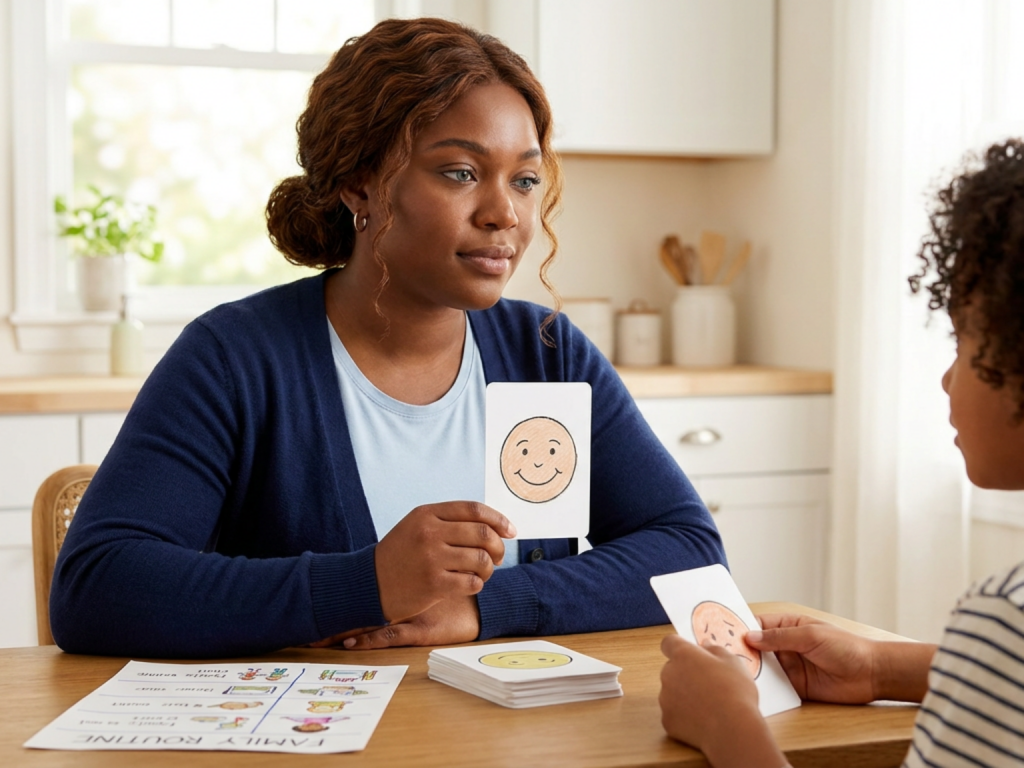
- Keep a feelings chart or emotion vocabulary list visible for younger children.
- Ask the child’s teacher or school counselor what communication patterns they notice in class.
- Consult a pediatrician, speech-language pathologist, or child mental health professional for persistent concerns.
FAQ
At what age should parents start teaching communication values?
From infancy, children learn through tone, responsiveness, and turn-taking. Formal language grows later, but respectful communication can be modeled from the beginning.
Should I require my child to make eye contact?
Eye contact can be encouraged gently as one social cue, but it should not be forced or treated as proof of respect. Some children listen better while looking away.
What if my child refuses to talk after conflict?
Give time for emotional arousal to decrease, then return with a calm, brief invitation. Some children communicate better through drawing, writing, walking, or answering one question at a time.
How can I teach honesty without making my child afraid to tell the truth?
Respond to disclosures with calm curiosity before consequences. Make it clear that telling the truth helps adults solve problems and keep people safe.
When should I worry about communication delays?
If a child has persistent difficulty understanding, speaking, socializing, hearing, or has lost skills, consult a pediatrician or speech-language professional for individualized guidance.
Sources
- PubMed Central — Communication Strategies for Empowering and Protecting Children
- All Saints School — Teaching Communication Skills to Children
- American International University — Teaching Kids Healthy Ways of Communication: A Path to Stronger Relationships and Emotional Well-Being
Disclaimer
This article is for informational purposes only and does not diagnose or treat communication, developmental, or mental health conditions. Consult a qualified healthcare professional for concerns about a child’s speech, hearing, behavior, safety, or emotional well-being.


















Please log in to leave a comment.