
Intro
Parenting can compress life into feeding schedules, school forms, work deadlines, laundry, emotional co-regulation, and the constant background hum of remembering what everyone needs next. In that atmosphere, hobbies may start to feel like luxuries from a previous life. Yet personal interests are not frivolous; they can be a meaningful part of mental health self-care for parents, identity continuity, and recovery from chronic caregiving stress.
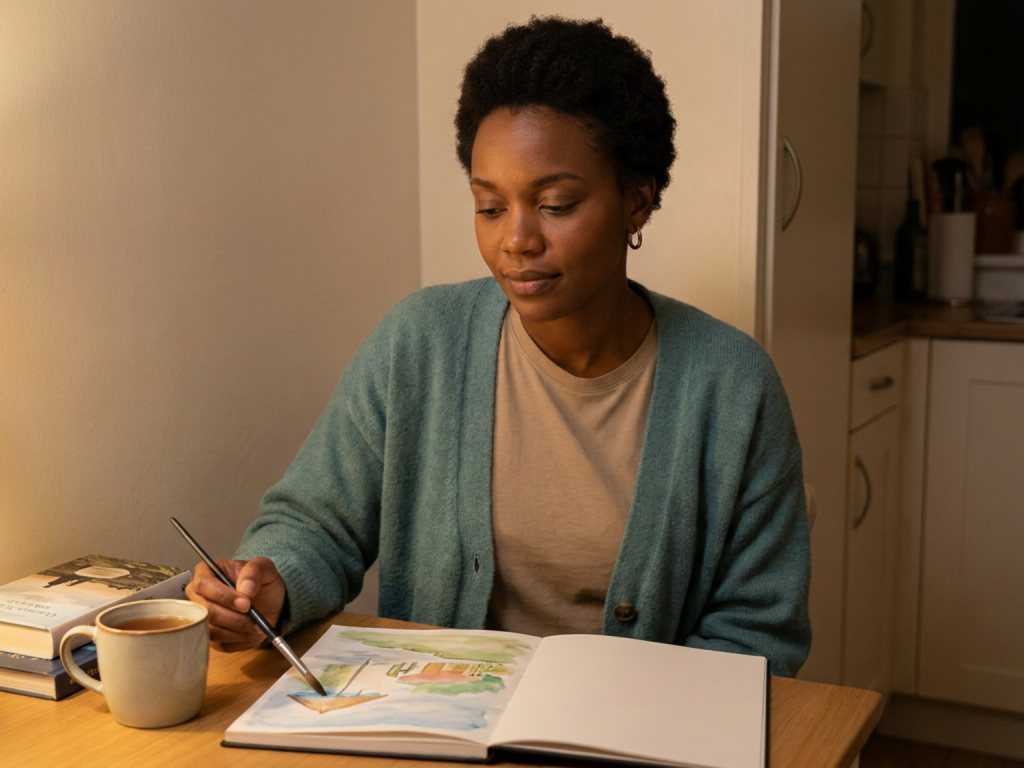
A hobby does not have to be productive, impressive, or even consistent to be worthwhile. It can be 15 minutes of sketching after bedtime, a weekly community choir, a balcony herb garden, a podcast walk, a woodworking class, a language app, or returning to a sport in a modified way. The goal is not to add another obligation to an already full life. The goal is to protect a small, humane space where you are more than the roles you perform for others.
Highlights
Hobbies are associated with better well-being, life satisfaction, and fewer depressive symptoms, and they may support stress reduction and social connection.
For parents, personal interests can help preserve adult identity without competing with love or responsibility for children.
Small, repeatable hobby routines are often more sustainable than ambitious plans that require perfect timing, childcare, or energy.
A hobby should restore or engage you; if it becomes another source of pressure, it may need to be simplified, paused, or reframed.
Persistent low mood, anxiety, exhaustion, or loss of interest deserves professional support, not self-blame.
Why hobbies matter after becoming a parent
Parenthood often changes the architecture of attention. Sleep may be fragmented, executive function can be taxed by planning and interruptions, and emotional labor may expand until there is little unclaimed mental space. In this context, hobbies can function as micro-recovery rather than escapism. They provide a structured but self-directed activity that is not primarily about meeting someone else’s needs.
Research and clinical commentary consistently suggest that hobbies are linked with better mental health and well-being. Reviews of the evidence describe associations with reduced stress, anxiety, and depressive symptoms, as well as improvements in relaxation, personal growth, social connection, and life satisfaction. Harvard Health Publishing also notes that hobbies are tied to better self-reported health, happiness, fewer depressive symptoms, and greater life satisfaction. These are associations rather than guarantees; a pottery class cannot replace medical care, psychotherapy, medication when appropriate, or social support. But hobbies can be one protective layer in a broader well-being plan.
For parents, the benefit may be partly physiological. Enjoyable activities can help downshift stress arousal, support parasympathetic recovery, and interrupt rumination. They may also provide mastery, autonomy, and social belonging, all of which can be depleted by chronic caregiving stress. When a parent says, “I feel like myself again,” that is not trivial. It may represent nervous system regulation, identity continuity, and relief from the sense of being consumed by tasks.
Let your hobby fit your current life, not your former schedule
Many parents avoid returning to hobbies because they compare today’s reality with a previous version of themselves: the runner who trained five days a week, the musician who practiced for hours, the reader who finished a novel every few days. That comparison can make a smaller version feel like failure. A more compassionate approach is to resize the activity while preserving its essence.
Ask what the hobby gives you. Is it movement, creativity, silence, challenge, beauty, social contact, competence, spirituality, or humor? Once you identify the core need, you can find a version that fits. A former marathon runner may start with a 20-minute stroller walk with intervals. A painter may keep a small sketchbook near the kitchen instead of setting up a full studio. A gardener may grow herbs in containers. A musician may play one song twice a week rather than aiming for performance-level practice.
It can help to sort hobbies into three categories:
- Micro hobbies: Activities that take 5 to 20 minutes, such as journaling, stretching, knitting a few rows, watering plants, practicing chords, or reading a short essay.
- Anchor hobbies: Activities that happen weekly or monthly and require some planning, such as a class, sports league, choir, book club, volunteer shift, or hiking group.
- Seasonal hobbies: Interests that become realistic only during certain phases, such as gardening in spring, swimming in summer, crafting during school breaks, or longer creative projects when childcare is more available.
This flexible framing reduces all-or-nothing thinking. Keeping an interest alive may mean touching it lightly for a season, not performing it at your highest capacity.
Start with 15 to 30 minutes and protect the beginning
Mental Health America suggests setting aside even 15 to 30 minutes for hobbies, with emphasis on process rather than perfection. This matters because initiation is often the hardest part for parents. The brain may be tired from decision fatigue, and the body may interpret rest as unsafe if there are unfinished chores nearby. A small, protected start lowers the activation energy.
Try choosing a hobby time that is specific enough to remember but flexible enough to survive family life. For example: “After bedtime on Tuesdays, I will draw for 20 minutes,” or “On Saturday morning, I will walk alone before errands.” If the plan depends on ideal sleep, perfect cooperation from children, and a spotless house, it is too fragile. Instead, build a minimum viable version: five minutes of guitar, one page of reading, one row of knitting, one yoga pose, one plant repotted.
Parents often need environmental cues more than motivation. Keep supplies visible and friction low. Put the book on your pillow, leave the walking shoes by the door, store watercolor pencils in a small basket, or keep a language-learning app on your home screen. If your hobby requires setup, create a “ready kit” so that scarce free time is not spent searching for materials.
Most importantly, protect the beginning from evaluation. The first 10 minutes do not need to be beautiful, efficient, or shareable. They only need to exist. Over time, repetition turns the hobby from an aspiration into a familiar route back to yourself.
Make space without making more work for yourself
A hobby plan can fail if it quietly adds to a parent’s workload. For example, arranging childcare, preparing snacks, leaving instructions, and cleaning the house before going to a class may become more exhausting than the class is restorative. This is where shared labor and explicit agreements matter.
If you co-parent, try discussing hobby time as a family health issue rather than an individual indulgence. Both adults may need protected time, and both may need to practice taking responsibility without requiring detailed management from the other. A useful agreement is concrete: “I will go to ceramics every Thursday from 6:30 to 8:30. You are in charge of dinner, bedtime, and any school forms that come up during that window.” The point is not only the time away; it is freedom from being the remote manager of the household.
Solo parents and parents with limited support may need different strategies. Consider swapping childcare with another trusted family, using community center programs, choosing hobbies that include children nearby but not at the center, or building interests into existing routines. A podcast during a commute, photography on the walk to school, stretching during a child’s bath, or writing voice notes while waiting at practice can all count. For some families, respite care, parent groups, faith communities, or local recreation programs may be important supports.
It is also reasonable to involve children in seeing that adults have interests. This does not mean children must always participate or approve. Rather, it teaches them that people are multidimensional, that rest and creativity matter, and that family members can care for one another’s needs.
Use social hobbies to reduce isolation
Parenting can be socially isolating, even when you are never physically alone. Conversations may become logistical, and adult friendships can shrink under the pressure of schedules. Hobbies can create low-pressure social connection because the activity itself provides structure. A gardening club, choir, running group, art class, volunteer project, or board-game night gives people something to do together before they are expected to disclose deeply.
Social connection is one reason hobby groups may support well-being. Shared interests can reduce loneliness, build belonging, and offer identity outside of parenting. This can be particularly important for new parents, parents who have relocated, parents of children with complex needs, and parents who feel their previous social network no longer fits their daily life.
If joining a group feels intimidating, start with a lower-intensity option: an online class with optional discussion, a library event, a beginner workshop, a walking group, or a one-time volunteer shift. Choose settings where beginners are welcome and attendance can be imperfect. The best social hobby for a parent is not necessarily the most exciting one; it is the one you can return to without shame after missing a week.
When hobbies feel impossible
There are seasons when even a tiny hobby may feel unreachable. Postpartum recovery, sleep deprivation, financial strain, infant feeding difficulties, a child’s illness, relationship stress, grief, or work-family conflict can narrow life to survival. In those periods, the goal may not be to “find a passion.” It may be to preserve one thread of selfhood: listening to music in the shower, stepping outside for morning light, saving recipes you want to cook someday, or texting a friend about a book you used to love.
It is important to distinguish normal constraint from clinically significant loss of interest. Many parents temporarily have less time or energy for hobbies. However, if you experience persistent anhedonia, low mood, excessive anxiety, panic symptoms, intrusive thoughts, marked irritability, changes in sleep or appetite beyond what caregiving explains, hopelessness, or thoughts of self-harm, please contact a healthcare professional promptly. Postpartum mood and anxiety disorders, major depressive episodes, anxiety disorders, thyroid dysfunction, anemia, sleep disorders, medication effects, and other medical conditions can all affect energy, motivation, and pleasure. Only a qualified clinician can assess these possibilities.
Do not use hobbies as a test of whether you are “coping well enough.” If you cannot enjoy anything, that is information worthy of care, not a personal failure. Support may include medical evaluation, psychotherapy, peer support, practical help, or other evidence-based care depending on your situation.
Keep interests alive over the long term
Long-term hobbies survive because they are allowed to change. A parent may cycle through periods of intensity, maintenance, dormancy, and renewal. Instead of asking, “Am I still a real artist, athlete, reader, volunteer, or musician?” ask, “What is the next livable expression of this interest?”
Several strategies can help:
- Create a visible identity cue: Keep one object from the hobby in sight, such as a camera, journal, seed packet, running shoes, or instrument.
- Schedule recovery, not just productivity: Treat hobby time as nervous system care rather than a reward earned after all chores are complete.
- Use gentle accountability: Meet a friend, sign up for a short class, or join a group where attendance is encouraged but not punitive.
- Reduce perfectionism: Let yourself be a beginner, a casual participant, or someone who returns repeatedly after gaps.
- Review the fit every few months: If a hobby no longer restores you, modify the format, frequency, cost, or social setting.
Children also grow, and family rhythms change. Nap schedules disappear, school hours begin, extracurriculars expand, and adolescents may need a different kind of availability. Your hobby routine can evolve alongside these transitions. The aim is not a perfectly balanced life every week. It is the repeated act of making room for the person who is doing the parenting.
When to seek extra support
- If loss of interest is persistent, distressing, or accompanied by hopelessness, consult a healthcare professional.
- Seek urgent help immediately for thoughts of self-harm, harming others, or feeling unable to stay safe.
- Do not rely on hobbies alone to manage significant depression, anxiety, trauma symptoms, or postpartum mood changes.
- New or severe fatigue, cognitive slowing, palpitations, weight change, or sleep disruption may warrant medical evaluation.
- If taking time for yourself triggers conflict, coercion, or fear at home, consider confidential support from a trusted professional or local service.
Tools & Assistance
- Choose one micro hobby that can be done in 15 minutes with supplies already available.
- Create a weekly protected time agreement with a partner, relative, friend, or childcare swap.
- Use a library, community center, parent group, or recreation program to find low-cost classes or clubs.
- Keep a small ready kit for your hobby so setup does not consume your limited free time.
- Speak with a primary care clinician, mental health professional, or postpartum care provider if motivation or pleasure feels persistently absent.
FAQ
Is it selfish to spend time on hobbies when my child needs me?
No. Appropriate personal time can support parental well-being, emotional regulation, and identity. Children benefit from cared-for caregivers and from seeing healthy boundaries modeled.
What if I only have 10 minutes?
Ten minutes can still count. Read two pages, stretch, sketch, water plants, practice a song section, or take a short walk. Consistency matters more than duration.
What if I do not know what I enjoy anymore?
Start with low-pressure experiments rather than searching for a perfect passion. Try activities that offer movement, creativity, quiet, learning, nature, or social connection, and notice what leaves you feeling a little more like yourself.
Can hobbies improve mental health?
Hobbies are associated with reduced stress, improved mood, social connection, and life satisfaction, but they are not a substitute for professional assessment or treatment when symptoms are significant.
How can I keep a hobby going if my schedule constantly changes?
Use flexible tiers: a five-minute version for hard days, a 20-minute version for ordinary days, and a longer version when support is available. This keeps the identity alive even when the routine changes.
Sources
- Harvard Health Publishing — Having a hobby tied to happiness and well-being
- PubMed / National Library of Medicine — Exploring the Impact of Hobbies on Mental Health and Well-Being
- Mental Health America — Why hobbies are good for your mental health
Disclaimer
This article is for informational purposes only and does not diagnose, treat, or replace professional medical or mental health care. Consult a qualified healthcare professional for persistent mood, anxiety, sleep, energy, or safety concerns.














Please log in to leave a comment.