
Intro
Wheeled activities help children build balance, coordination, confidence, and physical fitness, but falls are part of learning. Choosing protective gear is not about making play feel frightening or restrictive; it is about giving children a safer opportunity to practice skills and recover from ordinary mistakes. The best equipment is appropriate for the activity, correctly fitted, comfortable enough to wear consistently, and checked regularly.
This guide explains how to choose helmets, wrist guards, elbow pads, knee pads, and protective clothing for inline skates, roller skates, scooters, and skateboards. It also covers fit, replacement, supervision, and what to do when equipment does not provide adequate protection.
Highlights
A helmet is essential, but it is only one part of a protective setup for wheeled sports.
Wrist guards, elbow pads, and knee pads should match the child’s likely fall pattern and activity.
Correct fit matters as much as the label: loose, damaged, or uncomfortable gear may not protect effectively.
Children should learn in appropriate environments, with supervision and equipment checks adapted to their skill level.
Start with the child, activity, and likely falls
Protective gear should be selected according to the child’s age, body size, experience, and the activity they actually perform. Inline skating and roller skating often involve forward falls onto the hands, knees, or elbows. Scooters can produce forward or sideways falls, including impacts involving the head, wrists, forearms, knees, and shins. Skateboarding adds the possibility of falls while turning, stopping, jumping, or attempting tricks, so the child may need more robust and securely positioned protection.
Skill level is also important. A beginner practicing slow balance drills may need a different setup from an experienced child riding quickly on ramps or attempting jumps. Protective equipment should be upgraded when the activity becomes faster, more complex, or higher risk. A complete set is particularly reasonable for beginners, children who are still developing balance, and children returning to wheeled activity after a period away.
Children may resist gear because it feels hot, bulky, or unfashionable. Listening to those concerns can improve safety rather than undermine it. Let the child try several options, move their arms and legs, sit on a skateboard or scooter, and practice putting gear on and taking it off. Equipment that is comfortable and accepted is more likely to be worn consistently.
Choose a helmet designed for wheeled sports
A helmet should be the first purchase for skating, scooters, and skateboards. Look for a model specifically intended for the relevant wheeled activity and carrying the safety certification required in your region. A bicycle-style helmet may be suitable for some low-speed activities, but a child who skates, scooters, or skateboards should use a product whose design and instructions match that use. When comparing options, prioritize certified helmets for wheeled sports rather than appearance alone.
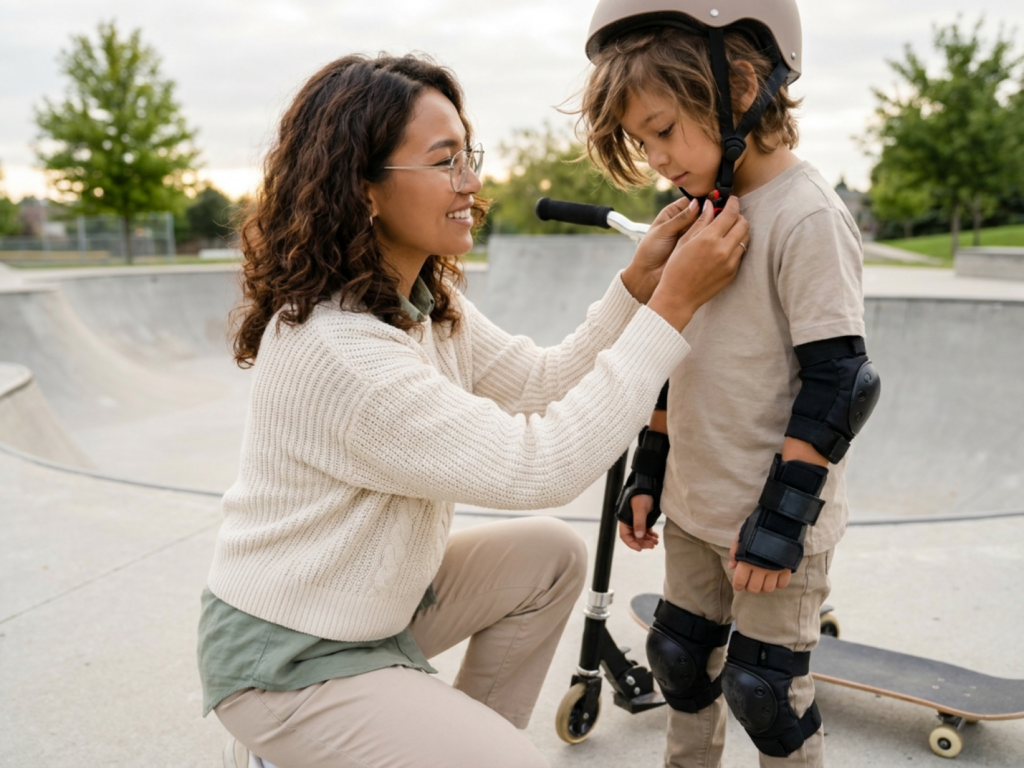
The helmet should sit level on the head, low over the forehead without obstructing vision, and remain stable during movement. The side straps should meet just below each ear, and the chin strap should be snug enough that the helmet does not shift when the child looks up, down, or side to side. The child should be able to open their mouth comfortably without the chin strap becoming markedly loose. Follow the manufacturer’s fitting instructions because internal adjustment systems differ.
Do not buy a helmet that is substantially too large in the expectation that the child will grow into it. Growth-related sizing is better handled by measuring the head and checking the manufacturer’s size range. Avoid decorating, modifying, drilling, or adding unapproved accessories, since alterations can affect structural performance. A helmet that has experienced a substantial impact should generally be replaced even if there is no visible damage; consult the manufacturer for specific replacement guidance.
Add wrist, elbow, and knee protection
Children commonly extend their hands during a forward fall. Wrist guards can help distribute force and limit painful hyperextension, although they cannot prevent every wrist or forearm injury. Evidence from inline-skating research supports the usefulness of wrist guards and elbow pads, while broader safety guidance recommends combining them with a helmet and other protective equipment. The findings are most direct for inline skating, so they should be applied thoughtfully to scooters and skateboards rather than presented as a guarantee.
Wrist guards should cover the wrist and provide firm support without cutting into the hand or restricting circulation. Many have a rigid or semi-rigid splint on the palm side and may be designed specifically for left or right hands. Check that the child can grip handlebars or a skateboard comfortably. A guard that slides around, exposes the wrist, or makes it difficult to release a handlebar may create practical problems even if its materials are protective.
Elbow pads should center over the elbow and remain in place when the child bends and straightens the arm. Knee pads should cover the kneecap and stay centered during squatting, pushing, and stepping off. Flexible sleeves can be comfortable for general skating, while more substantial shells may be preferable for skateboarding, ramps, or repeated practice on hard surfaces. Straps should be secure but not painful, and padding should not be compressed, cracked, or misshapen.
For younger or inexperienced children, a complete combination of helmet, wrist guards, elbow pads, and knee pads is often more practical than purchasing only one item. Protective equipment works as a system: a helmet does not protect the wrists, and knee pads do not address head injury risk.
Fit and comfort are safety features
Properly fitted protective gear should stay in the correct position during ordinary movement and a fall. Before each session, ask the child to walk, bend, squat, reach forward, turn their head, and hold the scooter or skateboard. Watch for equipment that shifts, pinches, blocks vision, catches on clothing, or interferes with braking and steering. A child who cannot move naturally may remove the gear or adopt awkward techniques that increase fall risk.
Measure rather than guessing. Helmet sizing is usually based on head circumference, while pads may be sized by limb circumference or height. Children grow quickly, and growth can create an unsafe gap between the body and the protective shell. Recheck fit periodically and after changes in clothing, braces, or other equipment. Some pads fit over thin clothing, while others are designed to be worn underneath; follow the product instructions.
Inspect fasteners, straps, buckles, stitching, padding, and hard shells. Clean equipment according to the manufacturer’s instructions and allow it to dry fully before storage. Odor, sweat, and skin irritation are not merely cosmetic concerns: they can make a child unwilling to wear gear and may aggravate sensitive skin. If persistent irritation, numbness, discoloration, or pain occurs, stop using the item and seek appropriate professional advice rather than forcing continued use.
Consider secondhand gear carefully
Secondhand equipment can be difficult to assess because its history may be unknown. This is especially important for helmets, which may have sustained an impact that is not visible. A used helmet should not be accepted if its crash history, age, storage conditions, or authenticity cannot be established. Check for manufacturer information, damage, missing parts, and current replacement guidance.
Used pads and wrist guards may be reasonable only when they are clean, intact, correctly sized, and free from cracks, torn straps, compressed padding, or distorted shells. Do not rely on appearance alone. A fastening system that repeatedly opens or a pad that rotates away from the joint should be replaced. Product recalls and manufacturer instructions can provide important information, so retain the model and product details when possible.
For safety-critical equipment, a modest saving may not justify uncertainty. If purchasing new gear is difficult, ask a pediatric clinician, local sports organization, community equipment program, or reputable retailer whether safe, correctly sized options are available.
Pair equipment with safer practice
Protective gear reduces the potential severity of some injuries, but it does not make hazardous behavior safe. Children should practice in a clear, well-maintained area away from traffic, water, steep slopes, and pedestrians. Beginners benefit from flat surfaces, adequate lighting, and an adult who can provide calm supervision. Helmets and pads should be worn during practice, not only during a formal lesson or when a child is attempting a trick.
Teach basic skills before speed: how to start, stop, turn, slow down, step off safely, and fall without trying to break the entire impact with an outstretched hand. Instruction should be age-appropriate and nonpunitive. Children learn better when they can pause, hydrate, and report discomfort without fear of losing the activity.
Weather and surface conditions matter. Wet pavement, loose gravel, leaves, ice, potholes, poor lighting, and crowded paths increase the chance of losing control. Check scooter handlebars, wheels, brakes, trucks, axles, and skateboard hardware before use. Equipment maintenance is part of injury prevention, because mechanical failure can cause a fall even when the child is wearing every recommended protective item.
Know when to stop and seek medical advice
Stop the activity after a significant fall, especially if the child has head, neck, back, or abdominal pain; difficulty breathing; severe pain; obvious deformity; uncontrolled bleeding; weakness; numbness; inability to bear weight; repeated vomiting; unusual sleepiness; confusion; seizure; or loss of consciousness. These findings warrant prompt medical assessment or emergency services according to their severity.
A child may have a concussion without losing consciousness. New headache, dizziness, nausea, balance problems, sensitivity to light or noise, slowed thinking, memory difficulty, unusual irritability, or behavior change after a head impact should be taken seriously. Remove the child from activity and seek guidance from a qualified healthcare professional. Do not use a return-to-play decision based only on how quickly the child says they feel better.
Wrist, elbow, knee, or ankle pain that persists, swelling that increases, or reduced movement also deserves clinical evaluation. Parents and caregivers should not attempt to diagnose a fracture, ligament injury, or concussion from appearance alone. A healthcare professional can advise on assessment, monitoring, and a safe return to activity.
Safety warnings
- Never use a helmet after a significant impact unless the manufacturer or a qualified professional confirms that it remains suitable.
- Do not allow children to skate, scooter, or skateboard in traffic or on wet, icy, uneven, or poorly lit surfaces.
- Remove a child from activity after a possible concussion or significant injury and seek medical advice.
- Replace gear that is cracked, torn, stretched, loose, or no longer fits correctly.
- Protective equipment reduces risk but cannot prevent every injury.
Tools & Assistance
- A flexible measuring tape for head and limb measurements
- A pre-activity checklist for helmet, straps, pads, wheels, brakes, and riding surface
- A reputable sporting-goods retailer or qualified instructor for fitting assistance
- A pediatric healthcare professional for injury assessment and return-to-activity guidance
FAQ
Does my child need pads if they are only riding slowly?
Pads are especially useful for beginners because slow practice still involves falls. A helmet should be used consistently, and wrist, elbow, and knee protection are reasonable additions based on the activity, skill level, surface, and child’s comfort.
Can a bicycle helmet be used for skateboarding?
Use a helmet whose labeling and instructions are intended for the child’s activity. Skateboarding can involve repeated falls and impacts from different directions, so check regional certification requirements and manufacturer guidance rather than assuming all helmets are interchangeable.
How tight should protective gear be?
It should be snug and stable without causing pain, numbness, skin discoloration, or restricted movement. The child should be able to move naturally and operate the scooter or skateboard safely.
When should a helmet be replaced?
Replace it after a substantial impact, when it is damaged, when the fit can no longer be adjusted correctly, or according to the manufacturer’s age and replacement recommendations. If its history is unknown, especially for used equipment, choose another helmet.
What should I do after my child hits their head?
Stop the activity and monitor for concerning symptoms such as confusion, worsening headache, vomiting, unusual sleepiness, balance difficulty, or behavior change. Seek urgent medical care for severe or rapidly worsening symptoms and consult a healthcare professional about suspected concussion.
Sources
- U.S. Consumer Product Safety Commission — Skate Safely - Always Wear Safety Gear
- PubMed — Risk factors for injuries from in-line skating and the effectiveness of protective equipment
- Monash University Accident Research Centre — Personal Protective Equipment Use By In-Line Skaters in Victoria
Disclaimer
This article provides general educational information and is not a diagnosis or substitute for individualized medical advice. Consult a qualified healthcare professional for injury assessment, concussion concerns, equipment-related medical questions, or return-to-activity decisions.














Please log in to leave a comment.