
Intro
Choosing sports equipment for a child can feel like a difficult balance between a household budget and a responsibility to protect a growing body. The least expensive option is not always poor quality, and the most expensive product is not automatically safer or more durable. The best decision usually depends on fit, intended use, safety features, construction, comfort, maintenance, and how quickly the child may outgrow the item.
Research on sporting-goods purchasing suggests that quality is often a leading consideration, while price, brand, and appearance may be less influential for many buyers. For children, however, “quality” should be interpreted practically: does the equipment fit the child, support the activity, tolerate expected use, and reduce avoidable hazards? This article offers a structured way to compare value without treating a higher price as a guarantee of better performance.
Highlights
The lowest sticker price may become expensive if equipment wears out quickly, fits poorly, or must be replaced.
A higher price is worthwhile only when it provides meaningful improvements in safety, fit, comfort, durability, or function.
Children’s equipment should be evaluated in relation to growth, skill level, frequency of use, and sport-specific risks.
For protective equipment, correct sizing and condition generally matter more than prestige branding.
What quality means in children’s sports equipment
Quality is not a single characteristic. In children’s sports equipment, it is a combination of functional performance, structural integrity, comfort, fit, and expected service life. A high-quality football boot, for example, should suit the playing surface, remain securely fastened, and allow the child to move without painful pressure points. A racket should be manageable for the child’s strength and coordination rather than simply being made from more expensive materials.
Studies examining sporting-goods decisions have reported that consumers frequently rank quality highly, while brand name and price may carry less weight for many respondents. Research involving athletes similarly emphasizes quality, comfort, and durability over style, although the importance of price can vary between groups. These findings support a balanced conclusion: buyers often value performance-related attributes, but a premium price is useful only when it delivers improvements that matter for the child’s actual activity.
For families, quality should therefore be translated into observable questions: Is the product appropriate for the sport? Does it remain stable during movement? Can the child use it comfortably for the expected duration? Are seams, fasteners, padding, soles, or frames well constructed? Can it be cleaned and maintained? Does it meet relevant safety requirements?
Why the cheapest option can cost more over time
Price is easiest to understand when considered as total cost rather than purchase cost. A low-priced item may be good value if a child uses it occasionally, grows rapidly, or participates in a low-impact activity. It may be poor value if it breaks after a few sessions, causes discomfort, or cannot be adjusted as the child develops. Replacing several inadequate products can ultimately cost more than buying one appropriately designed item.
Durability is particularly relevant for equipment used frequently or shared among siblings. Strong stitching, dependable closures, resilient materials, and replaceable components may extend useful life. However, durability should not be confused with indestructibility. Even a well-made product can become unsafe through heavy use, exposure to moisture, improper storage, or an impact that compromises its structure.
There is also a less visible cost: equipment that does not fit or function properly may discourage participation. Discomfort, slipping, excessive weight, or difficulty controlling an item can reduce confidence and enjoyment. A child who avoids practice because equipment feels unpleasant may receive less benefit from the purchase, regardless of its initial price.
A simple comparison can help. Estimate how often the item will be used, how long it is likely to remain suitable, whether it can be adjusted, and what replacement parts or care it may require. This approach is more informative than comparing two price tags in isolation.
Fit, comfort, and growth deserve priority
Children are still growing, and their body proportions, coordination, and skill level change over time. Equipment that is technically advanced but too large, heavy, stiff, or difficult to control may be less appropriate than a moderately priced product designed for the child’s current stage. “Room to grow” has limits: excessive looseness can impair control and may create avoidable trip, entanglement, or instability hazards.
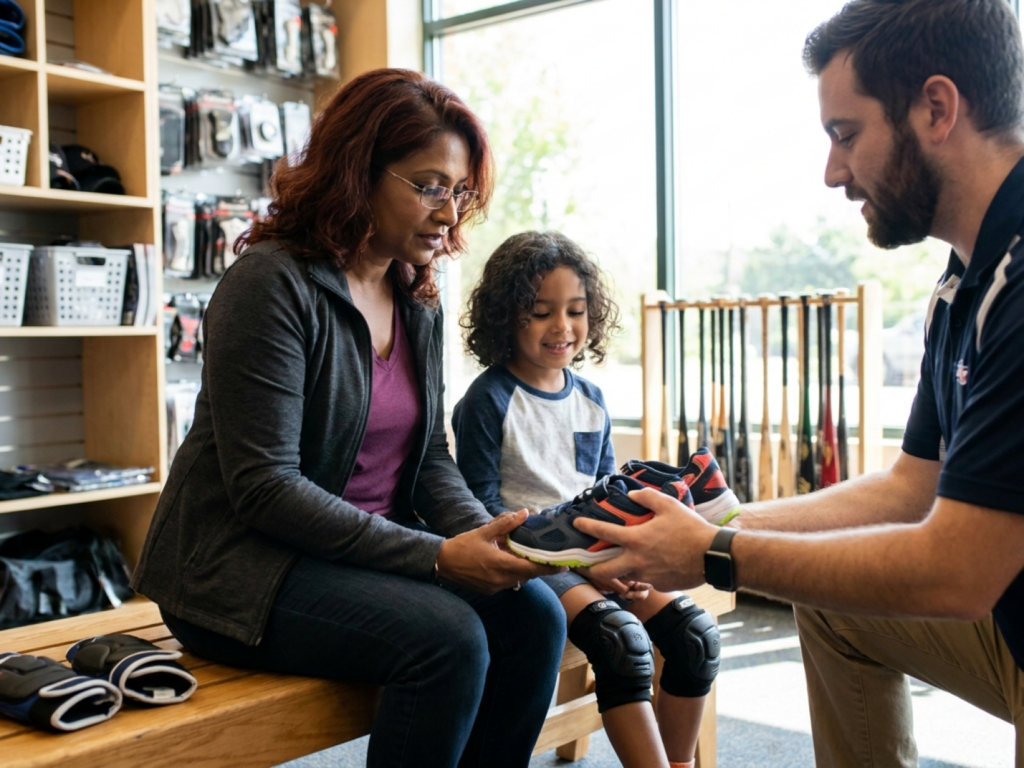
Fit should be assessed according to the item. Footwear should hold the heel securely without painful compression, while protective equipment should sit in the intended position and remain there during movement. Gloves, braces, helmets, pads, and buoyancy aids require particular attention to manufacturer sizing and adjustment instructions. An adult should observe the child moving, bending, jumping, or performing the relevant sport-specific actions rather than judging fit only while the child is standing still.
Comfort is not merely a luxury. Pressure points, excessive heat, chafing, and restricted movement can alter technique and cause a child to remove or loosen equipment. That undermines its intended protective or performance function. If a child reports persistent pain, numbness, skin irritation, or difficulty breathing or moving while wearing equipment, stop the activity and seek appropriate professional guidance rather than assuming the child simply needs to “break it in.”
When growth is rapid, consider adjustable designs, rental programs, club equipment, or reputable second-hand options. Do not deliberately buy protective equipment several sizes too large in anticipation of future growth.
Safety equipment is not the place for casual compromises
For protective equipment, the decision should begin with the hazards of the sport and the required standard, not with color, branding, or the lowest available price. Sport-specific protective equipment is designed for particular forces and contact patterns; a generic substitute may not provide equivalent coverage or retention. Families should follow the sport’s governing-body requirements and the manufacturer’s instructions, while coaches or qualified retailers can help verify suitability.
Correct fit is central to protection. A helmet, mouthguard, shin guard, life jacket, or protective pad that shifts, leaves important areas uncovered, or interferes with vision may not perform as intended. Inspect products for cracks, deformation, frayed straps, missing fasteners, compressed padding, or signs of chemical or heat damage. Products with a known impact history may require replacement even when damage is not obvious, particularly when the manufacturer advises replacement after a significant event.
Second-hand purchases require extra caution. Some items are reasonable to buy used after careful inspection, such as certain balls, nets, or washable clothing. Others are difficult to evaluate because internal damage, contamination, or previous impact may not be visible. Protective equipment should be purchased only when its history, age, model information, and condition can be established with reasonable confidence.
Price can matter in safety equipment because extremely low prices may reflect missing information, counterfeit products, or poor construction. Nevertheless, an expensive brand is not a substitute for certification, correct sizing, inspection, and responsible use.
When paying more may be worthwhile
Paying more can be sensible when the additional cost produces a clear, relevant benefit. Examples may include a better fit system, stronger construction for frequent training, improved ventilation, more reliable fasteners, sport-appropriate traction, or materials that tolerate repeated cleaning. The benefit should be connected to the child’s use rather than to marketing language alone.
Higher-priced equipment is more likely to make sense for a child who trains several times each week, competes regularly, uses equipment intensively, or has specific fit requirements. It may also be reasonable when the item will be shared by siblings and has a design that accommodates adjustment without compromising stability. In these situations, durability and comfort can reduce replacement frequency and support continued participation.
Before paying a premium, compare products by function. Look for independent testing or recognized safety information where relevant, clear sizing guidance, warranty terms, repairability, and availability of replacement parts. Ask whether the expensive feature affects safety or performance, or merely appearance and prestige. A sophisticated material has limited value if the child dislikes wearing the item or cannot control it.
Retail staff, coaches, physiotherapists, occupational therapists, or sports-medicine professionals may provide useful context for specialized equipment. Their role is to help match equipment to the child’s activity and needs, not to diagnose a medical condition through a product purchase.
When a budget option can be the better choice
A budget product can be entirely appropriate when it meets the essential requirements for safety, fit, comfort, and function. This is especially true for beginners who are still deciding whether they enjoy an activity, children who participate seasonally, and equipment that is used infrequently or for low-impact practice. The objective is not to buy the most advanced product but to buy a suitable one.
Used equipment can reduce financial pressure and support access to sport, provided its condition and history are acceptable. Community clubs, schools, libraries of sporting goods, rental services, and organized equipment exchanges may offer practical alternatives. Washing instructions, hygiene, and the ability to adjust the item should be considered before purchase.
Do not let a limited budget lead to unsafe improvisation. It is better to spend selectively on essential protective items and choose simpler versions of nonessential accessories. For example, decorative features, specialized storage, and premium styling may be postponed, while correct footwear, sport-required protection, and a properly sized item remain priorities.
A child’s voice also matters. Ask what feels comfortable, what is difficult to use, and whether the equipment affects confidence or enjoyment. A modestly priced item that the child consistently wears and uses correctly may offer more practical value than an expensive item left unused.
A practical quality-versus-price checklist
Before purchasing, test the item whenever possible. A consumer guide from DoneDeal recommends looking beyond price by considering purpose, safety, condition, and whether the equipment can be tested before buying. These principles are particularly useful for children because they combine objective inspection with the child’s real experience of using the product.
- Define the use: identify the sport, playing surface, frequency, skill level, and whether the child is training or competing.
- Check fit: use the manufacturer’s measurements, adjust every strap or closure, and observe movement rather than judging fit at rest.
- Inspect construction: examine seams, padding, soles, frames, fasteners, ventilation openings, and adjustment mechanisms.
- Check safety information: look for appropriate standards, model details, instructions, warnings, and an identifiable manufacturer.
- Test function: allow the child to walk, grip, throw, swing, pedal, or perform the relevant movement under supervision.
- Estimate total cost: include maintenance, replacement parts, shipping, rental fees, and likely replacement due to growth.
- Plan care: store equipment appropriately, dry it as directed, and inspect it periodically for deterioration.
If an item fails a basic requirement, a lower price does not make it a good purchase. Conversely, if a reasonably priced item fits well, meets the relevant requirements, and performs reliably, paying more may add little practical value.
Supporting safe participation without overspending
Equipment is only one part of sports safety. A child also benefits from appropriate supervision, instruction, gradual skill progression, rest, hydration suited to the environment, and attention to pain or unusual fatigue. Equipment cannot compensate for unsafe playing conditions, poor technique, excessive training load, or inadequate recovery.
Families should create a comfortable environment in which children can report discomfort, fear, dizziness, numbness, or an equipment problem without embarrassment. Persistent pain, recurrent injury, breathing difficulty, fainting, suspected concussion, or any concerning symptom warrants prompt assessment by a qualified healthcare professional. Do not use a more expensive product as a substitute for medical evaluation or individualized advice.
The most defensible purchase is one that supports participation now while respecting the family’s resources. By separating essential safety and fit features from optional upgrades, parents and caregivers can make thoughtful choices without shame or pressure. Quality is best understood as suitability in context, and value is the benefit a child receives across safe, comfortable, enjoyable use.
Safety reminders
- Never assume that a high price guarantees certification, correct fit, or protection.
- Do not use visibly damaged, poorly fitting, or impact-compromised protective equipment.
- Avoid buying protective equipment several sizes too large for future growth.
- Seek professional medical advice for persistent pain, repeated injuries, or concerning symptoms.
- Follow sport-specific rules and manufacturer instructions for use, cleaning, inspection, and replacement.
Tools & Assistance
- A written comparison chart recording fit, safety features, durability, comfort, warranty, and total cost
- A measuring tape and the manufacturer’s official sizing guide
- A supervised try-on and movement test before purchase
- A periodic equipment inspection routine at home
- Advice from a qualified coach, reputable specialist retailer, or healthcare professional when equipment needs are complex
FAQ
Is expensive sports equipment always better for a child?
No. A higher price may reflect useful improvements in durability, fit, or comfort, but it can also reflect branding or optional features. Suitability, safety information, condition, and correct fit are more important than price alone.
Is second-hand sports equipment safe to buy?
It can be appropriate for some nonprotective items if the condition, hygiene, and function are clear. Use greater caution with helmets and other protective equipment because hidden damage, age, or unknown impact history may reduce protection.
How much room should children have in sports footwear or protective gear?
Enough space is needed for comfortable movement, but excessive looseness can reduce control and stability. Follow the product’s sizing guidance and observe the child moving in the equipment rather than choosing a much larger size for future growth.
What should parents prioritize when money is limited?
Prioritize sport-required protective equipment, correct fit, suitable footwear, and reliable function. Optional styling, premium accessories, and advanced features can usually wait.
When should a healthcare professional be consulted?
Seek professional advice for persistent or recurrent pain, suspected concussion, unusual fatigue, breathing difficulty, fainting, repeated injuries, or questions about specialized equipment related to a health condition.
Sources
- Business Perspectives — Selected factors as determinants in the purchase choice of sporting goods
- International Journal of Sports Science and Education — Sport-performance-based buying behaviour assessment of athletes towards sports equipment
- DoneDeal Help Center — Buying sports equipment
Disclaimer
This article is for general educational information and does not diagnose, treat, or replace advice from a qualified healthcare professional. Consult an appropriate clinician or sports-medicine professional for individual concerns, persistent symptoms, injuries, or specialized equipment needs.
















Please log in to leave a comment.