
Intro
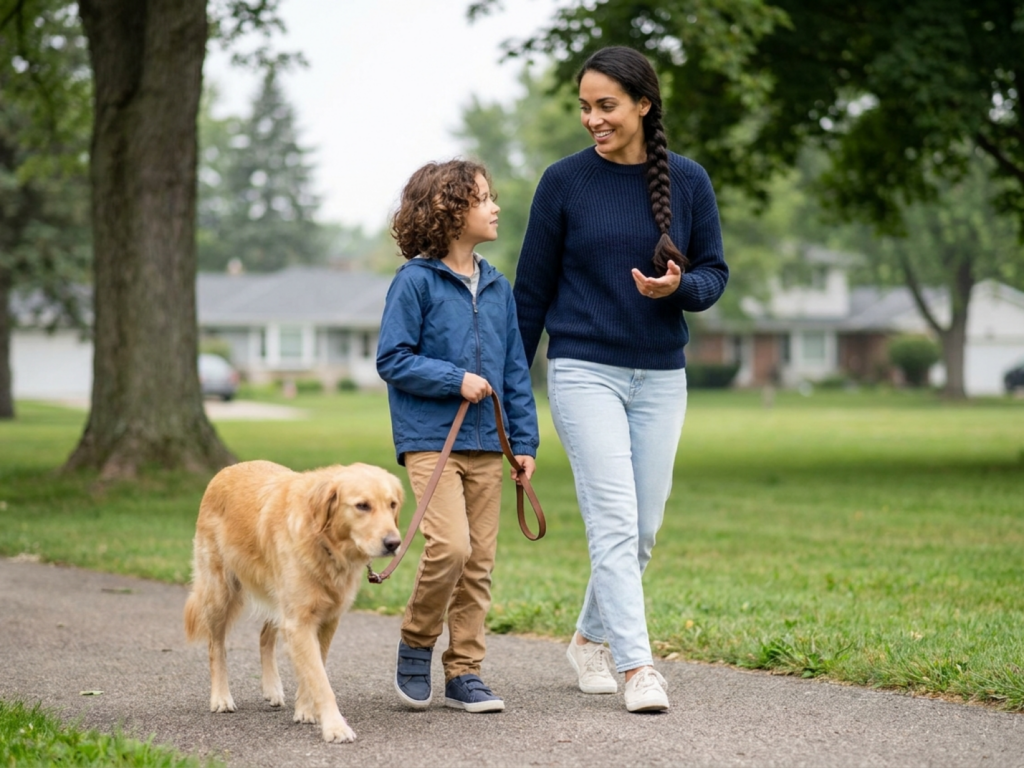
Walking a dog can help a child build confidence, responsibility, and practical outdoor skills. It is also a situation that combines several risks: traffic, unfamiliar people and animals, weather, leash handling, and the dog’s own behavior. A safe plan should match the child’s developmental abilities, the dog’s strength and temperament, and the route’s environmental demands.
Independent walking should be introduced gradually rather than treated as a single milestone. Caregivers can teach, observe, rehearse, and review the routine while keeping an adult responsible for deciding when the child and dog are ready.
Highlights
Readiness depends on the child, the dog, the route, and current conditions—not age alone.
A short, familiar route and reliable communication plan reduce avoidable risk.
Children should know how to respond calmly to unfamiliar dogs and when to return home or seek help.
Adult supervision remains appropriate whenever the child cannot safely control the dog or respond to an unexpected situation.
Start with a readiness assessment
There is no single age at which every child can safely walk a dog alone. Readiness is better judged by observable skills. The child should be able to follow several instructions in sequence, stay focused without a phone or other distraction, recognize unsafe situations, and ask for help without feeling embarrassed. They should also understand that being responsible does not mean taking risks to protect the dog.
The dog is equally important. A child may be unable to control a dog that pulls, lunges, bolts, chases bicycles, or reacts unpredictably to people or other animals. Consider the dog’s size and strength relative to the child, training history, recall reliability, anxiety, and behavior around traffic. A calm dog can still behave differently when startled, injured, frightened, or confronted by another animal.
Readiness also depends on the environment. Begin with a short, familiar route in a low-traffic area, ideally during daylight and predictable weather. An adult should first walk alongside the child, then follow at a distance, and only later consider brief independent walks. This gradual approach allows the caregiver to assess judgment in real conditions rather than relying only on verbal reassurance.
Build a clear walking routine
Before the first solo outing, create a written or rehearsed routine. The child should know the planned route, permitted boundaries, expected return time, and what to do if the route is blocked or conditions change. A family safety plan for children can make these decisions easier to remember, particularly when the child is anxious or distracted.
Use simple check-in rules. For example, the child might tell an adult when leaving and returning, carry a charged phone if appropriate for their age, and contact the caregiver if the dog becomes difficult to control, the child feels unsafe, or the walk will take longer than expected. The child should know a small number of safe adults and safe public places where they can ask for assistance, such as a staffed shop, library, community center, or known neighbor’s home.
Agree on what information the child may share. They generally do not need to disclose their full name, home address, school, or whether they are alone. Teach them to move toward a safe place and contact their caregiver rather than accepting transport, gifts, or invitations from an unfamiliar person. The aim is not to make the child fearful; it is to provide predictable actions for uncertainty.
- Walk on the agreed route and avoid shortcuts through isolated areas.
- Keep the phone accessible but do not use it while crossing roads or managing the leash.
- Return home if visibility, weather, or the dog’s behavior changes substantially.
Teach leash, road, and equipment skills
Practice leash handling in a controlled setting before going farther from home. The child should hold the leash securely without wrapping it around a hand, wrist, or body. They should learn to keep enough distance from the dog to avoid tripping and to stop moving if the dog pulls suddenly. A fixed-length leash is often easier for a child to manage than equipment that rapidly changes length, although equipment should be selected with guidance from a knowledgeable adult or qualified trainer.
Teach a consistent stopping cue and rehearse turning around without running. Running can encourage chasing and may cause the child to lose balance. The child should never attach the leash to a bicycle, scooter, or vehicle, and should not hand the leash to another child without the caregiver’s permission.
Road safety must be practiced as a separate skill. The child should stop at driveways and crossings, look and listen for vehicles, and keep the dog on the side away from traffic where possible. They should cross only at appropriate locations and never allow the dog to pull them into the road. A route that is manageable for an adult may be too complex for a child because of blind corners, loose dogs, heavy traffic, construction, water hazards, or poor lighting.
Check the collar or harness, identification information, leash, and footwear before leaving. The child should know not to chase a dog that escapes. Instead, they should move to safety, tell an adult immediately, and follow the household’s plan for contacting the appropriate animal service if needed.
Teach calm behavior around unfamiliar dogs
A child should not assume that every dog wants to be greeted. The safest default is to give unfamiliar dogs space and avoid approaching a dog that is loose, behind a fence, eating, sleeping, caring for puppies, injured, or with its owner but showing distress. Children should ask the owner before any interaction, and a refusal or uncertain response should end the interaction.
Explain that dogs communicate through posture and movement as well as vocalization. A stiff body, intense staring, raised hair, growling, showing teeth, repeated barking, backing away, or trying to hide may indicate that the dog is uncomfortable or aroused. The child should not test the dog, tease it, stare into its eyes, wave hands, run toward it, or shout. Calm movement and physical space are safer than attention-seeking behavior.
If an unfamiliar dog approaches, the child should stop, remain as quiet and still as possible, keep hands low and close to the body, avoid direct eye contact, and allow the dog to move away. They should not run, scream, kick, or try to pull their own dog toward the approaching animal. If holding their own dog’s leash, they should focus on maintaining control without placing their hands between the animals. The exact response may depend on the dogs’ behavior, so children should rehearse the plan with an adult rather than improvising.
If a dog knocks the child down, they should curl into a protective position, cover the head and neck, and remain as still as possible until the dog moves away. Afterward, they should go to a safe adult and report any bite, scratch, fall, or near miss.
Plan for weather, terrain, and physical strain
Weather can change the risk profile of an ordinary walk. Hot conditions may contribute to heat-related illness in both children and dogs, while icy, stormy, or poorly visible conditions can increase falls, traffic risk, and difficulty returning home. Avoid scheduling independent walks during extreme heat, severe cold, thunderstorms, high winds, or darkness unless the child has appropriate supervision and the route is demonstrably safe.
Choose terrain that matches the child’s endurance and the dog’s needs. Steep paths, fast-moving water, unstable ground, dense vegetation, and areas with ticks or other environmental hazards require additional planning. A shorter route with an easy exit is preferable to a longer route that leaves the child far from help. The child should have suitable clothing and footwear, access to water when needed, and a way to contact the caregiver.
Teach the child to notice early problems rather than pushing through them. Increasing fatigue, dizziness, confusion, unusual weakness, breathing difficulty, or feeling overheated should prompt an immediate return to a safe place and contact with an adult. If the child becomes acutely unwell, collapses, has severe breathing difficulty, or cannot safely return, the caregiver should seek urgent medical assistance. A child should not be expected to assess or manage a potentially serious medical problem alone.
Prepare for separation, escape, or an unexpected event
Role-play several scenarios at home: the dog slips its collar, the leash breaks, the child loses the route, a stranger asks questions, another dog approaches, or the child falls. Rehearsal can reduce panic and help the child remember the first safe action. Keep the instructions short: stop, create distance from danger, move toward a known safe place, contact the caregiver, and wait for directions.
If the dog escapes, the child should not enter traffic, climb fences, cross fast-moving water, or run into an unsafe area. They should tell an adult promptly and describe the last known location and direction. Identification information on the dog should be current, but the child should not be sent alone to search for an animal in an unfamiliar or hazardous place.
Establish a return-home rule for problems that do not require emergency action. Examples include a loose leash, a damaged harness, persistent pulling, a route closure, worsening weather, or the child feeling watched or uncomfortable. Returning early is a successful safety decision, not a failure of responsibility.
Review each walk briefly afterward. Ask what went well, what felt difficult, and whether the route or equipment needs changing. Avoid blame after a near miss; a calm review makes it more likely that the child will report future concerns promptly.
Know what to do after a bite, scratch, or fall
Any bite or scratch that breaks the skin should be reported to a caregiver immediately. The child should move away from the animal and seek prompt medical advice, because wound care, infection prevention, tetanus status, and assessment of possible exposure to animal-borne infection may need professional review. The animal’s owner and vaccination information may be relevant, but the child should not return to confront the owner or attempt to handle the animal.
Urgent help is warranted for uncontrolled bleeding, a deep or extensive wound, injury to the face, eye, neck, hand, or genitals, severe pain, loss of function, fainting, breathing difficulty, or any situation in which the child appears seriously unwell. A fall can also cause head injury even when there is no visible wound. If the child has concerning symptoms after a fall, seek medical assessment rather than relying on the child to decide that they are fine.
Keep a record of what happened, including time, location, the dog’s description, witnesses, and the child’s injuries. Follow local public-health, animal-control, and emergency-reporting requirements. A healthcare professional can advise on the appropriate evaluation and follow-up for the specific injury.
Review the plan as the child and dog change
Safety planning is not a one-time lesson. Reassess after a move, a change in the dog’s health or behavior, a new route, seasonal weather changes, or a developmental change in the child. A dog that was previously easy to manage may pull more strongly when frightened or excited. Likewise, a child who was reliable on a quiet route may need more supervision near traffic, crowds, or unfamiliar dogs.
Use developmental supervision principles rather than comparing the child with siblings or peers. Child safety basics by age can help families think about supervision, judgment, and gradually increasing independence, but an individual assessment remains essential. If the child cannot consistently control the dog, recognize danger, follow the route, or communicate a problem, continue accompanied walks.
Consider professional help when the dog shows aggression, severe fear, repeated escape behavior, or intense leash reactivity. A qualified veterinary professional can assess health-related behavior changes, and a suitably qualified trainer or behavior professional can help with safe handling. Caregivers should also seek advice from a healthcare professional after any injury or when they are unsure how to respond to a possible medical concern.
Stop the walk and get adult help when
- The child cannot control the dog or the leash equipment fails.
- An unfamiliar dog approaches aggressively, or either dog shows escalating distress.
- The child becomes lost, feels followed, or feels unsafe for any reason.
- Weather, traffic, darkness, or terrain makes the route unsafe.
- The child is bitten, scratched, knocked down, or develops concerning symptoms.
Tools & Assistance
- A short, rehearsed route map with agreed boundaries and safe places
- A caregiver check-in routine and a charged phone when developmentally appropriate
- A pre-walk equipment check for collar, harness, identification, and leash
- Role-play practice for unfamiliar dogs, separation, falls, and asking safe adults for help
- Contact details for the child’s healthcare professional, local emergency service, and animal-control service
FAQ
What age can a child walk a dog alone?
There is no universal age. Readiness depends on the child’s judgment and communication, the dog’s strength and behavior, the route, weather, and local rules. Begin with supervised practice and increase independence only when the child demonstrates consistent safe skills.
Should a child greet an unfamiliar dog?
Usually not without the owner’s permission and a calm, controlled situation. The child should give unfamiliar dogs space, avoid staring or sudden movements, and leave the interaction if the dog or owner appears uncertain.
What should a child do if another dog runs toward them?
The child should stop, stay as calm and still as possible, avoid running or screaming, avoid direct eye contact, and maintain distance. They should move toward a safe adult or location when it is safe and report the event to their caregiver.
Can a child walk a dog in hot weather?
Extreme heat increases risk for both children and dogs. Choose a cooler time or postpone the walk, and obtain adult guidance if conditions are uncomfortable or changing. A child should return and seek help if they feel overheated or unwell.
What should happen after a dog bite or scratch?
The child should move away, tell a caregiver immediately, and obtain prompt medical advice for any wound that breaks the skin. Urgent assistance is needed for severe bleeding, deep wounds, face or eye injuries, breathing problems, fainting, or serious illness.
Sources
- Health Service Executive (HSE) — Dogs - teaching your child to be safe
- Greater Manchester Police — Advice on keeping children safe around dogs this Child Safety Week
- Buckhead Pet Pals — 3 Hidden Dangers of Letting Kids Walk Dogs
Disclaimer
This article provides general safety information and is not a substitute for individualized advice from a healthcare professional, veterinarian, qualified trainer, or local emergency service. Seek prompt medical care after an injury or whenever a child may be seriously unwell.

















Please log in to leave a comment.