
Intro
Teaching a child how to contact emergency services is a practical safety skill, not an invitation to fear frightening situations. With calm explanations, repetition, and age-appropriate practice, children can learn what an emergency is, how to reach help, and how to answer a dispatcher’s questions.
The goal is not for a child to manage the emergency alone. The goal is to help the child communicate essential information while staying as safe and calm as possible until trained responders arrive. Caregivers should adapt the teaching approach to the child’s developmental level, language, communication abilities, and access to a working phone.
Highlights
Children should know which local emergency number to call when someone is in immediate danger or needs urgent medical help.
A child’s first priorities are to give the location, explain what is happening, and follow the dispatcher’s instructions.
Regular role-play helps children retrieve important information despite stress, fear, or confusion.
Children should remain on the line until the dispatcher says it is safe to disconnect.
Start with a calm, simple definition of an emergency
Children need a clear definition that they can remember under pressure. Explain that an emergency is a situation in which someone is in immediate danger or needs urgent medical help. Examples include a fire, choking, severe trouble breathing, a serious accident, or a person who is unresponsive. Use direct language, but avoid graphic descriptions or lengthy discussions of unlikely scenarios.
Clarify that emergency services are for situations requiring immediate assistance from professionals such as paramedics, firefighters, or police. A child should not call the emergency number for a joke, to ask a general question, or because they cannot find a toy. At the same time, reassure the child that calling is appropriate when they genuinely believe someone may be in danger. Dispatchers can help determine what assistance is needed.
Children may worry that they will get in trouble for calling. Tell them that seeking help in a real emergency is the right action. They do not need to know the medical diagnosis or use perfect words. Their job is to describe what they see and answer questions as accurately as they can.
Teach a memorable call sequence
A short sequence is easier to recall than a long list of instructions. Teach the child to use the following pattern:
- Get to a safe place if possible and find a working phone.
- Call the local emergency number, such as 9-1-1 where that service is available.
- Give the exact location first, including the street address and apartment or unit number if applicable.
- Explain what is happening, such as a fire, choking, trouble breathing, or a serious injury.
- Answer the dispatcher’s questions and follow instructions.
- Stay on the line until the dispatcher says to disconnect.
Practice the sequence as a spoken script: “My name is ____. I am at ____. The emergency is ____. The person who needs help is ____.” The child can then add what they observe, for example, whether the person is awake, breathing normally, bleeding heavily, or trapped. Do not require medical terminology. Observable details are more useful than guesses about a condition.
Explain that the dispatcher may ask the same information more than once or may give instructions while help is being sent. Reassure the child that questions are part of the response process and that staying calm, listening carefully, and speaking clearly are more important than answering instantly.
Build location and contact information into everyday learning
The location is often the most important information a dispatcher needs. A child should gradually learn the full home address, including the street number, street name, city or town, and apartment, floor, or unit number when relevant. Teach the child to identify the location of the emergency rather than automatically reciting the home address if the incident is elsewhere.
Use ordinary routines to reinforce this information. Point out the address when collecting mail, arriving home, or reading a school form. Ask the child to identify the home from outside and describe a nearby landmark. If the family spends time in more than one home, teach the relevant addresses separately. Children who are too young to memorize every detail can learn how to find an address card placed near a commonly used phone.
Teach the child their own name and, when developmentally appropriate, the injured person’s full name. The child should also know how to identify the caregiver responsible for the home. A dispatcher may ask for a callback number, so include the primary phone number in practice. Do not rely exclusively on a child reading a label; combine written prompts with repeated verbal practice.
Review information after moving, changing phone numbers, or altering the household arrangement. Families should also learn how emergency access works in their area, including the appropriate number to call and any language or communication options available through local services.
Teach children to describe what they see, not diagnose
Children may use broad words such as “sick,” “hurt,” or “bad.” Help them become more specific by asking observation-based questions: What happened? Where is the person? Is the person awake? Are they breathing normally? Is there blood? Is there smoke or fire? Is anyone still in danger? The child should report what they know and say “I don’t know” when they are uncertain.
For example, “My brother fell down the stairs and is not answering me” is more useful than “My brother has a brain injury.” “My grandmother is awake but cannot breathe normally” is clearer than “She is having a lung problem.” The child should not be expected to determine whether an event is a seizure, stroke, allergic reaction, or another medical condition. Diagnosis belongs to trained professionals.
Teach children to mention immediate hazards, including fire, traffic, electricity, aggressive animals, or unsafe water, and to avoid approaching danger to collect more information. If they can do so safely, they should move away and tell the dispatcher where they are. A child who is alone should say that clearly. This helps the dispatcher tailor instructions and locate the caller.
Children should understand that a dispatcher may ask them to describe breathing, responsiveness, or bleeding. They should answer only what they can observe and should follow instructions rather than attempting an unfamiliar intervention independently. If a dispatcher provides step-by-step first-aid or resuscitation guidance, the child should listen and do only what is safely possible.
Use realistic practice without making the child anxious
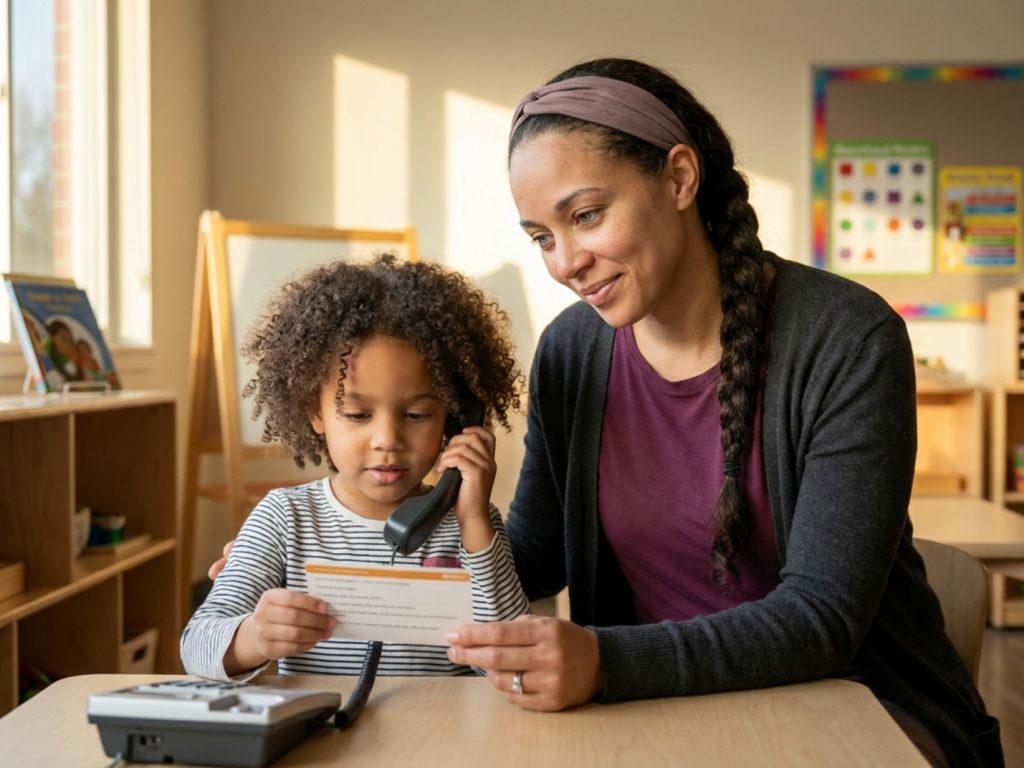
Practice calling emergency services in a controlled way, but do not place a real emergency call as a drill. Contact the local emergency communications service or consult its public guidance to learn whether a designated training line, educational visit, or other practice option is available. A caregiver can also role-play as the dispatcher using a disconnected phone, a toy phone, or a written scenario.
Begin with a neutral situation, such as a pretend fall, and model a calm voice. Prompt the child to state the location, describe the event, identify the person needing help, and wait for questions. As confidence grows, vary the setting: the home, a relative’s house, a playground, or a car. Include situations in which the child is frightened or does not know every answer, because uncertainty is realistic. The expected response is simply, “I do not know, but I am at ____.”
Keep sessions brief and repeat them periodically rather than conducting one intense lesson. Praise accurate communication and help-seeking, not performance perfection. Avoid threatening language such as saying that someone will die if the child makes a mistake. Explain that dispatchers are trained to guide callers, and that adults may also need to call while the child retrieves information or stays nearby safely.
Children with developmental, speech, hearing, mobility, or language differences may need an individualized plan. Discuss accessible communication options with healthcare professionals, school staff, caregivers, and local emergency services. The plan should reflect the child’s actual abilities rather than an idealized script.
Prepare the environment and the adults around the child
Teaching the call is only one part of preparedness. Keep a charged, accessible phone available, and ensure that caregivers know where the child can find it. A clearly displayed address card near the phone may help younger children, visitors, or babysitters. The card should contain the location, relevant unit number, and caregiver contact information, but it should not replace memorization and practice.
Tell babysitters, relatives, and other regular caregivers what the child has been taught. They should use the same wording for the emergency number, location, and safety instructions. If the child spends time at school or in childcare, ask how emergency calls are handled and how the organization communicates with families. Children benefit when the expectations at home and in other settings are consistent.
Consider practicing safe positioning: moving away from smoke or an unsafe person, going to a nearby trusted adult when possible, and leaving a dangerous area rather than investigating. The child should never be taught to delay a call while searching for a caregiver, gathering belongings, or attempting to solve a serious emergency. If another responsible adult is present and the situation is urgent, the child can tell that adult to call while also helping provide the location.
Review the plan after changes in residence, phone access, family composition, or the child’s developmental abilities. A brief refresher every few months can keep the information available without making emergencies the focus of family life.
Support the child after a frightening call or event
Even when the child follows instructions correctly, an emergency call can be emotionally difficult. Afterward, use a calm voice and acknowledge what happened: “That was scary, and you worked hard to get help.” Avoid interrogating the child repeatedly or implying that the outcome depended entirely on their performance. Emergency responders and adults share responsibility for managing the situation.
Children may temporarily show sleep disturbance, clinginess, irritability, concentration problems, or repeated questions after a frightening event. Offer predictable routines, honest age-appropriate explanations, and opportunities to talk or play. Do not promise that emergencies will never happen; instead, emphasize that adults and trained responders have plans to help.
If distress is intense, persists, interferes with daily functioning, or follows exposure to a serious injury or death, consult a pediatrician or qualified mental health professional. A clinician can help distinguish an expected stress response from a problem requiring further assessment. Seek urgent help if the child has immediate safety concerns, expresses a wish to self-harm, or cannot be kept safe.
Safety reminders
- Teach the emergency number used in your local area; do not assume every region uses 9-1-1.
- The child should leave immediate danger when possible and should not investigate a fire, weapon, traffic hazard, or aggressive animal.
- Never use a real emergency call for practice; ask local services about approved training options.
- Children should stay on the line until the dispatcher tells them to disconnect.
- For ongoing emotional distress after an emergency, contact a pediatrician or qualified mental health professional.
Tools & Assistance
- A laminated emergency information card near the household phone
- A disconnected phone or toy phone for role-play
- Short, age-appropriate emergency scenarios for family practice
- The local emergency communications service or public safety website for regional guidance
- A pediatrician, school nurse, or childcare professional for an individualized communication plan
FAQ
At what age should a child learn to call emergency services?
There is no single correct age. Begin with simple concepts as soon as a child can understand danger and use a phone, then adjust the lesson for language, development, and motor abilities. Supervised repetition is more important than a specific birthday.
What if my child does not know the address?
Teach the child to find an address card near the phone and to tell the dispatcher exactly where they are. Practice the full address regularly, especially after moving or changing the household phone.
Should a child hang up if no adult is available?
No. The child should remain on the line and follow the dispatcher’s instructions until told to disconnect. The dispatcher can guide the child and help coordinate the response.
Should children perform CPR or first aid?
Children should not be expected to diagnose or perform unfamiliar procedures independently. If a dispatcher gives instructions, the child should follow only what they can safely do. Caregivers can seek age-appropriate first-aid training from qualified providers.
Sources
- Government of Canada — Prepare children for emergencies: Tips for parents and caregivers
- Nemours KidsHealth — Teaching Your Child How to Use 911 (for Parents)
- Cleveland Clinic — When and How To Teach Kids To Call 911
Disclaimer
This article provides general educational information and does not replace emergency dispatcher guidance, professional first-aid training, or advice from a qualified healthcare professional. In an emergency, contact your local emergency services immediately.

















Please log in to leave a comment.