
Intro
Getting separated from a parent or caregiver in a shop, airport, park, museum, station, or other public place can feel frightening. A child may cry, feel confused, or worry that they are in trouble. The most helpful message is simple: getting lost can happen, and there are calm, safe steps to follow.
Children should learn these steps before an outing and practise them in an age-appropriate way. The goal is not to make children fearful of strangers or public places. It is to give them a predictable plan: stop, stay in a safe place, look and call briefly, then ask an appropriate adult or staff member for help.
Highlights
Stop and stay in a safe, visible place rather than wandering farther away.
Look for the caregiver and call their name, but do not enter unsafe or restricted areas.
Ask a uniformed staff member, security officer, police officer, or another designated safe adult for help.
Children should know their caregiver’s name and have a rehearsed family safety plan for children.
If a child feels threatened, they can use a loud voice, move toward other people, and contact emergency services.
Prepare before leaving home
Preparation is one of the most effective ways to reduce confusion. Before entering a crowded or unfamiliar place, caregivers should explain where the family will stay together, what to do if someone becomes separated, and which adults or locations can provide help. Use short, concrete instructions that match the child’s developmental level. Practise them calmly rather than presenting the exercise as a frightening warning.
A child should know the caregiver’s full name, not only “Mum,” “Dad,” or another family title. Older children may memorise a caregiver’s mobile telephone number and the name of the place they are visiting. Younger children can carry a family emergency contact card, ideally in a secure pocket or with a responsible caregiver. The card should contain only information necessary for reunification, such as caregiver contact details and relevant medical information; it should not display excessive personal data.
Agree on a visible meeting point for situations in which the family becomes separated. In a small venue, this might be the information desk or the entrance. In a large venue, follow the site’s instructions and identify a staffed location rather than choosing an isolated landmark. Explain that a child should not leave the venue, go to a car park, enter a restroom with an unfamiliar adult, or accept transport without caregiver permission.
Families can also review Emergency preparedness for children and practise a family safety plan for children that includes children who have communication differences, mobility limitations, diabetes, epilepsy, severe allergies, or other complex medical needs. The plan should describe how the child communicates, which medications or devices they may need, and which adults are authorised to help.
Stop, breathe, and stay where it is safe
The first action is to stop. Running through a crowd can increase the distance from the caregiver and create risks such as falls, collisions, traffic exposure, or entry into restricted areas. A child should take a few slow breaths, look around, and think about the last place they saw their caregiver. Reassure children that feeling scared does not mean they are doing something wrong; the plan still works even if they are crying.
If the child is in a safe, public, well-lit, and visible location, staying there is usually the best initial choice. They can stand near a shop counter, information desk, ticket booth, reception point, or other staffed area. They should not hide, leave the building, walk to a parking area, approach moving vehicles, or follow someone who says the caregiver is elsewhere.
A child can call the caregiver’s name briefly and listen for a response. They may look nearby without travelling far, especially if the caregiver has told them to remain in place. If the immediate location is dangerous—for example, beside traffic, water, machinery, a moving walkway, or an active emergency—the child should move only toward the nearest clearly safer, populated place or ask the closest responsible adult for immediate help.
The principle is to stay put when safe, not to search indefinitely. If the caregiver is not found quickly, the child should move to the help step rather than continuing to wander. This approach is consistent with child-facing safety guidance that encourages children to stay calm, remain in a safe place, look for their adults, and seek assistance when needed.
Choose a safe adult or staffed location
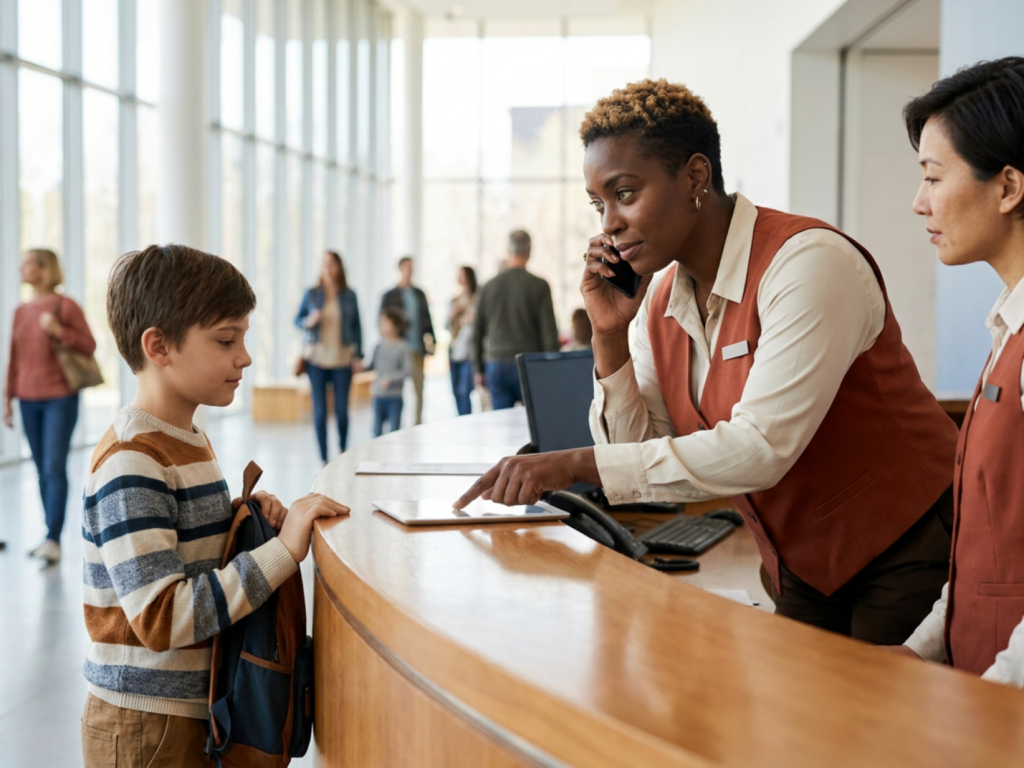
Children should ask for help from a person whose role is easy to verify. Good options include a uniformed employee, security officer, police officer, transport official, librarian, teacher, venue host, or the staff member at an information desk. A parent or caregiver who is visibly responsible for children may also be an appropriate choice if no staff member is nearby. The child should remain in a public area and ask the adult to help contact the caregiver or venue security.
Teach a simple sentence that the child can repeat: “I am lost. I cannot find my caregiver. Please help me call them.” The child can give the caregiver’s name and telephone number if they know it. They do not need to share their home address, school details, passwords, or other unnecessary personal information.
Children may find it easier to approach a staffed desk than to select an individual in a crowd. The concepts of safe adults and safe places should be discussed before an outing, while also explaining that no rule can cover every situation. If one adult does not listen or cannot help, the child should try another staff member or move toward a group of people and ask again.
Children should not be expected to decide whether a person is “good” based only on appearance. Instead, focus on observable safety features: the adult works there, is in a public role, remains in a public area, and helps the child contact the caregiver or authorities. A safe adult should not ask the child to keep the separation secret, take them to a private location, or transport them away without an appropriate authority or caregiver involved.
Use nearby authorities and public safety systems
Public venues often have procedures for separated children. A staff member may contact security, make an announcement, check designated meeting areas, or notify relevant authorities. The child should cooperate with reasonable instructions from identifiable staff or police while remaining in a public, supervised place. A child who is unable to find a safe adult can call the local emergency number if there is immediate danger, if they are injured, or if no responsible adult can be reached.
When a child is found by a bystander, the safest response is generally to remain with the child in the location where they were found, alert venue staff or authorities, and avoid taking the child elsewhere. This is also useful for children to understand: they should tell a responsible adult where they became separated and remain available for reunification rather than being moved through the venue by an unfamiliar person.
If a child has a phone, they should call the caregiver once and explain their location calmly. They should conserve battery power, avoid sharing live location publicly, and follow the venue’s instructions. If the phone has location services, the caregiver or authorities may use them, but a child should not leave a safe place simply because someone calls or sends a message claiming to be nearby.
For children with communication disabilities, hearing impairment, limited speech, cognitive disability, or language barriers, a prepared card, symbol sheet, translation feature, or medical identification can be useful. Caregivers should tell venue staff about communication needs and provide clear instructions for contacting the family. Children with complex medical needs should not delay seeking help if they need prescribed emergency medication or medical equipment; staff or emergency responders can assist according to established care instructions.
Protect personal boundaries while getting help
Being lost does not remove a child’s right to bodily autonomy. A child can ask for help without agreeing to unnecessary touching, photographs, private conversations, or travel to another location. Some safety actions may be necessary—for example, a staff member may need to guide the child to an information desk—but the child should remain where other people can see them. The child can say, “Please call my caregiver here,” or “I want another staff member to stay with us.”
If anyone tries to pull the child away, threatens them, tells them to keep a secret, or insists that the caregiver sent them, the child should use a loud, clear voice: “Stop. I do not know you,” or “I need help.” They should move toward staff, families, security, or a populated public area. If physically able, they can create attention by shouting, calling for help, or moving away rather than complying quietly. They should never get into a vehicle with an unfamiliar person or go to a private room, home, restroom, or isolated area solely because that person offers help.
These instructions should be taught without suggesting that children are responsible for preventing abduction. Adults and public institutions carry the primary responsibility for supervision and protection. Safety education gives children options during uncertainty; it does not guarantee a particular outcome and should never be used to blame a child.
Support children with medical, developmental, or emotional needs
Some children may become disoriented, mute, panicked, or unable to follow a verbal plan when separated. Caregivers should anticipate the child’s likely stress response and adapt the plan. A visual card might show three steps: stop, find staff, call caregiver. A child may be taught to show a card rather than explain verbally. Rehearsal should include realistic variations, such as a noisy venue, a changed meeting point, or a caregiver who cannot answer the phone.
Children with asthma, diabetes, epilepsy, severe allergies, adrenal insufficiency, or other conditions may need rapid access to prescribed medication or medical devices. Caregivers should follow the child’s individualized healthcare plan and discuss emergency arrangements with the child’s clinician and the venue when appropriate. Do not improvise dosing or treatment during a separation. If the child develops breathing difficulty, altered consciousness, a seizure, severe allergic features, significant bleeding, or another medical emergency, staff should activate emergency medical services.
After reunification, a child may remain tremulous, tearful, nauseated, or unusually quiet because of acute stress. Offer calm reassurance, water if appropriate, and a quiet place to recover. Avoid interrogation or punishment. If distress persists, interferes with sleep or daily activities, or follows a threatening encounter, consult a pediatrician or qualified mental-health professional for individualized guidance.
What caregivers should do after separation
Caregivers should respond promptly but try to communicate clear information rather than creating additional panic. Notify venue staff or security immediately, describe the child’s clothing and last known location, and provide a recent photograph if requested. Follow the venue’s search procedures and contact local authorities when the child cannot be located promptly, when there is evidence of danger, or when staff recommend escalation. Do not assume that a short separation is harmless if the child may have entered traffic, water, a transit area, or another hazardous environment.
Once the child is found, begin with reassurance: “You are safe. I am glad we found you.” Ask what happened in a non-accusatory manner and listen for information about where the child went, whom they approached, and whether anyone touched, threatened, or transported them. If the child reports harm, preserve relevant information and contact appropriate authorities and healthcare professionals. A medical assessment may be appropriate after an injury, ingestion, exposure, assault, or concerning change in behavior.
Review the plan later, when everyone is calm. Identify what worked, adjust the meeting point or contact information, and practise again briefly. Prevention also includes active supervision, staying close in crowded places, using clear boundaries, and teaching children how to identify help. A practical review of Stranger safety for children explained can reinforce these skills without portraying every unfamiliar person as dangerous.
Seek urgent help when
- The child is near traffic, deep water, machinery, a railway, or another immediate hazard.
- Anyone attempts to remove, threaten, touch, or transport the child.
- The child is injured, having difficulty breathing, confused, unconscious, or experiencing a seizure.
- The child needs prescribed emergency medication or medical equipment.
- The child cannot be located promptly or may have left the supervised venue.
Tools & Assistance
- A rehearsed family safety plan for children
- A family emergency contact card with essential information
- A recent, securely stored photograph for use with venue staff or authorities
- A simple visual help card for children with communication or developmental needs
- Venue information desks, security offices, police, transport staff, and local emergency services
FAQ
Should a child keep searching for the caregiver?
Only briefly and only nearby if the area is safe. The child should stop, call the caregiver’s name, and then remain at a staffed or visible location rather than wandering.
Who is the safest person for a child to ask for help?
A uniformed employee, security officer, police officer, transport official, or information-desk worker is usually the clearest choice. The child should stay in a public area and ask that person to contact the caregiver or authorities.
Should children memorise a caregiver’s phone number?
Yes, when developmentally appropriate. Younger children can carry a secure contact card, while older children may memorise a caregiver’s full name and telephone number.
What if the child cannot speak or does not remember the number?
The child can show a prepared card, point to a staffed desk, or say, “I am lost.” Caregivers should practise a visual or nonverbal plan suited to the child’s communication abilities.
When should caregivers involve police or emergency medical services?
Contact authorities promptly when the child cannot be located, may be in danger, or may have been taken. Activate emergency medical services for serious injury, breathing difficulty, altered consciousness, seizure, or another acute medical concern.
Sources
- American Academy of Pediatrics — Help Prevent Your Child from Going Missing: Safety Tips from the AAP
- Kidpower International — What If I Get Lost?
- U.S. Department of Justice, Office of Justice Programs — What Should You Do If You See a Child Who Appears to be Lost?
Disclaimer
This article provides general safety and health information, not individualized medical, legal, or emergency advice. Contact a pediatrician, qualified mental-health professional, emergency service, or local authority for guidance about a specific child or incident.


















Please log in to leave a comment.