
Intro
Knowing which restraint a child needs can feel complicated because age is only one part of the decision. Height, weight, developmental readiness, the seat manufacturer’s limits, and the child’s ability to sit correctly all matter. In the United States, state laws establish minimum legal requirements, while national safety recommendations often encourage families to use a higher level of protection for longer.
This guide explains the usual progression from a rear-facing car seat to a forward-facing harness, booster seat, and adult seat belt. It also highlights common safety checks and situations in which advice from a certified child passenger safety technician or the child’s healthcare professional may be especially helpful.
Highlights
Children should remain rear-facing until they reach the car seat’s stated height or weight limit, rather than changing seats solely because of age.
A forward-facing seat with an internal harness generally comes before a booster seat.
A booster is needed until the vehicle lap-and-shoulder belt fits the child correctly without help.
State laws differ, so families should check the requirements where the child lives and where the vehicle will travel.
Age is a guide, not the only rule
U.S. child passenger safety guidance is best understood as a sequence of restraint stages rather than a rigid birthday schedule. Age provides a useful developmental framework, but the transition from one stage to the next should usually occur only when the child outgrows the current seat according to its labeled height or weight limits. Moving too soon can leave the child inadequately supported in a crash.
Legal requirements vary substantially by state. A statute may specify an age, weight, height, or type of restraint, but meeting the legal minimum does not always represent the most protective option. The National Highway Traffic Safety Administration (NHTSA) recommends following the seat’s instructions and keeping children in each stage for as long as the seat permits. Parents and caregivers should also review the vehicle owner’s manual, because seating positions, tether anchors, airbags, and belt systems differ among vehicles.
Children with skeletal, neuromuscular, developmental, or behavioral needs may require specialized equipment or a more individualized plan. A pediatric clinician, occupational therapist, rehabilitation professional, or certified child passenger safety technician can help address those circumstances without relying on a generalized age chart.
Birth through the rear-facing stage
Newborns and infants should ride in a rear-facing car seat. This may be an infant carrier or a convertible or all-in-one seat approved for rear-facing use. The rear-facing position supports the head, neck, and spine by distributing crash forces across the child’s back rather than allowing the head to move forward abruptly.
Keep the child rear-facing until the child reaches the seat’s maximum rear-facing height or weight limit. Many children remain in this stage through toddlerhood, and some seats allow rear-facing use beyond age 2. Age alone is not a reason to turn the seat forward. A child’s legs touching the vehicle seatback or sitting with bent knees is generally not, by itself, a reason to change position when the seat is otherwise correctly installed and within its limits.
Harness straps should be adjusted according to the manufacturer’s directions, and the harness should lie flat against the child’s body. Bulky coats can interfere with a snug fit; use clothing that does not compress under the harness, and place a blanket over the secured straps if needed. Never add aftermarket inserts, padding, head supports, or toys unless they were supplied or specifically approved by the seat manufacturer.
Infant car seats are intended for vehicle travel, not routine sleep outside the vehicle. If an infant falls asleep during a trip, move the infant to a firm, flat, approved sleep surface when practical after arriving. Never place a rear-facing seat in front of an active frontal airbag.
Toddlers and preschoolers: forward-facing harness seats
After a child outgrows the rear-facing limits, the next stage is usually a forward-facing car seat with an internal harness and top tether. The harness restrains the torso and helps distribute forces over strong areas of the body. A top tether can reduce forward movement of the head and should be used whenever the seat and vehicle permit it, following the vehicle and car seat manuals.
Children should remain in a forward-facing harness seat until they reach the seat’s maximum height or weight limit. Some children may be ready for a booster at a younger age, but a booster is not a safer substitute for a harness seat that still fits and is being used correctly. Readiness also includes behavioral factors: the child must be able to sit upright for the entire trip, keep the shoulder belt positioned properly, and avoid placing the belt under the arm or behind the back.
Check that the harness is threaded through the correct slots, lies flat, and passes over the appropriate parts of the shoulders as specified by the manufacturer. The chest clip, when present, belongs at armpit level. The top of the child’s head and the harness position must remain within the seat’s stated limits; these details differ by model, so visual assumptions are not enough.
A forward-facing seat should generally be installed in the back seat. The center position is not automatically safest if it prevents a secure installation or lacks a compatible lower-anchor or seat-belt arrangement. A tight installation, correct recline, and appropriate use of the tether are more important than choosing a particular position without checking the manuals.
School-age children: when a booster seat is appropriate
A booster seat raises the child so the vehicle lap-and-shoulder belt can contact the strongest parts of the pelvis, chest, and shoulder. It does not replace the vehicle belt and should not be used with a lap-only belt unless the manufacturer and a qualified safety professional provide specific guidance. High-back and backless boosters may both be appropriate, depending on the vehicle seat, head restraint, belt geometry, and the booster’s instructions.
Children typically need a booster after outgrowing a forward-facing harness seat and before they fit an adult seat belt. The American Academy of Family Physicians notes that this commonly extends until a child is about 4 feet 9 inches tall and often between 8 and 12 years of age, although individual children vary. The child must also be mature enough to remain seated correctly throughout every trip, including when asleep or during a sudden stop.
For proper booster seat belt fit, the lap belt should lie low and snug across the upper thighs or pelvis, not across the abdomen. The shoulder belt should cross the middle of the chest and shoulder, not the neck, face, or upper arm. The child’s back should rest against the vehicle seat, and the knees should bend comfortably at the seat edge without slouching. If the child cannot maintain that position, continue using the booster.
Do not allow a child to place the shoulder belt behind the back or under the arm. Those positions can shift crash forces to vulnerable areas and may allow excessive upper-body movement. A booster should be used in a seating position with a lap-and-shoulder belt, and the belt should be routed exactly as directed by the booster manufacturer.
Transitioning to an adult seat belt
Children can leave the booster when the vehicle’s adult seat belt fits correctly without one. Because vehicle seats and belt geometry differ, a child may pass the test in one vehicle but still need a booster in another. The commonly used adult seat belt fit test has several parts:
- The child sits all the way back against the vehicle seat.
- The child’s knees bend naturally at the edge of the seat without slouching.
- The lap belt lies low and snug across the hips and upper thighs.
- The shoulder belt crosses the center of the chest and shoulder.
- The child can maintain this position for the entire ride.
If any part of the test fails, continue using a booster. Children should still ride in the back seat whenever possible; NHTSA recommends the back seat for children younger than 13 because it generally places them farther from frontal impact forces and active front airbags. State laws may set different age requirements, but a safer practice may go beyond the legal minimum.
Once a child uses an adult belt, every trip still requires the lap and shoulder portions to remain properly positioned. A seat belt is not optional for short drives, carpools, taxis, or rides with relatives. Caregivers should model consistent belt use, because children often follow the behavior they see.
Installation, fit, and special travel situations
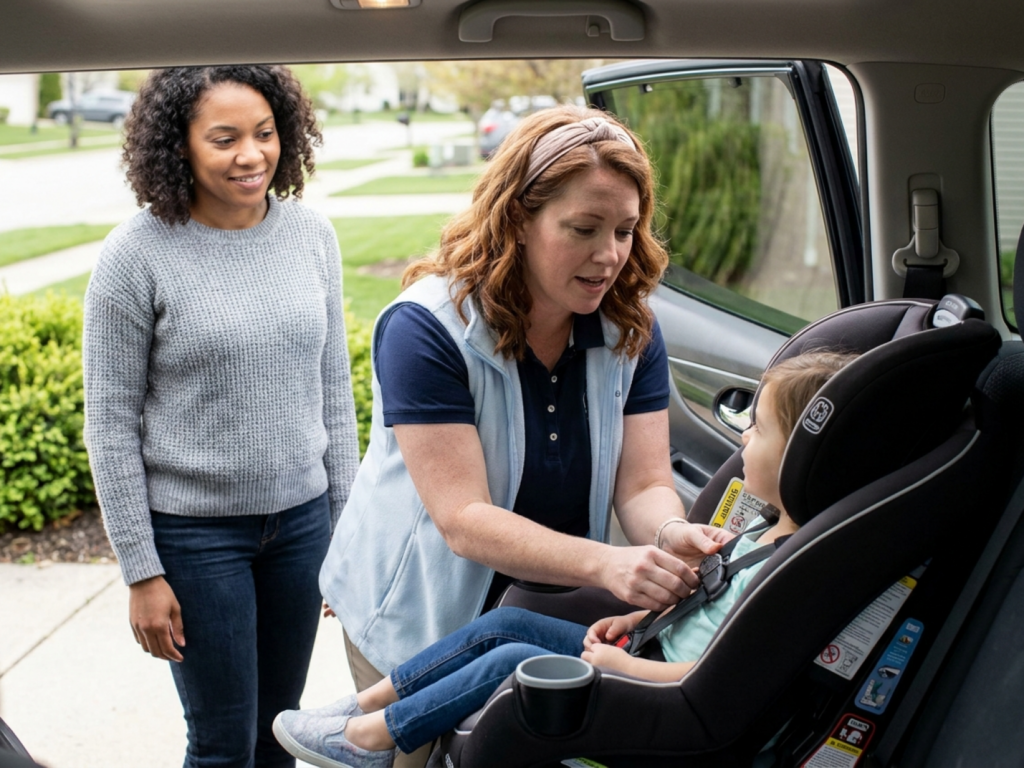
Correct installation is a major part of protection. Read both the car seat manual and the vehicle manual before installing the seat. Depending on the seat and vehicle, installation may use the lower anchors or the vehicle seat belt; these systems should not be combined unless the manufacturer expressly permits it. After installation, check for movement at the belt path, confirm the correct recline angle, and verify that the harness or belt is routed as instructed.
Car seats should not be used if they are expired, recalled, missing essential parts, or damaged in a crash unless the manufacturer or a qualified safety authority confirms that they remain appropriate. Follow the manufacturer’s cleaning instructions, because harsh chemicals or incorrect washing can affect webbing and components. Avoid secondhand seats when the complete history, expiration date, recall status, and instructions are unknown.
For air travel, contact the airline before departure and check whether the child restraint is approved for aircraft use. A child restraint that is suitable for a vehicle may not be approved for an airplane. For rideshares and taxis, requirements differ by state and service, but caregivers should plan to bring an appropriate restraint whenever possible rather than assume a short trip is low risk.
Families transporting a child with a tracheostomy, scoliosis, cerebral palsy, brittle bone disease, autism-related safety concerns, or another medical or functional need should seek individualized advice. A clinician can discuss positioning and medical equipment, while a certified child passenger safety technician can assess restraint compatibility and installation. In a crash, even when there is no obvious injury, seek medical guidance if the child has concerning symptoms or if the restraint manufacturer advises replacement.
A practical age-and-stage overview
The following overview describes the usual U.S. progression, but the seat’s labeled limits and state law control the specific situation:
- Infants and young toddlers: rear-facing car seat, used until the child reaches the seat’s rear-facing height or weight limit.
- Toddlers and preschoolers: forward-facing car seat with an internal harness and, when available and appropriate, a top tether after the rear-facing stage has been outgrown.
- School-age children: belt-positioning booster after the forward-facing harness limits are reached, continuing until the adult belt passes the fit test.
- Older children and adolescents: lap-and-shoulder seat belt alone once the belt fits correctly and the child can remain positioned properly; the back seat remains preferred through the younger teen years.
This sequence does not mean every child changes equipment at the same age. A petite child may need a booster longer, while a tall child may pass the fit test earlier in one vehicle than another. Growth patterns, posture, impulse control, and the design of the vehicle all affect readiness.
When in doubt, avoid rushing the transition. Photographing the installed restraint and having it reviewed by a certified child passenger safety technician can identify errors that are difficult to notice at home. Many communities offer inspection stations, health-system events, fire or police department programs, and public health resources, although availability varies.
Safety reminders
- Never place a rear-facing child restraint in front of an active frontal airbag.
- Do not move a child to the next stage solely because of age, preference, or legroom.
- Do not use a shoulder belt behind the back or under the arm.
- Do not add unapproved padding, accessories, or bulky clothing under the harness.
- Replace a seat after a crash when required by the manufacturer or safety guidance.
- Check current state requirements because child restraint laws differ across the United States.
Tools & Assistance
- The child restraint and vehicle owner’s manuals
- NHTSA child passenger safety guidance and recall information
- A certified child passenger safety technician or local inspection station
- The American Academy of Family Physicians or the child’s pediatric healthcare team
- A written checklist for harness fit, belt routing, expiration date, and recalls
FAQ
Does a child have to be rear-facing until age 2?
Age 2 is used in some laws and recommendations, but the more important safety principle is to remain rear-facing until the child reaches the car seat’s stated rear-facing height or weight limit. Check both state law and the manufacturer’s instructions.
When can my child stop using a booster seat?
Stop using the booster only when the vehicle’s lap-and-shoulder belt fits correctly across the pelvis, chest, and shoulder and the child can maintain that position for the entire ride. Many children meet these criteria between about 8 and 12 years, but height and vehicle design matter.
Is the front seat ever appropriate for a child?
The back seat is generally recommended for children younger than 13. If an exception is unavoidable, follow the vehicle and restraint manuals carefully, and never place a rear-facing seat in front of an active frontal airbag.
Can I use a secondhand car seat?
Only if you can verify its history, expiration date, crash history, recall status, labels, and required parts. If any of that information is unknown, choose a new seat or obtain advice from a qualified safety professional.
Where can I get help installing a car seat?
Look for a certified child passenger safety technician or an inspection event through local public health agencies, hospitals, fire departments, police departments, or community safety programs. Confirm that the service offers hands-on installation review.
Sources
- National Highway Traffic Safety Administration — Car Seat & Booster Seat Safety, Ratings, Guidelines
- National Highway Traffic Safety Administration — Car Seat Recommendations for Children
- American Academy of Family Physicians — Child Passenger Safety
Disclaimer
This article provides general educational information and does not replace current state-law guidance, the restraint and vehicle manuals, or individualized advice from a qualified healthcare professional or certified child passenger safety technician.
















Please log in to leave a comment.