
Intro
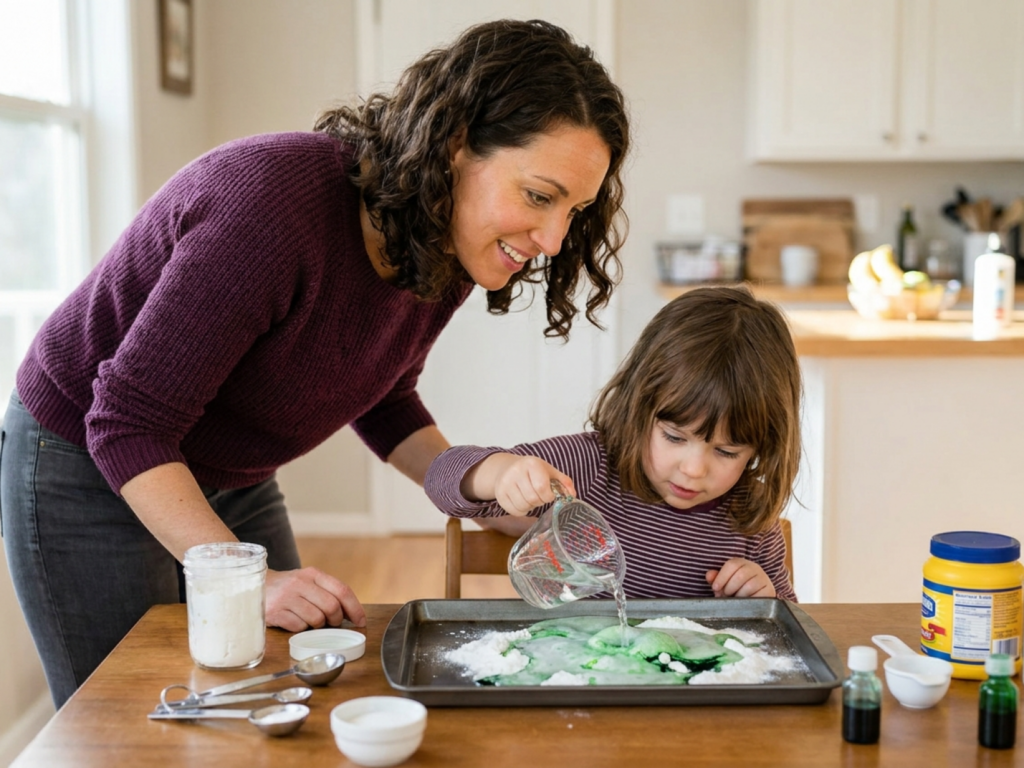
Many children love the feeling of making something bubble, stretch, layer, or change color. With a few familiar kitchen ingredients, you can turn that curiosity into a gentle science session that builds observation, patience, and confidence.
This article focuses on simple experiments that use common household materials such as vinegar, baking soda, cornstarch, milk, salt, sugar, food coloring, dish soap, and oil. The emphasis is on safety, not perfection. If a child has asthma, eczema, or a known sensitivity to scents, soaps, or foods, keep the setup simple, use good ventilation, and ask a healthcare professional if you are unsure about any exposure.
Highlights
Safe home science can be exciting without using special lab chemicals or complicated equipment.
Adult supervision, eye protection, and good ventilation matter whenever liquids can splash or powders can dust into the air.
Simple experiments can teach chemistry, physics, and careful observation in a child-friendly way.
Cleanup, handwashing, and careful storage are part of the science lesson and also part of home safety.
Why safe home science works so well for children
Safe experiments work best when they feel predictable. Children learn more when one adult chooses the materials, explains the rules, and keeps the pace steady. That kind of structure helps science feel like a game of discovery instead of a test.
For many families, this is also a practical way to support home safety for children. The same habits that make a kitchen experiment calmer, such as clearing the table, reading labels, and washing hands afterward, also lower everyday risk around the house. Children do not need a full laboratory to begin learning about cause and effect. A bowl, a tray, and a few pantry items are enough.
It also helps to set one small goal per activity. For example, a child might notice that a liquid fizzes, a mixture thickens, or two layers stay separate. That is real scientific thinking. Praise careful watching, not just dramatic results. If a child is younger, let them pour or stir while the adult handles measuring and anything that could splash. If the child is older, invite a prediction first, then compare the result with the guess.
Prepare the workspace before you mix anything
Good poison safety for children starts before the first pour. Keep medicines, cleaners, batteries, and cosmetics away from the table, and remember that child-resistant caps are not childproof. Even familiar ingredients can create a household chemical poisoning risk if a child drinks them, inhales a powder, or rubs a splash into the eyes.
- Use a tray, baking sheet, or washable table covering to contain spills.
- Choose ingredients you can name and identify at a glance.
- Keep water nearby for rinsing small splashes.
- Use eye protection when a reaction may foam, spray, or splatter.
- Open windows or use a well-ventilated space if odors are strong.
For younger children, pre-measure ingredients and place them in separate bowls. That reduces chaos and makes the session easier to manage. For older children, ask them to help set up the materials one step at a time, then review the rules together: do not taste, do not aim containers at faces, and stop if something feels uncomfortable. If a child has a known allergy, skin sensitivity, or respiratory condition, it is reasonable to keep the activity very low-odor and to ask a healthcare professional if you have concerns.
Try the classic baking soda and vinegar reaction
The baking soda and vinegar reaction is a favorite because it gives fast, visible feedback. It also introduces a basic chemistry idea: when an acid and a base meet, they react and release carbon dioxide gas. That gas is what makes the mixture fizz and foam.
- Place a cup or small bottle on a tray.
- Add a few spoonfuls of baking soda.
- If you want, add a drop of dish soap and a little food coloring for more foam and color.
- Pour vinegar in slowly and watch the reaction.
A child may enjoy changing one variable at a time. More vinegar, less baking soda, a different cup size, or a different pour speed can all change what happens. That is a simple introduction to experimental design. For safety, do not seal the container tightly, and keep the opening pointed away from eyes and faces. The mixture is usually gentle, but spills can still sting if they get into the eyes or on broken skin. A towel on the tray makes cleanup easier, and cleanup itself can become part of the lesson: good science includes responsible recovery.
Explore Oobleck and milk fireworks
Oobleck is a child-friendly way to explore how not all mixtures behave like ordinary liquids. Stir cornstarch with a little water until it feels strange: firm when pressed, loose when released. This is a non-Newtonian fluid, which means its flow changes when force is applied. A quick tap can make it feel solid, while a slow hand sinks in more easily.
Let children squeeze the Oobleck, lift it, and watch it drip. Then ask what changed when they used more pressure. That conversation is often the most valuable part. If you want a second short demo, use milk, food coloring, and a drop of dish soap in a shallow dish. The soap changes surface tension and helps the colors move. It looks magical, but the explanation is practical: soap interacts with fats and the liquid surface.
- Keep hands away from the eyes during and after the activity.
- Use a shallow container to limit mess.
- Do not serve experiment materials as food afterward.
- Wash hands after touching cornstarch or dish soap.
These activities are gentle enough for many children, yet supervision still matters. Small children may mouth interesting textures, so stay close and keep the amount small.
Build a density tower or grow salt crystals
Density activities help children see that different liquids and solutions do not always mix in the same way. A simple density tower can be made with oil, colored water, and dish soap. Pour slowly, one layer at a time, into a clear glass or jar. If you move carefully, the liquids may stack in layers instead of blending right away. That visual separation gives a concrete way to talk about density, which is how much mass is packed into a given volume.
Another slow, satisfying project is salt crystal growth. Stir salt into warm water until no more dissolves, then pour the solution into a shallow jar or dish and let it sit undisturbed. As water evaporates, tiny crystals can begin to form on the sides or bottom. This is not an instant result, and that is okay. Children often benefit from projects that reward waiting and noticing small changes.
For both experiments, a tray protects the table from drips. Avoid any urge to add random cleaning products or unknown liquids to improve the effect. The safest version is usually the simplest version. If a child asks why the layers or crystals appear, answer in plain language first, then add more detail if they want it. Curiosity is the goal, not speed.
Observe, record, and clean up kindly
A science experiment becomes more educational when children record what they notice. They can draw the cup, circle the bubbles, or describe whether a mixture felt thick, slimy, or watery. That habit builds observation skills and helps them learn that experiments are about evidence, not just excitement.
It is also a good time to build a simple home safety plan for children. Set a routine: wash hands, wipe the surface, cap the ingredients, and return everything to storage before moving on. This is practical poisoning prevention in children, because it keeps even ordinary household items from being left out where a child might reach them later.
Know the pediatric emergency warning signs that mean you should stop and seek help right away: trouble breathing, repeated vomiting, severe eye pain, unusual sleepiness, or a rash that spreads quickly after an exposure. If a child may have swallowed, inhaled, or gotten a substance in the eye, contact a healthcare professional or local poison center promptly. A calm response is best. Rinse the area with water if appropriate, keep the product container nearby, and follow the advice you are given. Ending the experiment early is never a failure; it is good judgment.
Safety reminders
- Use only familiar household ingredients that you can identify clearly.
- Keep cleaners, medicines, batteries, and sharp tools away from the experiment area.
- Do not let children taste, sniff closely, or rub powders into their eyes.
- Stop the activity if there is coughing, eye pain, skin irritation, or nausea.
- Ask a healthcare professional if a child has asthma, allergies, or a known sensitivity.
Tools & Assistance
- A washable tray or baking sheet
- Child-sized eye protection
- Measuring spoons and cups
- Paper towels, soap, and water
- A notebook for predictions and observations
FAQ
What age can start these experiments?
Many preschoolers can help with pouring, stirring, and watching, as long as an adult stays close. Older children can measure, predict, and record results.
Do I need special lab chemicals?
No. The safest beginner experiments usually use ordinary kitchen items such as vinegar, baking soda, cornstarch, salt, milk, oil, and dish soap.
Can we eat the ingredients afterward?
No. Once materials have been used for science, treat them as nonfood items and discard them or keep them only for future experiments.
What if my child has sensitive skin or asthma?
Choose low-odor materials, improve ventilation, and keep the setup simple. If you are unsure about exposure risk, ask a healthcare professional.
Sources
- Bluefield University — Chemistry Experiments At Home
- Rhode Island Department of Education — Guidance for Science Safety at Home: Support for Science Teacher ...
- Learn How to Science — Safe Chemistry Experiments You Can Do at Home
Disclaimer
This article is for educational purposes only and is not medical advice. If a child has a known allergy, asthma, a chemical exposure, or any persistent symptom, contact a healthcare professional or poison center promptly.













Please log in to leave a comment.