
Intro
Parenting a baby is a continuous process of observation, interpretation, and adjustment. The strategies that support a newborn's regulation and feeding may need to evolve as the infant becomes more alert, mobile, communicative, and socially engaged. Adapting does not mean abandoning consistency; it means preserving warmth and safety while matching care to the baby's developmental abilities and individual cues.
Responsive caregiving is central throughout infancy. It involves noticing signals, responding promptly and appropriately, and gradually allowing the baby more opportunities for exploration and participation. This article describes practical ways to adapt caregiving from the early newborn period through the transition toward toddlerhood, while recognizing that development is variable and that professional guidance is important when concerns arise.
Highlights
Parenting becomes more interactive as a baby's motor, language, sensory, and social capacities expand.
Predictable caregiving can provide security while remaining flexible enough to accommodate changing cues and needs.
Positive discipline in infancy begins with prevention, redirection, co-regulation, and realistic expectations rather than punishment.
Caregiver mental health and practical support are part of the baby's developmental environment.
Begin with regulation and relationship
In the newborn period, parenting is often focused on physiological regulation. The infant may need help maintaining an organized state between sleep, feeding, alertness, and crying. Holding, skin-to-skin contact, gentle voice exposure, low-stimulation settling, and prompt responses to discomfort can support co-regulation, in which an adult’s calm presence helps the immature nervous system return toward stability.
As the baby grows, the relationship remains the foundation, but the adult’s role gradually expands from primarily regulating the infant to interpreting increasingly differentiated communication. A cry may eventually be accompanied by facial expressions, body movements, vocalizations, gaze shifts, or attempts to reach. Caregivers can pause briefly to observe these signals before responding, while still addressing urgent needs promptly. This pause is not intended to create rigid delay; it creates an opportunity for the baby to participate in the interaction.
Responsive infant sleep routine and feeding patterns may also change as circadian organization, stomach capacity, and alertness mature. A routine can offer helpful predictability without requiring every day to follow an identical timetable. Watch for patterns in hunger, fatigue, comfort, and engagement, and discuss major feeding or sleep concerns with a pediatric clinician or other qualified healthcare professional.
Match stimulation to emerging abilities
A young infant may benefit from short periods of face-to-face interaction, quiet talking, singing, and supervised movement practice. Early activities should be brief enough to respect the infant’s behavioral state. Turning away, yawning, hiccupping, stiffening, frantic movement, or escalating fussiness can indicate that the baby needs a pause, a change of position, or less sensory input. An infant who looks toward a caregiver, relaxes, smiles, vocalizes, or reaches may be ready for continued interaction.
With increasing head control and mobility, babies typically benefit from more floor-based opportunities to move, grasp, roll, pivot, and explore. Brief supervised tummy time can be incorporated when the baby is awake and receptive, increasing gradually according to tolerance. Place interesting but safe objects within view or reach, and allow the infant time to attempt a movement rather than immediately completing it for them. This supports motor learning and problem-solving while preserving close supervision.
Play should not be measured by the number of toys or activities offered. Simple reciprocal exchanges often provide substantial developmental value: imitate a sound, wait for a response, follow the baby’s gaze, describe an object, or take turns making facial expressions. These serve-and-return interactions support early communication and social cognition. The systematic review of parenting interventions in the first three years found improvements in cognitive, language, motor, and socioemotional outcomes, as well as in parent-child interaction quality.
Make communication increasingly reciprocal
Before spoken language, babies communicate through gaze, gestures, vocal tone, posture, and timing. Caregivers can respond as though these behaviors have meaning without assuming that every signal has a single interpretation. Narrating ordinary care, naming familiar people and objects, and using clear, expressive speech gives the baby repeated exposure to language. Leave pauses so the infant can vocalize or gesture in return.
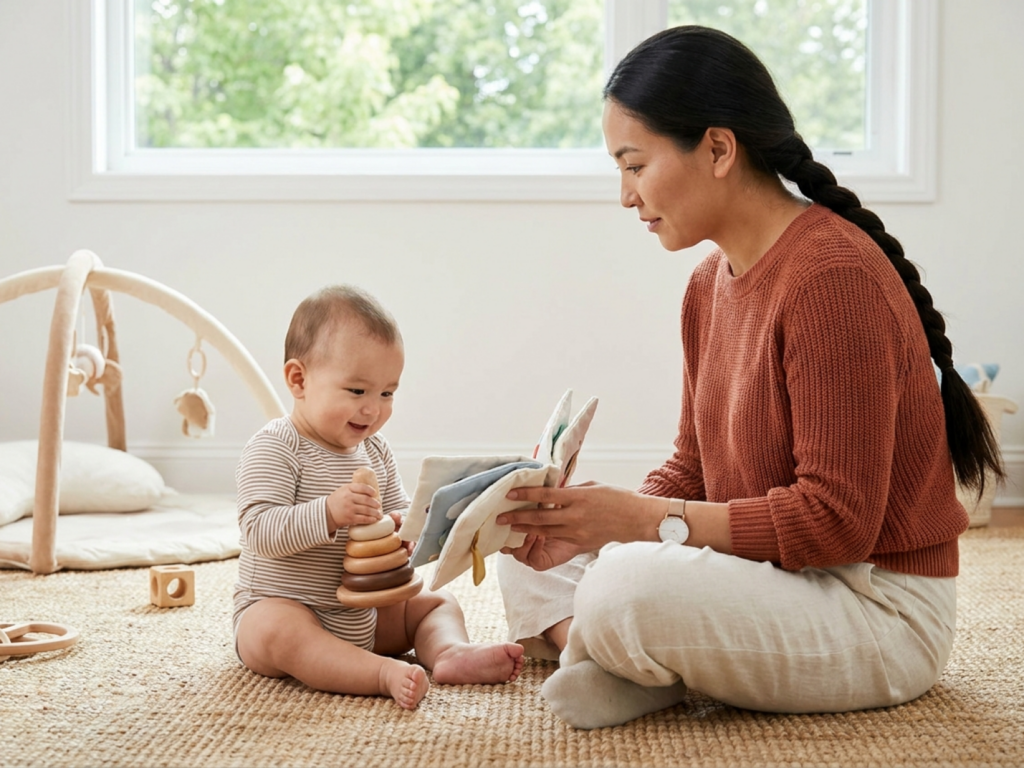
As babbling and intentional gestures develop, acknowledge attempts rather than demanding performance. If the baby points or looks toward something, name it and share attention. If the infant produces a sound, imitate it and add a simple word. Repeated routines such as dressing, bathing, and meals provide predictable contexts in which words and gestures can be learned. Books need not be read conventionally; looking at pictures, labeling images, and responding to the baby’s interest are valuable.
Communication also includes respecting refusal and signs of overload. A baby may turn away from a spoon, push an object aside, or stop engaging. These behaviors are opportunities to adjust pace and approach, not evidence of defiance. If hearing, vision, feeding, social engagement, or communication seems persistently different from what a clinician expects for the child’s age, seek an individualized assessment rather than relying on comparisons with other babies.
Adapt feeding and routines without losing structure
Caregiving often becomes more complex as the baby moves from frequent early feeds toward a broader pattern of milk feeds, complementary foods when developmentally appropriate, sleep periods, and active play. Feeding should remain responsive to hunger and satiety cues within the nutritional plan recommended by the child’s healthcare professional. Early cues can include rooting, hand-to-mouth movements, and increased alertness; satiety may be expressed through turning away, closing the mouth, or relaxing. Crying is a late and nonspecific hunger signal.
When complementary foods are introduced, caregivers can gradually offer varied textures and developmentally appropriate foods while following local clinical guidance about readiness, choking prevention, allergens, and nutrient needs. The adult determines what safe food is offered and where feeding occurs; the child can often participate in deciding whether and how much to eat. Persistent coughing, choking, vomiting, poor intake, feeding refusal, or concerns about growth should be discussed with a clinician.
Daily structure can evolve in the same way. A consistent sequence, such as waking, feeding, active interaction, and rest, may be more useful than a rigid clock-based schedule. Growth spurts, illness, travel, teething, and new motor skills can temporarily disrupt familiar patterns. A flexible infant routine helps caregivers respond to these changes while retaining anchors such as safe sleep practices, regular opportunities for nourishment, and calm transitions.
Shift from preventing distress to guiding behavior
Infants do not have the neurological capacity to use deliberate self-control in the way older children do. Crying, grabbing, dropping objects, and protesting are usually expressions of need, curiosity, fatigue, or limited communication rather than manipulation. As mobility increases, prevention becomes more important: secure hazardous items, supervise access to water and heights, and keep dangerous substances and small objects out of reach. A developmental home safety scan should be repeated as the baby acquires new skills, because a previously inaccessible hazard may become reachable within days.
When a baby begins to crawl, pull to stand, or explore boundaries, use concise language and calm physical guidance. Move the infant away from danger, block unsafe behavior, and offer an acceptable alternative. For example, a caregiver might say, “That is not safe,” while providing a soft object that can be handled. The goal is teaching through repetition and relationship, not expecting a single explanation to produce lasting compliance.
Positive parenting avoids harsh verbal or physical responses, which can increase fear and undermine trust. The World Health Organization emphasizes strengthening the parent-child relationship, reducing harsh parenting, and using age-appropriate approaches that prevent maltreatment. During intense episodes, the adult may need to place the baby in a safe location and take a brief pause to regain control. If anger feels difficult to manage, contact a healthcare professional, crisis service, or trusted support person promptly.
Support exploration while protecting safety
As babies become more mobile, their environment becomes part of the parenting strategy. Exploration supports learning, but it needs a carefully prepared setting. Use stable furniture, secure window and stair access, keep cords and medicines inaccessible, and ensure that sleep equipment is used according to current safety recommendations and manufacturer instructions. Supervision remains necessary even in a prepared space, particularly around water, animals, elevated surfaces, and objects that can obstruct the airway.
Allowing safe exploration can reduce unnecessary restriction. A baby can practice reaching, transferring objects between hands, crawling, standing, and cruising on an uncluttered floor. Caregivers can stay close, describe what the infant is doing, and intervene when risk becomes significant. Not every small frustration requires immediate rescue. A short opportunity to experiment may build persistence, provided the baby is comfortable and the situation is safe.
Environmental adaptation also includes reducing excessive background media and noise. Direct human interaction is generally more useful for early learning than passive screen exposure. Household activities can become shared learning experiences: sorting laundry by texture, listening to safe kitchen sounds from a distance, or looking at leaves during a walk. Keep the task simple and follow the baby’s interest rather than turning play into a test.
Include caregiver capacity in the plan
A baby’s development is influenced by the quality and availability of responsive care, and caregiver capacity is not an unlimited resource. Sleep deprivation, postpartum depression or anxiety, financial pressure, isolation, medical illness, and conflict can affect attention and emotional regulation. Recognizing these factors is not blame; it is a way to identify support that benefits both caregiver and child. The WHO guidance on early childhood development specifically includes caregiver mental health support as part of effective early intervention.
Practical adaptations may include sharing night responsibilities where possible, arranging regular breaks, accepting concrete help with meals or errands, and discussing emotional symptoms with a primary care clinician, obstetric provider, pediatric clinician, or mental health professional. A caregiver does not need to wait until distress becomes severe. Persistent hopelessness, panic, intrusive thoughts, inability to sleep even when the baby sleeps, or thoughts of harming oneself or the baby require urgent professional support.
Review parenting expectations periodically. A strategy that worked last month may no longer fit the baby’s temperament, schedule, or abilities. It can help to ask: What is the baby communicating? What developmental skill is emerging? Is the environment safe? What response is realistic for this age? What support do I need to respond calmly? These questions keep adaptation grounded in observation, safety, and compassion.
Seek prompt professional help when
- The baby has difficulty breathing, becomes unusually unresponsive, or has a medical emergency.
- There is persistent poor feeding, dehydration, repeated choking, or concern about growth.
- A baby loses a previously acquired skill or shows a marked change in alertness, movement, hearing, vision, or social responsiveness.
- Crying is prolonged or unusual and the caregiver cannot identify a safe way to cope.
- A caregiver fears they may hurt themselves or the baby, or feels unable to provide safe care.
Tools & Assistance
- A developmental and home-safety checklist reviewed with the baby's healthcare professional
- A brief daily log of feeding cues, sleep patterns, mood, and new skills
- Parent-infant programs focused on responsive caregiving and early learning
- Primary care, pediatric, postpartum, or mental health services for caregiver support
- Local emergency, crisis, or safeguarding services when immediate safety is at risk
FAQ
Does adapting parenting mean that babies need no routine?
No. Babies often benefit from predictable caregiving sequences, but a flexible routine can accommodate changing cues, illness, growth, and developmental transitions. Structure and responsiveness can be used together.
How can I tell whether my baby needs more stimulation or a break?
Look at the whole behavioral state. Relaxed posture, shared gaze, smiling, and vocalizing may indicate readiness to engage. Turning away, yawning, stiffening, frantic movements, or escalating fussiness may indicate fatigue or sensory overload.
When should I discuss development with a clinician?
Discuss concerns whenever they persist, interfere with feeding or interaction, or feel different from the baby's usual behavior. Prompt assessment is especially important after loss of a skill, significant changes in alertness or movement, or concerns about hearing, vision, growth, or safety.
What should I do if I feel overwhelmed by crying?
Place the baby on a safe sleep surface, step away briefly to regain control, and contact a trusted support person or healthcare professional. Never shake or physically punish a baby. Seek urgent help if you fear that anyone may be harmed.
Sources
- World Health Organization — WHO guidelines on parenting interventions to prevent maltreatment and promote positive parenting
- World Health Organization — Improving early childhood development: WHO guideline
- PubMed Central / National Library of Medicine — Parenting interventions to promote early child development in the first three years of life: a systematic review and meta-analysis
Disclaimer
This article is for general educational purposes and does not diagnose, treat, or replace individualized medical advice. Consult a qualified healthcare professional about your baby's development, feeding, sleep, safety, or any urgent concern.


















Please log in to leave a comment.