
Intro
Choosing an airplane seat with a baby involves more than finding extra legroom. The best location depends on whether your infant will travel as a lap infant or in a purchased seat with an approved restraint, the aircraft layout, feeding needs, and how easily you can manage diapering, soothing, and movement during the flight. A small amount of planning can make the cabin feel more predictable and reduce avoidable safety hazards.
For many families, a window seat is the most practical choice, particularly when the baby is secured in a rear-facing car seat. However, bulkhead rows, aisle seats, exit rows, and seats near lavatories each have tradeoffs. Review the airline's current rules and discuss travel timing or special precautions with your child's healthcare professional if your baby was premature, has cardiopulmonary disease, recent illness, or other medical needs.
Highlights
A window seat is often the safest and least disruptive position for a baby traveling in an approved car seat.
Buying a separate seat allows the infant to remain restrained during turbulence, rather than relying on lap holding.
Avoid exit rows, and confirm bulkhead restrictions before selecting seats because bassinet and armrest policies vary by aircraft and airline.
Seat selection should account for both restraint safety and practical needs such as feeding, diaper changes, and access to a traveling companion.
Why the window seat is usually the best starting point
A window seat provides a physical barrier between the baby and the aisle, where passengers, service carts, and bags move throughout the flight. This reduces the chance of accidental contact and gives the caregiver a more contained space for holding, feeding, or comforting the infant. A window position also limits the temptation for a baby to reach into the aisle or for loose items to drift into foot traffic.
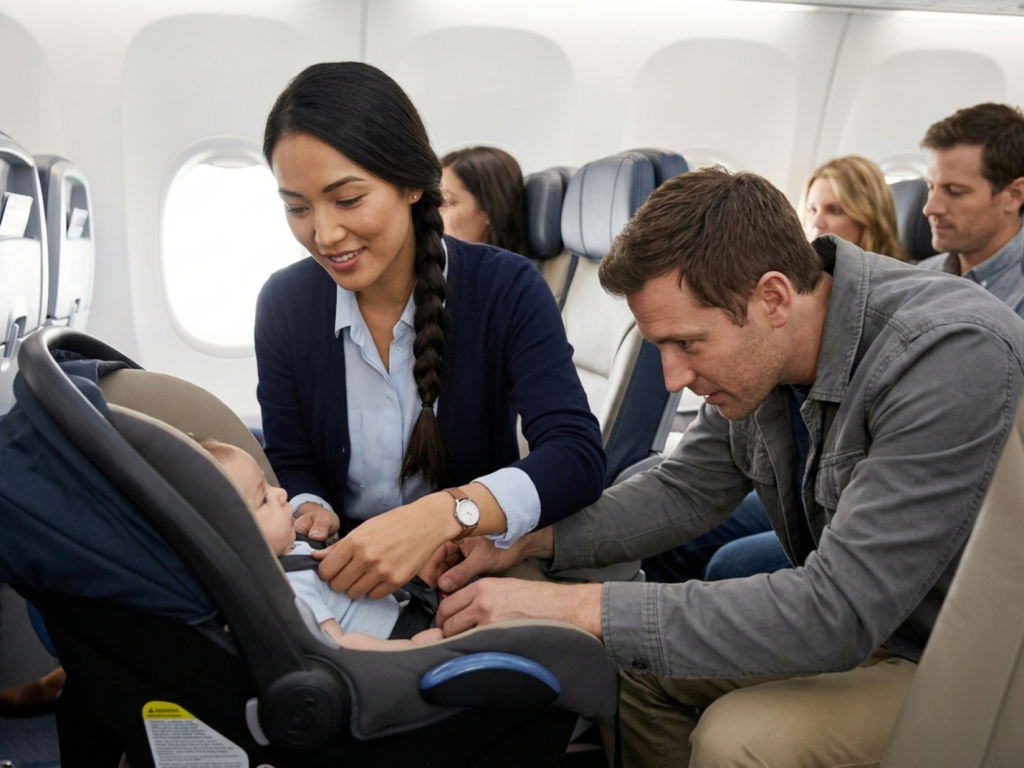
The window seat is especially important when an infant is traveling in a properly installed rear-facing car seat. Airlines and pediatric guidance commonly advise placing a child restraint by the window so it does not obstruct another passenger’s access to the aisle and does not interfere with evacuation. A restraint in the middle seat may be permitted in some configurations, but it can create practical and regulatory problems if it blocks the adjacent passenger’s route.
Window seating has a real inconvenience: the caregiver cannot leave the row without asking another passenger to stand. That tradeoff is generally manageable when the baby remains in a purchased seat and another adult is nearby. If one caregiver is flying alone, the aisle may appear more convenient for bathroom access, but the baby should still be protected from aisle hazards and secured according to airline requirements. Consider choosing a window seat for the infant and an aisle seat for the accompanying adult when the arrangement is allowed and the restraint remains correctly positioned.
A purchased seat with an approved restraint offers better protection
Holding a baby on an adult’s lap is permitted on some flights, particularly for infants younger than two years, but an adult’s arms cannot reliably restrain a child during sudden deceleration or severe turbulence. A dedicated seat gives the infant a stable seating position and permits use of an airline-approved child restraint system for the entire flight, including periods when the seat belt sign is illuminated.
Before buying a ticket, check that the car seat carries the required approval for use in aircraft and that its dimensions fit the airline’s seating space. Bring the manufacturer’s instructions or approval information if the label is difficult to identify. The restraint should be used exactly as directed, with harness height, buckle position, and recline angle appropriate for the baby’s size. Do not improvise with an unapproved carrier, a stroller attachment, or an adult lap belt.
A car seat can make boarding and deplaning slower, but it also creates consistency between the airport, aircraft, and ground transportation. If the baby will need a car seat after landing, using the same approved restraint on the plane may simplify the transition. For detailed preparation, review guidance on a rear-facing infant car seat and have installation questions addressed by a certified child passenger safety technician when available.
Never place a rear-facing restraint in an exit row or in a seat where it blocks access to the aisle. The caregiver should also avoid loosening the harness for convenience. Infants can slide into unsafe positions quickly, especially when sleepy or upset.
Bulkhead rows: useful space but important limitations
Bulkhead seats are located directly behind a cabin divider. They may offer additional floor space and can make it easier to stand briefly with a baby when permitted by the crew. Some aircraft also have bassinet positions attached to the bulkhead, which can be helpful on longer flights. Bassinets are not universal, may require advance reservation, and generally have limits based on infant age, weight, length, or mobility.
The extra space does not automatically make a bulkhead the safest or most comfortable choice. Armrests may be fixed, reducing usable seat width. Personal items often must be stored overhead during takeoff and landing because there is no seat in front of you. That can make it harder to reach feeding supplies, burp cloths, or a change of clothing at the moments you need them most. A bassinet also cannot be used during taxi, takeoff, landing, or turbulence when the crew instructs the infant to be held or secured elsewhere.
Car-seat compatibility is another concern. Some bulkhead seats have restricted belt geometry or limited room for a rear-facing restraint. The airline may assign a family to the bulkhead for a bassinet but use a different policy for a car seat. Ask specifically whether your exact aircraft, seat number, and restraint model are compatible. If the reservation changes aircraft, recheck the arrangement rather than assuming the original seat remains suitable.
When an aisle seat can help, and when it creates risk
An aisle seat gives the caregiver easier access to the lavatory, overhead storage, and the aisle for brief movement. That convenience can matter during a long flight or when one adult is managing the baby alone. It may also be useful for a caregiver who needs to alternate standing, walking, or accessing medical supplies that have been cleared for cabin use.
For the baby, however, the aisle is an active environment. Service carts, passengers, and bags can bump an infant’s arms, legs, or head. A baby held on the aisle side is also more exposed if a caregiver loses balance while standing. These concerns are why clinician-backed guidance generally favors a window position for the infant, especially when using a car seat.
If an aisle seat is necessary for the caregiver, keep the baby on the window side whenever possible. Do not place the infant, diaper bag, or blanket in the aisle, and do not leave the baby unattended while reaching overhead or using the lavatory. During turbulence, follow the crew’s instructions immediately. A caregiver should not stand or walk with a baby when the seat belt sign is on, even if the infant is crying.
Seats and row locations to avoid
Exit-row seats are not appropriate for infants or for passengers responsible for a child. Federal and airline safety rules restrict who may sit in these rows because occupants must be able to assist with an evacuation. A baby cannot perform those duties, and a caregiver may be unable to help if they must prioritize the infant. Exit-row restrictions can also affect the row immediately in front of an exit row, depending on the aircraft layout.
Seats near lavatories and galleys may expose the family to frequent foot traffic, noise, light, and queues. Those features can make settling a newborn more difficult. A rear cabin position may offer shorter access to a lavatory with a changing table, but it can also involve more movement and service activity. The optimal choice depends on the specific aircraft and flight duration rather than a universal front-versus-back rule.
Also avoid seats with limited or unusual belt configurations if you plan to install a child restraint. Some seats may have an airbag-equipped belt, a narrow pitch, or a nonstandard design that is incompatible with the restraint. Ask the airline before finalizing the reservation, and inspect the seat when boarding. If the seat cannot safely accommodate the approved restraint, request help from the crew before departure.
Choosing seats for two caregivers or one adult
When two adults are traveling, a window seat for the baby and an aisle seat for one caregiver is often a workable arrangement. The second adult can sit beside them, or across the aisle if the aircraft layout makes that more practical. Before selecting seats, confirm that the baby is assigned a ticketed seat if a car seat will be used; a lap-infant reservation does not create an additional seat for the restraint.
For a family seated in one row, placing the infant by the window and the adults in the middle and aisle seats keeps the restraint away from passing traffic while preserving some access. If the infant is traveling as a lap infant, the window side can still provide a quieter, more contained area, although lap travel does not provide the same protection as a dedicated seat and restraint.
A solo caregiver should prioritize safe restraint placement and realistic access to essential items. Pack the immediate supplies under the seat in front of the caregiver when permitted, while keeping the car seat installation area clear. Choose a flight and seat arrangement that leaves enough time for boarding, feeding, and diaper changes without rushing. Ask the airline about family seating policies early, since seat maps, paid seating rules, and aircraft changes can affect the arrangement.
Practical preparation before selecting the seat
Start with the airline’s current infant and child-restraint policy rather than relying on a seat map alone. Policies can differ regarding lap infants, ticketed infant seats, bassinets, approved restraint labels, seat width, and whether a caregiver may use a car seat in a particular row. Contact customer service if the online reservation system does not identify the aircraft or does not answer restraint questions clearly.
Then consider the baby’s medical and developmental context. A healthy full-term infant may have different travel considerations from a premature infant or a baby with respiratory, cardiac, neurologic, or feeding concerns. Cabin pressure produces a lower inspired oxygen partial pressure than at sea level, and infants with certain conditions may need individualized assessment. A pediatrician or other qualified healthcare professional can advise whether timing, documentation, or additional planning is appropriate; do not use seat selection as a substitute for medical clearance.
On the travel day, install the restraint according to its manual and ask the flight attendant for help if the seat belt path is unclear. Keep the harness snug, use only approved accessories, and remove bulky outerwear from beneath the harness. During descent and ascent, feeding or sucking may help some infants with pressure-related discomfort, but do not force feeding if the baby is distressed. Follow crew instructions about holding, bassinets, and restraint use throughout the flight.
Safety reminders
- Do not use an exit-row seat when responsible for an infant.
- Never place a rear-facing car seat where it obstructs access to the aisle.
- A lap infant is not protected as reliably as a baby in a separate seat with an approved restraint during turbulence.
- Do not leave a baby unattended in a seat, bassinet, or carrier during the flight.
- Seek professional medical advice before flying if the baby was premature, recently ill, or has a chronic cardiopulmonary or other significant medical condition.
Tools & Assistance
- Airline customer-service desk or infant-travel policy page
- Aircraft seat map and operating-aircraft information
- Child restraint manufacturer's aircraft-use instructions
- Certified child passenger safety technician
- Pediatrician or other qualified healthcare professional
FAQ
Is a window seat always required for a baby?
Not necessarily, because airline rules and aircraft layouts vary. A window seat is commonly preferred for an infant, especially when a rear-facing car seat is used, because it keeps the restraint away from aisle traffic and evacuation paths.
Can I use a car seat in a bulkhead row?
Sometimes, but compatibility depends on the aircraft, seat design, and restraint. Bulkhead armrests, belt paths, or limited space may prevent safe installation, so confirm the exact seat with the airline before travel.
Is it safer to buy a separate seat for my baby?
A separate ticketed seat permits use of an approved child restraint and generally provides more protection than lap holding during turbulence or sudden deceleration. It also creates a consistent, secure position for the infant during the flight.
Should I sit near the front or back of the aircraft?
There is no single best cabin section for every family. Compare noise, lavatory and galley traffic, access to changing facilities, available space, and restraint compatibility for the specific aircraft.
What should I do if the assigned seat cannot fit the car seat?
Tell the flight crew before departure and ask them to resolve the seating or restraint issue. Do not force the restraint into a seat or use it in a position that conflicts with the manufacturer's instructions or airline policy.
Sources
- American Academy of Pediatrics / HealthyChildren.org — Flying With Baby: Parent FAQs & Tips for Safer, Easier Air Travel
- Cleveland Clinic — Flying With a Baby: Your Questions Answered
- Mayo Clinic Press — Air travel with an infant
Disclaimer
This article provides general educational information and is not a diagnosis, medical clearance, or individualized safety plan. Consult your child's healthcare professional and follow the airline's current rules before flying.













Please log in to leave a comment.