
Intro
Many caregivers wonder whether a baby should be able to play independently for a particular amount of time. The short answer is that there is no universal target. A young infant may engage with a rattle for only a few minutes, while an older infant may remain focused on a familiar object for 10 to 20 minutes or longer. Attention varies with age, temperament, sleep, hunger, sensory stimulation, motor abilities, and the availability of a responsive caregiver.
Independent play is one part of a healthy day, not a substitute for warm interaction. Babies learn through both social and nonsocial play, and they often move back and forth between exploring an object alone and seeking an adult's face, voice, or help. The goal is to offer safe opportunities for exploration while remaining attentive and emotionally available.
Highlights
There is no medically required duration for solo play; even brief periods can be developmentally meaningful.
Play episodes often become longer and more complex as infants mature, although day-to-day variability is normal.
A baby who looks away, fusses, or reaches for a caregiver may be communicating a need for a pause or social connection.
Independent play should occur in a safe, supervised environment appropriate for the baby's motor abilities.
Caregiver interaction remains essential for attachment, communication, emotional regulation, and learning.
What counts as playing alone?
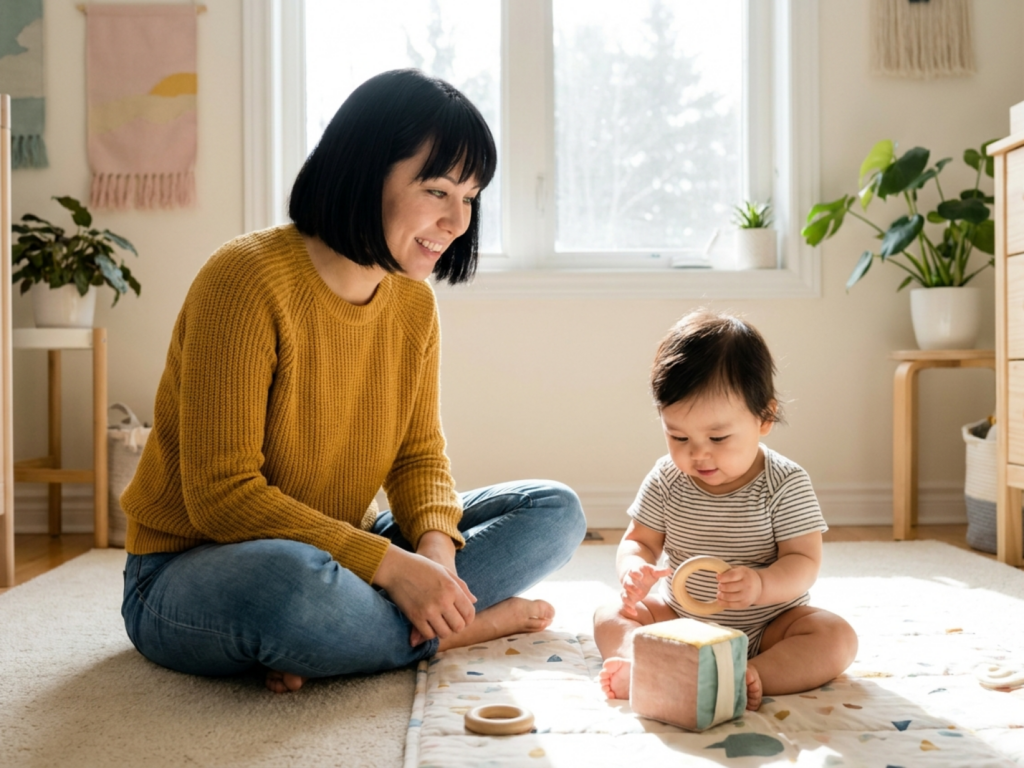
Playing alone, also called independent or nonsocial play, means that a baby is actively engaged with an object, movement, sound, or nearby feature of the environment without continuous direct interaction from an adult. The baby may watch a mobile, grasp and mouth a teether, kick against a play mat, rub fabric between the fingers, drop a cup repeatedly, or inspect a toy from several angles. The activity does not need to look purposeful to an adult; infant exploration is often repetitive, sensory, and gradual.
Solo play does not require the caregiver to leave the room. In fact, many babies explore more comfortably when a trusted adult is nearby. A caregiver may sit within reach, observe quietly, narrate occasionally, and respond when the baby looks over, vocalizes, or needs assistance. This combination provides a secure base while preserving the baby’s opportunity to initiate activity.
Independent play is different from placing a baby in a container and expecting prolonged entertainment. A baby may be content for a short time and then need movement, feeding, sleep, a diaper change, physical contact, or face-to-face interaction. The quality of the opportunity matters more than reaching a specific number of minutes.
How long can babies play alone by age?
Duration changes substantially during the first year. In the newborn period, wakeful attention is brief and easily disrupted. A newborn may spend a few minutes looking at a high-contrast object, listening to a caregiver’s voice, or studying their own hands before becoming tired or seeking contact. At this stage, quiet observation counts as engagement, even when there is little reaching or grasping.
During approximately 2 to 4 months, many infants begin to spend several minutes examining toys, kicking, swiping, and bringing objects toward the mouth. Their ability to sustain attention is still limited, and they may alternate rapidly between solo exploration and social interaction. At around 4 to 6 months, improved visual tracking, grasp control, and trunk stability can support longer periods of object exploration. Some babies may play independently for 5 to 10 minutes when rested and interested, while others shift activities sooner.
From about 6 to 9 months, infants often become more active investigators. They may shake, bang, transfer, rotate, drop, and retrieve objects, using repeated actions to learn about cause and effect. A familiar activity may hold attention for 10 to 15 minutes, occasionally longer, but this is not an expectation for every baby. Mobility, teething, separation concerns, and the desire to practice new motor skills can shorten a session.
By approximately 9 to 12 months, some babies can sustain independent exploration for 10 to 20 minutes or more, particularly in a well-prepared space with a small selection of suitable objects. Others remain socially oriented and prefer frequent check-ins. Research on everyday infant object interactions indicates that episodes can be measurable and complex, with duration and complexity generally increasing with age, while caregiver involvement also influences how play unfolds.
These ranges are descriptive rather than prescriptive. A single short session does not indicate a problem, and a longer session does not mean that a baby needs less interaction. Corrected age may be more relevant than chronological age for some infants born preterm; a pediatric clinician can explain how to interpret developmental expectations in that context.
Why play duration varies
Attention is state-dependent. A baby who has recently fed, slept adequately, and is physically comfortable may explore for longer than the same baby who is hungry, overtired, overheated, or recovering from illness. Homeostatic sleep pressure, or the accumulating biological drive to sleep, can make an infant appear uninterested in a toy when the underlying need is rest.
Temperament also matters. Some infants are naturally observant and can remain absorbed in subtle visual or tactile details. Others seek frequent movement, vocal exchange, or changes in sensory input. Neither pattern is automatically better. Sensory regulation, the ability to remain in a manageable level of arousal, develops gradually and is influenced by the environment and the caregiver’s responsiveness.
The task itself affects duration. Objects that are too simple may lose interest quickly, whereas objects that are too complicated can produce frustration. An intermediate level of complexity often supports exploration: a soft book, a graspable ring, a fabric square, a lightweight cup, or a toy that produces a predictable sound when moved. Rotating a few safe objects can preserve novelty without overwhelming the infant.
Social context changes play as well. Studies of infant object interactions and parent-infant affect synchrony show that babies behave differently during solo and social play. A caregiver’s presence can support regulation and extend exploration, but it can also redirect the baby’s attention toward faces, voices, or interaction. That is not a failure of independent play; social engagement is a central developmental activity.
How to support independent exploration
Start with the baby’s current state rather than a timetable. Offer solo play after a feed and diaper change, when the baby is alert and calm. Place the infant on a firm, clear floor surface in a location where an attentive adult can monitor them. Begin with one or two familiar objects and allow the baby to decide whether to look, reach, grasp, mouth, kick, or pause.
Use responsive caregiving in infancy as the framework. Watch for orientation toward a toy, repeated movements, excited vocalization, or a glance toward you. You can briefly describe what the baby is doing, imitate a sound, or answer a social cue, then give space again. This back-and-forth helps the baby experience both autonomy and connection.
Provide safe movement opportunities for babies, including supervised floor time and supervised tummy time while awake. Position objects close enough to invite reaching but not so far away that the baby becomes distressed. As mobility develops, reassess the environment frequently because rolling, pivoting, crawling, pulling to stand, and cruising create new hazards.
Keep the play area simple. Avoid loose items that can obstruct breathing, small parts that could cause choking, cords, plastic bags, unstable furniture, and objects not designed for the baby’s developmental stage. Follow safe sleep guidance separately: a play space is not automatically a safe sleep space, and an infant who falls asleep should be moved according to current pediatric safe-sleep recommendations.
When to join and when to pause
Caregivers do not need to occupy infants constantly. If a baby is calm, alert, and absorbed, quiet observation can be valuable. Interrupting every moment may reduce the opportunity to practice sustained attention, motor planning, and problem-solving. You can remain close, scan for hazards, and allow the baby to lead.
Join when the baby signals a need for connection or support. Signals may include turning toward you, smiling, babbling, reaching, alternating gaze between you and an object, or offering a toy. Joining can be as simple as making eye contact, responding to a vocalization, or helping with an object that is just beyond the baby’s ability. The purpose is not to take over the activity but to provide co-regulation with an attentive adult and then return control to the infant when possible.
Pause the activity when the baby repeatedly turns away, stiffens, arches, becomes frantic, rubs the eyes, yawns, cries, or shows escalating frustration. These behaviors may reflect fatigue, overstimulation, discomfort, or a need for assistance. Reduce sensory input, offer physical reassurance, check basic needs, and adjust the environment. Babies benefit from predictable interaction, but they also need permission to disengage.
There is no need to compare one baby’s independent play with another’s. A baby may have a long session one morning and only brief periods the next day. Looking at patterns over time, across different settings and states, is more informative than measuring a single episode.
When to discuss concerns with a clinician
Independent-play duration alone is not a developmental screening test. A pediatrician or other qualified healthcare professional considers the broader picture, including social communication, movement, hearing and vision, feeding, sleep, regulation, and the baby’s trajectory over time. A baby who prefers frequent interaction may be developing typically, just as a baby who plays quietly for longer periods may still need social engagement.
Arrange a clinical discussion if you have persistent concerns about a loss of previously acquired skills, very limited visual or auditory engagement, marked difficulty using one side of the body, unusual stiffness or floppiness, ongoing distress during ordinary play, or a lack of progress across several developmental domains. Seek prompt medical advice for signs of acute illness, breathing difficulty, injury, poisoning, or a possible choking event.
Do not use solo play to diagnose autism, attention problems, sensory disorders, attachment difficulties, or any other condition. Nor should caregivers feel pressure to train a baby to play alone for a fixed duration. Professional assessment is appropriate when concern persists, and early support can be helpful when a clinician identifies a developmental or environmental need.
Caregiver capacity matters too. If you are exhausted, isolated, or struggling to respond consistently, contact a healthcare professional or local family-support service. Meeting a baby’s need for independent exploration and meeting a caregiver’s need for practical support are compatible goals.
A practical daily approach
Think in short, flexible opportunities rather than a required block of solo play. After confirming that the baby is comfortable, offer a safe floor area and a few age-appropriate objects. Observe what attracts attention, allow uninterrupted exploration while the baby remains content, and respond to social cues. When interest fades, transition to feeding, rest, movement, caregiving routines, or face-to-face play.
Simple baby activities by age can help caregivers choose objects and movements that match current abilities, but individual variation remains expected. A newborn may benefit from looking and listening; a younger infant may practice reaching and grasping; an older infant may investigate containers, textures, object permanence, and cause-and-effect actions. Ordinary routines, such as talking during dressing or pausing during a diaper change for a vocal exchange, also contribute to learning.
The central question is not, “How long should my baby entertain themselves?” It is, “Is my baby safe, comfortable, engaged in a way that suits them, and able to return to a responsive adult when needed?” When the answer is yes, even a few minutes of self-directed exploration can be a meaningful part of the day.
Safety reminders
- Always supervise awake play and keep small objects, cords, plastic bags, and unstable furniture away from the infant.
- Do not leave a baby unattended on a bed, sofa, changing surface, elevated surface, or near water.
- Use age-appropriate toys without detachable parts that could create a choking hazard.
- Move a sleeping baby to a safe sleep environment according to current pediatric guidance.
- Seek urgent medical help for breathing difficulty, unresponsiveness, serious injury, poisoning, or choking.
Tools & Assistance
- A clear, firm floor play area suited to the baby's current mobility
- A small rotation of age-appropriate, washable toys without small detachable parts
- A daily observation note recording alertness, interests, cues, and transitions
- Your pediatrician, family doctor, or child development clinic
- Local parent-support, early intervention, or caregiver mental health services
FAQ
Is five minutes of independent play enough for a baby?
Yes. Five minutes can be a meaningful period of focused exploration, especially for a young infant. There is no minimum duration that every baby must reach.
Should I entertain my baby all day?
No. Babies need responsive social interaction, but they also benefit from safe opportunities to observe, move, pause, and explore independently. Follow the baby's cues and remain available.
Why does my baby play alone longer some days than others?
Sleep, hunger, illness, teething, temperament, motor development, stimulation, and the novelty of the activity can all affect attention. Day-to-day variation is normal.
Is a baby who prefers adult interaction developing normally?
A preference for social play can be entirely typical. Discuss concerns with a clinician when there are persistent difficulties across broader areas such as communication, movement, hearing, vision, or regulation.
Can independent play happen while I am nearby?
Yes. A caregiver can remain close, monitor safety, and respond to cues without directing every action. Nearby availability often helps a baby explore with confidence.
Sources
- PubMed Central — Parent–infant affect synchrony during social and solo play
- PubMed Central — Infants' Object Interactions are Long and Complex During Everyday Activities
- NYU Steinhardt — Discovery and Learning through Play at Home
Disclaimer
This article provides general educational information and does not diagnose, treat, or replace advice from a qualified healthcare professional. Contact your baby's clinician with individual developmental or safety concerns, and seek urgent care for emergencies.














Please log in to leave a comment.