
Intro
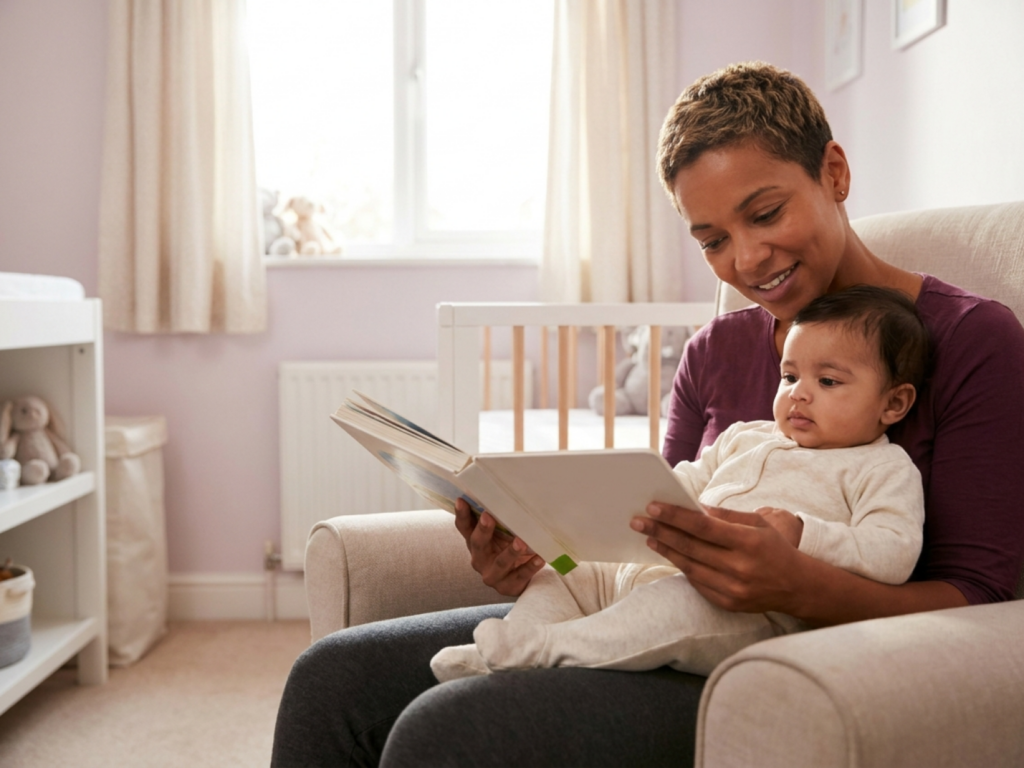
Reading aloud to a baby is a simple form of responsive caregiving that supports communication, attention, emotional connection, and daily routines. Infants do not need to understand every word or sit still through an entire story to benefit. They learn from the rhythm of speech, the sound patterns of language, shared attention, facial expressions, pauses, and the predictable experience of being close to a responsive caregiver.
Research suggests that consistent shared reading is associated with stronger early language outcomes, and parent-child reading programs may also support cognitive development and the quality of interactions. Reading is not a test of parenting or a substitute for medical or developmental care. The most useful approach is flexible, enjoyable, and adapted to the baby's age, state of alertness, sensory needs, and interests.
Highlights
Regular reading exposes babies to varied vocabulary, speech sounds, sentence patterns, and conversational rhythms before they can speak.
Shared books create repeated opportunities for eye contact, joint attention, imitation, and responsive turn-taking with infants.
Reading can strengthen parent-child bonding and help babies associate language with safety, warmth, and predictable connection.
Short, frequent reading sessions are valuable; finishing a book is not necessary for the activity to support learning.
Reading in a family's strongest language can support communication and does not prevent multilingual language development.
How reading supports early language development
In the first year, babies are building perceptual and neural foundations for communication. They are learning to distinguish speech sounds, recognize familiar voices, notice stress and intonation, and connect repeated sounds with people, objects, and routines. Reading aloud provides a concentrated stream of language that is usually more varied than the words used during routine care alone. A caregiver may name objects, describe actions, ask a question, pause, and respond to the baby’s vocalization, all within a few minutes.
This exposure does not mean a baby is expected to memorize vocabulary. Early learning is gradual and depends on repeated, meaningful experiences. Infants may first attend to a caregiver’s voice and facial expression, later show anticipation when a familiar page appears, and eventually babble, gesture, point, or attempt words. These behaviors reflect emerging receptive language, which means understanding language, as well as expressive language, which means communicating through sounds, gestures, and later words.
A study published through PubMed found that infants whose parents read consistently, particularly around seven books per week, had higher expressive, receptive, and combined language scores at 9 to 12 months. The finding supports regular shared book reading as one practical way to enrich an infant’s language environment, although it does not establish that a specific number of books guarantees a particular outcome. Reading works best alongside conversation, play, singing, and responsive daily interaction.
Cognitive skills grow through shared attention
Books give babies an organized setting for early cognitive learning. When a caregiver holds a book, turns pages, names pictures, and waits for a response, the baby practices sustained attention and begins to understand sequence and cause-and-effect relationships. The infant may learn that a page follows another page, that a familiar picture can be found again, and that a sound or gesture from the baby can influence the caregiver’s response.
These experiences contribute to joint attention, the ability of two people to focus on the same object or event. Joint attention is a foundational social-cognitive skill because it helps a child connect words with shared experiences. A caregiver can support it by following the baby’s gaze, pointing to a picture, labeling what the baby is looking at, and allowing time for the baby to respond. There is no need to demand eye contact or keep the baby’s attention on the page; responsive interaction matters more than performance.
A cluster-randomized trial in Brazil reported that a program promoting parent-child reading aloud improved parent-child interactions as well as children’s language and cognitive development. This evidence suggests that the benefit may come from the interaction surrounding the book, not only from hearing printed words. The caregiver’s timing, warmth, responsiveness, and willingness to follow the infant’s signals are central parts of the activity.
Bonding and emotional learning
Reading offers a predictable opportunity for physical closeness and shared regulation. A calm voice, gentle holding, and repeated routines can help an infant experience the caregiver as available and responsive. Over time, these moments may support secure relational expectations, although reading itself should not be treated as a guaranteed way to prevent attachment difficulties or regulate every baby’s behavior.
Books also introduce emotional language and social situations in a developmentally accessible way. Even before a baby understands a story, the caregiver’s tone can communicate excitement, tenderness, surprise, or reassurance. Simple comments such as naming a character’s facial expression or acknowledging a loud page help connect sounds and images with emotional meaning. For older infants, a caregiver might say, “The baby is upset,” or “The puppy is hiding,” then pause and notice the child’s reaction.
Reading can be especially useful after a busy day because the routine creates a transition from active play to quieter connection. However, babies differ in sensory tolerance and temperament. If an infant turns away, arches, fusses, becomes unusually still, or shows other signs of fatigue or overstimulation, pausing is appropriate. Respecting these cues teaches that communication is reciprocal and that the caregiver will respond to discomfort.
Choosing books for different stages
Newborns can benefit from hearing a familiar caregiver read any age-appropriate text, including a short board book, a poem, or part of a longer book. At this stage, the voice, rhythm, and closeness are often more important than the plot. High-contrast images may be easier for some young infants to notice, but there is no single required book format.
As visual attention and motor skills mature, babies may enjoy sturdy board books with clear photographs, simple illustrations, faces, familiar objects, and repeated phrases. Books with flaps or textures can invite participation, but they require supervision because small or detachable parts can present a choking hazard. For infants who mouth books, choose materials designed for their age and inspect them regularly for damage.
Book selection can reflect the family’s language, culture, routines, and interests. Reading in a language the caregiver speaks comfortably supports rich interaction and natural conversation. Families using more than one language can read, sing, and talk in each language. Multilingual exposure does not inherently cause language delay, though language development should be considered across the child’s full linguistic environment when concerns arise.
It is also reasonable to reread the same book repeatedly. Repetition helps babies recognize patterns and gives caregivers opportunities to emphasize different words, sounds, or pictures. A baby who repeatedly chooses one page is communicating an interest; following that interest is often more productive than trying to complete the book in a fixed way.
Practical ways to read aloud
Shared reading does not require a formal lesson or a long uninterrupted session. A few minutes during feeding transitions, after a nap, or before sleep can become a reliable routine. Hold the book so the baby can see it when comfortable, but prioritize safe head and neck support for young infants and a stable position for the caregiver. Keep printed materials away from the sleep space and do not leave a baby unattended with a book or loose objects.
- Begin when the baby is relatively alert and calm rather than hungry, overtired, or distressed.
- Use a warm, expressive voice and vary pauses naturally, without needing to imitate a particular reading style.
- Name pictures, describe actions, and repeat sounds or words that seem to capture the baby’s attention.
- Pause after a sound, gesture, or facial expression to invite a response.
- Let the baby touch, mouth an age-appropriate sturdy book, or turn away when interest ends.
- Continue talking about the pictures even if the baby looks away; shared listening can occur without constant visual attention.
These practices combine language input with contingent response, meaning the caregiver notices the baby’s behavior and adjusts in real time. That pattern resembles ordinary conversation and may be more valuable than the number of pages completed.
Building reading into family life
Consistency is useful, but perfection is unnecessary. A family may read one book on some days, several pages on others, and substitute songs or conversation when circumstances are difficult. The goal is a sustainable pattern of responsive communication rather than a rigid quota. Caregivers can keep a small basket of books near a feeding chair, stroller, or quiet floor area so that reading is easy to begin.
All caregivers can participate, including parents, grandparents, siblings, and other trusted adults. Hearing different voices and communication styles can give babies varied language experiences while preserving the emotional security of familiar relationships. Library programs, pediatric offices, early-childhood centers, and community organizations may provide books or group reading opportunities for families with limited access to children’s literature.
Reading should complement, rather than replace, direct conversation and play. Talk during bathing, dressing, meals, and walks helps babies connect language with real objects and actions. Face-to-face interaction, movement, sleep, nutrition, and opportunities for safe exploration also contribute to healthy development. For children born preterm or with medical needs, developmental expectations may require individualized interpretation, sometimes using corrected age; a pediatric clinician can provide appropriate guidance.
If a caregiver is worried about hearing, vision, feeding, social responsiveness, babbling, loss of previously acquired skills, or overall development, discussing the concern with a pediatrician or other qualified healthcare professional is appropriate. Reading can support development, but it should not be used to explain away a persistent concern or delay an evaluation.
Safety and medical considerations
- Never leave a baby unattended with books containing loose, detachable, or damaged parts.
- Keep books and other objects out of the baby's sleep space to support safe sleep practices.
- Stop or shorten the activity when the baby shows fatigue, distress, or overstimulation.
- Reading cannot diagnose, prevent, or treat a speech, hearing, vision, developmental, or neurologic condition.
- Seek professional advice for developmental regression or persistent concerns about communication or responsiveness.
Tools & Assistance
- A small collection of age-appropriate board books
- A public library or mobile library service
- A pediatrician, family physician, or child development clinic
- A hearing and vision assessment service when clinically indicated
- A simple daily routine that includes talking, reading, singing, and play
FAQ
When should I start reading to my baby?
You can begin from birth. Newborns benefit from hearing a familiar voice and experiencing close, responsive interaction, even though they do not yet understand the story.
How many books should I read each day?
There is no universal minimum. Frequent short sessions are realistic and useful, and stopping when the baby becomes tired or disengaged is appropriate. Research has associated consistent reading with stronger early language scores, but a specific book count does not guarantee an outcome.
What if my baby will not look at the book?
Keep the session relaxed. Babies may listen while looking away, moving, or exploring. Follow the baby's cues, describe one picture, or simply talk in a calm voice rather than insisting on completing the book.
Can I read in more than one language?
Yes. Reading and talking in languages caregivers use comfortably can support rich communication. When concerns arise, clinicians should consider the child's total language exposure and abilities across all languages.
Can reading replace evaluation for a language concern?
No. Reading is supportive but does not replace assessment. Contact a pediatrician or qualified healthcare professional if there are concerns about hearing, communication, responsiveness, or loss of skills.
Sources
- PubMed / National Library of Medicine — Parental Reading to Infants Improves Language Score
- PubMed Central / NIH — Reading Aloud and Child Development: A Cluster-Randomized Trial in Brazil
- Cleveland Clinic — 5 Benefits of Reading to Babies and Little Kids
Disclaimer
This article is for general educational purposes and does not diagnose, treat, or replace advice from a pediatrician or other qualified healthcare professional. Seek individualized medical guidance for developmental concerns or safety questions.

















Please log in to leave a comment.