
Intro
Talking with a baby every day is a practical form of responsive caregiving, not a performance test for parents. From the earliest weeks, infants are learning the rhythm, sounds, and emotional meaning of human communication. Your voice during feeding, diaper changes, walks, and quiet alert periods can support early language learning while also making everyday care feel more connected.
Babies do not need constant stimulation or perfect wording. What matters most is repeated, warm, back-and-forth interaction that follows the baby's cues. This article explains why daily conversation matters, how it supports communication, and when a discussion with a pediatric healthcare professional may be helpful.
Highlights
Daily child-directed speech helps babies attend to speech sounds, connect words with experiences, and build the foundations for later vocabulary.
Responsive turn-taking matters because babies learn communication through pauses, facial expressions, coos, gestures, and a caregiver's meaningful reply.
Ordinary care routines offer many effective opportunities for conversation without adding pressure or requiring special equipment.
Language development varies, but concerns about hearing, communication, or loss of skills deserve timely discussion with a pediatric clinician.
Why daily conversation matters from the beginning
Babies begin learning about communication long before they can say recognizable words. In the newborn period, they notice voices, changes in pitch, rhythm, and the timing of familiar interaction. A calm voice paired with eye contact, touch, and caregiving helps a baby associate communication with safety and attention. These early exchanges do not require a lesson plan. Narrating a diaper change, greeting a baby after sleep, or describing what you are doing while preparing a feed provides repeated exposure to meaningful speech.
Daily talking is valuable because language learning is cumulative. Babies gradually detect which speech sounds occur in their environment and begin separating the continuous stream of speech into patterns. Repeated words become easier to associate with people, objects, actions, and routines. For example, hearing “Here is your sock” while a sock is put on links the sound pattern of the word to a concrete experience. This pairing of language with shared attention is more informative than words heard without context.
Talking also supports the social basis of communication. Infants learn that another person can notice their state and respond. When a caregiver says, “You are stretching after your nap,” or, “I hear you,” the baby is not expected to understand each word immediately. Instead, the baby experiences a predictable sequence: signal, response, and connection. This pattern becomes a foundation for later conversational turn-taking.
It is understandable to feel awkward talking to someone who cannot yet answer with words. Simple, natural language is enough. You do not need to fill every quiet moment, and silence can be restorative for both caregiver and baby. The goal is regular, attuned interaction across the day, rather than uninterrupted speech.
Child-directed speech and vocabulary growth
Research on early language experience suggests that the quality and directness of speech matter. Child-directed speech is language spoken to a child in a socially engaged way, often with a warm tone, clear phrasing, and attention to what the child is seeing or doing. It differs from speech that happens nearby between adults because it invites the baby into an interaction.
A study published in Proceedings of the National Academy of Sciences found that infants who heard more child-directed speech showed stronger real-time language processing and larger expressive vocabularies by 24 months. Real-time processing refers to the ability to interpret spoken language efficiently as it is heard. This is an important mechanism: babies are not only collecting sounds but becoming quicker at connecting familiar words to their meanings.
This does not mean parents should count words, use elaborate vocabulary, or treat language exposure as a competition. A larger quantity of direct speech often reflects many ordinary responsive moments, not a rigid program. Repeating a baby’s sound, naming an object of interest, and waiting briefly for a look, movement, or vocal reply all make language more usable to an infant.
Use accurate everyday words while keeping sentences manageable. “The dog is barking” gives meaningful vocabulary and a clear event. You can add detail when it fits naturally: “That dog is barking loudly.” Repetition is useful because babies need many encounters with words before they can reliably recognize or use them. Reading the same short book or using the same phrases in familiar routines can therefore be productive, not boring.
Responsive turn-taking with infants
Responsive turn-taking with infants is the conversational pattern of noticing a baby’s cue, replying, and allowing space for another cue. A cue may be a coo, a gaze, a smile, a change in facial expression, an arm movement, or a brief pause in activity. The baby’s contribution can be subtle, especially early on, but treating it as communicative helps establish the rhythm of exchange.
For example, when a baby coos, you might look toward them, smile, and repeat the sound or answer with a short phrase. Then pause. That pause is important: it gives the baby time to process and respond in their own way. A baby may coo again, move excitedly, look away briefly, or become quiet. Looking away is often a normal sign that the baby needs a short break from interaction rather than a sign that the conversation has failed.
Responsive exchanges support more than speech. They help infants practice attention regulation and learn that signals can have social consequences. This reciprocal pattern is sometimes described as serve-and-return interaction. It is not dependent on scripted activities, expensive toys, or a particular accent. It relies on availability, observation, and a response that fits the baby’s current state.
- Follow the baby’s focus of attention before introducing a new object or topic.
- Use a warm, varied tone without needing to exaggerate every word.
- Pause after speaking, singing, or copying a sound.
- Reduce stimulation when the baby turns away, fusses, stiffens, or becomes distressed.
- Return to interaction after the baby appears settled and receptive.
Caregivers do not need to respond perfectly every time. Repair is part of healthy communication. If a baby becomes unsettled, soothing first and talking later is a responsive choice.
Making routine care language-rich without pressure
The most sustainable approach is to weave talk into activities that already happen. Routine care developmental moments are frequent and predictable, which gives babies repeated language paired with similar sensations and actions. During a morning change, you might name body parts, describe temperature or texture, and say what will happen next. During a walk, you can label sounds, light, movement, and things the baby watches.
Feeding is often an especially useful opportunity because it includes close physical proximity and periods of quiet alertness. A caregiver can describe the moment, hum, or simply respond to eye contact and small sounds. However, feeding should remain comfortable and safe. If a baby needs concentration, pacing, burping, or calm to feed well, there is no need to maintain conversation. Attunement is more important than maintaining a running commentary.
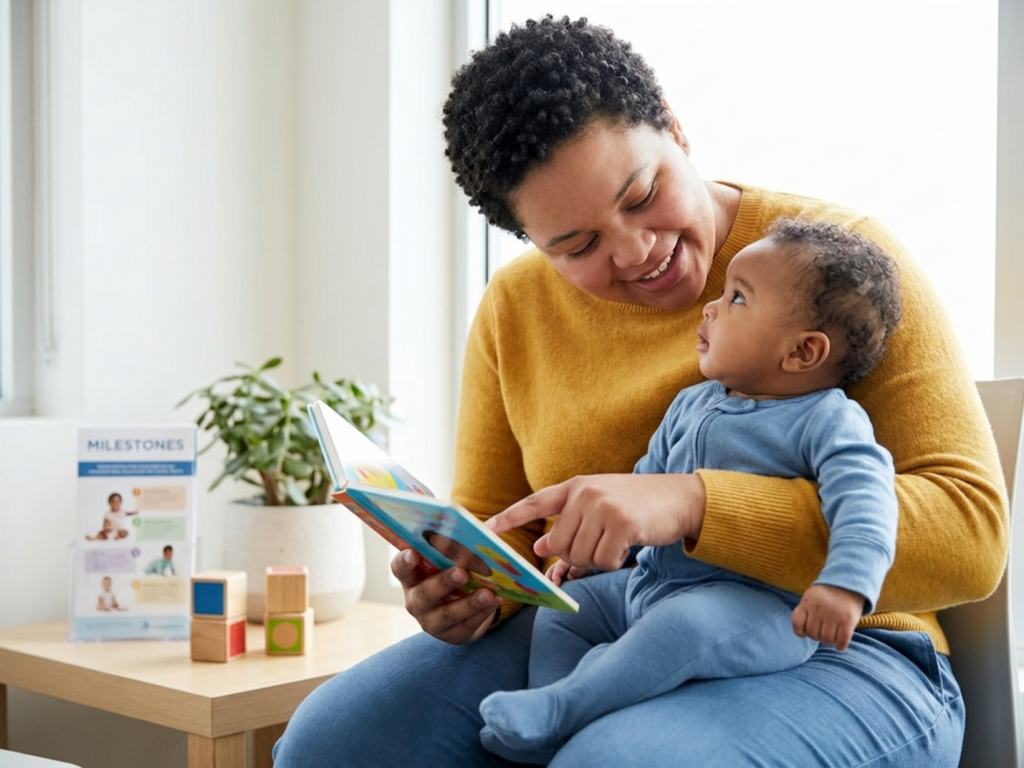
Books and songs offer another easy structure. Shared book reading with babies can involve pointing, naming a few pictures, changing vocal tone, and letting the baby touch or mouth an age-appropriate sturdy book. The baby does not need to sit still or finish the book. Brief repetition is appropriate. Songs and rhymes introduce predictable sound sequences and pauses; they can also help caregivers find language when fatigue makes spontaneous conversation difficult.
Daily caregiver-child interactions can be brief and still meaningful. A few connected moments during a bath, a walk, and bedtime add up. For caregivers managing recovery after birth, work demands, illness, or other responsibilities, a realistic approach is preferable to guilt. A baby benefits from warm, reliable connection across the caregiving network, including parents, relatives, and other trusted caregivers.
Adapting communication as babies grow
Communication changes rapidly during the first two years. In the first months, babies may respond to voices with alertness, calming, facial expressions, or early cooing. Speaking freely, making eye contact when the baby is awake and receptive, varying tone, and responding to vocalizations can support these early communication skills. At this stage, the interaction itself matters more than whether the baby appears to understand specific vocabulary.
As babies gain motor control and interest in their surroundings, naming what they look at or reach for becomes increasingly useful. Follow their lead: “You found the ball,” “The light is on,” or “You hear the truck.” Gestures can be part of communication as well. Pointing to an object while naming it and responding when the baby points, reaches, or looks between you and an item can support shared attention.
Later in infancy, babbling often becomes more varied. Imitating a baby’s sounds and then adding a simple word can create a bridge between the baby’s vocal play and adult language. If the baby says “ba-ba” while looking at a ball, you might respond, “Ball, yes, a ball.” Avoid pressure to repeat words on demand. Communication grows best when it remains social and enjoyable rather than a test.
Families who use more than one language can generally speak the languages that allow them to communicate most naturally and warmly. Consistent, meaningful exposure matters. Bilingual or multilingual exposure does not inherently cause a language disorder. When there are concerns, explain all languages used and the child’s communication patterns to the clinician or speech-language professional so assessment is appropriately informed.
Screen media, background sound, and focused attention
Speech heard directly from a responsive person is not interchangeable with background television, recordings, or videos. Babies learn efficiently when language is connected to a present person, a shared object, and an opportunity to respond. Background media can compete with conversation, make it harder for adults to notice small infant cues, and increase household noise. A quiet environment also gives infants more opportunity to hear the contours of speech clearly.
Technology can have limited practical roles, such as allowing a parent to connect with a distant family member, but it should not replace everyday face-to-face interaction. When video communication is used, a caregiver nearby can help make it social by naming the person on screen, responding to the baby’s reactions, and keeping the exchange brief if the baby loses interest.
Focused attention does not mean intense attention. Babies can become overstimulated by prolonged noise, bright visual input, or interactions that continue after they signal fatigue. Watch for cues such as turning away, yawning, fussing, hiccups, or a tense body. A quieter pause, cuddling, or sleep routine may be more appropriate than additional language activity. Respecting these signals models responsiveness and protects the quality of the interactions that follow.
When to seek professional guidance
There is broad normal variation in the timing of babbling, first words, and phrase development. Prematurity, hearing history, family language environment, medical conditions, and individual temperament can all affect how a baby’s communication appears. Milestone lists are useful prompts for observation, but they are not a tool for self-diagnosis.
Speak with the baby’s pediatric clinician or another qualified healthcare professional if you are concerned about hearing, limited response to sound or voices, a lack of expected communication progress, or any loss of previously acquired sounds, gestures, words, or social engagement. A clinician can review the baby’s history, growth, overall development, and hearing screening status. Depending on the concern, they may recommend formal hearing evaluation, developmental assessment, or referral to a speech-language pathologist.
Prompt discussion is worthwhile because hearing differences can affect access to spoken language, and early support can be helpful when it is indicated. At the same time, concern does not establish a diagnosis. Avoid comparing a baby too closely with another child or assuming that a quiet temperament means a communication problem. Bring concrete observations instead: examples of sounds, responses to name or noise, gestures, words, changes over time, and the languages used at home.
Daily talking remains beneficial regardless of a baby’s current communication level, but it is only one part of care. Listening to caregiver instincts, attending recommended well-child visits, and seeking individualized advice when questions arise provides the most reliable path forward.
When extra attention is needed
- Contact a pediatric healthcare professional if a baby loses words, babbling, gestures, or social responsiveness they previously used.
- Discuss concerns about limited response to voices or sounds, especially if there is a history of hearing risk factors.
- Do not use milestone charts or online content to diagnose a language, hearing, or neurodevelopmental condition.
- Reduce interaction intensity when a baby shows signs of fatigue or overstimulation, such as persistent turning away or distress.
- For premature babies, ask the care team whether corrected age should be considered when reviewing developmental progress.
Tools & Assistance
- Use routine care moments to name actions, objects, and feelings
- Keep a brief note of new sounds, gestures, words, and communication questions for well-child visits
- Choose sturdy age-appropriate books for short shared reading sessions
- Ask the pediatric clinic about hearing evaluation for language concerns
- Consult a speech-language pathologist when referred or when professional guidance is needed
FAQ
Do I need to talk to my baby all day?
No. Regular responsive moments are more useful than nonstop speech. Talk during ordinary routines, pause for cues, and allow calm quiet time.
Does baby talk help or hurt language learning?
Warm, responsive speech with clear words can be helpful. You can naturally use expressive tone while also naming objects and actions accurately.
Can reading to a newborn make a difference?
Yes. A newborn benefits from hearing your voice, speech rhythm, and shared attention. The content matters less than the calm, repeated interaction.
Should multilingual families choose only one language?
Usually, families can use the languages that support natural, meaningful communication. Discuss all language exposure with a clinician if development concerns arise.
When should I ask about a hearing test?
Ask a pediatric clinician when you have concerns about responses to sound, communication progress, speech development, or changes in previously observed skills.
Sources
- Proceedings of the National Academy of Sciences / PubMed Central — Talking to children matters: Early language experience strengthens processing and building new words
- Mayo Clinic — Language development: Speech milestones for babies
- Mayo Clinic — Infant development: Birth to 3 months
Disclaimer
This article is for general educational purposes and does not provide medical diagnosis or treatment. Consult a pediatric healthcare professional for concerns about your baby's hearing, communication, or development.















Please log in to leave a comment.