
Intro
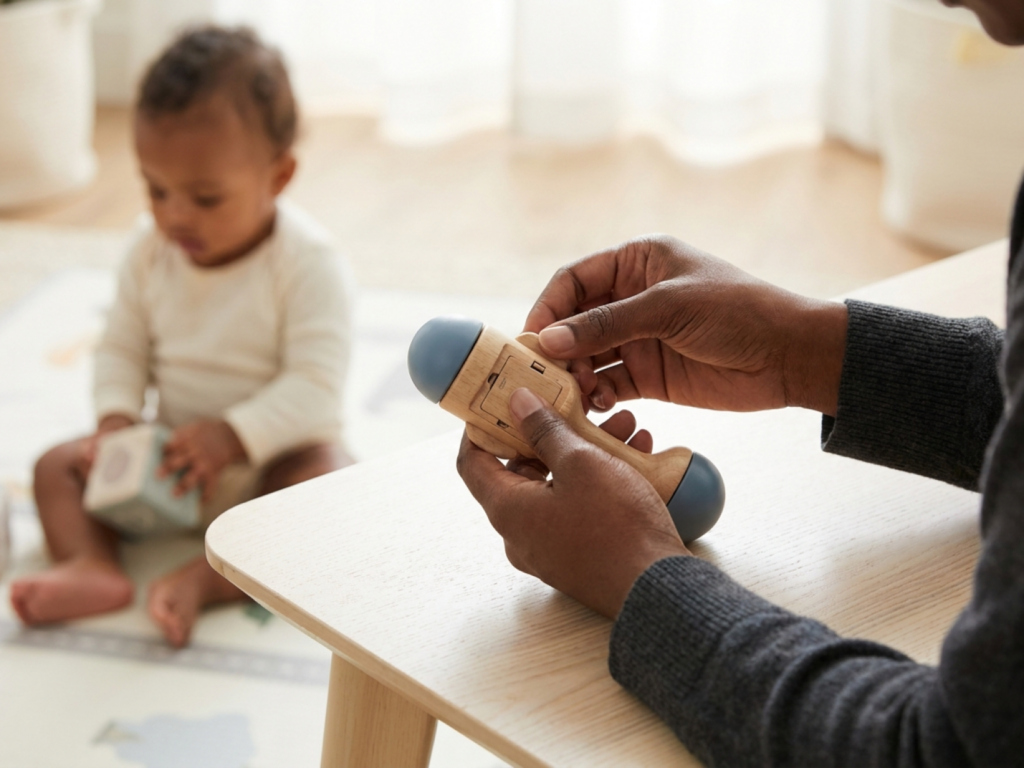
Toys support exploration, movement, communication, and early learning, but babies also investigate objects with their mouths and hands. Because infants have limited coordination, immature airway protection, and rapidly changing abilities, a toy that was appropriate last month may become unsafe as soon as a baby can sit, crawl, pull, or bite more forcefully.
A careful safety check does not require specialist equipment. It involves matching the toy to the child’s developmental stage, inspecting its construction, considering foreseeable misuse, and supervising play in an environment free from additional hazards. Regular reassessment is particularly important for toys that are mouthed, washed frequently, used outdoors, or passed between children.
Highlights
Age guidance is a safety tool, not merely an educational recommendation.
Small, detachable, sharp, brittle, or battery-containing components deserve particular scrutiny.
A damaged toy should be removed immediately, even if the defect appears minor.
Supervision reduces risk but does not make an unsuitable toy safe.
Start with age, development, and the whole play context
Begin with the manufacturer’s age recommendation, but treat it as one part of the assessment. Age labels often reflect foreseeable hazards such as small parts, cord length, sound intensity, or complexity. They do not replace observation of the individual child. A premature infant, a baby with reduced motor control, or a child who mouths objects persistently may need a more conservative choice after discussion with a healthcare professional.
Consider what the baby can do now and what may change during the period of use. A toy that is safe for a nonmobile infant may become accessible from the floor once the baby rolls or crawls. A hanging object may become a pull or entanglement hazard when the child can reach upward. Toys intended for older children should remain physically inaccessible, including in shared play spaces.
Look for age-appropriate toys that are large enough to avoid airway obstruction, simple enough to use without frustration, and designed for the type of play expected. Do not assume that a toy is safe because an adult is nearby: a brief distraction can be enough for a baby to place a small component in the mouth or become caught in a loop.
Screen for choking and aspiration hazards
Choking is a mechanical airway emergency in which an object blocks airflow; aspiration refers to material entering the airway or lungs. Babies are especially vulnerable because they explore by mouthing, have small airways, and may not reliably coordinate chewing and swallowing. Inspect every toy for detachable pieces, including wheels, eyes, magnets, bells, beads, caps, buttons, foam fragments, and battery doors.
Apply firm pressure and gentle twisting to parts that appear attached. A component that loosens, cracks, or separates should be treated as a hazard. Do not rely on household improvisations such as tape, glue, or replacement fasteners unless the manufacturer provides an approved repair method. Small parts can also emerge after repeated washing, dropping, biting, or exposure to heat.
Check rattles and squeeze toys for concealed contents. Avoid toys containing accessible high-powered magnets, because swallowed magnets can attract across bowel walls and cause obstruction, perforation, ischemia, or other serious injury. Water beads and similar expanding materials are also inappropriate where an infant could access them. If a baby may have swallowed a toy component, magnet, battery, or other object, seek urgent medical advice or emergency care rather than waiting for symptoms.
Inspect structure, materials, and surface condition
Run clean fingers over the entire toy, including seams, hinges, edges, handles, and openings. Reject items with sharp points, exposed wires, splintering wood, jagged plastic, loose stitching, peeling coatings, or brittle material. A toy should not shed fragments when squeezed, bent as intended, or handled normally. Examine fabric toys for torn seams and stuffing that could be pulled out and mouthed.
Check that painted or printed surfaces are intact and that no coating is flaking. Babies may ingest surface material through chewing, so avoid products with a strong chemical odor, unexplained residue, or unclear material information. Toys should be used only as intended; household objects or craft materials are not automatically suitable substitutes for infant toys.
Some products are marketed for oral soothing and deserve a separate review. Teething toys safety depends on one-piece or securely constructed design, appropriate size, cleanability, and freedom from detachable decorations. Avoid necklaces, bracelets, or cords placed around a baby’s neck or attached to clothing during sleep or unsupervised play. Ask a pediatric clinician or dentist for guidance if gum discomfort is severe, persistent, or accompanied by illness rather than trying unverified products.
Pay special attention to batteries, magnets, cords, and sound
Battery-operated toys require a secure battery compartment. The cover should be fastened with a screw or another mechanism that cannot be opened easily by a child. Inspect it after drops and repeated use. Button or coin batteries can cause severe internal chemical and electrical injury when swallowed, sometimes before obvious symptoms appear. Keep spare batteries, discarded batteries, and devices with missing covers locked away.
If a battery is missing or a child may have swallowed one, treat the situation as urgent and contact local emergency services or a poison information service immediately. Do not induce vomiting or wait to see whether symptoms develop. Magnets should receive the same high level of caution, particularly when more than one may be present.
Strings, ribbons, straps, and elastic loops can create strangulation or entanglement hazards. Avoid long cords on toys accessible to infants, and remove toys from a crib, bassinet, or sleep space. Sound-producing toys should not be held close to the baby’s ear. If the volume is uncomfortable for an adult at close range, it may be excessive for an infant. Toys with projectiles, heating elements, or moving mechanisms should be used only with close, active supervision and according to instructions.
Evaluate labels, manufacturing quality, and secondhand toys
Read the packaging and permanent markings for the manufacturer, model or batch information, age guidance, care instructions, and relevant safety certification or conformity marks for your jurisdiction. Regulatory systems differ by country, but standards commonly address small parts, sharp edges, accessible mechanisms, flammability, toxic substances, and mechanical strength. A recognized mark does not mean a toy can never fail; it helps identify products made under a defined compliance framework.
Be cautious with products sold without clear manufacturer information, instructions, or traceability. Online marketplaces and imported goods may use misleading labels or imitate established brands. Review the exact model rather than relying on a similar-looking product description. Keep receipts, packaging, and product identifiers when possible, especially for battery-operated or complex toys.
Secondhand toys need the same scrutiny as new ones, plus an assessment of age-related wear. Search the manufacturer’s recall information and government safety notices using the exact name and model. This is a practical form of baby product recall checks. Do not accept a toy if its history is unknown, its safety label is missing, it has been modified, or its instructions indicate that a component is no longer available. Products recalled for a serious hazard should not be donated or resold.
Clean, store, supervise, and reassess regularly
Follow the care instructions because some materials cannot tolerate boiling, dishwashers, solvents, or prolonged soaking. Wash washable toys before first use and after contamination with saliva, food, vomit, stool, or household chemicals. Dry them thoroughly to reduce microbial growth. Do not share mouthed toys between babies without appropriate cleaning, particularly when a child is unwell or medically vulnerable.
Storage affects safety. Keep toys with small parts, batteries, magnets, cords, and removable accessories in a closed container that the baby cannot open. Separate infant toys from toys belonging to older children, and check the floor after group play. A play mat does not eliminate the need to remove dropped components or inspect the surrounding area.
Supervise according to the hazard, not simply from the same room. Active supervision means staying close enough to intervene and watching the baby’s hands and mouth. Recheck toys at regular intervals and after drops, chewing, washing, or exposure to siblings or pets. Discard a toy when it is cracked, split, swollen, sticky, frayed, discolored from deterioration, missing a fastener, or no longer functions as designed. When uncertain, choose a simpler product and ask a healthcare professional or the relevant consumer-safety authority for advice.
Remove the toy immediately if
- A small part, magnet, battery, cap, or decoration becomes loose or missing.
- The toy has sharp edges, exposed wires, cracked plastic, splintering wood, or torn seams.
- A battery compartment can be opened without a tool or secure fastener.
- The toy contains a long cord, loop, or strap that could reach the neck.
- The product has been recalled or lacks reliable manufacturer and model information.
- A baby may have swallowed a battery, magnet, or toy component.
Tools & Assistance
- A bright light and clean hands for routine inspection
- The manufacturer’s instructions and exact model or batch number
- Government consumer-product recall databases
- A poison information service for suspected battery or chemical ingestion
- A pediatric clinician, dentist, or emergency service for medical concerns
FAQ
Can I use a toy labeled for an older baby if I supervise closely?
Usually it is better to wait. Supervision reduces risk but cannot prevent every rapid mouthing or pulling event, and age guidance may reflect specific small-part or mechanical hazards.
How large should a baby’s toy be?
It should be too large to enter the baby’s mouth or obstruct the airway, with no detachable component that could become small enough to swallow. When uncertain, select a product specifically designed for the baby’s age and ask a professional for advice.
Are hand-me-down toys safe?
They can be, but inspect them carefully for wear, missing instructions, inaccessible safety information, and recalls. Do not use a toy with an unknown history or any damage that could release parts.
What should I do if a toy breaks during play?
Move the baby away, collect every fragment, and inspect the mouth only if it can be done safely. If ingestion, choking, breathing difficulty, or battery or magnet exposure is possible, seek urgent medical help.
Sources
- Nemours KidsHealth — Choosing Safe Toys for Babies
- U.S. Consumer Product Safety Commission — Toy Safety Business Guidance
- Royal Society for the Prevention of Accidents — Toy safety
Disclaimer
This article provides general safety information and does not diagnose, treat, or replace advice from a qualified healthcare professional. Seek urgent medical care for suspected choking, battery or magnet ingestion, breathing difficulty, or other emergencies.














Please log in to leave a comment.