
Intro
Parties can be joyful occasions for babies and families, but decorations that seem harmless to adults may create serious risks for infants and young children. Latex balloons, balloon fragments, ribbons, cords, confetti, and small decorative objects can contribute to choking, suffocation, strangulation, ingestion, falls, or respiratory irritation.
Risk reduction does not require eliminating every celebration. It involves anticipating how babies explore their environment: by grasping, mouthing, crawling, pulling, and unexpectedly moving toward objects that were previously out of reach. Careful preparation, active supervision, and prompt cleanup can make a substantial difference.
Highlights
Uninflated latex balloons and broken balloon pieces can obstruct the airway and are particularly difficult to remove.
Children younger than eight years should not play with balloons without close adult supervision.
Ribbons, balloon strings, confetti, and detachable decorations may cause choking, strangulation, ingestion, or eye injuries.
A party area should be inspected before infants enter and again after decorations are removed.
If a baby may have inhaled, swallowed, or become entangled with a decoration, seek urgent professional advice.
Why Balloons Pose a Disproportionate Risk
Latex balloons are not simply another small object. When an uninflated balloon or a torn fragment enters a child’s mouth, it can conform to the contours of the oral cavity and airway. This flexibility may create an occlusive seal, making the material difficult to dislodge with routine first-aid maneuvers. A balloon can therefore cause suffocation even when it does not look large enough to be dangerous.
Infants and toddlers are especially vulnerable because they investigate objects orally, have narrow airways, and may not reliably follow instructions to spit something out. The risk is not limited to babies who crawl or walk. An older child may also aspirate a balloon fragment, particularly during play, inflation, or attempts to stretch the latex.
Research examining objects involved in pediatric choking has identified balloons as disproportionately hazardous and capable of causing asphyxiation across age groups. Public safety guidance also emphasizes that both uninflated balloons and pieces of broken balloons can cause suffocation, and that children under eight should not handle them without close supervision. These findings support treating balloons as high-risk party materials rather than ordinary toys.
Planning a Safer Celebration Around a Baby
Begin with the baby’s developmental abilities rather than the party theme. A nonmobile young infant may still grasp a nearby ribbon, while a crawling baby can reach beneath furniture and a newly walking toddler can pull down a table decoration. Place the celebration in an area that can be closed off, and create a separate zone where the baby can remain on a clear, firm surface away from decorations, food, drinks, gifts, and high-traffic walkways.
Keep all balloons out of the baby’s accessible environment. Balloons floating at ceiling height can later descend, and a balloon tied to a chair or gift may become reachable when an adult is distracted. Do not attach balloons to an infant’s clothing, wrist, crib, stroller, or car seat. Avoid positioning balloon clusters near fans, heaters, candles, light fixtures, or electrical equipment, where movement, heat, or rupture may create additional hazards.
Assign one adult to perform a pre-party safety check and another to monitor the baby’s immediate area when feasible. Supervision should mean active observation within reach, not merely having an adult somewhere in the same room. Visitors may unintentionally leave small items behind, so the safety check should be repeated throughout the event.
Decoration Hazards Beyond the Balloon Itself
Balloon strings, curling ribbon, elastic loops, and decorative cords can create strangulation or entanglement hazards. They may also be pulled toward a baby’s neck, wrapped around fingers or toes, or caught on furniture. Keep these materials completely inaccessible and never leave a tied balloon or ribbon within a crib, playpen, stroller, or sleep space. Long cords should be secured away from pathways and removed promptly after the event.
Small adhesive decorations, plastic gems, beads, sequins, confetti, paper clips, and detachable ornaments may become non-food choking hazards at home. Some materials are difficult to see on carpets or under furniture, and their bright colors can attract a baby’s attention. Avoid loose confetti where an infant will crawl or play. If a decoration has a small detachable part, assume it may become a choking hazard regardless of the manufacturer’s intended age range.
Other risks include sharp edges, staples, broken plastic, and heavy objects that can fall when pulled. Pin banners and decorations securely, but keep fasteners inaccessible. Do not hang items above a crib or changing surface. Avoid glass ornaments, candles, dry ice, and decorations that release powder, fragrance, or small particles near an infant, especially if the baby has respiratory vulnerability or a history of wheezing.
Safe Handling, Inflation, and Cleanup
Adults should inflate balloons only in an area inaccessible to children. Never allow a child to inflate a balloon by mouth, because sudden rupture can drive latex toward the airway and inflation itself may involve inhalation risk. Use only decorations appropriate for the intended setting, and inspect inflated balloons for tears, weak areas, or signs of deflation.
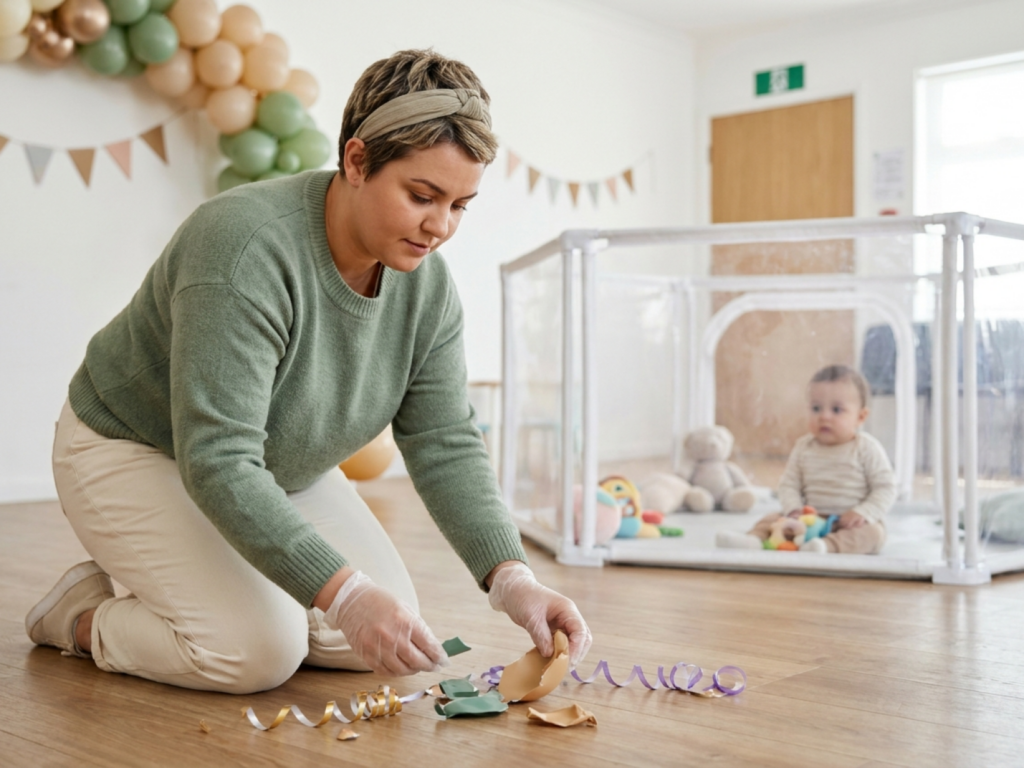
When a balloon breaks, stop the activity immediately and collect every visible piece. Do not ask a young child to help search, because handling the fragment may place it in the mouth. Check beneath furniture, around chair legs, under tables, and in bags or gift packaging. A vacuum may help remove small pieces from flooring, but adults should first remove larger fragments and confirm that the area is clear. Dispose of fragments in a closed container that children cannot access.
At the end of the party, remove all balloons, strings, ribbons, confetti, and loose decorations before the baby returns to the area. Inspect clothing, blankets, toys, diaper bags, and stroller storage compartments for fragments or small objects. A post-party sweep is particularly important if several children have been playing, because fragments may be transferred to other rooms.
These measures complement broader choking prevention. Families may also benefit from reviewing Common household choking hazards and maintaining a consistent approach to non-food choking hazards at home, since ordinary household objects can become dangerous during periods of increased mobility and oral exploration.
Recognizing an Emergency
A suspected airway event requires immediate attention. Concerning features may include inability to cry or breathe normally, a weak or absent cough, sudden silence, cyanosis, altered responsiveness, or severe respiratory distress. If a baby is choking, use age-appropriate first aid only if you have been trained, activate local emergency services, and follow the instructions of the emergency dispatcher. Do not perform blind finger sweeps, which can push an object deeper into the airway.
A balloon fragment may be particularly challenging because it can be difficult to visualize and may adhere to airway structures. If the child can cough effectively, encourage coughing and observe closely while seeking professional guidance. Do not give food or drink to test whether the object has passed.
Even when a child appears well after a possible inhalation, medical assessment may be appropriate. Aspiration can sometimes produce delayed coughing, wheezing, voice changes, tachypnea, or reduced activity. A swallowed fragment may also require advice based on the child’s age, symptoms, and the material involved. Contact a pediatric clinician, urgent care service, poison or ingestion advice service where available, or emergency services according to the severity of the situation. Do not attempt to diagnose the location or seriousness of an object at home.
Supervision Without Losing the Celebration
Safety planning can feel burdensome when a family is already hosting guests, managing feeding and naps, and trying to enjoy an important occasion. A practical approach is to reduce the number of hazards that require constant monitoring. Choose paper or fabric decorations that are securely mounted and remain above the baby’s reach, while keeping the floor and low surfaces clear.
Tell every caregiver the same simple rules: no balloons or fragments in the baby’s area, no loose ribbons or small decorations, and immediate reporting of anything that breaks or falls. Do not rely on an older sibling to supervise a baby. Children may be helpful witnesses, but they cannot replace an attentive adult.
Consider scheduling the most decoration-heavy activities while the baby is elsewhere with a trusted adult, or use a clearly separated room for older children’s games. Afterward, return the baby only when the area has been checked. These adjustments preserve the social experience while respecting infant physiology and developmental behavior.
Parents and caregivers often carry understandable anxiety about preventable injuries. The goal is not perfect control of every object or guest. It is to identify high-consequence hazards, remove them from the baby’s reach, and know how to obtain rapid professional help if an exposure occurs.
Critical Safety Warnings
- Never leave an infant or young child alone with an inflated, uninflated, or broken balloon.
- Keep balloon fragments, strings, ribbons, confetti, and small decorations out of all sleep and play spaces.
- Do not attach balloons, cords, or decorative loops to a baby's body, crib, stroller, or car seat.
- Do not perform a blind finger sweep inside a choking child's mouth.
- Seek emergency help for breathing difficulty, color change, loss of responsiveness, or ineffective coughing.
Tools & Assistance
- A pre-party and post-party floor-level safety sweep
- A closed waste container for balloon fragments and small decorations
- A designated balloon-free infant play and feeding area
- Current local emergency service and pediatric advice numbers
- Infant and child choking first-aid training from a recognized provider
FAQ
Can babies safely play with inflated balloons if an adult is nearby?
Balloons are best kept entirely away from babies. Close supervision reduces some risks but cannot prevent sudden rupture, mouthing, or access to fragments. Never place a balloon in an infant's crib, stroller, or play area.
What should I do if a balloon breaks near my baby?
Move the baby away, collect every visible fragment, inspect nearby flooring and furniture, and dispose of the pieces securely. If the baby may have mouthed, swallowed, or inhaled a fragment, contact emergency services or a pediatric clinician for situation-specific advice.
Are balloon strings dangerous even when the balloon is out of reach?
Yes. Strings and ribbons can fall, become reachable, wrap around the neck or limbs, or catch on furniture. Keep them secured and inaccessible, and remove them promptly after the celebration.
What symptoms can occur after possible balloon aspiration?
Coughing, wheezing, noisy or difficult breathing, voice changes, rapid breathing, bluish color, unusual sleepiness, or reduced activity may be concerning. Symptoms can be delayed, so seek professional assessment after a suspected inhalation even if the child initially appears comfortable.
Sources
- Paediatrics & Child Health — Preventing choking and suffocation in children
- PubMed — Characteristics of objects that cause choking in children
- U.S. Consumer Product Safety Commission — Balloons Can be Suffocation Danger to Kids
Disclaimer
This article provides general safety information and is not a diagnosis or substitute for medical care. Consult a qualified healthcare professional or emergency service for an individual child's symptoms or possible exposure.














Please log in to leave a comment.